Tri-Cities leads in state's population growth, census says
Seattle-Tacoma up 300,000 since 2000
By NICHOLA K. GERANIOS
THE ASSOCIATED PRESS
Many of Washington's metropolitan areas have grown substantially since 2000, with the Tri-Cities, Bellingham and Olympia showing the highest percentage growth, the Census Bureau reported Thursday.
The state's smaller communities, called "micropolitan" areas, also showed solid growth, the agency said.
More than 5.6 million of the state's 6.4 million residents live in metro or micropolitan areas, with the rest in more rural settings.
The Seattle-Tacoma-Bellevue metropolitan area contained about half the state's population, estimated at 3.3 million in July 2007, the Census Bureau estimated. That was an 8.7 percent jump from the April 1, 2000, population of 3.0 million.
Tacoma, if broken out as a stand-alone metro area, had 773,165 people, the Census Bureau said.
The Tri-Cities metro area of Richland, Kennewick and Pasco grew 19.4 percent in that time, to 228,992 people, sixth largest in the state.
The Tri-Cities metro area consists of Benton and Franklin counties, located on the Columbia River in arid, sunny southeastern Washington. The area is home to high-paying jobs at the huge Hanford Nuclear Reservation and has a big farm and food processing sector. Tourism, anchored by numerous wineries, golf courses and youth sports, is also on the rise.
The Tri-Cities area will likely soon supplant Yakima and Bremerton-Silverdale to become the fourth-largest metro area in Washington.
Yakima had 233,062 people, but grew only 4.7 percent since 2000. Bremerton had 236,732 people, but grew just 2.1 percent since 2000, slowest among the state's metro areas.
Spokane, the second-largest metro area, had 456,175 people, up 9.1 percent.
Bellingham grew 15.7 percent to reach 192,999 residents. Olympia grew 15 percent to reach 238,555 residents.
Mount Vernon-Anacortes grew to 116,397 people, up 13 percent. Wenatchee grew 8 percent to 107,170 people. Longview crossed the 100,000 mark for the first time, with the state's smallest metro area growing 8.1 percent to 100,467.
The fast-growing Vancouver, Wash., area is part of the Portland metro area and was not broken out separately in the statistics. But recent county population estimates from the Census Bureau said Clark County, which includes Vancouver, had 418,000 people and grew more than 20 percent since 2000.
Nationally, Seattle-Tacoma was the 15th-largest metro area.
Micropolitan areas also showed steady growth. Ellensburg grew 15.5 percent and Shelton 14.1 percent between 2000 and 2007.
Moses Lake, with 83,047 residents, was the largest of those and grew 11.2 percent. Pullman (1.2 percent) had the smallest growth rate.
Washington had 6.46 million residents in 2007, growing 9.7 percent from 2000
Transportation
Friday, March 28, 2008
Puget Sound grows 8% since 2000: Adds 0% Road Capacity


Tuesday, March 25, 2008
Light Rail now suggests LR in Seattle is a Bargain
Link Light Rail – Transportation Bargain for Seattle
© Light Rail Progress – February 2001
Special Note: Since this article was originally posted, Seattle's light rail project has been substantially revised. See the story at Seattle's Light Rail Project Reborn as South Starter Line.
Seattle traffic congestion Bumper-to-bumper traffic ... Air filled with exhaust fumes from motor vehicles. Narrow traffic corridors constrained by hilly terrain, waterways, and the coastline of Puget Sound (an inlet of the Pacific Ocean) – that's what most urban travellers in Seattle are facing today.
Transit alternatives? So far, it's mainly been ... buses in bumper-to-bumper traffic, and buses lumbering through roadways in air filled with exhaust fumes from motor vehicles.
But that's going to change, if a voter-approved and officially sponsored light rail transit (LRT) conception – called Link – can be brought to reality. By 2010, according to current plans, more than 20 miles of a north-south "spine" LRT line will carry some 120,000 riders a day. While trains would travel up to 55 mph maximum speed, with station stops the schedule speed would average between 25 to 28 mph – definitely competitive with the 20-25 mph average experienced on Seattle's crowded roadways.
Seattle mobility costs big bucks
Seattle and Tacoma area voters gave the green light to light rail back in 1996, when they overwhelmingly approved a multi-modal plan called Sound Move which includes bus service improvements and commuter rail as well as LRT. Certainly, the Link project is expensive – probably the most expensive LRT project yet in the USA. The latest analysis estimates a total cost of $3.6 billion – about $171 million per mile. Why? Well, Seattle is certainly one of the most expensive urban areas to build any kind of transportation facility. To the hilly terrain and numerous waterways, plus the constraint of the Pacific Ocean (Puget Sound) on one side, you can add compacted, densely populated, well-established neighborhoods. On top of all that, include environmental challenges (e.g., protecting salmon, preserving spectacular scenic vistas, etc.) and you've got a recipe for high cost and easily unforeseen engineering pitfalls.
If you think Link light rail is expensive, well, just consider freeway construction in the area.
Widening and rehabilitating interstate Highway 405 from the suburban communities of Lynnwood to Tukwila – 33 miles of freeway – is projected to cost $7 billion. That's about $212 million per mile – and just for upgrading an existing roadway facility.
[Source: Seattle Times 2001/01/29]
The Link LRT project would provide a totally brand-new rapid transit facility straight through the heart of the city, including its most heavily populated and congested areas. in contrast, Link starts to sound like a bargain.
High capacity, heavy cost
Link mapThe initial phase of the Central Link LRT project would span most of the length of urban Seattle – from the Northgate area in the north to the SeaTac Airport area in the south. That's a total of 24 miles. Currently, about 21 miles are included in the $3.6 billion cost estimate (from NE 45 St. In the University of Washington area to SeaTac), so Sound Transit is currently probing ways to finance the additional $400 million or so needed to extend Link the additional 3 miles north to the Northgate area. An array of 23 stations is ultimately planned for the final 24-mile line.
While Link is conceived as LRT, in many respects it's fairly close to full rapid transit – certainly, on the "high" or "heavy" end of the LRT spectrum in terms of capacity and design. One indication of the extraordinary capacity demand on the system is its power requirement. While LRT lines traditionally have been electrified at 600 to 750 volts direct current (VDC), Link's being planned for 1500 VDC – the first North American LRT line of that high a voltage since World War 2.
[Source: ASME/IEEE Joint Rail Conference, April 2000]
Compatibility with neighborhoods, environment
And the line will include approximately 4.5 miles of tunnel, most likely including a tunnel under the Portage Bay ship channel. Why so much tunnel? Short answer: it's what Seattle residents want. Certainly, an LRT system could be built on the surface, or – if it needs to be totally separated from other traffic – in an aerial, or elevated, alignment. But Sound Transit, the Seattle transit agency in charge of the project, has gone through years of study and dozens upon dozens of community meetings designed to get public input and to fine-tune the project in response to community desires. Neighborhhoods have made it clear they don't want elevated structures of any kind shadowing their streets and homes and interrupting scenic vistas.
Furthermore, there are daunting environmental challenges ... such as crossing Portage Bay. Engineering a crossing is the least of the project's problems. Portage Bay is a habitat of Chinook salmon, listed as an endangered species. Any transportation facility negotiating a crossing of the waterway must deal with the problem of protecting these salmon. A bridge has the additional liability of triggering opposition from adjacent neighborhoods. Sound Transit's favored solution is a very deep – and very expensive – tunnel under the waterway.
Through the University area north of the ship channel, the Central Link line would be routed in tunnel. This would continue beneath the waterway and on southward, beneath the Montlake residential neighborhood area, into the geologically formidable Capitol Hill/First Hill area. Why not an elevated alignment through these neighborhoods? Forget it. Any above-ground alignment through this area is described as a "political non-starter".
Linking north and south
Then, still underground, the LRT line would turn westward into downtown Seattle, travelling into the existing Downtown Seattle Transit Tunnel currently used by electric trolleybuses, thus serving the several existing stations already in place.
Rendering of Link LRT in arterialSouth of downtown, the LRT line would come to the surface and proceed on south, through the Rainier Valley area, in both surface and aerial alignments. Many surface routings would take the form of segregated alignments in existing thoroughfares – providing a more accessible and visible facility for surrounding neighborhoods, and a more pleasantly scenic ride for passengers. (it should be noted that Rainier Valley communities opted for surface light rail because of the greater potential of transit-oriented development. Area residents have in mind to create new town centers around the light rail stations.)
When it's completed, the Central Link LRT route will enable Seattle-area travellers as far north as Northgate to hop on board a light rail train and then relax as they cruise past the miles of almost-solid brake lights (of the bumper-to-bumper traffic on adjacent roadways) on their way to the University of Washington or downtown Seattle, or all the way to SeaTac international Airport. According to the Link Final Environmental impact Statement (FEIS), the total travel time to Northgate is about 50 minutes for a distance of about 23 miles, which works out to about 28 miles per hour; a more recent engineering update calculates a travel time of 53 minutes, or about 25-26 mph. Either way, it will be one of the fastest LRT lines in the world. Even through the predominantly street-routed Rainier Valley segment, south of downtown, the projected Link LRT travel time is 10.5 minutes over about 4.6 miles, or more than 26 miles per hour. As the local pro-transit group People for Modern Transit (PMT) points out, "This beats freeway gridlock any day and is far faster than most buses."
Dramatic impact on traffic flow
About 2/3 of Link's riders will come from existing buses. But they'll be getting a much better, faster, safer, more comfortable, and more reliable ride, at a lower subsidy (50% vs. 75% for buses), and saving travel time (an average of 5 to 8 minutes one way). This increase in "mobility" is, in fact, the major purpose of the light rail system – as well as exerting significant influence of land-use patterns. As the Sound Move plan states, "The high-capacity transit system's purpose is to improve mobility within the urban areas by providing travel alternatives so they may grow comfortably while preserving rural areas for future generations."
Thus, Link LRT is not intended just to be a commuter transit system. However, it will have a dramatic impact on traffic flow, with fully 1/3 of its ridership – about 36,000 passenger-trips a day – expected to be totally new riders, mostly from automobiles. Certainly, this amount of traffic is quite small in comparison with the vastness of Seattle's entire regional traffic – but why try to compare traffic improvements in a single corridor with travel volumes of the entire region? if that were routinely used as a basis for evaluating projects, not a single bridge, underpass, tunnel, or freeway would ever get built.
But in the corridor served by the light rail route itself, Link will make a major difference, especially since this route parallels interstate Highway 5 at its most constricted segment. Thus, light rail will take 16,000 cars a day off Seattle's jammed roads, more than one clogged freeway lane for the entire length of Seattle. Over time, many more new riders are expected to be attracted to LRT as a result of the superior level of service.
Slowing growth of congestion
Link simulation it's important to note that 24 miles of LRT – or even a hundred miles – will not, in and of itself, stop the growth of traffic congestion. However, LRT has shown in other cities that it has the potential for at least slowing the growth of overall congestion, providing an alternative to congested car and bus traffic, and representing the initial steps in building a future system which can impact overall congestion. in other words, growth in congestion will be slowed along specific Link routes, but LRT alone won't be enough to overcome current growth rates in car travel.
Over a longer term, the goal of new LRT systems like Link is to change the "automobile culture" by forging a regionwide rapid transit system with an intermeshing network of local and feeder transit plus a major push to foster transit-oriented development – commercial and residential real estate development adjacent to the transit stations. Clustering development helps to attenuate the "sprawl" effect, and at the same time boosts transit ridership by "building in" a base of clustered population with a greater tendency to use the system.
Even increasing transit ridership from the current 3% to just 6% of regional trips, as projected by Seattle planners, would be a major accomplishment for the system envisioned with Link light rail. However, LRT supporters expect the Link strategy to do far better in the long run, especially when Seattle motorists are forced to confront mitigation measures for global warming and the ballooning costs of energy brought on by dwindling global oil supplies.
Providing real alternative to traffic
By serving high-density neighborhoods directly, Link will enable large numbers of people to walk to the LRT stations. Many others will be able to take a short bike or bus ride. This is what leads to the huge ridership – more than 100,000 a day – that's far in excess of ridership on all other recent light rail lines in the country. This is why commuter-oriented proposals such as HOV lanes and the "freeway monorail" system touted by LRT opponents would have such low ridership – they specifically avoid accessing and serving Seattle's neighborhoods!
Extended throughout the Seattle-Tacoma region, Link will give people real alternatives, especially to congested freeways. Most regional car trips (about 85%) are non-commuter trips, often local (like a short hop to the grocery store); compared with millions of these daily car trips, transit ridership tends to seem minuscule, and its importance is often underestimated. But when fully built out, Link could be transporting the equivalent of more than 7 freeway lanes of traffic through the downtown bus tunnel. This sure beats building freeways incessantly.
[Source: FEIS 3-5]
Cost increase spurs "snake-oil" alternatives
LRT was selected as the best transit mode choice for Seattle after years of thorough, arduous, exhaustive, detailed examination and assessment of alternatives, which evaluated "heavy" rail rapid transit, monorail, maglev, Personal Rapid Transit, Automated Guideway Transit, busways, Bus Rapid Transit, HOV lanes, and other mass transit options. in this analysis, LRT proved superior in every respect – cost-effectiveness, ridership, technical flexibility, environmental impact, and many other aspects. in the campaign leading up to the popular vote in 1996, LRT opponents paraded a grab-bag of the same stale "alternatives", claiming they were better and should be "studied" further. But an array of previous planning studies had concluded that to meet transit needs in the Seattle core, light rail was the clear choice in terms of performance and versatility. Accordingly, in 1996, voters rejected the opponents and their hodgepodge of "better" alternatives, and resoundingly gave the green light to the Link LRT plan.
But a development late in 2000 has breathed new vigor into opponents of Sound Transit's Link LRT plan. in November 2000, top officials of Sound Transit announced that – particularly because of unexpected tunnel engineering challenges – the cost of the Link project would increase by about 35%, and completion would be delayed by three years.
Opponents, hoping to kill the LRT plan or at least further delay a rail solution to the Seattle region's mobility problems, have emerged from obscurity, brandishing anew a higgledy-piggledy assortment of "remedies" like snake-oil salesmen. Two purported alternatives have garnered most of the limelight: (1) Monorails and (2) Free buses.
But both alternatives – already evaluated and rejected in previous analysis by area planners – have serious problems. Proponents of both appear to be ridiculously lowballing their purported costs, while wildly exaggerating claims of ridership (without the systematic ridership forecasting process used to predict Link LRT ridership). Meanwhile, backers of each scheme also seem to be contradicting each other in their arguments and claims.
Monorail dreams ... real-world nightmare
Monorail advocates, for example, assert that surface transit is undesirable, and that elevated transit – of the monorail variety – should be built, mainly following freeway routes. Bus zealots, on the other hand, argue that fixed-guideway systems (of which monorail is an example) are inflexible and unaffordably expensive. However, virtually all LRT opponents have tended to bury these stark differences, temporarily, and to unite within their campaign to scuttle LRT.
Seattle planners have long since rejected either alternative, and for solid reasons – mainly based on real-world experience. Despite claims by proponents lowballing costs, monorail systems are substantially more expensive (they must be totally elevated). LRT can likewise be elevated, but Seattle residents and business owners, in numerous community meetings, have made it clear they don't want elevated structures of any kind – mororail or light rail – shadowing their streets and homes and obscuring scenic views. As the pro-LRT People for Modern Transit group has noted, "The advantage that monorail advocates have is that they haven't had to take their plans out into the neighborhoods."
Monorails additionally have technical drawbacks. Switching from one beam or track to another – a common requirement in any complex, heavy-duty urban transit system – is relatively slow and cumbersome. Since monorails run on rubber tires, operation in icy or wet conditions can present problems. And providing storage and maintenance facilities for a large fleet of monorail vehicles, straddling or hanging from huge concrete or metal guidebeams, is an enormous headache. No wonder most transit operators don't walk, they run away from monorail systems!
"Free bus" plan: turning lead into gold?
The other major alternative to LRT being touted – a no-fare bus plan dubbed "Ride Free Express" – likewise is rife with drawbacks. Essentially, the proposal would deplete capital funds by diverting them into operations to make up for the lost farebox revenue.
Like monorail zealots, "Ride Free" proponents blithely lowball the costs of their alternative and exaggerate potential ridership. Reminiscent of medieval alchemists who claimed to turn lead into gold, "Ride Free" boosters rely on numerical sleight-of-hand and the naivete of their audience.
Actual experience, such as that in Austin, Texas in the early 1990s, suggests that operating costs balloon (to make up for lost fares while providing extra capacity) while ridership increases only modestly (perhaps 10-11%) ... and most of the new riders are existing riders just making more trips, not motorists attracted from cars! Critics also argue that vagrants, truant schoolchildren, and similar "problem" riders tend to repel commuters and other "bread and butter" passengers.
One might ask: if a free-fare system were so cost-effective and successful, why has not one single major transit agency anywhere in the world adopted it on a permanent, ongoing basis? "After five years of running such a system and driving away some passengers, our agencies would have spent the money and free-bus service would be scrapped" says PMT. "We would be right back where we are now except with worse traffic, no light rail and no funding to build anything."
A bargain for the future
Sound Transit and supporters of the Link LRT plan should hang in there, say LRT proponents, and stay with the LRT project – because it will pay off abundantly in the long run, even with the higher budgeted cost. Besides, many large transportation projects encounter cost increases or budget overruns. The cost of a third runway for SeaTac Airport, for example, originally budgeted at $229 million in 1992, had ballooned to $773 million by 1999.
[Source: Karen Keiser: Tacoma News Tribune 2001/02/04]
As a letter to the Seattle Times argues:
The roads aren't getting any better. An additional three years to build the existing plan? As if we think going back to the drawing board - or better yet, trying to get this voted on again - is going to improve that timeline? Arrrggghh!
[Source: Seattle Times 2001/01/22]
The bottom line, say LRT supporters, is that it's time to bite the bullet and go forward with an investment in high quality light rail transit to serve many generations to come.
Much of this report has been adapted from materials provided by Sound Transit and People for Modern Transit.
Rev. 2001/02/17
Sane Transit tries to rein in Sound Transit
Dear Sound Transit,
It's time for us to get reacquainted--We, the voters and taxpayers, and you, the agency taking billions in public tax dollars. I must admit we've been feeling a little neglected, ignored even. You know how we are, we get angry but we don't always know how to express it. Which is why it's so nice that the lawyers have done it for us. I don't mean to beat around the bush. So, it's time for a revote on light rail, and maybe commuter rail too. It's hard to face but really, it's time.
Luv, a Northgate resident
And, if the public's will is not enough, there's also watchdog group Sane Transit's recent Valentine letter to Sound Transit. The note is intended, by way of pre-emptive legal strike, to save Sound Transit, and taxpayers, a costly financing failure like the WPPSS scandal in the early '80s.
At a briefing last month, City Councilmember Nick Licata asked Sound Transit executive director Joni Earl what assurance she could provide that the public still supports the light rail project, given that it is only two-thirds the length that was voted on, $1 billion more expensive, and projects only one-third of the original estimated ridership.
After a long silence, Earl answered that Sound Transit assumed the support was still there, so there's no need to allow the public to vote for alternatives. City Councilmember and Sound Transit Boardmember Richard McIver then asked if there is any evidence that the public does not support the current project.
They both really ought to know better, but since the truth can be hard to see when you're smitten with dollar signs. Maybe a quick look at three polls about light rail planning will shed some light on the public's wishes.
The Polls
Three polls were done in 2001: The Seattle Times did a poll on Sound Transit's Link light rail project last May. Last June, Sound Transit polled on how, as an agency, it was perceived. King County polled on Sound Transit's Link light rail project and alternatives in December.
The Seattle Times poll and the King County poll each asked whether there should be a revote. The Seattle Times poll showed 50 percent yes on revote, 40 percent no, 10 percent no answer. The King County poll six months later showed 67.5 percent yes to revote on a new plan, to 19 percent no, and 13.5 percent no answer.
The Sound Transit poll did not ask about a revote. What Sound Transit did ask is this: If light rail cannot be built according to the original plan, should we scrap light rail altogether and use the funds for other transportation services (28 percent), or decide what we can build with the currently available funds and start building light rail immediately (52 percent). Interestingly, seven percent voted for both options. The problem with this question is that it doesn't provide any other regional high capacity alternative, such as monorail or bus rapid transit, or a new light rail plan. We are offered either a portion of the current plan, or the appearance that nothing can or will be done to provide a new corridor.
The agency is currently straitjacketed by the need to save a semblance of the 1996 plan, despite the blown budget. It has led to all kinds of Orwellian word games. For instance, voter-approved Phase I from the U-District to SeaTac Airport has now morphed into two parts: the optimistic-sounding "initial segment," which runs instead from downtown to Tukwila, and the currently unfunded "extension of Phase I" from downtown to the U-District--sounds like we may get a bonus!
'Sane' Comes Calling
Requiring a revote is a job for our elected officials, the Sound Transit Board. If board members don't read the polls, hopefully they will read the letter sent to them recently by Sane Transit, a group of "civic leaders, lawmakers, business people and concerned taxpayers." It says the law prohibits Sound Transit from using tax funds to build the currently planned light rail project without a new vote of the people. Actually, it includes Sounder commuter rail as well.
Current light rail planning is in violation of Washington State Supreme Court rulings because projects funded by voter approved taxes must be built in "substantially" the form approved by the vote. Sane Transit also contends that Sounder commuter rail is in violation because the State Legislature specifically prohibited Sound Transit from spending tax revenues on commuter rail unless the cost of the system is at least as economical per passenger per mile as bus transit.
Bond (Just Bond)
Sane Transit cites legal rulings dating back to the '20s stating that a government agency cannot issue bonds for a project that deviates from that approved by voters. $350 million worth of bonds have already been issued for light rail construction, and there are plans to issue $1 billion more. If the rail projects were ruled illegal by Washington State legal precedent, the taxes meant to repay the bonds would be disallowed and the bonds would go into default. Sane Transit mentions that if Link light rail proceeds, there is sure to be legal challenge. Sound Transit can go to court to get a preemptive ruling on the bonds' validity (and utilize the 100 law firms it keeps on retainer), or the Board could get a revote on a new plan.
Whoops!
The Washington Public Power Supply System (WPPSS) defaulted on $2.25 billion worth of bonds twenty years ago, when the costs for a project to build five nuclear reactors ballooned out of control and the need for the expensive plants was questioned. Four of the plants were not completed. The State Supreme Court ruled that public utilities that had bought into the project weren't liable to pay for the project, and Wall Street was left out in the cold with the biggest bond default in U.S. history. Sane Transit claims its forewarning is to nip a "WPPSS on Wheels" scenario in the bud.
Palliatives like "We've just got to get started" suggest that Link supporters are afraid that if we lose Link, we get nothing. They're still living in the world of the early '90s, when only environmentalists were for transit. Now even Eastside Republicans want more transit. Every poll says that transportation is the No. 1 issue. If the Sound Transit Board does not ask for a revote, it is because they don't want to know the outcome. It's time to recognize that we don't need just any "alternative," we need alternatives that work.
Tara Peattie really does live in Northgate. She can be reached at peattie@drizzle.com.
Wednesday, March 12, 2008
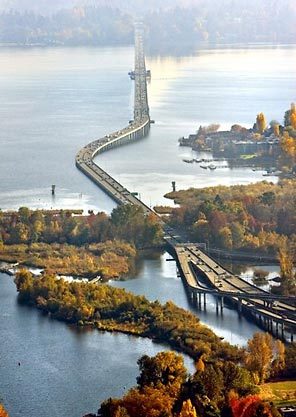
I-90 Took 40 years from idea to completion
What Happened
Planning for upgrading SR 90 to I-90 began in 1957 when population forecasts indicated that fast suburban growth would quickly overwhelm the capacity of SR 90 to service the needs of those commuting to jobs in Seattle. The land-acquisition process for the highway expansion began in the 1960s, with the bulk of it occurring in Seattle, not the growing suburbs. By 1970, there was increasing public concern in Seattle over the environmental impacts and equity of the project. Officials in the suburbs largely favored the project because of the decreased travel time to Seattle. Seattle saw the project as favoring suburbanites at the expense of its own neighborhoods and was concerned with the scale of relocations required in Seattle and the repeated disruption of mature neighborhoods. These concerns led to a court case that resulted in a 1971 Federal Appeals Court injunction prohibiting further I-90 land acquisition and construction. The court ordered the preparation of a relocation-assistance plan and an Environmental Impact Statement (EIS) pursuant to the National Environmental Policy Act (NEPA) of 1969.
Six years of impasse followed. Concerns among the affected municipalities were focused on the final scale and alignment of I-90. The impasse inspired the creation of unique groups to find areas of agreement among the municipalities, hear community concerns, and offer design recommendations. In 1972, FHWA convened a board of review to arbitrate disputes between the city of Seattle and WSDOT. It consisted of members appointed by the city of Seattle and WSDOT. At the suggestions of WSDOT, Citizen Advisory Committees were created for Seattle and the suburban communities. Composed of community representatives appointed by their respective city councils, the role of the committees was to hear community concerns and to provide local input to WSDOT. Representatives for the Judkins Park, South Atlantic Street, and Mount Baker neighborhoods sat on the Citizen Advisory Committee for Seattle.
In 1974, a groups was created to develop an overall solution to the I-90 impasse. The Governor appointed a 10-member, I-90 Commission consisting of State, county, and local officials from all the affected municipalities. Although the I-90 Commission failed to agree on the alignment or the capacity of I-90, the airing of community concerns ultimately led to the design of acceptable mitigation measures.
The idea of lids was discussed throughout the project, but there was no agreement on their use, even among community members. Originally, the Judkins Park and South Atlantic Street neighborhoods did not want a park over the lid, fearing that the space would attract crime. Later, the neighborhoods wanted a part. Also, the community groups at one time had not wanted an access ramp from I-90 into the community, but changed their position after the highway was redesigned.
The issue of noise and safety impacts of I-90 on an adjacent, common, local elementary school was also a critical concern for the three neighborhoods. The I-90 alignment require the acquisition of a smaller sliver of land (less than 1 acre) from the Coleman Elementary School playground. The neighborhoods, however, voiced concerns for the safety of school children because during construction they would have to cross a temporary, pedestrian-bridge structure over the active freeway to get to school. The long-term, daytime noise impact on the school children was also a strong concern of parents and educators.
When the draft EIS was completed in 1976, extensive negative comments were received, and serious differences of opinion emerged among the major local participants on the I-90 Commission, including Seattle, two suburban communities, and King County. The Governor appointed a two-person mediation team to identify areas of agreement among the parties--an approach that finally bore fruit.
In 1977, the affected municipalities signed a memorandum of agreement reducing the proposed configuration of the freeway from 12 to 8 lanes. The agreed-upon configurations of the lid over the freeway in the Judkins Park and South Atlantic Street neighborhoods was fixed at a length of 2,100 feet across the width of the highway. In addition to providing physical access across the freeway, the lid would serve as mitigation to reduce noise and aesthetic impacts from the proximity of the freeway and enhance the landscape of the affected neighborhoods. In 1979, the Federal Court of Appeals ruled that the EIS was adequate and lifted the injunction prohibiting I-90 construction. Work began that year.
Project Chronology
1940 U.S. 10 is completed as a four-lane road connecting Seattle, WA, to Mercer Island and Bellevue.
1947 The general alignment of U.S. 10 is selected for future upgrade to Interstate standards.
1955 Designation of U.S. 10 is changed to SR 90.
1957 Washington State Department of Highways (WSDOT) initiates engineering studies for I-90.
1960s R. H. Thomson Expressway is proposed, going through parts of Judkins Park and South Atlantic Street neighborhoods. Right-of-way (ROW) acquisition commences.
1963 The project alignment is selected for I-90 with a 10-lane project design. ROW acquisition commences.
1966 With revised traffic projections, design capacity for I-90 increases to 12 lanes.
1970 Construction is halted in response to public concern over environmental issues and lane arrangements for the entire facility.
1971 The U.S. Court of Appeals orders an injunction against further construction and land acquisition in the project corridor. The court also orders the preparation of a relocation-assistance plan and an Environmental Impact Statement (EIS) to comply with the National Environmental Policy Act of 1969.
1972 R. H. Thomson Expressway is deleted from the regional transportation plan.
The Federal Highway Administration convenes a Board of Review to arbitrate Seattle's issues, with the nine members selected by the Mayor and approved by WSDOT and Seattle's City Council. 1974 Governor appoints a 10-member commission consisting of State, county, and local officials to develop a solution to the construction impasse. The Governor and Mayor of Seattle propose a revised lane configuration of the project.
1976 Serious disagreement persists on the draft EIS among the jurisdictions involved--city of Seattle, two suburban communities, and King County. To address the impasse, the Governor appoints a two-person mediation team to find areas of agreement among the parties. Seven months later, the parties sign a memorandum of agreement stipulating an eight-lane arrangement with two center lanes designated for transit and high-occupancy vehicles as well as other mitigation, including the Seattle lid.
1979 The court rules that the EIS is adequate and the injunction is lifted. Construction of I-90 begins.
1987 Construction begins on the roadways of the Seattle lid.
1991 The new elementary school is completed.
1992 Construction of the Seattle lid is completed.
1993 I-90 is officially opened. (The project is constructed with the original SR 90 open to traffic throughout the I-90 construction process.)
1996 Landscaping work on the lid is largely completed
RTID acknowledges defeat of its blueprint
The Traffic Problem
Congestion on I-5Traffic congestion and aging infrastructure are serious problems facing residents and businesses in Snohomish, King, and Pierce counties, costing us time and money, impacting our quality of life, and putting the lives of our children and families directly at risk.
Strong population and economic growth has strained our roads beyond capacity, threatening our ability to move people and goods through economic corridors in our urban centers. According to the state’s Blue Ribbon Commission on Transportation, traffic costs the businesses and residents of Washington $2 billion annually. Congestion is costly for individuals and the economy.
Most of the key roadways in the highway system were built over 40 years ago. Since then very little has been done to expand their capacity. Meanwhile, the population has mushroomed; Washington’s population more than doubled between 1960 and 2005 to 6.3 million people. Compounding our traffic problems is the projected addition of another two million people who will be using our roads in Washington over the next 25 years.
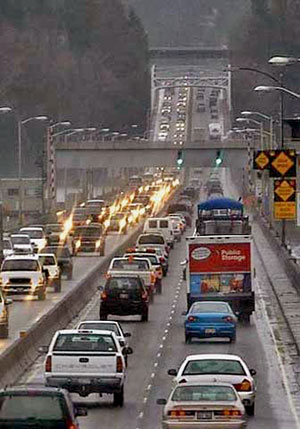
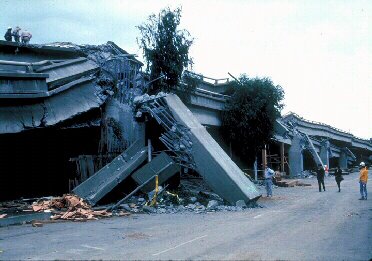
SR520 bridgeUnderinvestment in our transportation system has also led to deteriorating structures, such as the SR 520 bridge, which was built in 1963. This bridge and other structures are vulnerable to failure from earthquakes, with unacceptable risk to lives and property. The SR 520 bridge carries over 100,000 cars every day. The traffic impacts if it failed completely—not to mention the loss of lives—would be devastating. The risks are real and well understood.
In a show of leadership, elected officials from Snohomish, King and Pierce counties worked together to unite road and transit projects into a coordinated transportation plan to solve our region’s traffic problems. These projects would have levered construction already underway by Sound Transit and the state Department of Transportation. They would have tackled our region’s most congested corridors—such as I-405, which experiences up to 12 hours of gridlock in some areas every day.
The plan integrated transit and road improvements to reduce traffic backups and travel time, improve safety, and keep people and freight moving.
To ensure that funds would be spent wisely and produce results, the RTID Planning Committee adopted stringent policies for accurate cost estimation to keep projects on time and on budget, and to keep the public fully informed.
The Roads & Transit plan went before the region’s voters in the fall of 2007 and was defeated.
Tuesday, March 11, 2008
Why the region passed GMA; adds cost to Road building
The Growth Management Act 1/1/98
The Growth Management Act was adopted because the Washington State Legislature found that uncoordinated and unplanned growth posed a threat to the environment, sustainable economic development, and the quality of life in Washington. Known as the GMA, the Act (Chapter 36.70A RCW) was adopted by the Legislature in 1990. In 1991 the GMA was amended to create the Growth Management Hearings Boards to hear and determine allegations of non-compliance with the GMA. (Click to see the RCW version of the GMA or a more detailed version on the CTED site.)
The GMA has been amended several times since, including 1996, when the boards’ jurisdiction was expanded to include allegations of non-compliance with certain provisions of the Shoreline Management Act (SMA, Chapter 90.58 RCW). In 1997, the Legislature again modified some of the Act’s provisions, including the boards’ standard of review.
The GMA requires state and local governments to manage Washington’s growth by identifying and protecting critical areas and natural resource lands, designating urban growth areas, preparing comprehensive plans and implementing them through capital investments and development regulations. This approach to growth management is unique among states.
Rather than centralize planning and decision-making at the state level, the GMA built on Washington’s strong traditions of local government control and regional diversity. The GMA established state goals, set deadlines for compliance, offered direction on how to prepare local comprehensive plans and regulations and set forth requirements for early and continuous public participation. Within the framework provided by the mandates of the Act, local governments have many choices regarding the specific content of comprehensive plans and implementing development regulations.
The GMA requires that the three boards meet jointly at least annually to share information that promotes the goals and purposes of the GMA. The boards have jointly adopted administrative rules of practice and procedure, which are found in the Washington Administrative Code (Title 242-02 WAC).
The boards have jointly adopted the following mission statement:
The shared mission of the three Growth Management Hearings Boards is to help local governments manage growth and to serve the citizens of the State of Washington. They do so by making informed decisions on appeals arising from the implementation of the Growth Management Act in a clear, consistent, timely and impartial manner that recognizes the diversity of the three board jurisdictional regions.
Why Mobility Matters
The Galvin Project to End Congestion July 2007
Why Mobility Matters to Personal life
By Ted Balaker
POLICY
B R I E F
The Galvin Project to End Congestion
America’s insufficient and deteriorating transportation network is choking our cities, hurting our economy, and reducing our quality of life. But through innovative engineering, value pricing, public-private partnerships, and innovations in performance and management we can stop this dangerous downward spiral. The Galvin Project to End Congestion is a major new policy initiative that will significantly increase our urban mobility and help local officials move beyond business-as-usual transportation planning.
Reason Foundation
Reason Foundation’s mission is to advance a free society by developing, applying, and promoting libertarian principles, including individual liberty, free markets, and the rule of law. We use journalism and public policy research to influence the frameworks and actions of policymakers, journalists, and opinion leaders.
Reason Foundation’s nonpartisan public policy research promotes choice, competition, and a dynamic market economy as the foundation for human dignity and progress. Reason produces rigorous, peer-reviewed research and directly engages the policy process, seeking strategies that emphasize cooperation, flexibility, local knowledge, and results. Through practical and innovative approaches to complex problems, Reason seeks to change the way people think about issues, and promote policies that allow and encourage individuals and voluntary institutions to flourish.
Reason Foundation is a tax-exempt research and education organization as defined under IRS code 501(c)(3). Reason Foundation is supported by voluntary contributions from individuals, foundations, and corporations. The views are those of the author, not necessarily those of Reason Foundation or its trustees.
Copyright © 2007 Reason Foundation. All rights reserved.
The Galvin Project to End Congestion is made possible by the generous support of Robert Galvin.
The Galvin Project to End Congestion
Traffic congestion is choking our cities, strangling our economy, and reducing our quality of life. Rush-hour delays rob us of time with our families, and commute times often
dictate where we live and work. The impact our inadequate transportation network has on our economy is alarming. We waste an estimated $63 billion annually in time and fuel while sitting in traffic. Moreover, businesses and their customers bear enormous costs associated with traffic-related logistics problems, delivery delays, poor transportation reliability, and fewer potential employees within commuting distance.
This project is premised upon the conviction that the consequences of ignoring this threat will be dire. Inaccessibility leads directly to the depreciation of commercial and personal property values. This along with the gridlock will lead to the death of major cities in the United States and elsewhere in the developed world by mid-century if dramatic change is not implemented. But just as cardiac surgery can sustain our circulatory systems, we can prevent these clogged arteries that will stop the economic heart of cities from pumping.
The Galvin Project and the Reason Foundation have joined forces to develop practical, cost-effective solutions to traffic congestion, a policy initiative that will save our cities and significantly increase our urban mobility through innovative engineering, value pricing, public-private partnerships, and innovations in performance and management.
The old canard “we can’t build our way out of congestion” is not true. Adding innovative new capacity and improving the management of roads can eliminate chronic congestion.
A substantial new industry is developing as the private sector captures the opportunity in the value of our time wasted in traffic and seeks to profit from affordable, uncongested tollways. Public-private partnerships to build and operate these toll facilities have sparked innovations in engineering and design, overcoming obstacles such as limited right-of-way and noise pollution. Capital markets also provide access to much needed investment capital and ensure that new highway capacity is built where it is most needed.
In addition to adding road capacity, changing the way highways are managed can help to maximize the use of the capacity we have. The introduction of Intelligent Transportation System technologies can speed resolution to traffic delays, and electronic toll collection technologies can make extensive tolling practical. More importantly, variable pricing of lanes can keep traffic flowing all day by responding to changing demand.
Any city that ignores the threat and refuses to take up the challenge of eliminating congestion will find itself at an economic standstill by mid-century. We can solve our congestion woes. We can upgrade to an innovative, market-driven, world-class transportation infrastructure. We can change the institutions that guide our transportation decisions to create greater responsiveness, robustness, and efficiency. This project provides the ideas and tools needed to make change happen.
R e a s o n F o u n d a t i o n
Why Mobility Matters to Personal Life
By Ted Balaker
R e a s o n F o u n d a t i o n
Table of Contents
Introduction ... ... 1
A. What’s the Best Way to Get There? ... ... 2
B. Progress Gets Stuck in Traffic... . 5
C. The Cost of Congestion ... ... 6
The Stress of Congestion ... ... 10
Mobility and Love Life ... ... 13
Mobility and Married Life... .. 15
Mobility and Family Life ... . 17
A. Living Close to Work ... .. 18
Mobility and Fun ... .. 20
Conclusion: Toward a Mobile Society ... . 22
Related Reason Foundation Studies... .. 24
About the Author ... .. 25
Endnotes... ... 26
WHY MOBILITY MATTERS TO PERSONAL LIFE 1
P a r t I
Introduction
Americans rightly celebrate freedom of opportunity, but how far would it take us if our movement were severely restricted? How might the lack of mobility affect the kind of jobs we
hold, the places we explore, or even the people we marry? The freedom of mobility helps make other freedoms more meaningful. The more mobility we enjoy, the more choices we have. Mobility gives us more of what’s important in life.
Imagine that you are in the center of a circle (Figure 1). Call it your opportunity circle.
Figure 1: The Opportunity Circle
YOU ARE HERE
The space within the circle represents the amount of ground you can get to in a reasonable amount of time, say, one hour. The dots represent all the possible jobs you can apply for. The bigger your opportunity circle, the more jobs you can get to, and the better chance you have of landing the job that is right for you. If your mobility improves, the circle grows and you have more opportunities. If mobility degrades, the circle shrinks and you have fewer opportunities. And the dots need not represent just job opportunities. If you are an employer the dots could represent potential customers or your available labor pool. The dots could actually represent just about anything, from
2 Reason Foundation
dining opportunities (area restaurants) to opportunities for love (available singles). A previous policy brief (Why Mobility Matters available at reason.org/pb43_whymobilitymatters.pdf) takes a broad look at mobility. Here we focus on those aspects of mobility that relate to our personal lives: our relationships, family life, leisure options, state of mind, and so on.
When we enjoy efficient mobility, we can fill our personal lives with rich and varied activities thanks to what Reason magazine’s Nick Gillespie calls a “culture boom,” that is, “a massive and
prolonged increase in art, music, literature, video, and other forms of creative expression.”1
Economist Tyler Cowen chronicles cultural proliferation:
From 1965 to 1990 America grew from having 58 symphony orchestras to having nearly 300, from 27 opera companies to more than 150, and from 22 non-profit regional theaters to 500.2
Since 1990 our culture has continued to boom. Consider, for example, that the American Symphony Orchestra League currently boasts nearly 1,000 member orchestras.3 And countless
other cultural offerings—from restaurants, to health clubs, sports complexes, and art galleries— have also grown more plentiful. The more mobility we enjoy, the more we’re able to take advantage of our cultural bounty.
But our ancestors had to make do with smaller opportunity circles and fewer choices. Long ago they had only their feet to rely upon. But new modes of travel—wheeled carts, animal-powered carriages, trains, cars, and planes—have allowed us to cover more ground faster.
A. What’s the Best Way to Get There?
The average person can walk about four miles per hour, but cars can easily travel on arterial streets at 30 miles per hour. It’s a substantial increase in speed, but the impact may be even greater than it seems. A person who walks for an hour has access to 50 square miles, but someone who drives at 30 miles per hour for 60 minutes has access to 2,827 square miles. In other words, the driver’s opportunity circle is more than 56 times as large as the walker’s. And when conditions permit, motorists may drive much faster on highways, thus expanding opportunity circles even more.
In many cases public transit offers greater mobility than walking and in some cases it can also beat driving. But auto travel is generally much faster than taking transit (see Figure 2).
WHY MOBILITY MATTERS TO PERSONAL LIFE 3
Figure 2: Average Speed by Mode
Car*, 33
Commuter Rail, 32
Heavy Rail, 20
Light Rail, 16
City Bus, 13
0 5 10 15 20 25 30 35
Miles per Hour
Sources: American Public Transportation Association, International Union of Public Transport, Millennium Cities Database, 2001 (Brussels)
* Average U.S. urban roadway speed for all types of roads (highways, arterials, local streets) combined.
Other factors, from transfers from one bus or train to another to time spent walking to the transit stop, make a slow transit trip even slower. Even though transit commutes typically cover shorter distances4, it takes the average American transit user about twice as long to get to work as the
average car commuter.5 This holds true in some unexpected places. For many New Yorkers transit
offers the fastest way to get to work, but, on average, transit commutes take much longer than auto commutes even in the New York metro area. Indeed New York’s transit commuters endure the longest commutes in the nation (52 minutes each way vs. 28 minutes for solo driving). Transit commuting takes much longer than driving in many other areas with celebrated transit systems (see table).
Table 1: How Long It Takes to Get to Work
Metro Area Transit Solo Driving
New York 52 minutes 28 minutes
Chicago 50 minutes 29 minutes
San Francisco 46 minutes 27 minutes
Washington, DC 47 minutes 30 minutes
Boston 44 minutes 26 minutes
Philadelphia 47 minutes 26 minutes
Source: Nancy McGuckin and Nandu Srinivasan, Journey to Work Trends in the United States and its Major Metropolitan Areas, 1960-2000, U.S. Department of Transportation, Federal Highway Administration, Publication No. FHWA-EP03058, June, 3, 2003.
4 Reason Foundation
Motorists enjoy additional advantages that push many people toward cars and away from transit. Travelers can reach relatively few destinations directly by transit, but motorists can go from (almost) anywhere to (almost) anywhere. Transit service frequency varies according to schedules, but motorists can travel whenever they like. Their travels are not as restrained by fatigue as are walkers and transit users who trek to and from transit stops. Simple conveniences, like trunk-space, make it easier to carry things and additional seating makes it easier to transport small children, the elderly, and handicapped. The enclosed space of a car can also spare travelers from the rain, snow, heat and humidity. And although driving brings its own risks, many people feel safer traveling at night or through unfamiliar areas within the confines of a car.
Yet, as they have always done, Americans will trade in their cars once a superior form of transportation comes along. Telecommuters already outnumber transit commuters in 27 of the top 50 metro areas, and telecommuting has already partially replaced cars for millions of American workers.6 And why not? Even with no traffic congestion and nothing but green lights, driving to
work will never be as fast as the zero-minute commute that telecommuters enjoy. New technology has given us a new kind of mobility. Armed with cell phones, laptops and PDA’s we can “be” almost anywhere without crawling into a car, train or plane. But that should not diminish the importance of “old-fashioned” mobility—moving people, parts, and products across physical space.
Although a growing number of people can work remotely, countless occupations—from hair stylist to dentist to construction worker—remain location-specific. The telecom explosion allows more business to get done over the phone or via email. The falling cost of communication has generated more communication—even across continents—and these interactions routinely result in new plans that require traditional mobility.
Recently, Austin learned that the new economy still requires efficient, old-fashioned transportation. South Korea-based Samsung considered opening a new $3.5 billion chip plant in Austin, but company officials worried that congestion would slow the global production process—silicon wafers would be trucked from Austin to Dallas, then flown to South Korea for final processing.7
After local political officials committed to a congestion relief plan, Samsung decide to build the plant. Economic development benefits are soon to follow.
Business is one aspect, but in the context of personal life, physical proximity might matter even more. Even with the growing popularity of online games and shopping, many still find relaxation or stimulation by experiencing a new location. They look forward to trying a new restaurant across town, taking their kids to the park, or taking dance lessons. So when it comes to enriching our personal lives, traditional mobility does indeed matter. And, for now at least, the car usually offers the best way to stretch our circles as wide as they can be.
WHY MOBILITY MATTERS TO PERSONAL LIFE 5
B. Progress Gets Stuck in Traffic
When mobility improves, our opportunity circles expand and we have access to more of what’s available not only in our neighborhoods, but nearby regions. Yet how much a city offers is quite different from how much any individual denizen can access. We have come so far, but in so many places mobility is no longer improving. Mounting traffic congestion chips away at the progress we have made.
Today congestion smothers well-established areas (it’s up 183 percent in Washington, D.C. since 1982) as well as upstart ones (up 475 percent in Atlanta).8 Not only has congestion gotten much
worse in areas where we expect it to be bad, but it’s also making life increasingly sluggish across the nation, from Portland to Austin to Charlotte.
The average urban American now spends 47 hours a year stuck in traffic—more than an entire work week—and it’s much worse in our big cities. In Los Angeles, the average driver spends 93 hours sitting in traffic jams on the roads. In 1983, only one urbanized area, Los Angeles, had enough congestion to cause the average driver to spend more than 40 hours per year stuck in traffic. Just 20 years later, 25 areas reached this threshold (Figure 3).
Figure 3: Commuters in Congestion for at Least 40 Hours Annually
Source: Texas Transportation Institute
The future looks bleaker still. Congestion in Los Angeles is legendary, but if officials continue to respond to the mobility crisis with a shrug, many more areas will succumb to LA-style gridlock. By 2030 11 additional urban areas (Chicago, Washington D.C., San Francisco, Atlanta, Miami, Denver, Seattle, Las Vegas, Minneapolis-St. Paul, Baltimore, Portland) will suffer through traffic
6 Reason Foundation
conditions as bad as or worse than present-day Los Angeles.9 Eighteen other areas, from Phoenix
to Orlando, will endure a level of congestion only slightly less severe.
Our elected officials have been slow to address the problem, and for many years few people seemed to care. Traffic congestion was long regarded as little more than a minor annoyance. But times have changed. Former U.S. Secretary of Transportation Norman Mineta recently called gridlock “one of the single largest threats to our economic prosperity.”10 Public opinion has also changed. Silicon Valley CEOs rate traffic congestion as their second most pressing concern, as do business owners in downtown Portland, Oregon.11 In its aptly titled new study Growth or
Gridlock?, the Partnership for New York City estimates that traffic congestion saps the regional economy of as many as 52,000 jobs each year.12 According to recent surveys, congestion is among
residents’ top concerns in places as different as Denver and Washington, D.C. Residents have placed congestion atop their list of concerns in Austin, Atlanta, Houston, Portland, Los Angeles, Minneapolis-St. Paul, Sacramento, San Diego, and San Francisco. The longer public officials put off dealing with it, the more traffic congestion will transform from a minor annoyance into a force that threatens economies and quality of life, dampening our enjoyment of so many of the things that make life fun, varied, exciting, and fulfilling.
C. The Cost of Congestion
Often officials and planners tout a supposed urban renaissance in which everyone, from singles to empty-nesters, is moving to downtown centers. Although this may be true in some cases, it obscures the bigger picture and real trend: cities are losing influence.
Since 1950, suburbia accounted for more than 90 percent of the growth in our metropolitan areas.13 Cities like, Baltimore, Detroit, St. Louis, and Philadelphia continue to lose population and even foreign immigration cannot keep some of our most celebrated urban centers growing. In the first half of the 2000s, Chicago, San Francisco, and Boston lost population.
The situation would be less dire if demographic trends simply reflected the preference of Americans to live and work in suburban environments. Indeed the lure of suburbia has much to do with Americans’ preference for distinctly suburban features such as affordable single-family homes and backyards. And although it’s true suburbia grows more cosmopolitan all the time, cities still offer a greater concentration of cultural offerings, be they restaurants, art galleries, museums, theaters, playhouses, or most anything else.
Businesses think it wise to follow all these potential workers to the suburbs, even though a suburban environment is not inherently superior for many of them. Many businesses, families, and singles would love to stay in the city and draw on all the energy offered by agglomeration economies, but they are forced out by a variety of urban headaches, including degraded mobility.
WHY MOBILITY MATTERS TO PERSONAL LIFE 7
Too many elected leaders find comfort in misleading tales of urban renaissance and too many assume that our great cities can thrive even as mobility degrades. But improving mobility is essential to ensuring our urban centers’ long-term survival, and if we ignore the mobility crisis our cities will wither.
Not only are talented and energetic people increasingly choosing suburbia over city life, but sluggish urban life is also draining some of the talent and energy that remain. As travel becomes more difficult, fewer interactions take place. Vibrant competition has traditionally ensured that city dwellers enjoy the best of the best, but when mobility degrades, a city functions less like a grand urban space and more like a collection of isolated communities. Instead of traversing several neighborhoods to patronize the best establishments, denizens are more apt to resign themselves to whatever’s nearby. First-rate establishments find it more difficult to attract customers and secondrate operations realize that, with less competition, they face less pressure to improve. Residents are often stuck with fewer choices, higher prices, and inferior service.
Downtown cultural institutions fret about traffic-weary would-be patrons steering clear of music, dance, and theater events.14 And often it’s the offbeat establishments, the very spots that give cities
their character, that are particularly vulnerable to congestion (see text box). In Commuting in America III, Alan Pisarski suggests that policies that suppress freewheeling travel “are destroying part of what makes a big region a great region.”15
Although researchers have done their best to explain and quantify how it restrains our lives, a complete assessment of congestion’s costs is hard to come by. The U.S. Department of Transportation estimates that each year traffic congestion costs the American economy about $168 billion.16 It’s a huge amount—more than the combined value of Yahoo!, Office Depot, Ford,
Charles Schwab, and Walt Disney Co.—yet it still does not include all of congestion’s ill effects. The figure isn’t just incomplete; it’s impersonal.
Others have attempted to provide a more complete and personal assessment of congestion’s costs. Researchers at the Texas Transportation Institute figure that congestion costs each big-city resident $1,000 each year.17 The figure is personal, but incomplete for it only accounts for the loss of
wasted gas and time. Congestion also robs us of opportunities in more subtle ways. For example, it decreases our job opportunities. Instead of landing a more distant, but higher-paying and more fulfilling job, those living in the midst of gridlock are more likely to stick with the jobs they already have. Researchers have begun to account for how restricted mobility limits our employment opportunities and one analysis considers how cutting congestion back might enrich workers by matching them with better-paying jobs. They estimate that a 90 percent reduction in congestion in the Atlanta area would put an extra $2,900 into the pocket of each area resident.18 An
analysis of metro New York estimates that—because it limits how may trips they can make— congestion costs taxi drivers $6,000 per year and repairmen $7,000 per year.19
8 Reason Foundation
What’s a Niche-Market Business to Do?
An Uzbek restaurant in LA—who knew? I didn’t until I happed to drive past it one night and ever since then I’ve wanted to investigate. The restaurant (conveniently named Uzbekistan) sits only eight miles from my home, but a year passed before I dug into my first bowl of ogra. Why? Traffic congestion.
When I noticed the restaurant in one of the city’s anonymous strip malls, my wife and I were embarrassingly late for a dinner party. We had factored in a generous amount of travel time, but the Saturday evening Hollywood traffic was downright wicked. So although I was intrigued by the mystery of central Asian cuisine, I certainly didn’t want to venture into that traffic hell again.
When conversation would turn to dinner options I would think of Uzbekistan sometimes and suggest it occasionally, but only half-heartedly. For an entire year my cranky, hassle-averse self overcame my adventurous, boundary-expanding self. Whenever the spark of interest emerged, it was smothered by dreaded congestion. A clever mockumentary buoyed Uzbekistan’s profile by highlighting its rivalry with Kazakhstan, but even Borat-mania couldn’t propel me to Sunset and La Brea.
Then one evening my hunger coincided with the realization that it was the week after Christmas—the citywide lull when even congestion takes a break. The missus and I headed to the car, breezed all the way to Uzbekistan, and even scored a parking spot right in front. Once inside we experienced what critics of LA miss when they fixate on the external
drabness of the city’s strip malls. The architectural tedium gave way to gaudy murals and a concave ceiling complete with a partly cloudy faux sky and a dangling disco ball. The synthesizer-heavy live music alternated between Uzbek tunes (or maybe they were Russian) and Sting cover songs. Most of the cocktails were vodka-based, some with simple ingredients (vodka, pickle), others a tad more elaborate like my “Asian mule” (vodka, beer and lemon juice). We enjoyed eggplant and beef salad, noodley kaurma lagman, ogra (dumpling soup), and some oh-so-juicy chicken kabobs.
No doubt congestion has thwarted the plans of other would-be diners and explorers across the city, and it’s probably not those bent on experiencing something specific who get thwarted most often. Rather, it’s the fence-sitters (like me) who get nudged to the “don’t go” side. Traffic congestion restrains all sorts of businesses, but the quirky ones face special
challenges. We all need milk and toothpaste, so a supermarket can rely on a customer base that extends just a short distance. But businesses that cater to niche markets are especially dependent on mobility.
At any one time only a fraction of Southlanders get a hankering for Uzbek cuisine, karaoke, dance lessons, model trains, hiking trails, or any of the off-beat offerings that make cities interesting. The more ground potential customers can traverse quickly, the more actual customers establishments will attract.
A longer version of this piece appeared in the Los Angeles Business Journal.
WHY MOBILITY MATTERS TO PERSONAL LIFE 9
The cost of congestion moves beyond dollars and cents when the issue turns to emergency response. A prompt response time saves a life; a sluggish one costs a life. Consider just one type of emergency—sudden cardiac arrest. Each year this emergency claims roughly 67,000 American lives.20 In most of our nation’s big cities only about 6 to 10 percent of those stricken are saved.
These deaths are particularly tragic because this type of emergency is particularly treatable—that is, if medical care arrives quickly.
If treatment arrives within one minute, 90 percent of patients survive. At 5 minutes, survival probability drops to about 35 percent. At 10 minutes, it’s zero. Even relatively modest increases in response time yield substantial benefits. An analysis of Austin emergency medical services estimates that if response times improved by just 30 seconds, 41 lives would be saved each year.21
Of course, quick response is not just a matter of ambulances arriving quickly. Often friends and loved ones rush patients to emergency rooms in their own cars. And speed is crucial not just for this particular medical emergency—many emergencies, medical and not medial alike, are time sensitive.
It’s especially difficult to put a dollar figure on the many other ways congestion interferes with our lives. Consider the toll it takes on our personal lives—how it keeps parents away from their kids, stymies would-be love connections, and sours us on exploring our surroundings. There’s also the psychological toll: how much is each gridlock-induced gray hair worth?
10 Reason Foundation
P a r t 2
The Stress of Congestion
Everyone knows that congestion wastes time, but it does so in a way that is especially irritating. When it comes to low-grade torture, few things enrage the human animal like gridlock.
Consider the very human desire to understand our surroundings. When free flowing traffic halts abruptly, our first response is “what happened!” And yet helpful information is hard to come by— it often travels only slightly faster than gridlocked speeds. Even with local radio stations announcing traffic conditions every few minutes, many motorists have learned that frequent updates aren’t necessarily helpful updates. Think of any big city. At any one time there could be dozens of traffic snarls, but traffic reporters only mention the worst of the worst. Many of us have been there. We hush our passengers, listen intently as the traffic reporter ticks through the other back ups, and then wail in agony when he doesn’t even bother to tell us why we’re trapped.
And different kinds of congestion can trigger different kinds of helplessness and stress. Many of us travel on roads that are almost always sluggish. Such trips may be frustrating, but at least we know what to expect. What’s particularly enraging is when travel becomes unpredictable.
Transportation researchers give these two kinds of congestion different names. Sometimes congestion is simply a matter of not having enough roadway space to accommodate all the cars. This is called “recurring congestion,” since it is the kind of congestion we run into on a regular basis. Then there’s the more sinister kind. New York-area commuter Dossy Shiobara notes, “It's the exceptional or unusual situations, like the bridge jumper, or severe automobile accidents that create unusual amounts of traffic that bother me.”22
What he’s referring to is known as “incident-related congestion.” As he explains, this type of congestion occurs when some type of incident—an accident, a stalled car, a big rig’s spilled cargo—brings traffic to a crawl. Incident-related congestion is particularly frustrating because it’s unpredictable. In fact, researchers have crunched the numbers and discovered that incident-related congestion is two and a half times as frustrating as recurrent congestion.23 Although the breakdown
varies widely by location, incident-related congestion typically accounts for half of congestion’s delay, as illustrated in Figure 4 below.
WHY MOBILITY MATTERS TO PERSONAL LIFE 11
Figure 4: The Sources of Congestion (National Summary)
Source: “Traffic Congestion and Reliability: Trends and Advanced Strategies for Congestion Mitigation,” Prepared for Federal Highway Administration by Cambridge Systematics, Inc. with the Texas Transportation Institute, September 1, 2005.
Travelers have a hard time planning for the unknown, and incidents by nature are unknown. One accident could double your 30-minute trip without warning. Since the element of the unknown always threatens us, travelers are forced to plan for the worst. “It will probably take me a half hour
to get to that meeting. Then again, it could take twice as long.” When we absolutely have to be somewhere on time—perhaps a job interview or a first date—we build in even more buffer time. Since it’s so hard to predict our travel times we often overcompensate. We end up at the job interview 45 minutes early. We sit in the parking lot and our anxiety about getting there on time fades away. Boredom takes its place. We imagine all the other things we could have done with this time. Slept in more, grabbed some lunch, responded to those emails. Buffer time is wasted time, and it adds up.
Heart in San Francisco, Home in Kansas City
Although they love the San Francisco area, Wayne Brown and his wife, Teresa, decided to leave it all behind.24 Steep housing costs and Wayne’s treacherous commute finally proved too
much to bear, and in 2005 the couple moved to suburban Kansas City. “I would find myself sitting in traffic screaming at people,” Wayne recalls. When weekends came around, the two were often too worn-out from work and commuting to explore the area they loved. “During the week, it was no life,” says Wayne. “And there was no way to relieve stress from work; it just continued on in my life.”
12 Reason Foundation
During the rush-hour gauntlet we flail our arms in anger, bark at others who are competing for precious freeway space, and even lunge our cars threateningly at them. Since we’re surrounded by thousands of pounds of armor and enjoy some degree of anonymity, we feel emboldened to engage in showdowns with most anyone. Dockers-clad executives and manicured soccer moms strip off the conventions of civil society, grit their teeth, and prepare for war.
In fact, some evidence suggests that the war analogy isn’t just silly overstatement. Dr. David Lewis of the International Stress Management Association conducted a study of British commuters and found that— based on heart rate and blood pressure readings—they often experienced greater stress than fighter pilots going into battle.25 No doubt much of the disparity has to do with
personality differences. Fighter pilots are a steely bunch. They have the kind of mental toughness that allows them to stay cool in the most perilous of situations. Yet Dr. Lewis highlights another factor—control. Fighter pilots have it and stranded commuters don’t.
Fighter pilots can use the whole sky to maneuver. They can bob and weave, fire at the enemy, and, if necessary, escape. Their fate is—in the most extreme sense—in their hands. But stranded commuters are at the mercy of uncontrollable forces and their inability to control their fate explains why their hearts pound with frustration.
The Stress of Transit
Long-time LA transit commuter Barbara Lott-Holland lives about 30 miles from work, yet her roundtrip commute consumes roughly four hours of each day. Bus service is often slow, spotty, and unreliable. Traffic congestion makes a bad situation worse. It’s a big reason why Barbara has to add so much buffer time into her day. Will the bus arrive in five minutes or 25 minutes? Who knows?
“I have to be at work at 8 o’clock in the morning,” says Barbara. “I have to be at my bus stop at 6 o’clock and the littlest variation—the bus doesn’t come, it breaks down, the bus is so overcrowded that it doesn’t stop for you—means that you have to wait for the next bus, and all of this is working on your nerves. It’s causing you to be more tense when you get to work and makes your day longer and more exhausting.”26
Barbara explains that low-income people think long and hard about everything they do because it takes so long to get anywhere. They often avoid trips unless they’re absolutely necessary—like picking up a child from daycare. Such trips can be particularly nerve-wracking, says Barbara “because you can’t be late, because normally at child care you’re docked for every five minutes that you’re late. You’re already in a lower-income bracket; you can’t afford to pay any more for child care. Your whole day is full of stress.”27
WHY MOBILITY MATTERS TO PERSONAL LIFE 13
P a r t 3
Mobility and Love Life
All across the nation, Cupid’s arrow is getting stuck in traffic. Although Westchester County is geographically close to Manhattan, because travel is such a hassle, New York City singles
often tag Westchesterites as “geographically undesirable.”28 Thousands of Atlanta-area Match.com subscribers will not date anyone who lives more than 10 miles away. Atlanta spans nearly 2,000 square miles, but immobility limits these love seekers to a tiny corner of the metropolitan area.29
Washington, D.C. might be worst of all. According to Match.com, singles there are most likely to care about how far they travel for love.30 Elizabeth Reed refused to travel more than five miles for
a date. “In D.C.,” she says, “five miles is the longest five miles you’ve ever traveled.”31
To some, particularly those in small towns and rural America, it might sound ridiculous that traffic would get between humans and what they crave most in life. Surely today’s singles can deal with a longer drive, particularly since they’re driving in the comfort of their leather interior, climatecontrolled, satellite radio-equipped sedans. But there’s little reason to launch into a “the trouble with kids today” speech. After all, some aspects of courtship are timeless, but others are quite modern.
When people lived and worked in small villages, they chose their spouses from within those small villages, local clans, and within cliques and social classes. Today mobility gives us more choices. Ever improving transportation modes—from foot to carriage to train to car—expand our dating pools. Online dating expands them still more. We don’t have to settle for our acquaintances living on our block, or rely on distant relatives to arrange a date, let alone a wedding. And that’s a good thing because modern love-seekers expect a lot more out of a mate.
Our spouses should not only love us, they should fulfill us, excite us, make us laugh, and make us feel better about ourselves. We want our spouses to be our best friend and our confidant. What are the chances we’ll find that person living next door?
Singles can no longer assume other singles share their religious beliefs; yesterday’s agrarian villages were nothing like today’s vast, multicultural metropolises. Singles can no longer just assume agreement on core issues. Having kids is no longer a foregone conclusion; it’s an open choice. Even if both want kids, there are still the questions of “how many?” and “when?”
14 Reason Foundation
And let’s not forget the serendipitous side of love—the chance encounters that occur when people are allowed to churn naturally. The more they go out the better chance singles have of finding “the one.” Singles go to places—to bars, bookstores, churches, concerts, restaurants—and fall in love.
Unfortunately, many American love-seekers find that their dating pools are no longer expanding— they’re shrinking. Rising congestion has begun to reverse the process that gave us more opportunities for romance. And congestion routinely compromises prime dating times. It’s often at its worst on Friday and Saturday evenings. And once you do finally meet your date, the aggravation you just endured is often written all over your face. “Why would you want to show up on a first date and give that face?” asks Elizabeth.
Elizabeth did find the man of her dreams (lucky for Jay he lived 4.9 miles away from her) and they were married in 2003. But what about all those other Elizabeths and Jays who don’t meet because their travel orbits never overlap? When traveling takes longer than it should, when it’s more frustrating and exhausting than it should be, people do less of it. The large-scale mixing that makes cities so exhilarating becomes smaller scale. People are less inclined to experience new things, in new places, with new people. They’re more inclined to mimic their ancestors and travel within the confines of their tiny, familiar orbit.
WHY MOBILITY MATTERS TO PERSONAL LIFE 15
P a r t 4
Mobility and Married Life
Congestion can restrain singles’ spontaneity, but that problem doesn’t end once couples get hitched. When they go out on the town, Elizabeth and Jay usually don’t stray far from their
home in Arlington, Virginia. Still, one Thursday evening the couple opted to stretch their boundaries and take in a Coldplay concert. A trip that would have taken 30 minutes without congestion ended up taking two hours. Elizabeth calls the trip a “ridiculous march” and vows never to go to the Nissan Pavilion again.
That’s the kind of specific experience that elicits a specific response. In this case, congestion’s impact is concrete and memorable. But, as is so often the case, the victims of congestion often fail to see the extent to which they have reshaped their lives around gridlock. Elizabeth mentally “strikes out certain nights to go into the city” and when asked how it would affect her life if congestion magically vanished, she pauses. It’s a surprisingly hard question because she’s “gotten so used to not doing things.”
Eventually Elizabeth notes that, if it were easier to get around, she and her husband would go out more often. It would really help Jay, who has a longer commute and is often exhausted and stressed out when he gets home. Jay “has to go through a decompression period,” says Elizabeth.
With a decompressed and better-rested Jay, they’d do more things together, but they’d also see their friends more often too. They’d check out the nightlife in the District and they’d even venture into Baltimore.
Whether explicitly or subconsciously, many of us behave like Elizabeth and Jay. We mentally strike out more and more of our options, things we could do that would add spice, spontaneity and fun. Psychology research suggests that spontaneity—getting out of the house and doing things that break the routine—helps nurture a long-term relationship. Certainly, traffic is no excuse for living a dull life, but it’s clear that congestion does have a dulling effect.
16 Reason Foundation
Congested Marriages
“Once you commute, you can never have dinner with your spouse again,” says Eric Larsen.32 The corporate consultant might be overstating the problem somewhat—then again, he
does spend as many as four hours commuting each day. And it’s not as if he lives particularly far from his job. Eric lives in the Los Angeles suburb of El Segundo. His job is in Rosemead, 30 miles away. Without congestion, his roundtrip commute time could easily shrink to one hour. He would have three more hours each day, 15 more hours each work week.
WHY MOBILITY MATTERS TO PERSONAL LIFE 17
P a r t 5
Mobility and Family Life
Long commutes make it more difficult for families to spend time together. The long trip home can be just a matter of distance, but as writer Brian Blum explains, congestion always looms:
The job and my home were in different cities and my travel time every morning was an hour door-to-door. Same in return. That's if I avoided traffic. Otherwise I could be in the car for three, sometimes four hours a day. It happened on one too many occasions. To get around a totally unacceptable commuting situation, I got in the habit of beating the traffic by leaving the house at 10:00 a.m. I'd hang around the office again until sometimes as late as 9:00 p.m., long after the traffic had died down.
I'd chow down on the junk food munchies that were provided for free to other late night hangers-on, arriving back home no earlier than 10:00 p.m.
As a result, except on weekends, I was never home for my kids' bedtimes. I never got a chance to give them the tuck-in I loved as much as they did. No books before bed. No family dinners. After three years of this crazy commute, I was frazzled and not a little bit lonely. I felt like a bad father, a rotten husband, a slave to a salary that no longer seemed worth the sacrifices.33
Blum coped with rush-hour traffic by leaving for work after it died down. Others use the opposite strategy. They leave before rush hour. Beating traffic this way often means hitting the road while it’s still dark. Alan Pisarksi points out that commuters “leaving before 6 a.m., even 5 a.m., is a very rapidly growing group.”34 Some who work at National Airport but live in Maryland have to cross
the perpetually congested Wilson Bridge. In order to avoid traffic they leave for work before 5 a.m. Once they arrive they sleep in the parking lot until their shift begins. That kind of a schedule makes it nearly impossible to see the kids off to school.
18 Reason Foundation
The Extended Impact of Congestion
Congestion’s impact can be felt beyond the immediate family. Alan Pisarski is not just a transportation expert, he’s also a grandfather. And even though his granddaughter lives in the same metro area, congestion makes it harder for him to visit her. The peak time for special events often coincides with the peak time for traffic—Friday evenings: “A half dozen times my kids have said your granddaughter is going to be in the school play, but I just don’t go.”35 He
explains that the only way he could make it on time is if he can find a way to leave at 3:30, and even then the aggravation of Friday afternoon traffic leaves him in a foul mood when the curtain rises.
A. Living Close to Work
Why don’t more gridlock-weary commuters simply move closer to work? The approach certainly works for some people, but it’s often more feasible in theory than in practice. It would be much easier for most of us to live closer to work if jobs and people were interchangeable. However, different jobs require different skill sets and skill levels. Different people have different talents and aspirations. If all jobs and people were identical, then more people would probably take jobs closer to home. But people don’t want just any job. They want the one that offers the best combination of pay, benefits, and hours. Jobseekers consider the workplace environment, chances for advancement, and highly personal factors like how fulfilling the job is. When it comes to proximity, finding the right job is somewhat like finding the right romantic partner: chances are neither one is right around the corner.
Yet many urban planners promote the concept of “balance,” in which the number of jobs roughly equals the number of workers. Some communities have actually achieved that goal, but does that mean the end of freewheeling commute patterns? Consider Fairfax County, Virginia, a rapidly growing community just outside of Washington, D.C.:
By 2000, the Fairfax job-worker ratio was effectively 1.0, that is the “perfect” situation of one job per worker. At this time, if every worker in the county worked at one of the jobs available in the county, there would have been no one entering or leaving the county to work. So, if the goal was to reduce congestion by minimizing the need for work travel, the county ostensibly would have been close to achieving it. In reality only about 53 percent of county resident workers worked in the county in 2000, a steady increase from 1990, but this still yielded a considerable need for imports and exports. The fact that large numbers of workers were moving in both directions is a measure of the differences in skills and attractions, and certainly not some kind of failure. 36
Even the 53 percent figure likely overstates the degree to which Fairfax workers stay close to home. After all, living and working in the same county is far different from living and working in
WHY MOBILITY MATTERS TO PERSONAL LIFE 19
the same neighborhood or on the same block. One may live and work in the same county but still face a rather long journey to the office.
Moving for employment purposes makes sense if you’ve already been hired and you plan on staying at the job for a long time. But what if you decide to try something else? It’s not clear that moving would even improve your long-term job opportunities. Say there are 1,000 jobs inside your job circle. When you move to a different part of a congested city you leave your old job circle behind. You might have new job opportunities, but you might not have more opportunities. Dual
income families (a category that represents 70 percent of workers37) have even more juggling to do.
Chances are both jobs won’t be near each other. Moving closer to your job could mean moving farther away from your spouse’s job. And if the geographic puzzle could be solved, families would still have to contend with frequent moves. A recent Bureau of Labor Statistics study found that, on average, young baby boomers held nearly 11 different jobs between the ages of 18 and 40.38 Of course, if both spouses work, the goal of living near work grows even more unrealistic. Families would scarcely have time to unpack before heading off to another new home.
Even if a family were amenable to frequent uprooting, simply finding a home close to work may prove challenging. If a metro area offers a high level of mobility, house hunters can choose from among a wide assortment of properties. But traffic congestion often conspires with steep housing costs to make it even harder for people to move closer to work. In Los Angeles an artificially constrained real estate market squeezes the supply of housing and costs shoot up. The median price of a house in LA County is $550,000.39 In the ritzy parts of LA prices are even more outlandish. In
Santa Monica, it’s hard to buy a home for under a million dollars. The bitter mix of high housing costs and mounting congestion is something many recruits, particularly young ones, are hesitant to swallow. Yes, affordable housing does exist in LA, but it’s often located in high-crime neighborhoods, the downtrodden pockets that have resisted the citywide trend of safer streets.
Schooling may further complicate matters. Many families shape their travel patterns, not around the location of their jobs, but around their children’s education. After all, unlike jobs, public schools are assigned on the basis of proximity. Parents carefully shop for a house located in a good school district and when they find one this becomes the center point of their opportunity circles.
Young couples may live near a school, but once they have children they give careful consideration to whether it’s the right school. Jill Cashen and Keith Ashdown love their Capitol Hill neighborhood in Washington D.C., but when the young professional couple looks at the public school their 2-year-old daughter Audrey would be assigned to they see the reason they plan to leave the city. “No child should go to school there until some serious changes are made,” says Cashen. “It’s certainly not an option for our child.”40
20 Reason Foundation
P a r t 6
Mobility and Fun
Mixed-use developments, and the “live, work, play” motto included in their promotional literature, have found favor among many local public officials. The idea is to put many
kinds of options in the same area, so that they are easily accessible by foot or transit. Public officials hope that folks will find most of what they need nearby, so that there will be less need to drive. They often encourage and even subsidize projects that combine apartments or condominiums with employment spaces and entertainment options like restaurants and public parks.
Unfortunately, many municipalities still segregate properties by use. Retail has its designated areas, which are separate from residential, office space, and so on. Officials should liberalize land use regulations to accommodate a greater mix of uses. Even so, we must not hold to unrealistic expectations about “live, work, play” communities. We have examined some of the factors that trip up the “live, work” part of the vision, but what about “live, play”? Might people be able to satisfy their playful sides close to home?
In some cases, the answer is yes. Those who live in city centers in New York, Chicago, San Francisco and elsewhere often enjoy having a cozy restaurant a few doors down. It can be very convenient and relaxing to leave the car in the garage and take a quick stroll to dinner. The same can be said for other entertainment destinations, like parks or theaters. But whether they want to be entertained or just unwind, people don’t just care about proximity. Variety matters too.
When we head out the door, much of the fun is seeing, tasting, and experiencing something new. We seek a change in scenery. We enjoy poking around some unexplored corner of our city. Funseekers in the liveliest neighborhoods may be a short walk from a half-dozen quality restaurants, but after they’ve experienced each of them a few times chances are they’ll want to add new options to the mix. Efficient public transport can expand our opportunity circles somewhat, but our entertainment options explode exponentially if we enjoy speedy auto travel.
When mobility improves, we enjoy more choices, not just in restaurants, but in all aspects of the culture boom. Two decades ago who would have imagined that chefs would join the ranks of celebrities? Today Americans watch all sorts of cooking shows and buy the latest cookbooks. So many of us are eager to satisfy our inner Emeril. America’s amateur chefs enjoy hunting down ingredients—meats, cheeses, vegetables, and spices—to make their dishes just right. They head to
WHY MOBILITY MATTERS TO PERSONAL LIFE 21
specialty markets. Some stores display wide organic food offerings. Others promise the freshest fish. Ethnic markets allow us to indulge in other cultures and treat our friends and family to authentic tastes. If it is difficult to get around we have to ratchet down our expectations. We have to settle for the places that are nearby. But the more mobility improves, the easier it is to get to the farmer’s market, to Chinatown, or to the Italian deli.
Although America’s “foodie” population has swelled, it still accounts for only a small slice of our nation. Most people’s interests lie elsewhere. But whatever you do simply because you enjoy it— dance, hike, fish, hunt for antiques—improved mobility will provide you with more opportunities to do it.
22 Reason Foundation
P a r t 7
Conclusion: Toward a Mobile Society
We all endure congestion and we recognize how it pesters us on our way to and from work, so we may think we know it quite well. Few people like congestion, but few recognize the
full extent of the problem. Recall Elizabeth Reed, the woman who would not travel more than five miles for a date. Although she was keenly aware of congestion’s impact on her dating options, she was slow to recognize how it restrained other aspects of her life. She had “gotten so used to not doing things.” Countless others of us have also gotten used to not doing things.
If we’re stuck in some particularly frustrating traffic jam, we might we erupt in anger. But most of the time we just surrender a little bit more because we assume that degraded mobility is the natural result of an increase in population and driving. Rarely do public officials seek to undo such feelings of surrender. Most planning agencies have decided they will not even attempt to reduce congestion—they aim only to reduce its growth. Yet if such a plan were applied to a different policy area, Americans would not stand for it. Imagine if our leaders told us that, in the future, our education system would get worse, that there’s nothing we can do about it, and that all they hope to do is make test scores fall more slowly.
The gradual deterioration of mobility has also lulled us into making subconscious accommodations to congestion. We slowly shrink our opportunity circles. We pare back the list of things we might do if it were easier to get around. More of us mentally cross out more of our potential lives. The widespread surrender dulls individual lives, and it also dulls entire cities. As opportunity circles shrink, dynamism filters out of the city. If it were infused with the energy and talent of all its denizens, a city could grow into a grand metropolis. Sadly, urban life isn’t as vibrant as it could be because too many neighborhoods function as their own little hamlets, increasingly isolated from other parts of the city.
But instead of allowing isolation and dullness to gain ground, what if we were to really ponder what we could do if our travels were speedy and predictable?
We could get to and from work, run our errands, and have more time to spend with our loved ones. We could stay home and relax or we could do just about anything—explore a new neighborhood, drop in on a friend, take in a concert, go to a new restaurant, the zoo, the park, the beach, the gym, and know that our journey would be swift.
WHY MOBILITY MATTERS TO PERSONAL LIFE 23
Our culture booms with opportunity and choice, and sorting it all out is central to making the most of it. If we enjoy a high level of mobility, we can sort through many jobs and find just the right one. Likewise, mobility makes it easier to find just the right date, just the right restaurant, just the right anything. Ours is indeed a land of opportunity, but only if we can get to it.
24 Reason Foundation
Related Reason Foundation Studies
Ted Balaker, Why Mobility Matters, Policy Brief No. 43, August 2006:
reason.org/pb43_whymobilitymatters.pdf
Robert W. Poole, Jr., Reducing Congestion in Atlanta: A Bold New Approach to Increasing Mobility, Policy Study No. 351, November 2006.
Robert W. Poole, Jr. and Ted Balaker, Virtual Exclusive Busways: Improving Urban Transit While Relieving Congestion, Policy Study No. 337, September 2005: reason.org/ps337.pdf
Robert W. Poole, Jr., Peter Samuel, and Brian F. Chase, Building for the Future: Easing California’s Transportation Crisis with Tolls and Public-Private Partnerships, Policy Study No.
324, January 2005: reason.org/ps324.pdf
Robert W. Poole, Jr. and C. Kenneth Orski, HOT Networks: A New Plan for Congestion Relief and Better Transit, Policy Study No. 305, February 2003: reason.org/ps305.pdf
WHY MOBILITY MATTERS TO PERSONAL LIFE 25
About the Author
ed Balaker is a policy analyst at Reason Foundation, a nonprofit think tank advancing free
T mind and free markets.
Balaker is co-author, with Reason's Sam Staley, of the book The Road More Traveled: Why the Congestion Crisis Matters More Than You Think and What We Can Do About It (Rowman & Littlefield, 2006). U.S. Secretary of Transportation Mary Peters says, "Balaker and Staley clearly debunk the myth that there is nothing we can do about congestion." The Washington Post says the
book offers, “a useful debunking of the myths associated with traffic,” and urban scholar Joel Kotkin argues the book “should be required reading not only for planners and their students, but anyone who loves cities and wants them to thrive.”
Balaker has advised legislators in several states on transportation and outsourcing policy. His recent research includes studies on urban transit and employment issues, such as offshore outsourcing and telecommuting.
Balaker's work has appeared in dozens of publications, including Investor's Business Daily, The
Los Angeles Times, The Orange County Register, Playboy, and The Washington Post. He has appeared on many broadcast programs, including The CBS Evening News and various National Public Radio shows.
Balaker is former editor of Privatization Watch, a Reason publication that analyzes the latest developments in outsourcing and government reform. Prior to joining Reason, Balaker spent five years with ABC Network News producing pieces on issues such as government reform, regulation, the environment, and transportation policy.
Balaker graduated Phi Beta Kappa from the University of California, Irvine, with bachelor degrees in Political Science and English.
26 Reason Foundation
Endnotes
1
Nick Gillespie, “All Culture, All the Time,” Reason, April 1999.
2
Tyler Cowen, In Praise of Commercial Culture (Cambridge: Harvard University Press, 1998), p. 31.
3
Members include symphony, chamber, youth, and collegiate orchestras. See: symphony.org/about/index.shtml
4
Metropolitan Planning Organizations in regions such as Los Angeles and San Francisco have reported this.
5
Nancy McGuckin and Nandu Srinivasan, Journey to Work Trends in the United States and its Major Metropolitan Areas, 1960-2000, U.S. Department of Transportation, Federal Highway Administration, Publication No. FHWA-EP03058, June, 3, 2003.
6
Ted Balaker, The Quiet Success: Telecommuting’s Impact on Transportation and Beyond, Policy Study No 338 (Los Angeles: Reason Foundation, November 2005).
7
Kirk Ladendorf, “Samsung says ‘yes’ to Austin plant,” The Austin American-Statesman, April 14, 2006.
8
Based on change in Travel Time Index, 1982-2003.
9
David T. Hartgen, Ph.D., P.E. and M. Gregory Fields, Building Roads to Reduce Traffic Congestion in America’s Cities: How Much and What Cost? Policy Study No. 346 (Los Angeles: Reason Foundation, August 2006).
10 U.S. Department of Transportation press release, “U.S. Transportation Secretary Mineta
Launches New National Initiative to Tackle Highway, Freight an Aviation Congestion,” May
16, 2006.
11 Larry N. Gerston, 3rd Annual CEO Business Climate Summit, Silicon Valley Leadership
Group, San Jose, California, 2006; Davis, Hibbits & Midghall, Inc. Portland Business Alliance Membership Surve, December 2005.
12 Growth or Gridlock? The Economic Case for Traffic Relief and Transit Improvement for a
Greater New York (New York: Partnership for New York City, December 2006).
13 Joel Kotkin, The New Suburbanism: A Realist’s Guide to the American Future, The Planning
Center, November 2005.
14 Steve Lopez, “Going Nowhere on the Westside,” Los Angeles Times, January 7, 2007.
15 Alan E. Pisarski, Commuting in America III: The Third National Report on Commuting Patterns and Trends (Washington, D.C.: Transportation Research Board, 2006), p. 151.
WHY MOBILITY MATTERS TO PERSONAL LIFE 27
16 Jack Wells, Chief Economist, U.S. Department of Transportation, “The Role of Transportation
in the U.S. Economy,” presentation to the National Surface Transportation Policy and Revenue
Study Commission, June 26, 2006.
17 Tim Lomax and David Schrank, 2005 Urban Mobility Report, (College Station, Texas: Texas
Transportation Institute, May 9, 2005).
18 Wendell Cox and Alan E. Pisarski, “Blueprint 2030: Affordable Mobility and Access for All of
Atlanta and Georgia,” June 21, 2004.
19 Growth or Gridlock?, Partnership for New York City.
20 Robert Davis, “Six Minutes to Live or Die: Many lives are lost across USA because emergency
services fail,” USA Today, July 28, 2003.
21 Les Bunte, “Traffic Calming Programs & Emergency Response: A Competition of Two Public
Goods,” Emergency Services Training Institute, Texas A&M University, May 2000.
22 Ted Balaker correspondence with Dossy Shiobara.
23 Memorandum prepared by Stephen Lockwood, Principal Consultant, PB Consult, “The
Leverage of Operations and ITS: Excerpts from NCHRP 20-24 (21) The 21st Century State
DOT,” 2005.
24 Mike Swift, “Droves Cash Out of Golden State; Census data show more people are leaving
than arriving, citing cost of living and quality of life,” Contra Costa Times, December 11,
2006.
25 “Commuters ‘suffer extreme stress,’” BBC News, November 30, 2004.
http://news.bbc.co.uk/1/hi/uk/4052861.stm
26 Ted Balaker interview with Barbara Lott-Holland, “L.A. Story,” Privatization Watch, Vol.28.
No.5, 2004.
27 Ibid.
28 Jennifer Medina, “Stay Local or Go South? It’s the Geography, Cupid,” New York Times,
February 13, 2005.
29 Helena Oliviero, “Looking for love in all the close places,” Atlanta Journal-Constitution,
October 15, 2002.
30 Katherine Shaver, “On Congested Roads, Love Runs Out of Gas,” The Washington Post, June
3, 2002.
31 Interview with author.
32 Caitlin Liu, “SigAlert on the Roadway to Love,” Los Angeles Times, February 13, 2004.
33 Brian Blum, “The Commute Upstairs,” A Dad’s Journal (on-line column),
http://www.parentsaction.org/share/parentsstories/dadsjournal/commuteupstairs/.
34 Interview with Ted Balaker.
35 Ibid.
36 Pisarski, Commuting in America III, p. 58.
37 Ibid, p. 59.
28 Reason Foundation
38 “Number of Jobs Held, Labor Market Activity, and Earnings Growth Among the Youngest
Baby Boomers: Results from a Longitudinal Survey,” Bureau of Labor Statistics, August 26, 2006. www.bls.gov/news.release/pdf/nlsoy.pdf.
39 Figure for February 2007. Data Quick Real Estate News:
http://www.dqnews.com/ZIPLAT.shtm
40 Ted Balaker, “Bad Schools Threaten Urban Renewal,” Privatization Watch, Vol.28, No.6,
2004.
Reason Foundation
3415 S. Sepulveda Blvd., Suite 400
Los Angeles, CA 90034
310/391-2245
310/391- 4395 (fax)