ORWELL ALERT: Proponents of a new $4.2 billion Columbia crossing say doubling the number of lanes from six to 12 is not an expansion because the new capacity represents “auxiliary” rather than through lanes.
[May 21st, 2008]
Rex Burkholder until recently would have probably ranked last on a list of Portland elected officials most likely to push for a $4.2 billion highway project.
“Every penny we spend on transportation is wasted,” Burkholder wrote in a November 2006 Oregonian op-ed.
Burkholder is a true greenie. Before winning a seat on the Metro Council in 2000, he founded the Bicycle Transportation Alliance in 1990 and was a founding trustee of the Coalition for a Livable Future in 1994. His oft-stated belief that people should live where they work and trade in SUVs for bicycles and bus tickets has made him, for critics of Portland’s mania for mass transit and land-use planning, the devil on two wheels.
Google Burkholder and you’ll find the plainspoken 51-year-old Kansan transplant is treated as a bespectacled piñata by highway-loving conservatives on postings such as “Is Rex Burkholder Mentally Challenged?” (NW Republican, August 2005).
“Rex’s idiotic transportation dogma has caused congestion to grow more quickly [here] than [in] any other urban area,” wrote GOP activist Rob Kremer in a February 2007 post on his blog.
But lately something big and blacktopped has taken hold of Burkholder. It’s called the Columbia River Crossing project, which if built, would be the most expensive public works project in Northwest history.
On May 2, the 39-member bi-state CRC task force published a document describing the five options for reducing congestion on the six-lane Interstate 5 bridge between Portland and Vancouver, Wash. Leading the charge for the Cadillac-cost option, which includes a new 12-lane bridge: none other than Burkholder.
“In terms of congestion, safety and obsolescence, the existing bridge is broken,” he tells WW. Burkholder believes incremental fixes would cost nearly as much as a new bridge and would be far less effective.
“Instead of patching a leaky roof, it’s better to build a whole new house,” he says.
Burkholder is Metro’s representative on the CRC task force. Although Metro is but one of eight government entities that must approve the project, the agency’s vote next month on which option to pick is crucial because Metro is the conduit for federal transportation dollars.
Yet the gigantic project wasn’t much of an issue in the races for Metro—Burkholder was unopposed for re-election Tuesday to his third term on the Metro Council—and two of his colleagues faced only nominal opposition. And even in hotly contested primary races for mayor, City Council or even U.S. Senate, candidates (other than City Council hopeful Chris Smith, a critic) rarely mentioned the issue.
Despite his decades of work to end the primacy of the single-passenger auto on local roads, Burkholder is now advocating a mega-project to make it easier to commute between Clark County and Portland.
The $4.2 billion he wants to spend could buy a $21,000 Toyota Prius hybrid and a year’s worth of gas, four new $1,000 bikes, and an annual $1,260 C-Tran pass to Portland for each of Clark County’s 150,000 households.
Burkholder acknowledges his views have changed during three years on the CRC task force. Hearing Washingtonians’ pain led him to the epiphany that Clark County suburbs aren’t structured like Portland’s Irvington neighborhood where he leads a mostly carless existence.
“When we started, I said, ‘This [building a new bridge] is not my issue,’” Burkholder says. “But it’s been death by 1,000 cuts.”
The tectonic shift in Burkholder’s approach—from highway hater to bridge booster—is evidence of just how difficult it is for even the most committed environmentalists to choose between the way Americans live now and the wrenching sacrifices needed to combat global warming.
Critics of the CRC project, many of whom are longtime Burkholder allies, have banded together into a group called SmarterBridge. They say Burkholder is simply choosing a mid-20th-century roads-first solution rather than seizing an opportunity to attack global warming.
“This bridge is the first real test of whether we’re going to change the status quo,” says Jeremiah Baumann of Environment Oregon. “Instead of changing our auto dependence and giving them options, we’re preserving the status quo.”
Rather than building additional capacity, Baumann and other project critics would toll both Columbia River crossings now to discourage driving and to fund light rail and seismic upgrades to the existing six-lane crossing. And they’d leave intact the spans that a 2006 ODOT inspection found were in “fair to satisfactory” condition.
Oregon politicians from Gov. Ted Kulongoski to Burkholder to Portland City Commissioner Sam Adams talk tough on global warming: Oregon has committed to reduce carbon emissions 10 percent below 1990 levels by 2020 and by 75 percent below 1990 levels by 2050; the city has committed to reducing emissions to 10 percent less than 1990 levels by 2010.
Rex Burkholder: "I am convinced there is a serious problem." (PHOTO: Jonathan Maus)
But below are six reasons critics are dismayed those same pols are driving full speed ahead on the CRC project—in spite of such ambitious carbon-reduction goals.
And if you think the bridge is somebody else’s problem because you don’t drive or because you don’t live in Vancouver, remember this: You’ll open your wallet to pay for the project in the short term, and in climate terms, we’ll all pay in the long run.
1: The bridge isn’t Oregon’s problem.
The task force says the option that best reduces congestion is also the most expensive—with an estimated cost of $4.2 billion. That sum would streamline seven I-5 entry ramps approaching the Columbia River and build a light-rail/bike-and-pedestrian bridge and a new 12-lane bridge for vehicles, replacing the existing I-5 bridges.
Although the project is pitched as a bi-state partnership, traffic counts show the congestion on the I-5 bridges results primarily from Clark County commuters. During the morning rush hour, for instance, southbound traffic outnumbers northbound commuters by about 2 to 1. And figures show more than three-quarters of the vehicles carry only one person.
But the financing plan calls for Oregon and Washington to split the balance of whatever the feds don’t pay.
Critics question that allocation.
“Why should people in Portland pay for tax refugees in Washington to travel to Portland?” asks Burkholder’s Metro Council colleague, Robert Liberty, who favors tolling, light rail and phased improvements to the existing bridges.
Burkholder and other CRC members say congestion affects Washington and Oregon residents alike.
“We have to look at the transportation system as a whole,” Burkholder says. “A million new people are going to move to this region in the next 20 years, and we need to figure out how to manage that growth on a regional basis.”
Transportation dollars are tight in both states. Given that the Oregon Legislature hasn’t increased the gas tax—the source of most local transportation funds—since 1993 and Metro has compiled a wish list of critical transportation projects costing $15 billion in the region, some observers fear the CRC could crowd out other priorities, such as replacing the Sellwood Bridge.
“I worry that it could consume all the federal dollars for the area for the next 20 years,” says City Commissioner Sam Adams, a member of the CRC task force. Yet Adams is a cautious supporter of the project, provided it includes light rail, bicycle and pedestrian capacity, and relief for Hayden Island.
Doug Ficco, a WashDOT engineer and co-director of the CRC project, says Adams’ concerns are unfounded because federal transportation funding comes from different pools of money, and the CRC project would not compete with other regional priorities.
Liberty says teeing up a $4.2 billion project without considering the impact on other more environmentally friendly projects around Oregon is irresponsible. “We ought to figure out what our priorities are, how much we have to spend, and then rank our possible expenditures,” he says.
2: Gov. Kulongoski’s own climate change task force says there is an “urgent” transportation problem—but that problem is not congestion.
In January, Kulongoski’s climate change integration group, which included Burkholder, sounded a dramatic wake-up call.
“The earth’s climate is undergoing unprecedented change as a result of human activity, and this change will have significant effects on all Oregonians, their families, their communities and their workplaces,” the group’s report stated. “It is urgent that we act now.”
The most effective action, the report says, is to reduce driving, which accounts for 34 percent of Oregon’s carbon emissions.
“Reducing VMT [vehicle miles traveled] is simply the single most effective way to reduce greenhouse gas emissions,” the report said.
Yet reducing vehicle miles is nowhere near the top of the list of CRC task force priorities. And CRC forecasts show the project would not result in a material reduction in vehicle miles—estimates show that compared to leaving the bridges intact, the proposed $4.2 billion project, which proponents say is “revolutionary,” would reduce VMT only four-tenths of a percent by 2030.
Despite championing emissions reduction, Kulongoski is also a big booster of the new bridge. Dave Van’t Hof, the governor’s sustainability adviser, denies the two concepts are in conflict.
icon Story continues below
advertisement
advertisement
Jill Fuglister: "We think every investment of any size has to move us toward a net reduction in carbon emissions."
“If the governor’s criteria are met and the project includes light rail and congestion pricing, it will be a national model of a climate-friendly project,” says Van’t Hof, who represented the governor on the climate change group.
Critics note that as proposed, the tolls would only be installed after the bridge is built in 2015. That means their purpose is to finance additional capacity rather than reduce vehicle miles traveled.
“We want to make the climate change goals primary,” says Jill Fuglister, co-director of the Coalition for a Livable Future, the Portland nonprofit Burkholder helped to found. “The question they are trying to answer is how do we relieve congestion. We think every investment of any size has to move us toward a net reduction in carbon emissions.”
3: $4.2 billion is a lot of money for marginal improvement.
Even if Vancouverites ride light rail, instead of rejecting it as they did in a 1995 vote by a 2-to-1 margin, and even if the 500 or so who now walk or ride bikes daily across the bridge were to quadruple, CRC projections show the reduction in total carbon emissions associated with the bridge versus the no-build option could be a less-than-Olympian 2 percent (emissions would drop more than VMT because of reduced congestion).
“Even if you accept that their assumptions are right,” says Environment Oregon’s Baumann, “they’re talking about a very small improvement to a very big problem.”
Traffic studies project the morning rush-hour commute for Clark County residents in 2030 would be 41 minutes from 179th Street in Vancouver to the I-84 interchange—if the new bridge gets built. That’s 10 minutes longer than today and only five minutes faster than if there is no new bridge.
CRC projections show it would actually take two minutes longer to drive the busiest part of the route—from SR-500 in Vancouver to Columbia Boulevard in North Portland—with a new bridge than if we stick with the old one. That’s because by 2030, 44,000 more vehicles—178,000 vs. 134,000 now—would be crossing the 12-lane bridge.
Critics say the minimal improvements in southbound commute times prove building the new bridge would only shift the existing bottleneck south.
WashDOT’s Ficco says concentrating on the rush-hour travel time misses the bigger picture—that the proposed bridge reduces the number of hours of daily congestion from a projected 15 by 2030 to 5 1/2.
“If we don’t do this, what we call ‘rush hour’ now will last all day,” he says.
4: In fact, if you build it, however, they will drive…more.
There’s a concept transportation planners call “induced travel,” which means more road capacity results in more traffic.
While the precise relationship between capacity and demand remains under debate, CRC figures show if a new bridge were built without tolls, the number of people crossing the Columbia would increase dramatically, versus the no-build option. Figures show that without tolls, a new bridge would carry 225,000 passengers a day by 2030, while the current bridges, if left in place, would carry only 184,000. The difference of 41,000 is the “induced travel” generated by the newly built capacity.
If, as the task force proposes, the new I-5 bridge is tolled, and an adjacent light-rail, bicycle and pedestrian bridge is built, that combination would reduce traffic by 47,000 car trips, leaving only a small net reduction—6,000 trips from the no-build scenario (see chart below).
“Unfortunately, the added lanes [on the bridge] are projected to erase most of the benefits of tolls and light rail, reducing the gain to just a 3 percent improvement,” Baumann says. “For $4.2 billion, Portland should do better than a 3 percent improvement.”
5: The need for a new bridge is predicated on a massive increase in traffic—but current behavior raises questions whether such assumptions are valid.
There’s a flip side to a new bridge creating more traffic demand. That is, people may already be changing their driving habits, according to Portland economist Joe Cortright.
Cortright, who is part of the SmarterBridge group, is no highway engineer. But he is a nationally recognized expert on economic behavior (a report he did in 2002 for the Brookings Institution correctly predicted OHSU’s bio-tech hopes were a pipe dream, for example).
He says CRC backers’ underlying assumptions are opaque, and probably wrong when they project traffic congestion more than doubling, from six hours per day currently to 15 hours in 2030, if nothing is done.
For one thing, the price of gas is now an attitude-adjusting $4 per gallon and could go a lot higher. And, Cortright says, the CRC models seem to assume people will continue blindly moving to and commuting from Clark County to Oregon regardless of increasing congestion.
CRC staff have punched back at Cortright, charging that he cherry-picks data to support his arguments. But data released by ODOT recently tend to back up Cortright’s case. They show Oregonians are driving less and using the I-5 bridge less. Highway miles driven decreased from 20.9 billion in 2002 to 20.6 in 2006, even though the state’s population grew about 4 percent during the same period.
“This project is predicated on the assumption that traffic will increase at about the rate it did from 1990 to 2005, when we had declining real gas prices that averaged maybe $1.25 a gallon,” Cortright says. “People adjust their behavior when the world changes significantly.”
6: Greenies and land-use advocates stopped the Mount Hood Freeway in 1974 and a proposed Westside Bypass in Washington County in 1988. Why, with so many questions remaining about the CRC project, does it appear to have the momentum of a brakeless log truck careening down a mountain pass?
One of the five options the CRC task force evaluated was doing nothing. That’s a nonstarter with road builders, manufacturers, shippers and trade unions represented on the CRC task force.
At a Portland Planning Commission hearing on the CRC project last week, Corky Collier, director of the Columbia Corridor Association, which represents more than 100 local manufacturers and shippers, noted the unusual nature of many of the public comments.
“What you have here is a roomful of business leaders asking for more government spending,” Collier said.
“This [the CRC project] is the No. 1 transportation priority for us,” testified the Portland Business Alliance’s government affairs director, Marion Haynes, at the same hearing. Haynes noted that every major business group in the region supports the project. Construction trade unions also love the new bridge.
Democratic governors, Democratic legislatures and overwhelmingly Democratic congressional delegations control both Oregon and Washington. Democrats win elections with union money. A $4.2 billion construction project would create thousands of union jobs, which helps explain the lack of political opposition.
“There are no fiscal conservatives when it comes to transportation projects,” says Metro’s Liberty.
Next month, Metro will vote on a preferred option for the CRC. It is unlikely the Metro Council will block the project at this stage.
And later this summer, Portland’s City Council will weigh in. While Adams and Commissioner Randy Leonard are leaning toward the project, Mayor Tom Potter and Commissioner Dan Saltzman both say they have serious questions about its financial feasibility.
If global warming is a dire threat—as the Intergovernmental Panel on Climate Change and most climate scientists say it is—you might think there would be serious debate about spending $4.2 billion.
But this is a country in which sacrifice is for other people, as shown by two of the three remaining presidential candidates suggesting a summer gas tax holiday and most citizens’ total disassociation from the Iraq war.
Burkholder says critics are coming late to a debate that started even earlier, with a 2001 bi-state freight mobility task force that also recommended bridge replacement. He says he’s already asked all the questions his critics now want examined and found the greenest and most efficient solution is a big new bridge.
For his re-election bid this month, Burkholder accepted $500 contributions from the Portland Business Alliance and Oregon Truck Political Action Committee. Nobody is suggesting those modest checks bought his support, but they reflect a puzzling duality in a politician known for ideological purity.
Maybe, as Metro watchers suggest, he’s moving toward the political middle in preparation for a bid to replace Metro President David Bragdon in two years.
Or maybe after dozens of meetings with highway builders, business lobbyists and the representatives of commute-weary Washingtonians, he’s suffering from Stockholm Syndrome. Burkholder says he’s simply changed his thinking based on facts.
“I’m open to learning, and after three years on the task force, I’m convinced there’s a serious problem,” he says. “It may not affect Oregonians, but building a new bridge is the right thing to do.”
His Metro colleague, Liberty, says the bridge is a litmus test, not only for Burkholder but for all politicians who’ve swaddled themselves in green.
“The fate of this project will tell you about whether Oregon is serious about reducing carbon emissions,” he says. “Or whether all the talk is so much greenwash to help get politicians elected.”
The CRC options are contained in a “draft environmental impact statement,” a document required before the feds will approve and fund any project. To read the draft and other project documents, go to columbiarivercrossing.org. For more on critics’ concerns, see smarterbridge.org.
The $44 million spent so far on CRC studies is nearly one-third of the projected $140 million cost for replacing the Sellwood Bridge.
The CRC’s 70 staffers work in Vancouver. And the Washington Department of Transportation has kicked in most of the $44 million spent so far on studies.
In 2005, state figures show Clark County residents paid $145 million in Oregon income taxes.
The public comment period on the project ends July 1, 2008, after two open houses discuss the CRC options 5-8 pm Wednesday, May 28, at the Red Lion at the Quay in Vancouver, and 5-8 pm Thursday, May 29, at the Portland Expo Center.
Doug Pearson writes on May 21st, 2008 8:07am
As a Washington "tax refugee"--who somehow has been unable to avoid paying Oregon income taxes for about 18 years now without any right to vote in the state--my wife and I ride the bus every day to Downtown. As a life-long resident of Clark County, and a life-long Oregon worker, I have to chuckle at the incredibly naive tone of some of the critcisms noted in the article. I would ask those that have adopted the "it's Washington's problem" philosophy to assess the largest tax paying sectors of Oregon's economy....Hhhmm? Who's paying all that income tax but using almost no public services in the State? Also, I wonder why Clark County has experienced explosive growth? An unusually high birth rate among Washingtonians? Or, could it be Oregonians escaping in hordes across the river to find afforable housing and better schools?--thereby maxing out Clark County's own public services. So, I would ask folks to think in broader terms before becoming involved in public policy debates and accept that Oregon and SW Washington have a symbiotic relationship that benefits both states' tax coffers. I would certainly love to see daily SUV drivers forced onto buses with high toll fees, but I also live in the real world. Though it's sometimes forgotten in Portland political debates, all of us tax payers don't live in condos in SW or close-in SE. Also, frankly, I really don't want to ride a bike to work in the cold rain.... The "bridge issue" is about 30 years past due date of when alternative planning should have been seriously considered. And, now we're in this rediculous artificially created "crisis". We can thank our government officials for failing to have the strength of vision to address this problem earlier. I absolutely agree that planners are not being creative in problem solving this issue. When I was up in arms about the loss of the Southbound HOV lane in Clark County a couple years back, one regional traffic planner's quip was: "Hey, just hold on buddy, you're gonna get a new bridge"...I responded that that will be wonderful when I'm retired in about 30 years to see the new bridge being built. Planners seem incapable of supporting intermediate fixes like supporting mass improvement/expansion of existing public transportation or having the slightest political will to support even simple HOV lanes. Of course, massive public works projects are really cool and just think how many mid-level planners will be employed for the next 3 decades?
Source Williamette Weekly
Transportation
Wednesday, May 21, 2008
The case for and against the Columbia Bridge


Friday, March 28, 2008
Using blackmail to get Light Rail into Washington State
Thursday, March 27, 2008
By Elizabeth Hovde
Portland Mayor Tom Potter joked Monday that to get to Vancouver, he gets to “cross the I-5 Bridge that apparently was built by the Lewis and Clark expedition.” The bridge isn’t that old, but it is outdated in size, form and function.
Ask almost anyone if we need a new Interstate 5 bridge and they should nod in agreement. For heads that don’t bob, tell them the northbound span was built in 1917 and the southbound in 1958. Remind people that the bridge is seismically unfit and that it offers the only red light (for bridge lifts) on Interstate 5 between Canada and Mexico. Inform them that this area of I-5 has double the collisions of comparable highways. Finally, tell folks that 134,000 vehicles cross the Columbia River each day on I-5 — leading to four to six hours of congestion each weekday. That might really drive home the point that the drawbridge’s three lanes each way and frequent lifts are entirely inadequate at keeping commerce flowing or getting commuters to and from work.
By 2030, the Columbia River Crossing planners estimate that 184,000 people will be crossing the bridge each day, leading to 15 hours of daily congestion if no action is taken.
That’s where we can make a difference. We can help make sure action is taken. But there’s a small problem: The opposition to light rail (past and present) by many people in Vancouver.
A decade ago, a light-rail measure failed miserably here. And some suggest that a bridge should be built without a mass-transit component.
Whether you believe mass transit is good or bad for a replacement bridge, a new bridge isn’t going to be built without it. The governors of Washington and Oregon and the Portland City Council have all indicated they will not support a new bridge without a light-rail component. Vancouver Mayor Royce Pollard has suggested the same. With these officials saying it’s all or nothing, we better get on board with the idea of shiny little trains traversing the river. One of the primary reasons officials insist on light rail is because without a mass-transit component, the bridge won’t likely win the federal funding it needs to be built. Local leaders aren’t trying to ignore the will of voters or stick it to naysayers; they’re truly trying to get an expensive bridge built.
And right now, the federal government appears willing to help. A lot.
The good news for light-rail detractors follows:
- Because tolls will be required to build the new crossing, those who use the bridge will be paying much of the cost. Fares will contribute to any ongoing light-rail costs. That means commuters and truckers and folks who spend their free time playing in Portland will be paying more of the bill than others. That’s appropriate.
- Light rail isn’t going to be added to the bridge project while vehicle lanes go ignored. The bridge is going to bloat big time: up to 12 lanes in the current plan.
Feds could walk away
I was at a recent meeting where a
CRC representative and Thayer Rorabaugh, Vancouver’s transportation manager, both said that at some point before the bridge is built, Vancouver voters would need to approve a maintenance and operation measure for any mass-transit plan in the project. I asked what would happen if voters said “no” to the expected 1- to 3-cent tax increase on a $10 purchase:
Their best guess? No bridge. The feds will likely walk away from the table.
Pollard told me Tuesday, “Our time is now. If we don’t take advantage of this opportunity when the feds and the tolls are almost prepared to pay the whole thing for us, we are going to go WAY to the back of the line,” he said.
The back of the line is a bad place to be when dealing with an unfit, overcrowded bridge.
Various light-rail alignments and Park & Rides planned for Vancouver are worrisome. One in particular — up Main Street through Uptown Village — could adversely impact quality of life for residents and businesses.
Bridge planners have to be innovative in finding ways to make any alignment or parking lot a benefit rather than a bust. But Vancouver voters need to make sure Vancouver’s quality of life thrives, too. One way to do that is getting the feds to buy us a new bridge by showing support for the whole package — mass transit and all.
Tuesday, March 18, 2008
Olympia Transport Bills 2008 Tolls, Eastside Rail, Ferries
Washington Legislature Advances Tolling For Puget Sound
Matt Rosenberg
In its election year "short session" concluded last week, the Washington state legislature took several important, albeit partial steps to advance tolling, commuter rail, passenger-only ferries and innovative transportation funding partnerships with non-government entities.
Let's review some key '08 transportation bills that made it through both legislative chambers, and now await the signature of Gov. Christine Gregoire.
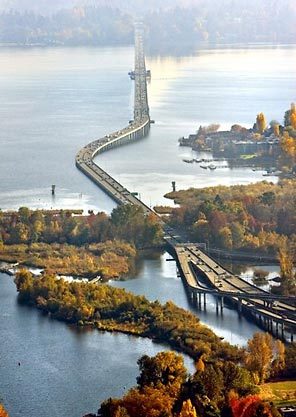
ESHB 3096 (bill as passed - bill report - legislative history) has to do with the State Route 520 floating bridge connecting Seattle across Lake Washington to fast-growing Eastside business and residential centers such as Bellevue, Kirkland and Redmond. As the bill reports reminds us, the bridge carries 115,000 vehicles and about 150,000 people per day; it is 1.5 miles long and 44 years old. As has been widely noted, the rickety span could suffer a catastrophic failure in a severe windstorm or earthquake. So 3096 codifies the intent of lawmakers to toll State Route 520 to help pay for replacement of the current bridge. It creates an SR 520 bridge tolling implementation committee to guide coming decisions by the state transportation department and state legislature.
The committee's charge includes making recommendations to avoid traffic diversion to other state and regional roads such as the parallel I-90. Effectively, this will mean tolling on I-90 as well as 520. This will be a crucial second step toward regional tolling for Puget Sound - following on tolling which began last year on the new Tacoma Narrows Bridge, and the four-year SR 167 congestion pricing pilot project starting next month. While politically sensitive, regional highway tolling, and in particular congestion pricing to control peak hour flows, are crucial if we are to handle a projected 52 percent increase in population by 2040.
The committee must also consider technology. That means, in accordance with the current industry standard and tolling on SR 167 and the Tacoma Narrows Bridge, that electronic transponders and overhead gantries will be prioritized over tollbooths. Additionally, the bill requires that the SR 520 tolling committee consider "partnership opportunities." This is a clear reference to possible alliances limiting taxpayer exposure if costs will ultimately exceed available public monies. Partners would be non-government entities, perhaps labor or public employee union pension funds. Private transportation investment funds also enter into a variety of partnership agreements with willing government sponsors, but it's best if the public entity retains ownership of the asset and toll rates.
The 520 tolling committee must also consider input from the public and local elected officials, and report back to the governor and legislature by January of 2009. Then, the bill says, the state department of transportation may seek legislative approval for tolling the existing 520 bridge, and work with the feds to get around a generic prohibition of tolling on Interstates, barring a special agreement tailored to a facility. This is considered eminently do-able; and tolling on I-90 to limit traffic diversions is essential if tolling 520 is to work.
As noted in this Washington Post story yesterday, Seattle is one of five regions nationwide to receive a special federal "Urban Partnerships" grant for innovative solutions to road congestion. Here, it is $139 million, to help pay for implementation of congestion pricing on the new SR 520 bridge and various transit projects including $3.5 million to help launch a new passenger-only ferry in the metro region's western reaches, between Kingston in Kitsap County, and downtown Seattle. But for Puget Sound to get this federal largesse, there's a hook: the grant requires that "variable" tolling, levied at different rates depending on time of day or road congestion level, be approved by the state by September 30, 2009 for the 520 corridor.
To set the stage for that '09 legislation, state lawmakers in the recent session also approved E2SHB 1773, which sets a broader state policy framework for tolling (bill as passed - final bill report - legislative history). The bill states that the legislature must authorize any specific tolls; that tolls can be applied to bridges, highways, transportation corridors, approaches and bi-state facilities; and that the aims of tolling in Washington state will be to improve transportation system efficiency and provide funding, not only for construction but also for maintenance, operations and management. This last part represents an important acknowledgement that tolling is not just for getting things built; it is also now necessary for a big share of life-cycle costs. That's because federal and state gas tax revenues are in an irreversible decline as sources for construction and maintenance.
Without specificly mentioning the word, the bill leaves open the possibility that with legislative approval some future tolling revenues could be used to help fund transit. This is something Cascadia Center supports, as our director Bruce Agnew tells the Seattle Post-Intelligencer this morning.
HB 2730 (bill as passed - bill report - legislative history) advances regional passenger-only ferries, rescinding a state prohibition against their operations by port districts on Puget Sound. This bill is tailored to the above-noted Kingston-Seattle foot ferry route for which the Port of Kingston has received federal grant funding contingent on tolling of SR 520.
The Eastside commuter rail line which Cascadia Center has championed as part of a rails and trails partnership will get a feasibility analysis, under HB 3324 (bill as approved - bill report - legislative history). It directs Sound Transit and the Puget Sound Regional Council to do a fresh analysis of proposed north-south commuter rail between residence-rich east Snohomish County and the booming Eastside business centers of King County, along the abandoned BNSF freight rail line.
Supplemental transportation appropriations via HB 2878 provide an additional peek into the legislature's thinking on metro-region roads and transit (bill as passed - bill report - legislative history).
Included in the bill are provisions which:
# secure $300,000 for a consultant to devise a plan for co-development and public private partnerships at public ferry terminals (page 22, line 30);
# direct WSDOT to analyze, and if found feasible, seek requests for distribution of alterrnative fuels along WSDOT rights-of-way (page 22, line 34);
# underscore the importance to the $4 billion bi-state I-5 Columbia River Crossing bridge replacement project of fully assessing "opportunities for the joining of state and local government agencies and the private sector in a strong partnership that contributes to the completion of the project" (page 51, between lines 14-23);
# direct that $8.5 million of the state's passenger-only ferries account is provided for "near- and long-term costs of capital improvements in a business plan approved by the governor for passenger-only service."
The state is getting out of operating passenger-only ferries, and local operators including King County, the Port of Kingston, Kitsap Transit and others are filling the void. Cascadia Center continues to advocate a voluntary interlocal agreement between ports, cities, counties, private boat operators, tribes, labor and others - coupled with combined funding for foot ferries and Puget Sound cleanup - to help establish a coordinated regional foot ferry system on Puget Sound.
Thursday, March 13, 2008
More Green Scare Tactics over building the Columbia River Bridge
Bridge to Disaster
A Proposed New 12-Lane Bridge over the Columbia River Will Cost $4.2 Billion, Increase Traffic, and Do Little to Alleviate Climate Change. What the Hell Are We Thinking?
BY AMY J. RUIZ
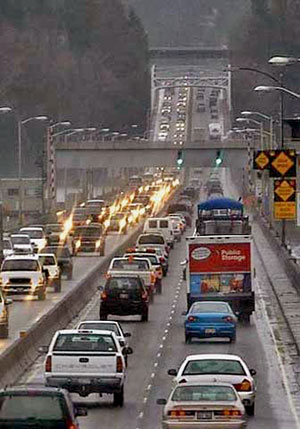
A man driving a gray Toyota pickup truck seems frantic; veering in and out of lanes trying to pass other traffic on the Interstate Bridge. His furtive moves don't do him much good—moments later, as we crest the green steel bridge headed south into Portland, we're greeted with flickering brake lights. Traffic slows to a plodding 20 miles an hour. We've stumbled into the morning congestion, a daily feature of the Vancouver-to-Portland commute.
Fortunately, it's a commute I never have to make. I drove to Vancouver on a recent morning to guide my Oregon-plated car into the current of vehicles bearing Washington plates purely as an experiment. I spent twice as much time in the southbound lanes trying to return to Portland as I had in the northbound lanes venturing into Vancouver. My blood pressure rose. I cursed OPB's April Baer for reminding me about the traffic I was clearly stuck in.
Like me that day, the vast majority of people driving across the bridge each morning—and back across each evening—are coming from Vancouver. According to 2005 numbers, 64 percent of people crossing the bridge southbound hopped onto I-5 via one of Vancouver's on ramps. Northbound, 60 percent of vehicles jump off the freeway into Vancouver. Unsurprisingly, Vancouver—with its cheaper real estate—is functioning as a bedroom community to Portland. And unsurprisingly, those commuters would like an easier commute into Portland.
One answer may be on the way, in the form of a $4.2 billion, 12-lane replacement bridge, coupled with light rail or bus rapid transit, and smoother on and off ramps in the five miles surrounding the bridge. Traffic engineers say the new bridge across the Columbia River—AKA the Columbia River Crossing—will make travel between the two states easier, safer, and faster.
It's the biggest public works project in our region's history, it's been years in the making, and local government bodies are poised to make final decisions on the project in the next few months. The problem is, even if we build one of the proposed new bridges, traffic is still going to increase from today's levels. And in an era of climate change—when a state task force has recommended drastically cutting greenhouse gas emissions to 75 percent below 1990 levels—increasing lanes and thereby increasing commuter traffic is simply unacceptable.
A Recipe for Disaster
Nearly everyone agrees that the bridge and the five miles of freeway surrounding it are trouble spots. Columbia River Crossing graphs show that current collision rates are proportional to traffic volumes, but "appear to increase two-fold" during peak congestion. Short entrance and exit lanes give drivers little room to maneuver into a through lane. The bridge lifts about once a day to allow river traffic to pass underneath, and "three to four times more collisions occur" on the bridge during a lift, when traffic is stopped. (The bridge has the only red light on I-5 between Mexico and Canada, too.) Transit options are limited, carrying an average of only 3,475 people across the bridge each day. Clearly, the crossing could be improved.
In 2001, Oregon and Washington agreed. The "Transportation and Trade" partnership recommended coming up with solutions to congestion in three spots, including the bridge over the Columbia.
In 2005, the Columbia River Crossing project was born. By last spring, the 39-member Columbia River Crossing (CRC) task force narrowed down the possible solutions to five that address the area's problems: "congestion, dangerous travel conditions, and travel demand that exceeds capacity," according to a CRC summary. The options include both a 10-to 12-lane replacement bridge and a four-to five-lane supplemental bridge that would augment the existing span, which would be downsized to four lanes. Both of those options are being studied twice: once with light rail, and once with bus rapid transit. The fifth option is a "no build" option that compares the alternatives to doing nothing.
A Draft Environmental Impact Statement (DEIS) analyzing those five options will be released sometime this month. From there, the public can weigh in for 60 days, and the local jurisdictions—including the City of Portland and Metro—will vote on the "locally preferred alternative" chosen by the CRC task force. Once the agencies agree on an alternative, the project will be submitted for federal funding, with the goal of starting construction in 2010.
The DEIS isn't out yet, but there's already data on the five alternatives—and the numbers don't look too good.
Right now, 134,000 vehicles cross the bridge in a given day.
If we do nothing—absolutely nothing—that traffic is going to increase thanks to growth in the region, causing many more hours of congestion. By 2030, CRC staff estimate, 184,000 vehicles will use the I-5 bridges daily, a 34 percent increase from today's levels, and they'll be stuck in eight hours of northbound congestion, and seven hours of southbound congestion. In other words, that section of freeway will be clogged up just about all day.
But if a replacement bridge is built, paired with high-capacity transit like light rail, and tolled, traffic in 2030 will be only 178,000 vehicles a day. That's a decrease, project staffers argue, if you compare it to 2030 traffic without a new bridge, transit, and tolls. Indeed, according to their math, the $4.2 billion project gives us a three percent reduction in traffic—compared with sitting around and doing nothing.
But according to the project staff's own numbers, it's light rail and tolls that has the biggest impact on the traffic in 2030, reducing it by a whopping 20 percent. CRC staff compared a new bridge with transit and tolls to a new bridge without transit and tolls. Without the alternatives and fees, roughly 225,000 vehicles would use the bridges in 2030. With them, 2030 traffic is cut by one-fifth—to the 178,000 figure.
The problem is, no one has bothered to study what happens if we do the things that deter people from crossing the bridge in the first place. Ideas that would give commuters an alternative, but don't make driving an easier choice. In other words, could we reduce traffic by 20 percent today by building light rail to Vancouver, and tolling the bridge now, without spending billions of dollars on a new, bigger bridge? Instead of giving Vancouver drivers a continued excuse to drive their single-occupancy vehicle into Oregon every day, why not give them reasons to leave the car at home?
But that option's not on the table. What the hell are we thinking?
Climate Change Is Coming
According to the final report of Governor Ted Kulongoski's Climate Change Integration Group (CCIG), released in January, Oregon needs to "act now" to address the threat of global warming.
If we don't, the prognosis is grim.
"A broad scientific consensus tells us that climate change is accelerating, and that it is happening at a speed that was unanticipated even recently," the CCIG report says. "It is urgent that we act now, both to reduce the cause of this earth-transforming crisis by rapidly driving toward a low-carbon economy, and to begin to prepare for and adapt to the changes that mitigation cannot prevent."
The CCIG report doesn't mince words in describing Oregon's future, if we don't make drastic changes. "Sea-level rise is likely to erode beaches, flood low-lying areas, and increase the damage during storm surges. Changes in average growing season temperature will change the types of wine varietals that may be grown in Oregon, making some areas suitable for wine growing that presently only support less valuable crops, while making some high value wine grapes such as pinot noir more difficult to grow. Changes in climate will affect public health, as patterns of communicable diseases and disease vectors in Oregon change; chronic disease risk factors like ambient pollen concentrations, the prevalence of smoke from forest fires and physical activity patterns are altered; and economic changes threaten communities and put some Oregonians at risk for family violence and suicide." In other words, we're all going to die (and drink bad wine in the process).
Thankfully, the CCIG came up with a plan. It's not an easy one, however. According to the group's calculations, "we must reduce emissions by 42 percent from forecasted business-as-usual levels."
The "Oregon Strategy"—a 2004 report recommending greenhouse gas reductions, which the state legislature adopted last year—dictated a similarly tough goal: Emissions need to drop significantly, to at least 75 percent below 1990 levels, by 2050. Considering that we're currently pumping out emissions at a level that's 22 percent higher than 1990 levels—and we're expecting considerable population growth in the near future—we've got a lot of work to do.
According to the Oregon Department of Energy, transportation is the single largest source of greenhouse gas emissions in Oregon, accounting for 34 percent of emissions.
Smartly, the CCIG report devotes an entire chapter to transportation and land-use recommendations, urging the state to reduce "vehicle miles traveled." According to the report, "it is the area in which the state can have the most influence." Moreover, "reducing [vehicle miles traveled] is simply the single most effective way to reduce greenhouse gas emissions."
Though the report doesn't specifically address the CRC project, the general recommendations caution against expanding infrastructure—which is exactly what the CRC project, which began before either report was issued, is poised to do.
"Traditionally, improvements in transportation systems have focused on supply, increasing capacity to meet travelers' needs. However, new infrastructure is expensive and may induce demand, locking governments into a spending cycle of adding increasingly more capacity as more drivers take advantage of new facilities."
Opposition Mounts
Last October, Sightline, an environmental think-tank based in Seattle and focused on the Northwest, released a study addressing highway expansions' impact on emissions. Not surprisingly, Sightline found that building more roads increases greenhouse gas emissions, even when improved fuel efficiency of future vehicles is taken into account, and even if the highway expansion project initially relieves congestion (cars that aren't idling in stop-and-go traffic pollute less).
"Sightline assumes that rush-hour traffic will flow more freely after new lanes are opened, and that congestion relief will raise the effective fuel efficiency of vehicles on the roadway," wrote Sightline's Clark Williams-Derry. "However, consistent with academic findings and real-world experience, we also assume that new highway capacity in a metropolitan area will gradually be filled by new trips, and that congestion and stop-and-go driving will gradually increase to approximately the same level experienced prior to the highway expansion."
Applying that logic to the CRC project—which, project staffers say, is bigger than the current bridge thanks to auxiliary lanes that allow for smoother entrances and exits—Williams-Derry points out the potential long-term effects of a bigger bridge. "You're increasing the capacity of the corridor. The end result is that there's going to be more space in the corridor and in that facility for more cars. Over the long haul, any cars that get diverted from the main freeway lanes into the auxiliary lanes, that's going to free up more space for long-distance traffic on the Columbia River Crossing."
And according to Sightline, "Adding one mile of new highway lane will increase CO2 emissions by more than 100,000 tons over 50 years." To put that in context, the average US citizen is currently responsible for 20 tons of CO emissions each year.
Groups like Sightline aren't the only ones raising alarm bells about building more roads. Locally, critics of the big bridge are emerging as the CRC project nears a decision-making point.
Joe Cortright, an economist with Impresa Consulting in Portland, released an economic analysis of the CRC project on February 13. In it, he compared the cost of the bridge project to "80 OHSU aerial trams," which "works out to nearly $2,000 per capita from each of the region's two million residents."
He picks apart the CRC's own numbers, and concludes that the bridge isn't going to solve any traffic problems. Instead, it will exacerbate congestion: "Growth in trips across the Columbia will be 70 percent greater with the bridge than if we don't build the bridge... The presence of larger transportation facilities encourages people to take trips they would otherwise avoid, or re-route."
And that traffic will spill over into the rest of the transportation system, Cortright argues. (Watch out, North and Northeast Portland.) "Presumably, with four or five travel lanes in each direction, there will be no congestion on the bridge. But what about the rest of the traffic system? How do they manage this volume without congestion on the rest of I-5? How do I-5 and North Portland road networks handle the additional 13,900 peak hour trips that will be generated by the new bridge?" Cortright asks.
The CRC's Transportation Planning/Traffic Engineering Team, along with project finance specialists, issued a March 3 memo reviewing Cortright's analysis. The CRC staffers called Cortright's analysis "incorrect," because, for example, he uses numbers from a preliminary 2002 study.
Cortright responds: "I used the newest data I could find on their website when I put it together. They've come up with some other numbers. It doesn't lead me to believe that what I wrote was wrong," he says. "What we know is—and what their data shows—that bridges cause more traffic, and tolls reduce it. It you want to reduce traffic, tolls and transit are the way to do it."
The Coalition for a Livable Future (CLF)—a group of over 90 organizations working for "healthy and sustainable communities" in our region—is pushing for a "climate smart" Columbia River Crossing. The current proposals, according to the CLF, represent an "outdated freeway expansion project that will increase global warming pollution, harm people's health, and undermine our region's vision of a sustainable economy."
Instead, the CLF wants to see a project that "reduces the growth in driving," according to Co-Director Jill Fuglister, who's also a member of the CRC task force. They recently adopted a "Climate Smart" resolution that says "we only support a Columbia River Crossing Project that will reduce the growth of driving in the future."
More Lanes, More Problems
Fortunately, the six local agencies involved in the project on both sides of the river—on this side, that's the City of Portland, Metro, and TriMet—have veto power over the project (Metro votes in April, and Portland's city council votes in May on the preferred alternative). CLF members are hoping to convince one agency to put a stop to the big bridge plan.
As that battle shapes up, local political leaders are gathering information, and beginning to take sides. At the City of Portland, Transportation Commissioner Sam Adams "really wants to hear what the community has to say on it," says his chief of staff. Mayor Tom Potter, according to a spokesperson, "has serious questions about how it's got to this point," but doesn't believe it would be a good idea "to pull back" at this time. Commissioner Dan Saltzman hasn't taken a position yet, and Commissioner Erik Sten will likely have left office by the time the issue hits the city council.
Commissioner Randy Leonard says his position has been consistent: "I would be generally supportive of the project on the condition that it has light rail, pedestrian and bike lanes."
At Metro, Councilor Robert Liberty has "very serious reservations about the project. It shows weaknesses in how we make decisions about transportation. It's a failure in creativity in how to define and address the problem."
He'd prefer to start by tolling, and then build the bike and pedestrian plus transit connection as a second phase.
So far, Liberty is the most outspoken of local leaders, but he says several of his colleagues on the Metro council— which will also consider the project—are "raising concerns."
It's unclear, however, if Liberty's strong views will trickle over to the City of Portland. "There's something basically wrong with the idea that the approach to Portland, which is trying to brand itself as a leader in sustainability, is a 12-lane bridge. How we spend our money says a lot about what kind of place we are, and I think we can do a lot better than this."
Monday, March 10, 2008
Governor Gregoire Hypes Disaster to sell bridges
Is Gregoire hyping disaster to sell bridges?
Gov. Christine Gregoire is eagerly sharing the happy news of her willingness to slap tolls on bridges and highways. She met with Oregon Gov.Ted Kulongoski in Clark County the other day to discuss moving ahead on a $4.2 billion new bridge over the Columbia River on I-5. The feds would pick up most of the tab, but Gregoire is set on imposing tolls. To push her agenda, she's using last summer's Minneapolis bridge collapse to make her case for urgency. Only problem is, it turns out the Minneapolis bridge disaster wasn't a case of aging infrastructure. The National Transportation Safety Board (NTSB) has concluded the problem was a design flaw.Gregoire's statements on tolling the Columbia will ring bells for anyone listening to her rationales for exploring tolls the SR-520 bridge across Lake Washington. According to the Columbian, Gregoire is not only firm about making the new Columbia span--a key north-south link in the greater Vancouver-Portland area--a toll bridge, but she wants to look at imposing more tolls nearby:
Tolls, Gregoire said, will be a part of the finance package...
“The interesting questions there are: Do we start tolling before we even begin construction on the bridge to make sure the tolls can be lower when it’s ultimately opened? Do we do variable tolling to reduce congestion and give more choices to consumers? Do we have to toll someplace else because we’re going to push traffic in a big way” to other bridges? “In my mind, we are going to toll. How do we toll?”
The current Columbia bridge is considered a "bottleneck," but Gregoire is also raising the specter of safety and disaster. According to The Oregonian:
Gregoire said last summer's collapse of an interstate bridge in Minneapolis was "a wake-up call to this nation."
"The interstate bridges that connect Vancouver and Portland are heavily used and aging, and it is time to replace them in the name of safety as well as economic vitality," she said.
The Minneapolis bridge became the poster child for America's aging infrastructure, but Gregoire may have to look for another example. On Jan. 15, the New York Times reported:
Investigators said Monday that the Interstate 35W bridge in Minneapolis, which collapsed into the Mississippi River on Aug. 1, killing 13, came down because of a flaw in its design.
The designers had specified a metal plate that was too thin to serve as a junction of several girders, investigators say....
The I-35W bridge was of a type called “fracture critical,” meaning that the failure of any major member would cause a collapse, because it had no redundancy. The design is lighter and less expensive to build, but has gradually fallen out of favor with highway departments.
This doesn't mean that infrastructure isn't aging and that it doesn't need additional inspection, repair and possible replacement. But the situation in Minnesota isn't a case of neglected maintenance but likely a case of human error or poor judgement.
The case for bridge replacement can be made without hyping the Minnesota tragedy.