Rail transit ballot measures lost in Kansas City and San Jose, but won in Seattle, Sonoma-Marin counties, and Los Angeles. From the point of view of sensible transportation policy, the biggest disaster of the election was passage of the California high-speed rail measure.
Sometimes I think it is wonderful that we can live in a country that is so wealthy that we can afford to build rail lines that cost five times as much per mile as freeway lanes yet carry only one-fifth as many people. But, as it turns out, we really can’t afford to do so.
The bursting of the stockmarket bubble in 2001 would have sent us into a recession but for the increase in consumer spending that resulted from the housing bubble. Now that the housing bubble has burst, our weak economy stands naked and trembling for all to see. Yet this did not much dampen enthusiasm for ridiculous rail projects.
First, the good news. After rejecting light rail seven times, then approving a plan that turned out to be unworkable, Kansas City once again resoundingly defeated a new light-rail plan. It would be nice to think that after 56 percent of voters rejected this plan that it will stay dead and buried, but these things always come back.
As it came back to Santa Clara County, California, which in 2000 approved a sales tax increase for a BART line from Fremont to San Jose. But the line turned out to cost a lot more than expected, so votes were asked for another sales tax increase. The latest count says that 66.27 percent said yes, which means that it failed because California requires a two-thirds majority to pass tax increases. But it was painfully close.
In two other ballot measures, San Jose residents gave up what little oversight they have over the nation’s worst transit agency, the Valley Transportation Authority (VTA). Under VTA’s charter, the agency must submit its transportation plan to the voters every six years. In measure C, VTA asked voters to approve a plan that it had not yet completed. In measure D, VTA asked voters to repeal the requirement that it submit plans to the voters. Both passed by huge margins.
In Los Angeles, the “red” subway line is, by all accounts, a failure, costing 50 percent more to build than the original estimates and carrying less than half as many people as estimated. The Los Angeles County Metropolitan Transit Authority (MTA) was content to focus instead on light rail. But L.A.’s new mayor, Antonio Villaraigosa, wanted to complete the “subway-to-the-sea” line, and he managed to persuade 67.4 percent of voters to raise sales taxes to do so.
The “SMART” train is a proposed commuter-rail line in Sonoma and Marin counties that would end near (but not at) a San Francisco ferry terminal but otherwise not approach any major job centers. Voters twice before failed to muster the two-thirds majority needed to fund it, but in this case, the third time’s the charm.
Finally, California high-speed rail passed with 52.2 percent of the vote. This commits California to spend $9 billion starting construction on what ultimately will be a $50 to $60 or more billion megaproject.
Backers of the plan are counting on getting matching or even more than matching funds from the federal government. They may even get it, but not without starting high-speed rail crazes in other parts of the country.
It is widely agreed that government failure caused the current economic crisis (though not everyone agrees on just what that failure was). Ironically, as NBC anchor Brian Williams noted during Tuesday night’s election coverage, “There is evidence that more people are now viewing government as the solution and not the problem.” It will be sad indeed if we end up suffering from more government failures as a response to government failures of the past.
Transportation
Friday, November 14, 2008
Light Rail wins in Seattle, LA,; loses in Kansas City and San Jose


Saturday, April 26, 2008
Sound transit moving forward towards November ballot.
Sound Transit turns to citizens in push for expansion plans
By Mike Lindblom
Source Seattle Times transportation reporter
Sound Transit is fast-tracking a possible route to the November ballot by showing transportation expansion plans to citizens this spring, even though agency leaders haven't figured out several crucial details.
In about two weeks, a mass mailing will display maps of potential rail, bus, and park-and-ride locations in Snohomish, King and Pierce counties, along with instructions on how to comment.
Transit-board members voted Thursday to seek more feedback before they decide whether to call a public vote.
A 20-year "Roads & Transit" construction plan was defeated last year. One question for board members is whether to field a ballot proposition now or wait until 2010.
Another question is money: whether to boost sales taxes an average of $100 or $125 a year per household, and for how many years.
A downsized 12-year version, nicknamed "ST 2020," is opposed by board members from Snohomish County, because light rail wouldn't cross the county line to Mountlake Terrace.
Snohomish County Executive Aaron Reardon, along with Deanna Dawson, an Edmonds City Council member, argued Thursday that last year's bigger plan to reach Lynnwood should remain in play. Rail would reach Northgate and at least downtown Bellevue but stop short of Federal Way, on a south line under new options.
Everett Councilmember Paul Roberts cast the lone vote against the public outreach, saying there "are too many unanswered questions."
He won't support express buses instead of rail, because the state lacks a plan to reduce clogs in high-occupancy freeway lanes.
"I feel like we're running through the street trying to get dressed," he said.
Board Chairman and Seattle Mayor Greg Nickels, who wants an early vote, called last year's roads-and-transit proposition "a shotgun marriage" and said nobody is asking him for less transit. "We have a public that wants action," he said.
Another problem is the lack of a deal with BNSF Railway on two transit proposals: for additional Sounder commuter rail trips into Pierce County, or to convert a freight line to limited passenger service from Snohomish to north Renton.
advertising
Past BNSF deals took years to negotiate and cost tens of millions of dollars more than Sound Transit first hoped. An independent Expert Review Panel urged Sound Transit to reach a "term sheet" agreement before a transit election, something Chief Executive Joni Earl said she intends to do.
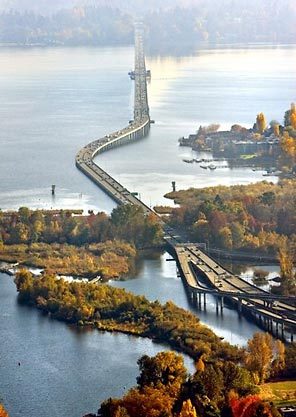
Also at issue is the Interstate 90 floating bridge, where concrete must be removed to add buoyancy if light-rail trains are to run there from Seattle to Bellevue.
State Transportation Secretary Paula Hammond, a board member, said construction and bridge-maintenance costs are unclear, and could increase.
She said studies aren't yet done to predict the effect on traffic, especially freight, from losing two road lanes. "I'm leaning 'no,' " she said of putting the issue before voters this year. "Why would you go back to a vote, when you don't have the answers?"
As gasoline prices approach $4 a gallon, backers such as Redmond Mayor John Marchione and Sumner Mayor Dave Enslow said they should keep trying for a plan this year.
With several highway-tolling proposals being considered around the state, Nickels argued transit lines are urgently needed. "I think it requires that we create an alternative to driving, and paying an $8 toll," he said
Tuesday, June 5, 2001
Please don't let light rail ``go south'', and steer clear of I-5
June 5, 2001
Honorable Paul Schell
Mayor, City of Seattle
Dear Mayor Schell,
My name is Jonathan Dubman. I am an active member of the Montlake Community Club and I have been closely following Sound Transit and other regional transportation issues and engaging many others in discussions on these important topics. I have generally supported your agenda from early on, but I was recently very disappointed to hear of your enthusiasm for "going South" with Link, if we assume the entire system can't be built at once.
Furthermore, I understand you have expressed some degree of support - and please correct me if I'm wrong - for an eventual alignment north of downtown close to I-5.
There are a great many reasons why that is an inadvisable approach.
Simply put, the University Link segment would be an enormous boon to the transportation infrastructure to the region, a belated success. The segments to the south, if built first, would be so ineffective, and manufacture such a coalition of enemies, as to doom future phases of this important system.
Transit must first go where the lion's share of the people and the jobs are: First Hill, Capitol Hill, the University District, Northgate, and of course, downtown. There are the designated urban hubs of the region. These are the areas that have been accepting growth, and all the attendant traffic, with the expectation that light rail was going to come and solve some of our mobility problems. These are the areas with land use that best supports light rail.
Southeast Seattle has a transit-dependent population with high Metro ridership, but let's be frank about it - it's the redevelopment potential that would give that region the density to justify the large expense of constructing light rail. And that could take a long time to develop, at the possible expense of affordable housing there. Why not start light rail where the existing density is, and build a system that will convince the region that even the starter light rail is a big success, and higher density can afford a high quality of life, and we're serious about transportation concurrency?
Many within Rainier Valley have been very vocal against at-grade light rail through their community. I respect both sides of this issue. Whether or not their fears are justified, a lot of people there really don't want it. Tukwila doesn't want it down route 99. The airport won't be ready for light rail for years, and even if we did build light rail to the airport, Metro express route 194 would still be faster from downtown. Sound Transit's own operating plan calls for half the frequency south of downtown than north of downtown, and that is because north is where the ridership is. The Federal Full Funding Grant Agreement was made for the north segment first because that's the segment that's easiest to justify.
Those arguments seem to make a strong case for University Link as the first segment of light rail in the region, if cost weren't an issue. But is University Link the most cost effective segment? The answer is a resounding "yes"!
The Executive Summary of the recently released Central Link Board Workbook bears this out. University Link is by far the most cost effective segment of the Central Link light rail system. While it's admittedly easy to oversimplify here, let's take a quick look at the numbers, straight from this document:
* University Link: Cost of $2,250 million (today's estimate) for ridership of 85,000, or $26,000 per daily rider.
* CPS to Henderson: Cost of $1,580 million (conservatively using the low estimate) for ridership of 27,000, or $58,000 per daily rider.
* CPS to South 200th: Cost of $2,250 million (again, using the low estimate) for ridership of 51,000, or $44,000 per daily rider.
* Capitol Hill to Henderson: $2,150 (again, using the low estimate) for ridership of 60,000, or $35,000 per daily rider.
These are construction costs, not including operating expenses, but operating expenses should not vary that greatly among these various routes.
While the projected revenue service dates vary, they do not vary by much. University Link is projected to open Fall 2009. The earliest projected opening date is mid 2008 for CPS to Henderson, perhaps 15 months earlier, but that system has less than half the cost-effectiveness of University Link by the straightforward calculations above.
In the interim, Southeast Seattle can be served reasonably well with a new in-city express bus route or routes - call them "7X" and "9X" - that run frequently, with few stops, from downtown or Capitol Hill along MLK with traffic signal priority. This could be done in the relatively short term to provide improved service for Southeast Seattle much faster than with Link, and feed into University Link when that is complete. With this plan, Southeast Seattle could see big improvements sooner than anyone else, and there won't be any injury statistics or lawsuits related to at-grade rail down MLK.
There are those who support the "Ride Free Express" or some other solution involving buses. The biggest problem is, in the north direction there is no uncongested right of way for buses to travel on, and I-5 doesn't even have two-way HOV operation. Where would these buses go?. How do we expect to handle transit north of downtown if we don't build Link? If you think another technology could be the answer here, I'm happy to consider that, but it seems clear that buses aren't going to cut it.
There are those who think that Capitol Hill has good bus service now, so why is Link necessary? While Capitol Hill may have excellent bus service to downtown and decent bus service to the University District, try getting from Capitol Hill to downtown Bellevue, or to Northgate. Even to the University District, buses snake through a lot of congestion. Capitol Hill transit service is not as great as it's cracked up to be.
Next to University Link, Capitol Hill to Henderson is the segment under consideration that makes the most sense (except for well-publicized reservations about at-grade operation in the Rainier Valley). But this would make sense only as a very interim solution. It seems like folly to construct a hugely expensive rail system that doesn't cross the biggest bottleneck in the city, the ship canal. We would still need generous bus service from the University to Capitol Hill. Direct service downtown would also be required. Downtown is the place that's already the easiest to get to from Capitol Hill, and route 9 does directly serve First Hill and Rainier Valley from Capitol Hill.
And of course, the place we really want to end up is Northgate, itself an urban hub, but also within shot of rapidly growing south Snohomish County, which generates a lot of the traffic south into Seattle. It is going to be much harder to effectively serve South King County than North King County with light rail any time in the foreseeable future, given that it's 7 miles from Northgate to downtown, with just a handful of stops, and about 15 miles just to get to Sea-Tac, which will still be 40 minutes away from downtown by light rail. We may want to build great infrastructure everywhere, but we have to start where it's going to be most effective.
There are those who support an I-5 alignment for north Seattle. I used to think the same myself, until I realized that between downtown and Northgate, this alignment would service not one major center of activity. How will Eastlake and Portage Bay / Roanoke Park feel about more transportation infrastructure, and another huge bridge, in front of their doors? They strongly oppose the idea. A station stop at Campus Parkway instead of Pacific Street has lower ridership and requires disruptive cut-and-cover construction in the already suffering University District. And a station stop near I-5 makes no sense at all. It would be the death knell for the University District as we know it today. How many transit users want to visit the Blue Moon Tavern on 45th near I-5, versus the University and the Ave? How would we shuttle everyone to where they are going? With more buses that travel down traffic-choked arteries? Are we planning to redevelop the station areas near I-5 with high rises to justify light rail? Imagine the effects on I-5 of all the light-rail related pedestrian and vehicle traffic next to the exits. The topography, the comparatively low density of the built environment, the dominance of low-density zoning (much of it single-family), the high levels of traffic and noise, and the limited pedestrian crossings in the vicinity of I-5, to say nothing of the complexity and costs of constructing a light rail system in this overburdened corridor, all point to the fact that I-5 is not only not the best but perhaps the worst choice for an alignment north of downtown. Can we build adjacent to I-5 while keeping I-5 open the whole time? Can we visualize the effect of closing part of I-5 and the bus tunnel at the same time? That would be a good time to get out of town.
I encourage you to consider very seriously the possibility of routing University Link under the Montlake Cut to save $50 million and raise the level of the stations in the University District. A station could be built near Rainier Vista, the UW Medical Center and Husky Stadium, and would service the University population very well. Moreover, such a station would interface much more readily with transit across SR-520, the forgotten stepchild of Seattle's transportation infrastructure, which is considering a tunnel connecting the Eastside directly with this very spot. If we could intercept buses from the Eastside at a University District station, perhaps we could get them off the downtown streets, off of congestion on I-5, and make up for the fact that they are no longer in the tunnel.
Please forgive me if there's a critical piece I'm missing here, but with all this in favor of University Link, why would you support another segment of this crucial piece of our transportation infrastructure in the region?
The only reason I can see to postpone the segment north of Capitol Hill is to refine the alignment, perform the necessary study for the Montlake Cut alignment, and coordinate with the Trans-Lake Washington Project. If that is your motive, I strongly respect that, and support Capitol Hill to Henderson as the next best way to get started on this important north-south artery. Please let me know your reasons for your current stance, how strongly you take that stance, and if you might be willing to reconsider in light of the arguments above.
Thank you,
Jonathan Dubman
2014 E Calhoun Stre