Eastside sounds off about Sound Transit's new plans
By Lisa Chiu
Seattle Times Eastside Bureau
Just a week before Sound Transit's board of directors meets to determine whether it prefers a Seattle-to-Redmond light-rail line or bus rapid-transit system that can convert to light rail in the future, Eastside residents and community leaders are debating the merits of both.
The city councils of Kirkland and Redmond have endorsed the light-rail option, while Bellevue City Council will consider a recommendation Monday.
By the end of the year, after community input, the Sound Transit board will decide on a more detailed plan and funding package that will go before voters in November 2007.
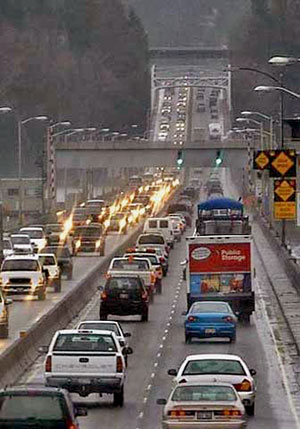
The fast-paced growth of the region has spurred many on the Eastside to consider alternatives to alleviate traffic.
It's estimated that by 2030, the area's biggest job and housing centers will be Bellevue, Redmond and Seattle, according to the Puget Sound Regional Council.
Your voice
For comments or questions, write to:
Sound Transit, 401 S. Jackson St., Seattle, WA 98104.
For more information or to fill out a comment form on the Web: www.soundtransit.org/st2
Also by 2030, the number of vehicles that cross Lake Washington on both bridges will grow from 250,000 a day to 330,000, said Sound Transit CEO Joni Earl.
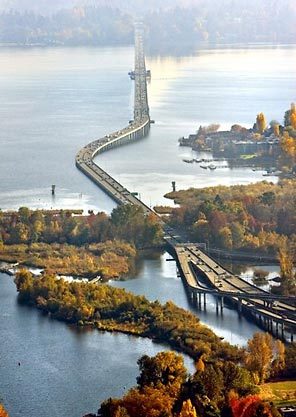
Both a light-rail system and a bus rapid-transit convertible system would take up an exclusive right of way across Interstate 90 from Seattle to Bellevue and then connect to the Highway 520 corridor to Redmond.
Sound Transit's 18-member board — made up of local elected officials and the state secretary of transportation — will decide on its preferred choice next Thursday.
Eastside representatives include Bellevue City Councilwoman Connie Marshall, Kirkland City Councilwoman Mary-Alyce Burleigh and Issaquah Deputy City Council President Fred Butler.
In addition to studying growth patterns, environmental effect and funding options, the Sound Transit board has asked cities for feedback on which option they prefer.
Both proposals would alleviate traffic, increase commuter reliability and provide alternative modes of transportation for special events, Sound Transit officials say.
But the differences between the systems are stark.
Light rail vs. bus rapid transit
Bus rapid transit: The system would have a dedicated lane, would average 24,500 Redmond-to-Seattle riders on a weekday and would cost up to $3.4 billion — but converting to light rail would add up to $960 million.
Light rail: The system would run on tracks, would average 35,000 Redmond-to-Seattle riders on a weekday and would cost up to $3.9 billion.
Source: Sound Transit
• A light-rail system would run on tracks with an overhead electrical-power system, while a convertible BRT system would use custom buses with doors on both sides to provide access to center or side platforms at stations.
The BRT dedicated lane would be built big enough to accommodate light rail in the future.
• The number of estimated riders on a BRT system from Redmond to downtown Seattle would be about 10,000 fewer than those on light rail, according to Sound Transit.
• Travel time from Bellevue to Westlake Center, the University of Washington and Northgate would be 13 minutes faster on light rail than on a BRT system, while travel time from downtown Seattle to Bellevue, Bellevue to Redmond, and Bellevue to Seattle-Tacoma International Airport would be three minutes faster on light rail than on a BRT system.
• A convertible BRT system would likely be cheaper, costing up to $3.4 billion compared with a light-rail system at up to $3.9 billion.
However, the cost to convert the BRT into light rail could be as much as $960 million in 2005 dollars. Converting the BRT would also close the lane for a period of time and significantly affect ridership, Earl said.
Bellevue's perspective
There are supporters and opponents on both sides.
While the Bellevue Chamber of Commerce has not taken a position, its government-affairs director, Shannon Boldizsar, said its members question the use of rail and believe that more focus should be placed on connecting Eastside communities to each other.
"Is rail really worth doing at the sake of being able to do little else on the Eastside?" Boldizsar said at a recent public hearing. "Our members say they are recruiting talent throughout the suburban crescent. That's where their commute is, and it's not necessarily between Bellevue and Seattle."
But Jim Long, a managing director at Equity Office Properties in Bellevue, said light rail would provide greater connections to increase regional business growth.
"More than 15,000 people work in our buildings each day. It's critical that our employees and customers on both sides of Lake Washington are able to commute to work easily and effectively," Long said. "Investing in rail-oriented mass transit is the only way we can continue to evolve as a world-class region."
In addition to high-capacity transit, the Sound Transit board will consider adding more parking at park-and-ride lots along the I-405, Highway 520 and Highway 522 corridors, as well as building transit centers, pedestrian bridges, direct access ramps and transit lanes as part of the transit package that will go to voters next year.
At the same meeting the board also will release for public review up to five possible funding packages for the preferred choice, each with a different tax rate.
The highest rate would mean a sales-tax increase of up to 50 cents per $100 purchase. By the end of the year, the board will pick one package to put on the November 2007 ballot.
Beyond the debate between light rail and BRT on the Eastside, many residents also are concerned about the effects that either alternative would have on their neighborhoods.
Residents of the Surrey Downs neighborhood in Bellevue have spoken out strongly against any option that would run along 112th Avenue Southeast, citing neighborhood and environmental effects. They favor a system that follows I-405 instead.
"The majority of our neighborhood would not be opposed to light rail; many would like to use it," said Joseph Rosmann, president of the Surrey Downs Community Club board of directors, who added that if 112th Avenue is part of the route, he'd oppose the measure.
"We don't want to incur major social and economic costs on our community. [Light rail or BRT] should come to the city on a route with minimal neighborhood impact, noise and unsavory characters coming to the community."
While Sound Transit has studied 112th Avenue Southeast as part of the general corridor for expanded transit, it is a long way from determining the exact route that a light-rail or BRT system would take — nor would a preferred route be determined before the measure goes before voters in 2007, said Don Billen, Sound Transit's east-corridor project manager.
Sound Transit had used a sample alignment to estimate potential costs and ridership that included Bellevue Way, 112th Avenue Southeast, 116th Avenue Northeast and portions of Bellevue-Redmond Road, Billen said. None of those are preferred routes, Billen added.
Public input
Once the board decides on light rail or BRT, Sound Transit will begin to study multiple street options for the project, including I-405.
The public will play an important role by suggesting alternative routes to study during a public-comment period that will begin late this summer and end in the fall, Billen said.
Those suggestions will become part of a draft environmental-impact study that could be published by mid-2008, with a final environmental study published as early as 2009.
However, voters in King, Snohomish and Pierce counties will cast their ballots in November 2007, long before the study is done.
The Sound Transit measure also will be voted on alongside an estimated $7 billion highway package by the Regional Transportation Investment District.
The Legislature requires that the two measures, one for public transit and the other for roads, must both pass in order for either to go forward.
Lisa Chiu: 206-464-3347 or lchiu@seattletimes.com


The Sound Transit Board of Directors has approved the formation of a new task force to comprehensively examine how the agency manages its operations as more services reach maturity and new facilities come on line. The six-member task force, to be led by Sound Transit Board member and King County Council Vice Chair Dow Constantine, will look at current service approaches and search for ways to make the services more efficient and effective.
King County Council Chair Julia Patterson, Sumner Mayor Dave Enslow, Issaquah City Council Deputy President Fred Butler, Edmonds City Council member Deanna Dawson and Redmond Mayor John Marchione will also serve on the task force. All are members of the Sound Transit Board.
The new Operations Task Force will compare Sound Transit's current operational costs with peer agencies and review industry standards for operations and maintenance benchmarks. The group will seek out opportunities for more efficient overall operations costs, including an examination of current agreements with Sound Transit’s partners. The group will also consider policy options to address parking constraints at Sound Transit facilities.
Ridership on Sound Transit's regional system of Sounder commuter rail, ST Express buses and Tacoma Link light rail has steadily risen since the first passengers came aboard in 1999. Last year almost 14 million riders used Sound Transit services, a 12.3 percent increase over 2006. About 50,000 riders a day take Sound Transit services between Everett, Seattle, Bellevue, Tacoma and points in between.