Light Rail in Minneapolis: A Bridge to Nowhere
Presentation by Wendell Cox
to the
Sensible Land Use Coalition Forum
Doubletree Park Place Hotel
St. Louis Park, Minnesota
26 May 1998
Minneapolis-St. Paul Public Transport Information
INTRODUCTION
It is a pleasure to speak to you today. From the questions posed to (previous speaker Hennepin County) Commissioner McLaughlin, it seems a forgone conclusion in the audience that light rail will reduce traffic congestion and air pollution. My job is to give you the other side of the light rail argument. I do not argue from a position of preference or from a position that light rail is inherently inappropriate. My case is simply this. Light rail simply has not and will not reduce traffic congestion and air pollution. Despite the misleading perceptions so often peddled by promoters, there is simply no connection between the problem of traffic congestion and light rail. Moreover, whatever rather modest benefits it may bring to te transit system can be obtained for considerably less through other strategies.
Ronald Reagan said that he went to Washington and found a great number of solutions looking for problems. That is the situation with light rail in the Twin Cities. It is a solution looking for a problem. Arguments are made in the abstract. People are led to believe that it will reduce traffic congestion, that it will provide a speedy alternative to the automobile and that it will transform the areas through which it runs. The reality is quite different, based upon the experience elsewhere.
I will spend a good deal of time talking about the problems with light rail. I will spend less time on better solutions, because the this community has "put the cart before the horse," and selected light rail without an adequate specification of the problem that would be solved by the preferred solution.
Much of what I say will surprise you. I invite you to challenge me on any fact you believe wrong. I can tell you that everything I say I believe to be true, and I will be happy to correct anything that is wrong. Obviously we will disagree on judgements and analysis.
Harry Truman developed a reputation for "giving them Hell." When asked about this, Truman responded that he just told the truth and they though it was Hell. That is what my presentation today is about.
I will start out with a question, then discuss the experience with rail, its application to the Twin Cities and conclude with a brief resume of more effective and efficient solutions.
A QUESTION
I am going to describe conditions in an urban area, and see if anyone in the audience can guess what urban area I am talking about.
* The central city has lost more than one quarter of its population since 1950.
* The population of the suburbs has exploded.
* For some time, virtually all new job growth has been in the suburbs.
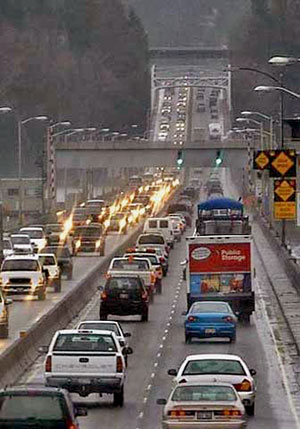
* Traffic conditions are intolerable.
* About the only place you can go on the transit system is the central city. Virtually no effective suburb to suburb service is available.
* Transit trips take a lot of time --- the average transit work trip takes approximately double the time of the average commute by single occupant automobile.
* It has some of the worst air pollution.
* It has the best freeway system of any urban area for a least a 1,000 mile radius.
* Local transportation officials are wrestling with solutions to the problem of growing traffic.
What city am I talking about?
At this point there were a number of answers from the audience --- all US cities --- and the most prominent was Los Angeles.
The answer is not Los Angeles. Indeed the city isn't even in the United States. The city is Paris, a community in which transit is much more significant than in any US city.
A former Paris transit official recently suggested that the only effective way to handle the growing traffic demand in the Paris urban area is more automobile capacity. And, it is to be added. The long term regional plan includes a significant amount of new freeway construction.
Now if Paris, with one of the western world's finest metro and suburban rail systems faces problems, surely there is little hope for US cities or for Minneapolis St. Paul to solve their traffic problems with rail.
The central city of Paris --- smaller than either Minneapolis or St. Paul in area, has a population density of 50,000 per square mile. Minneapolis and St. Paul are in the 5,000 to 7,000 range.
Paris' suburbs have population density of 17,000 per square mile --- that's at least double the most densely populated urbanized area in the United States --- city and suburbs included.
THE EXPERIENCE
Let me offer a few facts pertinent to the discussion of light rail.
* Light rail not more energy efficient than the automobile. US Department of Energy data indicates that light rail, and for that matter heavy rail (subways and elevateds) consumes more energy per passenger mile than the average automobile.
* Light rail is not safer than automobiles. In fact, light rail's fatality rate per 100 million passenger miles is double that of the bus and double that of the automobile in urban applications.
* Light rail is not faster. Light rail operating speeds are barely faster than bus speeds. The average single automobile commute in the United States is twice as fast as the average light rail commute.
* Air pollution is going away. Our progress in reducing air pollution is astounding and will continue. Traffic will continue to grow, but air pollution will continue to diminish.
Light rail has not reduced traffic congestion. During the 1980s, three US cities built light rail. In Buffalo, the work trip market share dropped 29 percent. It dropped the same in Sacramento. And the champion was Portland, where the work trip market share dropped 33 percent. Traffic counts in light rail corridors in St. Louis and Portland show that traffic volumes have continued to grow at historic rates.
This raises an important issue. How shall we judge the success or failure of light rail. I would argue that the test is not the number of people who ride the trains --- most of them are former bus riders, former car pool riders or people who did not previously make the trip. The test is how many automobiles light rail takes off the street. And the answer is "precious few." Think about it. All of the world's major cities have traffic congestion. Indeed traffic congestion tends to be worse in cities like London, Paris and Rome, which are served by comprehensive rail systems.
Each year, the Texas Transportation Institute published congestion indexes for America's major urbanized areas. Among the 12 cities that have built rail, the number of cars removed from the road in 11 of those cities would not change the TTI congestion index. Only in Washington, DC can an impact be discerned --- from 1.44 to 1.43. Put another way, the traffic removed by rail systems in the US is so small that it can be measured in days of traffic growth avoided. The top score is again Washington, DC, where it is estimated that the $12 billion subway system has removed less that three months worth of traffic growth from roadways. In other words, in exchange for $12 billion in tax funding, traffic conditions in May 1998 are what they would have been in February 1998 without rail.
* Washington's $12 billion, 90 mile subway system is, without doubt, the ultimate in modern US urban rail construction. No city is likely to duplicate this system which reaches far into the suburbs on every side of the city. Yet work trip market share is lower today that before the rail system opened. And barely 20 years after the first segment opened, the region faces a significant revitalization bill.
* Los Angeles is a good example of transit policy gone wrong. When I left the Los Angeles County Transportation Commission in 1985, we were carrying nearly 500 million riders per year, all of it on buses. Now --- with two light rail lines, a subway and six commuter rail lines opened, the transit system carries approximately 380 million annually. Transit bureaucrats there appear to be trying to outdo John Lindsay and Abe Beam, who drove New York City to the financial brink in the 1970s. They have mortgaged away the very future of transit in Los Angeles. Debt service will rise to $400 million annually by 2004 --- that's more than Los Angeles can expect to collect in fares --- and double the operating cost of the light rail and subway lines. The situation has become so bad that the Metropolitan Transit Authority has temporarily suspended work on three rail lines --- lines on which it has already spent more than $300 million. And a review of the agency's recovery plan --- required by the US Congress --- indicates that there will be no money to start construction again until at least 2004. I suspect more realistic timing would be late in the next life. Los Angeles' preoccupation with rail has been so great that bus service has suffered --- fares have risen and services have been cut. In response, a bus riders union has formed and been successful in forcing MTA to begin re-emphasizing bus service again. If the measure of success is building rail, then Los Angeles is a success. If, on the other hand, the measure of success is moving people, it is a failure.
* Take Atlanta, whose $3 billion heavy rail system did virtually to prevent a 36 percent work trip market share loss during the 1980s when most of it was opened.
And then there is the matter of projections. You can expect the costs of rail construction to be 50 percent to 100 percent higher than the planners estimates. And the federal government will not pay for this overrun --- you will, in higher taxes. Costs are exorbitant. Virtually all new rail systems have been so costly that it would have been less expensive to less new riders new automobiles every three years. In Milwaukee, the cost per diverted automobile over a 40 year career has been projected to be $7 million.
Any number of claims are made to suggest that light rail will spur development. Studies from Portland and St. Louis are trotted out. But let me ask you this --- if light rail spurs development, why did the Portland city council pass an ordinance to forgive 10 years of property taxes for any new development within one-quarter mile of a light rail station? Why are governments subsidizing development of apartment buildings along the new westside line --- and why are landlords providing all sorts of lucrative incentives to attract renters? In St. Louis, virtually all development along the light rail line has been tax financed. If the TWA Dome and Kiel Center in St. Louis are products of light rail, how does one explain two new sports stadiums in downtown Detroit --- or Erickson Stadium in Charlotte, where there is no light rail?
(Hennepin County) Commissioner Peter McLaughlin referred to himself earlier today as an "infrastructure determinist." That's a defensible position, under the right circumstances. But not all infrastructure projects are successes. Montreal's Mirabel Airport and St. Louis' Mid-America Airport are good examples. Then there is the Detroit People Mover, the Miami Metromover and Jacksonville's Skytrain. You cannot expect development to follow light rail and you cannot expect light rail to reduce traffic congestion. For infrastructure to drive development it has to be productive. A bridge to nowhere will not spur development. And in terms of traffic congestion and air pollution, light rail is a bridge to nowhere.
Why is it that urban rail has so little impact? It has to do with he fact that urban rail is poorly matched to the development and demographic patters of the late 20th century.
*
Modern life styles require door to door transportation. About the only place this can be provided by transit is to downtown.
* Downtown is the only location well served by transit because it is the only place there is a sufficient density of destinations to be served by transit. You in the Twin Cities have the only transit system in the country with two radial systems --- comprehensive service levels are provided both to downtown Minneapolis and downtown St. Paul. To effectively serve the 87 percent of jobs that are not in these areas, you would need to establish radial systems that delivered people within one-quarter mile of the highly dispersed work locations in the rest of the area. Each of these systems would need to be 200 to 400 buses. You simply can't afford that.
* Even if you could provide the radial transit system --- bus, light rail or even heavy rail --- commuting speeds would still not be competitive with the automobile. As a result, few would ride.
A report produced for the Netherlands Ministry of Transport found that public transit was not an alternative for 80 percent of the person trips in this highly urbanized European nation, despite the comparatively high level of service.
And just a note on commuter rail, because it has recently been added to the debate in Minneapolis-St. Paul. It is less costly than light rail and does just that much less. Commuter rail suffers from the same deficiencies as light rail, only worse. It can only serve downtown and it has fewer stations so is less accessible. It leaves commuters further from their downtown destinations, which requires transfers to shuttle buses. One issue upon which transit planners are unanimous is that forcing passenger to transfer increases the likelihood that the passenger will go by car instead.
MINNEAPOLIS-ST. PAUL
This brings us to the Twin Cities --- the second least densely populated urbanized area among those with more than one million population. Consider this..
* Transit provides more than 20 percent of the work trips to the combined downtown areas of Minneapolis and St. Paul. But these central business districts account for less than 13 percent of employment in the area.
* In the cities of Minneapolis and St. Paul themselves, transit provides approximately 10 per cent of work trips outside the central business districts. But this is only 22 percent of metropolitan employment. More people work at home or walk to work than work in the non-CBD portions of Minneapolis and St. Paul.
*
Most of the jobs --- 64 percent in 1990 and probably more now --- are in the suburbs Transit's market share here is infinitesimal --- one percent. In fact, twice as many people walk to jobs in the suburbs as ride transit.
My point is that, except with respect to the central business districts, transit contributes very little to in travel volume in the Twin Cities. Overall, transit provides approximately two percent of trips. If transit were to double or triple in volume, no one would know the difference.
Commissioner McLaughlin noted that there has been considerable concern about a $400 million light rail line, but little concern at all about a $267 million bill to maintain the area's freeways. I don;'t find this surprising at all. The area's roadways carry more than 95 percent of daily trips, while the Hiawatha light rail line would, at most, carry 0.2 percent.
Transit ridership has dropped dramatically in the Twin Cities. In 1979, 105 million rides were carried. This has fallen to the low 60 millions. Minneapolis-St. Paul has lost as much ridership as is carried by all of the buses in St. Louis. And there's good reason. Fares have risen substantially. If you apply the industry standard fare elasticity of -0.35 over the past 20 years, the resulting number fairly accurately reflects the actual reduced ridership.
My point is that there is nothing in Minneapolis-St. Paul that is different enough from other cities in the United States to suggest that rail will have any perceivable impact on traffic and air pollution. Indeed, in Washington and Atlanta, metro systems (subways and elevated) have failed to materially impact traffic. What is proposed in Minneapolis-St. Paul is much more modest --- light rail or surface rail, which will be subjected to cross traffic, rather than being grade separated. It would not be unfair to suggest that light rail, with its speeds barely better than buses represents the form rather than the substance of urban rail. You can expect light rail to have an impact on traffic in Minneapolis-St. Paul after water starts running uphill.
But there is more. You can expect light rail to cost much more than planned. The current number is approximately $400 for the Hiawatha Corridor. You had better plan on at least $500 million and perhaps $800 million based upon experience elsewhere. This will have to come from either the state or local taxpayers.
SOLUTIONS
There are solutions.
With respect to transit, a substantial role can be played with respect to downtown oriented commuting. And more transit riders will be carried if bus service is expanded and fares are lowered. If you are serious about transit, then you will provide it as inexpensively as possible --- through competitive mechanisms, like competitive contracting. Currently the transit systems in London, Copenhagen, Stockholm, Melbourne, Adelaide, Perth, etc., etc. are converting to this cost saving strategy. Some of this has occurred here --- but there is still much in transit service that should be converted to competitive contracting, with the savings applied to new services and lower fares. Then there are busways. Busways can do anything that light rail can do in this country. Curitiba, Brazil's most effective busway carries more riders daily than all the transit services in Minneapolis-St. Paul or even Seattle. According to Harvard's John Kain, busways cost, on average, one-fifth to build and operate per passenger mile as rail systems. And, priority lanes can be established on arterial streets.
But it must be recognized that there is little that can be done with a mode of transport that carries two percent of trips to have much impact. The plain fact of it is that transit improvements have little, if anything to do with relieving traffic congestion. You could, like Washington and Atlanta, build a comprehensive regional rail system --- and you will still have massive traffic congestion. There is simply no necessary connection between urban rail and traffic congestion.
The real answer requires strategies to better handle the automobile traffic which is today and will be in the future the overwhelming mode of transport not only here but also in Europe. And such strategics exist:
* Roadway expansions can be implemented. It is not true that we cannot build our way out of congestion. Phoenix and Houston have greatly improved their traffic flows by expanding freeway networks. It must be recognized that our freeway system was largely designed to handle the traffic loads anticipated by 1975. It is now nearly a quarter of a century later and little is being done to respond to the continually increasing demand.
* Roadway bottlenecks need to be removed and improved on existing roadways.
* Intelligent transportation systems can be used to improve information to drivers and direct flows of traffic around particularly congested segments.
* An expensive but effective means of providing new capacity is the "metroroute" --- automobile only expressway tunnels under cities. The first of these is under construction in Paris. It will provide two decks of freeway --- a total of six lanes --- in a 35 foot in diameter tunnel.
* Finally, it needs to be remembered that people are not sheep. During the 1980s we built little additional capacity in urban freeways around the nation. Yet the average single occupant commuting speed increased, while average travel time to work increased by only 42 seconds. People will find ways to avoid traffic congestion.
CONCLUSION
So what it comes down to is this.... Why build rail?
* Surely not to reduce traffic congestion, because it doesn't do that.
* Not to reduce air pollution, because it cant do that without reducing traffic congestion
* Not to channel development, because it doesn't do that.
There seem to be two possible rationales.
* The first is to provide an incinerator for federal funding that otherwise would be spend in other areas.
* The second is to build rail simply to build rail --- sort of a 20th century bureaucratic idolatry.
At best, there is no justification for the use of tax funding to build light rail. At the worst, the damage should be limited by the minimum legal amount necessary to qualify for the federal funding that has been earmarked. And recognize what you are getting --- not an alternative to the automobile --- not an efficient or effective addition to your transit system --- but federal funding that would otherwise go elsewhere. It is a sad commentary on the state of public policy in the United States.
In the final analysis, you cannot expect the proposed light rail program or any other rail system to reduce traffic congestion in Minneapolis-St. Paul. Vision is not driving the debate, it is rather fantasy, if not hallucination.
Transportation
Wednesday, March 12, 2008
LIght Rail is a bridge to nowhere in Twin-Cities


Tuesday, March 11, 2008
History of Light Rail in North America
History of Streetcar and Light rail
From the mid-19th century onwards, horse-drawn trams (or horsecars) were used in cities around the world. In the late 1880s electrically-powered street railways became technically feasible following the invention of a trolley pole system of collecting current by American inventor Frank J. Sprague who installed the first successful system at Richmond, Virginia. They became popular because roads were then poorly-surfaced, and before the invention of the internal combustion engine and the advent of motor-buses, they were the only practical means of public transport around cities.[2]
The streetcar systems constructed in the 19th and early 20th centuries typically only ran in single-car setups. Some rail lines experimented with multiple unit configurations, where streetcars were joined together to make short trains, but this did not become common until later. When lines were built over longer distances (typically with a single track) before good roads were common, they were generally called interurban streetcars in North America or radial railways in Ontario.
In North America, many of these original Streetcar systems were decommissioned in the 1950s and onward as the popularity of the automobile increased. Britain abandoned its last light rail system except Blackpool by 1962.[3] Although some traditional trolley or tram systems still exist to this day, the term "light rail" has come to mean a different type of rail system. Modern light rail technology has primarily German origins, since an attempt by Boeing Vertol to introduce a new American light rail vehicle was a technical failure. After World War II, the Germans retained their streetcar networks and evolved them into model light rail systems (stadtbahnen). Except for Hamburg, all large and most medium-sized German cities maintain light rail networks.[4]
The renaissance of light rail in North American began in 1978 when the Canadian city of Edmonton, Alberta adopted the German Siemens-Duewag U2 system, followed three years later by Calgary, Alberta and San Diego, California. Britain began replacing its run-down local railways with light rail in the 1980s, starting with Tyneside and followed by the Docklands Light Railway in London. The trend to light rail in the United Kingdom was firmly established with the success of the Manchester Metrolink system in 1992.
Historically, the rail gauge has had considerable variations, with narrow gauge common in many early systems. However, most light rail systems are now standard gauge.[4] An important advantage of standard gauge is that standard railway maintenance equipment can be used on it, rather than custom-built machinery. Using standard gauge also allows light rail vehicles to be delivered and relocated conveniently using freight railways and locomotives. Another factor favoring standard gauge is that low-floor vehicles are becoming popular, and there is generally insufficient space for wheelchairs to move between the wheels in a narrow gauge layout.
Origins of light rail in North America
The renaissance of light rail in North American began in 1978 when Edmonton, Alberta adopted the German Siemens-Duewag U2 system, followed three years later by Calgary, Alberta and San Diego, California. These modern light-rail systems are more like subway or metro systems that operate at street level. They include modern, multi-car trains that can only be accessed at stations that are spaced anywhere from a couple blocks to a mile or more apart. Some of these systems operate within roadways alongside automobile traffic, and others operate on their own separate right-of-way.
[edit] Politics of light rail in North America
Due to lower density of many American cities, LRT speed relative to the automobile, generally lower ridership levels, and questions of cost-effectiveness, the construction of light rail systems has spurred political controversy as a use of public funds. Arguments made against light rail systems often bill it as less practical than equivalent bus systems and less effective than increases in highway capacity. Arguments in favor of light rail point to overall improvements in safety and quality of life in cities supporting rail-based mass transit and long-term sustainability benefits.
[ Usage of light rail in North America
North American Light Rail Ridership City Number of Boardings
Average Weekday (thousands)1 Annual Total (millions)²
Toronto 322.4 88.6
Calgary 220.0 52.6
Boston 200.4 70.6
San Francisco 148.2 43.4
Los Angeles 137.7 39.7
Portland 104.3 32.1
San Diego 100.9 28.8
Philadelphia 68.6 18.8
Dallas 62.4 17.6
St. Louis 58.7 16.1
Salt Lake City 58.3
Edmonton 42.7 15.6
Houston 37.8 10.6
Denver 30.8
San Jose 30.5
Minneapolis 28.8 7.9
Pittsburgh 26.0 7.3
Buffalo 18.0 5.4
1Second Quarter 2006
22005
Sources: American Public Transportation Authority,
Diesel light rail
A few recently-opened systems in North America use diesel-powered trains, including the River Line in New Jersey (opened in 2004), the O-Train in Ottawa (opened in 2001), and the upcoming SPRINTER in northern San Diego County, California (projected to be opened by late 2007). Diesel operations are chosen in corridors where lower ridership is expected (and thus do not justify the expense of the electric power infrastructure) or which have an "interurban" nature with stations spaced relatively far apart (electric power provides greater acceleration, making it essential for operations with closely-spaced stations). Operations with diesel-powered trains can be an interim measure until ridership growth and the availability of funding allow the system to be upgraded to electric power operations.
Light rail in the United States
United States use of light rail is low by European standards. According to the American Public Transportation Authority, of the 20-odd light rail systems in the United States only five (Boston, San Francisco, Los Angeles, San Diego and Portland, OR), achieve more than 25 million passenger boardings per year, and only Boston exceeds the 50+ million boardings per year of the London Docklands Light Rail system.
Compared with that of Canada, the United States federal government offers considerably more funding for transportation projects of all types, resulting in smaller portions of light rail construction cost to be borne at the local and state levels.[citation needed] This funding is provided by the Federal Transit Administration though as of 2004 the rules to determine which projects will be funded are biased against the simpler streetcar systems (partly because the vehicles tend to be somewhat slower). Some cities in the U.S. (e.g. San Pedro, California) have set about building the less expensive streetcar lines themselves or with only minimal federal support.
Boston
The oldest and busiest light rail in the United States is the MBTA Green Line in Boston. With 235,300 daily ridership on its 25.4 miles (40.9 km) of track, the Green Line is a primary transportation route in Brighton and Allston for students and for the work force where the line runs further downtown.
The subsurface portion of the line had originally built to alleviate congestion for street level trolley cars. In 1932, the expansion of the Boston subway resulted in the creation of four westbound surface portals as the line split off four ways above ground to what would later be called the B, C, D, and E lines. Though, unlike most trolleys, the lines have their own separate path in the medians of their respective roads, still three of the four lines do not have grade-separated right-of-ways and consequently are forced to wait in traffic lights. The D line is an exception to this because it runs on a disused grade-separated railroad right-of-way.
A recent project by the MBTA was the 2004 removal of the Causeway Street Elevated portion of the line, which was replaced with underground tunnel, as a part of Big Dig environmental remediation, leaving the Lechmere Viaduct as the only remaining elevated part of the line. Other work includes many station overhauls that will improve handicapped accessibility.
Los Angeles
The Los Angeles County Metro Rail light rail system comprises three lines: the Green, Gold, and Blue lines. Collectively they have 134,300 daily weekday boardings. The Blue line, in particular is the second-busiest line in the United States with 72,295 boardings. The Blue and Gold Lines run mostly at grade, with some street-running, elevated, and underground stretches in more densely populated areas. The Green Line is entirely grade separated, running in the median of the I-105 Freeway and then turning southward along an elevated route. The Blue Line opened first, in 1990. The Green Line began service in 1995, and the Gold Line entered service in 2003.
This short section requires expansion.
San Francisco
The San Francisco Municipal Railway (MUNI) light rail lines are vestigial from its streetcar days, and it is one of few American cities to continuously operate light rail from the streetcar era. As a result, the present-day system has above ground portions running in mixed traffic, stopping at traffic lights as streetcars, while buried sections have their own right-of-way like a subway. Though in other United States cities in 1950s, the trend was to replace streetcars with bus service, five heavily used lines traveled through tunnels or otherwise had private right-of-ways, making bus replacement not viable. About this time, plans for a subway, the Muni Metro, were drawn up, opening in 1980. Similar to Boston's Green Line, five separate lines above ground converge to one subway route, though in the former, the underground line was constructed first and surface routes later.
In response to the dot com boom, the system became strained and Muni ordered newer, larger vehicles, which turned out to have their own noise and braking problems. In 1998, a four station extension of the trunk line was built, and in 2007 light rail service began on a new line going south from downtown, achieving limited success. Plans are underway for a three station underground light rail line, expected to serve 78,000 daily riders by 2030. Due to underground routing, the cost for the 1.7-mile (2.7 km) line is estimated at $1.5 billion.
Portland, Oregon
The Metropolitan Area Express (MAX) system serves the Portland metropolitan area. It has 44.3 miles (71.3 km) between three lines: the Blue, Red and Yellow and serves 104,200 daily, counting the free boarding "Fareless Square". Like most modern light rail systems MAX runs in mixed traffic in the city, but has its own right-of-way further out. The 2-car trains are length limited by the relatively small (200 ft) blocks in downtown Portland.
The MAX system was born out of funds left over from the canceled Mount Hood Freeway, with the Blue line opening in 1986, the Red Line connection to Portland International Airport opening in 2001, while the latest line to be opened was the Yellow Line in 2004, which connects downtown to Portland Expo Center via Interstate Avenue. The Green Line is a 6.5-mile (10.5 km) track under construction intended to connect Gateway Transit Center and a new Clackamas Town Center Transit Center, while a planned Orange Line would be built from the Green Line's southern terminus at Portland State University.
San Diego
San Diego Trolley currently comprises three lines, the Blue, Orange and Green, collectively running on 51.1 miles (82.2 km) of track and achieving a ridership of 107,000. During the time that the Metropolitan Transit Development Board (MTDB) was drawing up options for a transit system, Hurricane Kathleen made landfall, damaging many of the tracks operated by the freight carrier, San Diego and Arizona Eastern Railway, and cutting them off from the greater Southern Pacific Railroad, and South Pacific petitioned for abandonment. The auspicious timing of the incident led the MTDB to buy and repair the tracks, opening a 13.5-mile (21.7 km) light rail segment on 1981, while also reestablishing freight service on the same line (the Blue Line runs on shared-use track). The system has been expanded incrementally ever since. There are currently plans for an 11-mile (18 km) extension to the University City community, connecting the University of California, San Diego (UCSD) campus and University Towne Centre shopping center to the rest of the system.
St. Louis
St. Louis light rail consists of two lines, both running through the city center with 73.3 kilometers (46 miles) of track. There are terminals across the Mississippi River in western Illinois, at Lambert Field Airport, and in the southwestern part of the county. The first part of the system opened in 1993. The second line of the system, the "Cross County Extension," entered service in 2005. All track is in independent right of way, mostly at surface level. In the downtown area, the system uses abandoned railway tunnels built in the 19th century. There are three underground stations, which have an ancient appearance with rough-hewn rock walls. The "Cross County Extension" also has a few portions in tunnels, which are large and of modern concrete construction. Since it opened expansion has continued, if slowly. Ridership, at more than 16 million yearly, has always exceeded expectations.
Dallas
Dallas Area Rapid Transit (DART) is the operator of the 45-mile (72 km) light rail system that runs in Dallas and three of its suburbs, along with a 34-mile (55 km) commuter rail line that connects to Fort Worth and runs through Irving, a DART member city. The LRT lines began with the opening of the 20-mile (32 km) starter system in 1996. In the first few years after the turn of the century, DART opened several small expansions, culminating in the opening of Victory Station, serving the American Airlines Center in 2004.
DART currently runs two LRT lines. The Red Line begins in southwest Dallas at Westmoreland Station and runs northeast to downtown, then runs north through the suburbs of Richardson and Plano to its terminus at Parker Road Station. The Blue line begins in South Dallas at Ledbetter Station and runs north, joining the Red Line at 8th and Corinth Station on its trek to downtown. It continues north to Mockingbird Station before it breaks away from the Red Line and turns northeast toward Garland, ending its run at Downtown Garland Station.
The system is currently under expansion as the Green Line is under construction and will run from Pleasant Grove in southeast Dallas to the suburbs Farmers Branch and Carrollton. It is set to open in two phases, first in September 2009, then in December of 2010. Other expansions include the Orange Line, to run from downtown, the Las Colinas in Irving and on to DFW Airport. Also, the Blue Line is set to expand east to Rowlett and south to Interstate 20. When the latest expansion round is completed, DART's system will have 93 miles (150 km) of LRT.
Salt Lake City
The Utah Transit Authority (UTA) runs the 19 mile (31km) light rail system known as TRAX in the Salt Lake Valley. The system, which opened in 1999, serves approximately 58,300 people every day and contains 69 vehicles.[5] The system has 2 lines, both of which end Downtown at EnergySolutions Arena. One line ends at the University of Utah, while the other ends in the suburb of Sandy. Four extensions have recently been approved and funded, with completion expected by 2014.
Houston
The Metropolitan Transit Authority of Harris County, Texas (METRO), started its opened its METRORail service on January 1, 2004 to very large crowds. The system currently consists of a single track of 7.5 miles (12.1 km). The system serves 45,000 passengers daily. Like many other light rail systems in America, METRORail runs in city streets and does not have its own right of way. Two-car trains are the maximum on the line due to Downtown Houston's city block size.
San Jose
San Jose's light rail network, owned and maintained by the Santa Clara Valley Transportation Authority, consists of 42.2 miles (67.9 km) of track across three different lines.
The Alum Rock - Santa Teresa line serves the eastern, northern, downtown, and southern areas of San Jose. The Mountain View - Winchester line operates between Mountain View and the Winchester neighborhood of San Jose. Both of these lines share the same tracks and stations on First Street between Tasman Drive in northern San Jose and the San Jose Convention Center in downtown. A third line, the Ohlone-Chynoweth - Almaden line, is a three-stop spur that connects the Almaden Valley area to the Alum Rock - Santa Teresa Line.
Minneapolis
The Twin Cities have one LRT Line, the Hiawatha Line. This line runs from downtown Minneapolis, next to the Metrodome, near the University of Minnesota campus, to the Minneapolis-St. Paul International Airport, then to the Mall of America. This line opened in 2004. Two other lines are in planning: the Central Corridor, which runs from downtown Minneapolis to downtown St. Paul; and the Southwest Corridor, which runs from Eden Prairie to downtown Minneapolis.
[edit] New Jersey
In New Jersey, New Jersey Transit provides light rail service along three lines in different parts of the state.
Jersey City
In Jersey City, New Jersey, the Hudson-Bergen Light Rail (HBLR) services the eastern and southern parts of the city and other areas of the Gold Coast to North Bergen, New Jersey, extending south to Bayonne on one branch.
Newark
The Newark Light Rail, previously the Newark City Subway, is a grade-separated line running through the center of Newark that now runs northward to Belleville, with a second branch to Newark-Broad St. station. This line originally was the #7 streetcar line before its conversion to light rail in the early 2000s.
Trenton to Camden via Burlington City
The River Line is a diesel light rail line in southern New Jersey, running along, except at its ends, what was previously the Bordentown Secondary, from Trenton to Camden, serving communities along the Delaware River between thee cities. This line is one of only two diesel light rail lines in North America, and the only one in the United States.
Baltimore
The Baltimore Light Rail is a single line reaching from BWI Airport south of Baltimore, through the city and north to a strip mall and office park. With 30 miles (48 km) of track, the line achieves a daily ridership of 24,500.
Major efforts toward the creation of the light rail were championed by then mayor William Donald Schaefer, who wanted a transit link to the new baseball park, Camden Yards, about to be built downtown. In order to have the line completed the month that the Baltimore Orioles started playing in Camden Yards, the system was built entirely without federal money, a rarity in late 20th century U.S. transit projects. Federal funds would later be used to double track the whole system, decreasing headways which had been restricted to 17 minutes.
The light rail line was built entirely at grade, even through downtown's narrow streets. Though the majority of the track's length is grade-separated from acquiring disused railroad rights-of-way, trains run in the streets in some portions downtown and must obey traffic lights there as well. The Maryland Transit Administration has drawn up plans for an additional four lines which may be light rail, bus rapid transit, or heavy rail to create a comprehensive city system. As of 2007, only the future of one line is certain. The Red Line, which is in its intermediate planning stages, would be an East-West link via either bus rapid transit or light rail. Whichever mode is selected, officials have insisted that the line be underground through the city center because of Baltimore's narrow streets and dense traffic.
Charlotte
Charlotte's LYNX system consists of a single 9.6-mile (15.4 km) line called the Blue Line. After receiving a positive Record of Decision from the Federal Transit Administration on May 19, 2003, continued preparation and land acquisition would finally result in its groundbreaking in spring 2005. The line is in full operation, at a projected final cost of $462.7 million. This price tag does not include indirect or ancillary costs such as rerouting water and sewer lines to accommodate the line, estimated at an additional $72 million as of April 2006.
The Blue Line's construction was part of a greater comprehensive transit network for the Charlotte region. 70.6 more miles of track are planned, though many of these may be Bus Rapid Transit or streetcar lin
Pittsburgh
Pittsburgh Light Rail
Pittsburgh's light rail network, commonly known as The T, is a 25-mile (40 km) light rail system in Pittsburgh, Pennsylvania; it functions as a subway in downtown Pittsburgh and largely as an at-grade light rail service in the suburbs. The system is owned and operated by the Port Authority of Allegheny County (PAT). It is the successor system to the far more extensive streetcar network formerly operated by Pittsburgh Railways.
The current lines, which run south from the downtown into the South Hills area, were formerly operated by PCC streetcars. Beginning in the 1980s PAT reconstructed the lines along the existing right-of-way and ordered new trams from Siemens. PCCs continued to operate in tandem with the new light rail vehicles until 1999 when the last five were retired from service. PAT also constructed a new subway line in the downtown, ending decades of street-running in the Golden Triangle. Current expansion plans include an extension from the downtown subway under the Allegheny River to connect with PNC Park and Heinz Field; the North Shore Connector is slated to open by 2011.
Buffalo
Buffalo's light rail line of only 6.6 miles (10.6 km) was to be a starter line in a much larger system. However with the declining population of the area, no expansions were sought. The small line still averages over 20,000 daily riders
[edit] Seattle
Seattle's Sound Transit light rail system consists of a 1.6-mile (2.6 km) line known as Tacoma Link. Extensions to the University of Washington are planned to begin operation in 2009. The initial phase, Link light rail in Tacoma, is already operational. Voters in the Sound Transit service area rejected a controversial plan to extend light rail and roads in a 2007 vote, but may approve a light rail-only extension on the ballot in 2008.
Light rail in Canada
A Calgary Transit Siemens-Duewag U2 LRV #2043, part of Calgary, Alberta's C-Train.
Canadian cities have much higher transit use than comparable U.S. cities. Toronto, Ontario (metropolitan population 5 million) has twice the transit ridership of comparable U.S. cities, while Calgary, Alberta and Edmonton, Alberta (metro population 1 million each) have riderships three times comparable U.S. cities. Most Canadian cities average 100-200 annual boardings per capita, whereas only the largest U.S. cities with subway and rapid transit systems (Chicago, San Francisco, Washington) exceed 100 boardings per capita. However, Canadian cities have significantly lower capital spending (less than US$60 per capita, versus US$50-$100 for American cities).[6] As a result of lower federal government funding, Canadian cities have to recover a much higher share of their costs out of operating revenues. This lack of federal funding may explain why there are only a few light rail systems in Canada, and why there are intense budget fights over building new ones.
Calgary
Despite the fact that Calgary, Alberta has a lower population density than the sprawling Denver, Colorado, the Calgary C-Train system is the most successful and busiest light rail system in North America, averaging about 250,000 riders per workday.[7][8]
The Calgary system was started in 1981 as the result of decisions to avoid building either downtown freeways or a heavy rail system. At that time, Calgary had less than half a million people and was considered too small for rail transit, but when it first opened the C-Train carried about 40,000 passengers per day. By 2007, Calgary was twice as big with 1 million people, but the C-Train system was over three times as long and carried over six times as many passengers.[7]
As of 2007 45% of the people working in downtown Calgary took transit to work, and the city's objective was to increase that to 60%.[9] The reason is that Calgary's downtown core covers only 1.4 square miles (3.6 km²), is isolated from the rest of the city by two rivers and a railway line, and was built with relatively narrow streets by North American standards. In the 1960s planners proposed a comprehensive freeway system to improve access, but this was rejected due to intense public opposition. However, subsequent growth exceeded expectations and by 2006, Calgary had become the second largest head office center in Canada, with 32,000,000 square feet (3,000,000 m²) of office space and 120,000 people working in the downtown core.[8] The downtown street system is at maximum capacity and has no room for traffic growth, but the city is confident it can add another 60,000 downtown workers in the next 20 years without making space for more cars.[9] Peak hour travel by LRT is equivalent to the capacity of about 16 free flow traffic lanes and allows the city to have fewer than 0.4 downtown parking places available per worker. [10]
Despite the downtown rush, 25% of the riders during rush hour are counterflow commuters - going out of downtown during the morning and into it during the afternoon. Many of these are students going to educational institutions, who receive deep discounts because they are filling seats that otherwise would be empty, and workers doing crosstown commutes to avoid the lack of freeways.[10] However, as of 2007, the C-Train is suffering growing pains. Because population growth has exceeded expectations and LRT ridership has outpaced population growth, Calgary has had trouble buying enough new LRT vehicles and hiring enough new drivers to meet the demand. As a result, many passengers experience lengthy train waits due to overcrowding.[7]
Despite funding problems resulting from lack of support from the provincial and federal governments, there are two extensions under construction. In November 2007, Calgary City Council approved another two further extensions on the two lines, to be completed by 2012. [11]
In addition, on November 20, 2007, Council gave final approval for the new West Leg of Calgary's LRT, which would be the system's fourth leg. Construction for the West leg will begin in 2009, with completion expected in 2012. When the new light rail vehicles ordered for the extension are finally delivered, the city will have a total of 223 LRVs.
Besides the ongoing program of extending all station platforms to 100 m to accommodate four-car trains, transportation planners have identified two additional lines to be constructed within the next 25 years. They are to the North-Central and South-East districts of the city. BRT service is in place along the future North-Central route, and is expected to begin on the South-East route within a year. Calgary will also one day have to place a tunnel in their downtown to accommodate one of these new lines, or a combination of lines, much like Edmonton has already done.
[edit] Edmonton
Main article: Edmonton Light Rail Transit
By contrast with Calgary, in Edmonton, Alberta the Edmonton Transit System built much of its light rail system underground, which meant that it could not afford to lay as much track to the suburbs. In addition, Edmonton's central business district has less office space and the single line which was built did not reach areas which housed many commuters to downtown. The system is successful by North American Standards, but not nearly as successful as Calgary's: it has attracted only a sixth of the ridership. Edmonton is building new extensions at grade that will extend to the TOD Century Park.
According to John Bakker, professor emeritus at the University of Alberta and one of the original designers of the system, going underground was a serious mistake. "Going into tunnels is about 10 times as expensive as going on the surface because you have to relocate utilities", said Mr Bakker. "Edmonton went into tunnels first, and it really bogged down everything thereafter, because they didn't have money". Edmonton's system is only 12 km long, while Calgary's light-rail system covered 42.1 km for about the same cost.[12] As a result, by 2006 Edmonton's LRT ridership was relatively static at 42,000 per day, while Calgary's was over 250,000 and growing rapidly. However, a 10 km South LRT expansion was underway, almost all of it at surface, and was expected to be completed by 2009.
[edit] Ottawa
The O-Train, Ottawa's light rail train system
In the 1970s and 1980s Ottawa, Ontario opted for grade-separated busways (the Ottawa Transitway) over light rail on the theory that buses were cheaper. In practice, the capital costs escalated from the original estimate of C$97 million to a final value of C$440 million, a cost overrun of about 450%.[13] This is nearly as high as Calgary's C-Train system, which had a capital cost of C$548 million, is about the same length, and carries more passengers.[14] Unfortunately, the Ottawa Transitway has reached capacity, with over 175 buses per hour on the downtown section, and has no cost-effective way to increase the volume.[15]
In 2001, to supplement its BRT system, Ottawa opened a diesel light rail pilot project, (the O-Train), which was relatively inexpensive to construct (C$21 million), due to its single-track route along a neglected freight-rail right of way and use of diesel multiple units (DMUs) to avoid the cost of building overhead lines along the tracks. O-Train has had some success in attracting new ridership to the system (a few thousand more riders), due to its connection of a south end big box shopping mall (South Keys), through Carleton University to the east-west busway (Ottawa Transitway) near the downtown core of the city.
Ottawa produced plans to expand both the Transitway and to open additional rail routes. The intention of the light rail project was to add to the system, not to replace the existing Transitway. However, in mid-December 2006, the new Ottawa city council voted to cancel the LRT system despite the fact that funding was already in place and contracts were already signed. As of 2008, lawsuits against the city of Ottawa over its canceled light rail system totaled over $280 million.[16] Examinations for discovery are expected to start in the fall, with the trial beginning in 2009. The trial is expected to be lengthy.[17]
Toronto
Main article: Transit City
LRT in Toronto is somewhat difficult to classify, since the city employs several forms of transit that may or may not be considered "light rail". The legacy streetcar system is still largely in place in the downtown area and is extensive in terms of routes and service intervals. Some lines even tie into integrated subway stations without the need for a transfer, and many traffic signals give priority to streetcars. However, the system as a whole is not normally considered true light rail because the mixed running with surface traffic slows travel considerably. Because of the differences in technology and speed, Canadian transportation planners do not usually classify historic streetcar systems as LRT, although they may technically qualify as such.[18] Two streetcar lines (Spadina/Harbourfront and St. Clair) have been recently rebuilt and come closer to meeting light rail standards as they run in dedicated rights-of-way. However, the largest vehicles used are articulated double streetcars which are much smaller than most LRT trains and these use trolley wheels rather than pantographs to collect electricity. Streetcar fares must also be paid upon boarding as with a local bus. Finally, the Scarborough RT was a demonstration project for elevated light rail that served as a prototype for Vancouver's SkyTrain and JFK's AirTrain). However, it does not meet the common definition of light rail either since it supplies electricity to the trains using two extra power rails (one at +300 VDC and the other at -300 VDC), uses linear induction motors acting on a metal plate between the tracks for propulsion, requires a fully grade-separated right-of-way, and has large stations that have much more in common with a heavy-rail metro. In Toronto it is usually mapped as part of the subway system.
All of the above is now under reconsideration as vehicles near the end of their lifespan and the future size and type of vehicle and trackway is contemplated. On March 16 2007, the Toronto Transit Commission announced a 120 Kilometre Light Rapid transit web throughout the city. This will be a 15 year project predicted to have 175 million-users by 2021. Funding has been announced at the municipal and provincial level, though not the federal. The plan has been released and can also be viewed at TransitCity.ca
Vancouver
In 1986, Vancouver, British Columbia built the Expo Line of the SkyTrain. It is the longest automated light rapid transit system in the world.[19] In addition to using driverless trains, it uses two energized power rails (one at +300 VDC and the other at -300 VDC) rather than overhead wires to supply electricity, making it unsafe to operate in the street or use level crossings. Since it is not conventional light rail it is often called an advanced light rapid transit or light metro system. The network, including the newer Millennium Line and extension, carries about 66 million passengers annually. Vancouver's two new lines under construction, the Canada Line and Evergreen Line, are planned to be grade-separated automated light transit and at-grade light rail, respectively. Additional extensions are planned for the Millennium Line mostly underground under Central Broadway to University of British Columbia. There is preliminary talk about extending the Expo Line (although its routing has not yet been determined).
Monday, March 10, 2008
Rash of crime strikes Minneapolis Light Rail
- Oct 25, 2006 2:30 pm US/Central
Rash Of Robberies Strike Hiawatha Light-Rail Line
Minneapolis (WCCO) ― Police want light-rail riders to watch their backs. Investigators say a number of people have been robbed at gunpoint at Light Rail stations in Minneapolis, and police are stepping in to make sure it stops.
Riders have fallen victim at two Minneapolis stations: the VA Medical center station on 54th Street South and Minnehaha Avenue, and the station at 38th Street South and Hiawatha Avenue.
Police said that the light-rail has remained predominately free of crime since its inauguration in June 2004, which is one of the reasons why they are concerned about the reports of robberies, as are local residents who use the trains for their commute.
"My father lived at the VA hospital, so I guess I would rather be safe than sorry," said Delena Walker.
Police say since Oct. 8, there have been at least seven robberies near the two light-rail stations on 38th and 54th Streets. Some of the incidents have happened away from the platforms, however, so police are urging surrounding neighborhoods to stay alert.
"Walking to a car or walking home, once they leave the area of the LRT platform, (they) have been approached by anywhere from one to four African-American males, who approach them, usually at gunpoint, and rob them of their belongings," said Inspector Scott Gerlicher of the Minneapolis Police Department.
According to police, the crimes have typically happened between the hours of 7 p.m. and midnight. Generally, the incidents have not yet developed into extreme violence.
"Anytime you do have guns involved, it's a very dangerous situation," said Gerlicher. "But, in this particular case, the only injuries we have seen have been in a couple of cases, and have been the result of the suspects pushing people to the ground."
Police have increased their patrol of the light-rail line, even sending officers undercover, to ask passengers to take caution. Most passengers don't need to be told twice. Some, like Mishon Pawson, even recruit people to pick them up from their stop.
Police are also requesting that passengers only carry what they need with them while riding the line, and call them should they notice anything suspicious.
(© MMVI, CBS Broadcasting Inc. All Rights Reserved.)
Light Rail Accident at Mall of the Americas
-
 Dec 21, 2007 5:36 pm US/Central 12/21/07
Light Rail Train Accident At Mall Of America
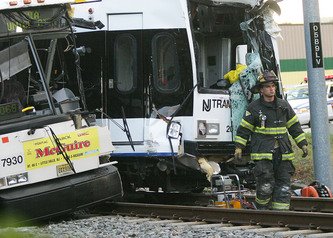
(WCCO)A light rail train was involved in an accident at the Mall of America Friday.
According to Metro Transit representative, Bob Gibbons, the accident happened just before 10 a.m. when the train hit the barrier at the end of the line at the Mall of America Station.
The barrier is known as a buffing post and it is intended to stop a train in case of a malfunction.
Gibbons said the two-car train was going at a low speed when it hit and six people were injured with only bumps and bruises.
Investigators plan to look at the data recorder on the train -- which works like a "black box" on a plane -- to see what happened.
The investigation is expected to take about a week or so.
Service was delayed for about 2 hours after the accident, but service is running smoothly now and both sides of the Mall of America platform are still able to be used.
Saturday, February 16, 2008
Minneapolis Light Rail Does Not Generate Enough Ridership
Minnesota is a state much like Washington. I found opinion among politically active people there to be much the same as here. That is, Democrats are excited by Obama's candidacy. Yet, with less excitement, most would accept Clinton's nomination if it came to that. Both Obama and Clinton must tread carefully until Ohio and Texas — and in the weeks thereafter, if Clinton remains in the race after March 4 — to maintain the sense in their party that either would be an acceptable standard bearer. Toughening rhetoric, charges and counter-charges, and edgy media campaigns now emanating from both camps could polarize opinion among Democrats and make it harder to come out of their Denver convention united.
Infrastructure politics
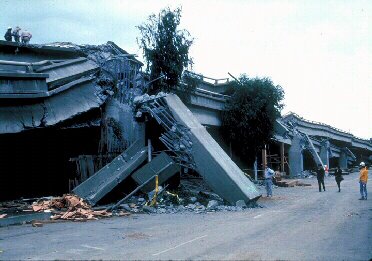
While in Minneapolis, I visited the site of the Interstate 35W bridge across the Mississippi River, which collapsed last summer. Sub-zero temperatures, biting winds, and weeks-old piles of snow on the ground had not deterred construction workers building its replacement. Huge covered, heated tents protected them as they made daily progress.
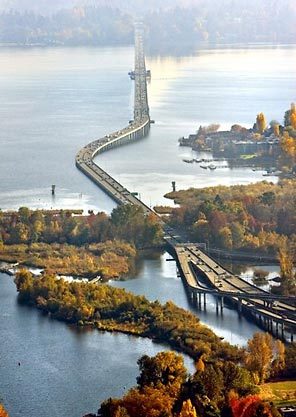
Neither our Alaskan Way Viaduct nor Highway 520 bridge across Lake Washington has collapsed, requiring such immediate replacement. However, I could not help but think, as I watched the construction crews in Minneapolis, that the job was being done start-to-finish there in a few months, whereas more than seven years after the Nisqually Quake called attention to the vulnerability of the aging viaduct and 520 bridge, state and local officials here had not yet arrived at final plans for their replacement or repair. Plans under discussion are provisional and subject to substantial change.
Minnesota is a progressive state which expects high performance by its public officials. Minnesotans would not tolerate for a moment the delay and fumbling existing around our viaduct/520 bridge issues. One particular thought crossed my mind: Does Gov. Chris Gregoire not recognize that she took office pledging fixes in both places and, in 2008, is still light years away from getting it done? Her Republican challenger, presumably Dino Rossi, no doubt will remind voters of that fact on a regular basis in the gubernatorial campaign. Both the viaduct and bridge are state highways. Any governor has it in her/his power to bring fix proposals to the Legislature and to drive them to conclusion, either with or without full support of local officials.
Minneapolis has a light rail system which is a convenient link to the airport but which does not make enough stops in the right places to generate ridership and revenue to sustain itself. A cautionary story for folk here. Federal money appears on the way to extend our Seattle light rail system beneath hills and across water to Husky Stadium, although local money also will be required. The University of Washington regents agreed long ago to cooperate in getting light rail to the University District. However, if you talk with officers of the university, you will find that most believe present bus service to the campus area is excellent and, moreover, that they anticipate the huge hole-in-ground and street disruptions attending light-rail extension to Husky Stadium with fear and loathing. Regents may wish to revisit the light rail station issue as they simultaneously examine how and with what money they propose to renovate Husky Stadium. Light rail also has become wrapped up in the debate about costs and configurations of the Montlake-adjacent 520 redo.
If all these decisions remain in limbo entering the gubernatorial and legislative campaigns, those in charge — and presumed to be not effectively dealing with them — will be on the defensive.
Minneapolis and Seattle are not alone in confronting the need to spend immediate billions on transportation and infrastructure upgrades. The questions here, as everywhere, have to do with priority, practicality, and affordability.