FOR IMMEDIATE RELEASE:
May 30, 2003
Coalition for Effective Transportation
www.EffectiveTransportation.org
P.O. Box 33045
Seattle WA 98133
206 365-CETA (2382)
Contact: Maggi Fimia
_________________________
Sound Transit's "preliminary agreement" with Burlington Northern doesn't live up to promises
The recent announcement by Sound Transit about their "preliminary agreement" with Burlington Northern to run commuter trains from Seattle to Everett sounds like good news. Unfortunately, but true to form, Sound Transit's declaration of victory really is another admission of defeat.
What voters were promised in the 1996 Sound Move Plan:
1) Cost-sharing contracts with BN within two years of vote.
2) Track and facility costs of $107 million (1995 dollars)
3) 4 stations including Bond St., Edmonds, Mukilteo and Everett Multimodal (additional $25 million 1995 dollars)
4) 6 trains each way during commute time between Seattle and Everett
5) Daily boardings of 2400 to 3200 Seattle to Everett and 10,600 to 14,000/day Seattle to Lakewood.
6) Service to start within 5 years at the most.
What Sound Transit is delivering seven years later:
1) A "preliminary agreement" with BN, not unlike the preliminary agreement with the Port of Seattle for where the light rail line would go -- not signed, not decided, not funded.
2) Track and facilities costing $224 million plus interest -- again, not decided.
3) 1 station, Everett multimodal, one temporary platform in Edmonds and an "eventual" stop in Mukilteo.
4) 1 train each peak period- with maybe four, if there is an actual agreement.
5) Daily boardings for the Seattle to Lakewood/Tacoma service are 14,000 per week, not per day.
6) Service will not start for at least 7 years after the vote, more like 9 years for anything more than one train each way per day.
Questions for Sound Transit:
1. Where is this extra money supposed to come from?
2. Why is an actual Agreement taking so long?
3. When will these other stations and services really happen?
4. Has anyone actually seen this Preliminary Agreement?
5. What effect does ST controlling the 21-mile Nisqually/Tacoma track have on the State Inter-City Rail project?
Assessment:
This Agency has no idea how to "run a railroad."
Sources: The Sound Move Ten-Year Regional Transit System Plan pages; 21, A-3, C-19, D-5 and the Sound Transit announcement 5/28/03
Transportation
Wednesday, March 26, 2008
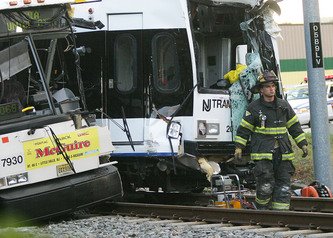
Sound Transit doesn't know how to run a railroad based on Sounder North disaster


Monday, March 10, 2008
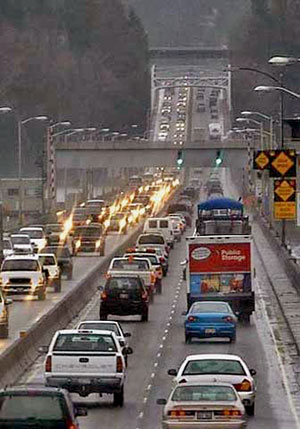
Light Rail in Seattle wont help congestion
9/3/07
Getting Around Our Region is a Problem Now...
Light Rail Won't Make It Better. In Fact It’s Going to Get Worse.
 |
| Light rail in traffic is massive and slow |
LIGHT RAIL WON'T HELP CONGESTION
- Even by 2020, light rail would remove only 400 of the 34,400 autos expected during peak traffic hour through Downtown Seattle. Seven extra tunnel buses would have the same effect!
- Bus tunnel closure for light rail construction will add 140 buses during peak traffic hour back onto downtown streets.
- Delays traffic at intersections along the route.
CURRENT LIGHT RAIL PLAN IS NOT WHAT WE VOTED FOR IN 1996
- Voters approved: 21 miles, 10 years to complete, $1.7 billion, from U-District to the Airport.
- Now: 14 miles, 13 years to complete, $2.9 billion, uses all available funds just to go from Downtown Seattle to two miles short of the Airport. THERE IS NO MONEY FOR EXTENDING THIS "INITIAL SEGMENT."
DOESN'T GIVE US NEW OPTIONS OR NEW CAPACITY
- Replaces buses and flexible routes with expensive, slower, fixed surface rail cars with a fixed route.
- An equal investment in express buses and van pools will carry thousands more people.
NOT REGIONAL
- Only one station outside Seattle; we were promised five.
- 75% of riders now using the downtown bus tunnel are from outside Downtown Seattle. Adding rail replaces many regional buses with local rail.
OVERPRICED
- Currently $200 million per mile, compared with nationwide average of $35 million per mile and this is the easy segment!
- Requires borrowing at least another billion dollars and puts us in debt until 2039.
DISRUPTS NEIGHBORHOODS
- Requires full or partial buying of over 300 homes and businesses.
- Runs massive trains and overhead wires down neighborhood streets in the Rainier Valley.
UNFAIR
- Most Seattle residents and those in Shoreline and Lake Forest Park get nothing for their Sound Transit taxes except slower express bus service and more transfers.
UNSAFE
- Sound Transit estimates rail collisions with 29 cars and three pedestrians a year. That's an accident every 12 days.
- The light rail plan includes 18 at-grade crossings without gates at intersections throughout Rainier Valley neighborhood.
Sound Transit's operating costs six times US Average
Sound Transit's light rail capital costs are six times the national average
12/6/02by Maggi FimiaQuestion: Is it fair and accurate to claim that the Sound Transit Light Rail project is $200 million/ mile, six times higher than the National average?
The following is a breakdown of the cost per mile for LRT in Seattle vs. average cost around the country.
Source for average capital cost in US is from the General Accounting Office-01-984 MASS TRANSIT Bus Rapid Transit Shows Promise pg. 4 Table 1 -
Thirteen LRT facilities were examined, average cost in Yr. 2000 dollars was $34.8 milion/mile with a range of $12.4 million to $118.8 million.
Source for capital cost for Link Light Rail is from an analysis by Emory Bundy using Sound Transit numbers:
The 14-mile portion for which we know the cost, the cheap, easy part, has more than tripled, from $900 million in 1996 to $2.9 billion today. Sound Transit publicly says its current, 14 mile MOS is $2.1 billion, or, in its February update of its 2002 financial plan, $2.2 billion. But that is simply what it calls its development, or capital project. It omits "other capital"--such as costs for acquiring the downtown tunnel, the promised Rainier Valley fund, public art, that sort of thing--which is $253 million. It omits project reserves, $138 million. And it omits debt service during construction, $351 million. That, according to Generally Accepted Accounting Principles, is part of the development cost of the project.
So the cost is not $2.1, or $2.2 billion, but $2.9 billion. You can verify it in appendix B of Sound Transit's New Starts submission to the FTA, October 2001 (where it's $2.84 billion), and in the agency's updated 2002 financial plan ($2.9 billion). Further, if you refer to the Inspector General's April 4, 2001 report, page one, and to the January 2001 report of Diversified Capital, Inc's review of the project., also page one, you will find the total cost at $4.16 billion. Sound Transit liked to say $3.6 billion, the difference being the same aforementioned items, other capital, project reserves, and debt service during construction. In doing so, it failed to include $560 million of the actual cost of the project. Long-term debt service? That's in addition, per GAAP, and begins when the project has been completed, and put into service. (end of Bundy's text)
Calculation
$2.9 billion / 14 miles = $207 million/ mile or almost 6X the National average in Year 2000 dollars.
Members of People for Modern Transit would like to argue that the ST segment would be going through tunnels and be elevated and that it is not fair to compare it with other systems on flat, established ROW. That, however, is our whole point- it has become prohibitively expensive in our region and needs to be re-evaluated.
The light rail proposal - even the 21- mile line - has never been compared to an equal investment in other technologies and solutions. In fact, the original 1993 EIS that looked at options for our region did not even study Surface Light Rail because they concluded that it would not serve our three county Region. The rail option compared to Bus Rapid Transit in 1993 was a totally grade -separated Rapid Rail system like BART or Vancouver, BC. No portion of it ran on the surface- putting any part on the surface affects the whole line for number of cars you can ever have per train, frequency and speed.
The 2001 Joint Operations "Study" done by Metro and ST compared this 14- mile segment with buses for maximum capacity- but assumed a built out light rail system, standing room only, service from the Eastside and much more frequent headways than are actually planned or possible. The bus assumptions used present day operations which are at about 50% of capacity for volume of buses, seated passengers only, and only 85% full. They concluded that trains can carry 3 X the number of people than buses. Nowhere in the "study" do they reveal that the comparison did not assume equal investments. When asked why not, the answer was, "No one told us we had any money to spend on buses."
Thursday, April 27, 2006
Emissions from Light Rail Tunneling will offset benefits
Comments from CETA to Sound Transit Board on the Seattle Light Rail Tunnel and Global Warming
John Niles, April 27, 2006
Emory Bundy summarized the carbon emissions problem with Sound Transit's University Link in a July 2007 essay specially prepared for the online newspaper Crosscut titled "The carbon cost of building and operating light rail.".
Good afternoon and thank you. I'm John Niles, Technical Chair of the pro-transit Coalition for Effective Transportation Alternatives (CETA). We are in favor of mass transit, but we oppose massive transit that costs way too much for what it does.
Case in point is today’s agenda item to authorize University Link light rail, which would include the first three miles of the multi-billion dollar, six-mile train tunnel on the route between Westlake Center and Northgate. These resources would be better spent on improvement and expansion of bus service, ride sharing, and transportation demand management. King County Metro’s new Transit Now initiative for more Rapid Bus service coverage is more to our liking. So too is City of Seattle’s Urban Village Transit Network. Neither of these initiatives is incorporated in the alternatives analysis to date, but should be in the next review cycle for FTA New Starts. That’s for later.
But, today, whether or not the Board decides to take the next step on University Link light rail via Resolution R2006-07, I implore you to deal forthrightly with an important environmental issue implied by the North Link Final SEIS. That issue is the relationship of University Link to greenhouse gas emissions and climate protection. Is building it good or bad for global warming?
On the one hand, people taking trips on electric light rail instead of gasoline-powered cars or trucks yields a reduction in CO2 greenhouse gas emissions on the day of the trips. The Final Supplemental Environmental Impact Statement (SEIS) for North Link provides energy consumption data and conservation data that can be converted to greenhouse gas emissions. North Link Light Rail in operation, were it to be eventually built, would reduce carbon dioxide emissions by about 14 thousand tons annually from operations that save on SOV travel.
To put that in perspective, 14 thousand tons is about two percent of the annual CO2 reduction recommended by the Seattle Mayor’s Green Ribbon Commission on Climate Protection.
But a problem lies in the 640 thousand tons of greenhouse gas generated by the seven year construction of North Link, of which University Link is the next step. The EIS for North Link reports that its construction consumes an amount of energy that CETA figures is equivalent to a line of tanker trucks from Union Station to the Canadian border, each carrying 8000 gallons of diesel. Fortunately, some of that construction energy will come from non-polluting hydropower energy sources. The line of tanker trucks would only reach to the La Connor exit, or to Mt Vernon.
Let’s generously assume that a full 50% of the energy to construct North Link comes from City Light and BPA dams. In this case, the other 50% converted to fuel for construction vehicles like dump trucks hauling tunnel dirt yields a total CO2 emission of 640 thousand metric tons, greenhouse gas poured into the atmosphere during a seven year construction period.
Here’s the rub: 640 thousand metric tons emitted now – against just 14 thousand annual metric tons saved later. This estimate implies about 45 years to get the CO2 in balance. Is putting out a lot of CO2 now to get a net saving that won’t be realized until four decades later a good thing or bad?
Before letting FTA issue a Final Record of Decision on North Link, Sound Transit and City of Seattle should inform the people of the region in plain English what the full life cycle of North Link light rail means for climate change.
Flash: On June 6, 2006 FTA issued a Record of Decision that includes a response to CETA's request to U.S Department of Transportation Secretary Norman Mineta that a full explanation and justification of North Link's CO2 emissions during construction be provided. FTA agrees with CETA's calculations of CO2 emissions, but claims that a 100 year recovery of the CO2 emitted during construction is adequate. The Record of Decision is posted here.