Rossi has plan to fix U.S. 2
Candidate would tap general fund for work
By Jerry Cornfield
Herald Writer
SULTAN -- Republican gubernatorial candidate Dino Rossi drove one of the deadliest stretches of U.S. 2 on Tuesday and then pledged to residents and community leaders to deliver $600 million to make the road safer.
Rain fell and temperatures dropped as Rossi said those dollars could pay for projects such as a bypass around Monroe and wider ramps linking the highway with I-5 or other ones desired by the community, he said.
"Highway 2 has become very dangerous. This has been languishing for too long," Rossi said to about 50 people gathered at the gazebo in River Park.
Rossi discussed U.S. 2 as part of a broader plan for transportation policy he outlined Tuesday in Sultan and Bellevue. Today he continues the roll out in Spokane as it becomes clear the issue of transportation will be a cornerstone of his campaign to unseat incumbent Democratic Gov. Chris Gregoire.
"My opponent has no plan," he told those in Sultan. "There is no plan out there right now, because there is no funding source."
Rossi laid out a list of $15.4 billion in projects that could be finished in 12 years and insisted he can pay for them all -- though not with a means accepted by the Legislature's Democratic majority.
To finance the work, Rossi wants to divert hundreds of millions of dollars from the general fund starting in 2009. The state presently relies on gas taxes for its transportation needs.
He's suggesting using a portion of sales tax paid on new and used cars and on transportation construction projects. If it did, Washington would join 33 other states already tapping their general fund for roads, he said.
"I think his plan is bogus," said Aaron Toso, a Gregoire campaign spokesman. "He's taking $10 billion out of the general fund. He'll either be raising taxes or cutting education and health care."
Rossi anticipated such criticism. He said revenues into the state continue to grow each year.
"Nobody has to lose any funds. There will not be one dime less" for education and health care and other programs, he said.
Much of Rossi's plan is not new.
His call for widening Highway 9 in Snohomish County was in the Proposition 1 ballot measure rejected by voters in November.
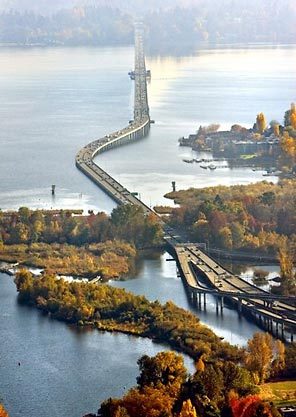
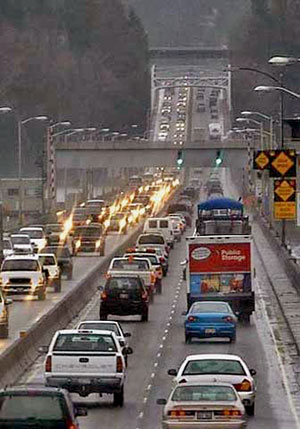
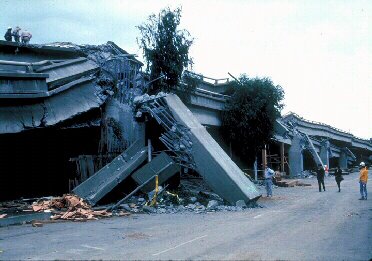
He also backs building a tunnel to replace the Alaskan Way Viaduct and making a new Highway 520 bridge eight lanes wide, two other much-discussed ideas.
On U.S. 2 specifically, one of Rossi's proposals is grinding rumble strips in the center median on a 15-mile stretch between Monroe and Gold Bar. The state is already paying to grind that stretch plus 30 miles more of the highway.
He vows to overhaul the running of the state ferry system. He said new car and passenger ferries slated for construction will be built on time and on budget and the work contracted to non-Washington firms if that's what it requires, he said.
He promises hundreds of culverts blocking the travel of salmon will be opened up and transit and transportation planning in the Puget Sound will be placed under control of one superagency.
Gregoire also supports a single regional transportation agency but the Democratic-controlled Legislature turned it down this year.
Most folks Tuesday wanted to hear Rossi talk about U.S. 2, where 49 people have died in crashes since the late 1990s.
Rossi said despite the deaths, Gregoire came up with only $3.6 million and the Legislature added another $10 million. He said his funding plan is the vehicle for getting to $600 million.
Thomas Cock, whose teenage son died in a crash on U.S. 2 in December, spoke at the event at Rossi's invitation and said the GOP candidate's plan is the type of change for which he's been advocating.
"We should demand safer roads," Cock said.
Fred Walser of Monroe, leader of the U.S. 2 Safety Coalition and a Democratic candidate for state Senate, attended and said Rossi's proposal sounded good. "Whether it's feasible or not, I can't say."
He praised Gregoire for pushing through the money, saying the area's three Republican lawmakers did not secure funding for the highway in 2003 and 2005, when the Legislature committed to billions of dollars of improvements with new gas taxes.
"The governor deserves credit for responding. I don't think there is any quick-and-simple fixes," he said.
His wife, Monroe Mayor Donetta Walser, said beforehand that she's disappointed that the road's safety is becoming a political issue.
"It is about saving lives," she said. "People that die, I don't think of them as Democrat, Republican or independent. They are members of our community."
Rossi also said Tuesday he would fire Secretary of Transportation Paula Hammond because she's not made erasing traffic snarls the department's highest priority.
"We have to have somebody onboard who is interested in congestion relief," he said.
Gregoire appointed Hammond in November and the state Senate confirmed her appointment this session.
In response, Hammond said, "I think it's harsh. But it's his prerogative to hire who he wants for his cabinet."
Reporter Jerry Cornfield: 360-352-8623 or jcornfield@heraldnet.com.
Transportation
Wednesday, April 16, 2008
Everett Herald leads with Rossi's plan to fix I-2 Killer Highway


Wednesday, March 19, 2008
Starting to Improve Safety on Killer Highway 2
$14M a "start in right direction" for Snohomish County roads
By Christina Siderius
KEN LAMBERT / THE SEATTLE TIMES
The Legislature appropriated $14 million for improvements for Highway 2, commonly referred to as the "Highway of Death."
Enlarge this photo
MIKE SIEGEL / THE SEATTLE TIMES
Fred Walser, US 2 Safety Coalition chairman, stands along a section of Highway 2 at Fern Bluff Road where four fatal crashes occurred in a six-month period.
Over the years, white crosses have been planted again and again alongside Highway 2 to mark where loved ones were hit and killed in car crashes on the narrow, winding road.
The stretch of Highway 2 from Interstate 5 in Everett to Stevens Pass — particularly the portion east of Snohomish — was nicknamed the "Highway of Death" due to its high number of fatal collisions. Those deaths have prompted outcries by citizens and lawmakers to make the stretch safer.
The state Legislature this session approved $5 million more than what was initially budgeted to improve the stretch — bringing the total allotted for the highway to $14 million. Lawmakers also agreed to add six more state troopers to patrol the highway.
Fred Walser, chairman of the U.S. 2 Safety Coalition and former Sultan police chief, said trying to get the dangers of the highway addressed has been like banging on a wall.
"We think we finally made a hole in the wall," he said.
The funds budgeted for Highway 2 are only a drop in the bucket compared with the state Department of Transportation (DOT) estimate that the stretch needs nearly $2 billion in improvements.
"Clearly, it's not enough," Walser said. "But it's better than nothing, and it's a great start in the right direction."
Meghan Soptich, a DOT spokeswoman, said $4 million will go toward installing 47 miles' worth of median rumble strips from Monroe to Stevens Pass.
Those rumble strips will be an attempt to address the high number of crossover crashes that occur along this part of the highway, by alerting drivers when they begin to cross the centerline.
This project — funded by state, federal and county money — will begin in the next few months, she said.
The other $10 million will be phased in over the next few years to fund projects as decided by DOT, with input from the community.
Walser said a crucial area to address is near Fern Bluff Road, where four fatal crashes occurred in a six-month period. Other much-needed improvements are installing turn lanes and widening shoulders near a dairy farm west of Monroe, upgrading turn lanes along 17th Street in Gold Bar, and installing a westbound passing lane in Sultan, he said.
"They are short-term fixes but nevertheless, hopefully they will help contribute to saving a life," Walser said.
The coalition will seek public views at an open meeting at 7 p.m. Monday at the Monroe Public Library.
Rep. Liz Loomis, D-Snohomish, said the "most important thing to point out is that the local community will determine which project they want to do."
Ultimately, the highway needs to be widened to four lanes, but that multibillion-dollar fix is "way beyond the scope of the state," she said.
For now, the goal is to make sure fatalities don't occur, she said. In less than a decade, 47 people have been killed in crashes on the highway's dangerous stretch.
Patrol Sgt. Kirk Rudeen said the presence of six more troopers will also have "a huge impact" on the highway.
Currently, there are 16 troopers spread across east Snohomish County who "don't have the luxury of focusing all their attention on Highway 2."
Rudeen said the extra patrols will help reduce speeds and the number of impaired drivers, which will help cut back on collisions.
Also included in the state transportation budget was about $27 million for concrete-median barriers along Interstate 5 from Marysville to Smokey Point, to keep drivers from crossing from one side of the freeway to the other. That stretch of freeway also has seen fatal collisions
Tuesday, March 11, 2008
The need to fix Highway 2
'The Highway of Death' and taxes
U.S. Highway 2 between Everett and Stevens Pass is widely regarded as the most dangerous in the state, and yet getting money appropriated for making it safer seems to be an uphill battle. Could that be because local Republican legislators keep voting against highway taxes?
By Austin Jenkins, Olympia Journal
Posted on March 10, 2008, Printed on March 11, 2008
http://www.crosscut.com/olympia/12453/
Are partisan politics getting in the way of fixing Washington's "Highway of Death"? Comments made by key Democratic lawmakers suggest the answer might be yes. At issue is U.S. 2 between Everett and Stevens Pass. Since 1999, 47 people have died on that 70-mile stretch of mostly two-lane road.
Last November, the Washington State Department of Transportation (WSDOT) released a list of 56 recommended projects to improve safety and reduce congestion on Highway 2. Total estimated cost: $1 billion to $2 billion.
But this year the governor and majority Democrats in the Legislature originally pledged just $9 million to get started. That number has now been increased to $14 million. (By way of comparison, the Aurora Bridge in Seattle is slated to get $7.5 million for a suicide prevention fence.) The money would pay for rumble strips and high-visibility striping on a 40-mile section of the highway. The remaining $10 million would be spent on other priority Highway 2 improvements.
The additional $5 million might appease Republicans whose districts include Highway 2. But earlier in the session they were incensed. State Rep. Dan Kristiansen, R-Snohomish, recently said this about the original budget proposal, which included $5 million for a passing lane near the town of Sultan: "Fifty-six projects and what did we get in the budget? We got $5 million to repair an area where there's never been a fatality. That concerns me."
(The Department of Transportation notes that the passing lane is one of the top items on the Highway 2 project list. A spokesperson says the passing lane would relieve frustration from drivers, and that could reduce crashes further down the road.)
Majority Democrats have offered several responses to GOP complaints. Chief among them: The state doesn't have any money for major new transportation projects. And that's basically true.
However, it seems where there's a will there's a way. Last summer, Gov. Chris Gregoire pledged $26.9 million to replace cable-median barriers with concrete barriers along Interstate 5 in the Marysville area. This was in response to high-profile, deadly cross-over accidents there.
Democrats have also suggested on more than one occasion that Highway 2 is a victim of politics. They point out that Republican lawmakers whose districts include the "Highway of Death" voted against the most recent gas-tax increases – increases that funded hundreds of projects statewide.
Here's what the Senate transportation chair told The Seattle Times last September:
"It's really brutal to say, but the people from those districts didn't support anything as far as funding," said Senate Transportation Committee Chairwoman Mary Margaret Haugen, D-Camano Island. Consequently, less revenue went to districts with legislators who didn't support the tax measure, she explained. "That certainly is a big reason."
More recently, state Sen. Chris Marr, D-Spokane, vice chair of the Senate Transportation Committee, offered this answer when asked why Highway 2 doesn't get more attention:
I would suggest to those who say today that we're not addressing that as a priority, the lesson I've learned is that be part of a solution process, be part of saying here's what would work for me and I think that message has been delivered to quite a few legislators.
If it's true that Highway 2 and its users are being penalized for votes taken by GOP lawmakers, it's a brutal lesson. As Kristiansen puts it: "We know statistically if we do not deal with this issue this year we're going to probably lose anywhere from eight to 10 people on that corridor."
This year Kristiansen and other Highway 2 lawmakers tried to wrangle more money for safety projects. State Senator Val Stevens, R-Arlington, even attempted to take $13 million from a rail project in Transportation Chair Haugen's district and use it for Highway 2. When that amendment failed, Stevens put out a press release that read: "How the majority party can prioritize a railroad pullout over saving lives on what has been called Washington's most dangerous road is beyond me."
The recent addition of $5 million seems to have calmed Stevens. In a news release, she says: "This money is still not enough to buy the land needed to widen Highway 2, but it's a mall start."
Meanwhile, Sen. Haugen, the Senate transportation chair, defends her commitment to Highway 2. In her budget, Haugen orders the Washington State Patrol to redirect six troopers from other areas to patrol the "Highway of Death."
Haugen also points out that there wasn't a comprehensive plan for Highway 2 improvements until last fall, when the WSDOT project report came out. Now she suggests attention is shifting to this long-neglected and deadly road. "We have a plan now, we're beginning to invest in it," says Haugen. But she warns a lot more money will be needed, and where that money comes from is anyone's guess.
Austin Jenkins is the Olympia-based political reporter for Northwest News Network, a consortium of public radio stations in Washington, Oregon, and Idaho. He covers Northwest politics and public policy as well as the Washington Legislature. You can find his work posted at the Web sites of KPLU-FM (88.5) and other network stations. You can e-mail him in care of editor@crosscut.com.
View this story online at: http://www.crosscut.com/olympia/12453/