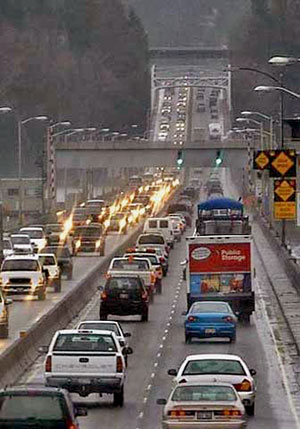
1/8/08 I-394 MnPASS Express Lanes between downtown Minneapolis and the western suburbs. MnPASS is fully electronic - no tollbooths, no slowing down or stopping to drop coins. How to open an account: Highlights: MnPASS is designed for solo drivers to be able to use the HOV lane by paying an electronic toll. Its purpose is to maintain traffic flow and alleviate congestion. If you drive alone and want a more convenient and predictable trip, open a MnPASS account and start using the MnPASS Express Lanes. Carpoolers still ride Free Transit buses, carpools and motorcycles can use the MnPASS Express Lanes for free. MnPASS users can use the lanes during the designated hours. Truckers Small, two-axle trucks weighing less than 26,000 pounds will also be able to use the lanes by opening a MnPASS account. Flexible - just like you are View from the driver's seat. * When traffic or time is against you - choose to use MnPASS * When driving with a friend - use the lanes for free. * Driving another car - take your MnPASS transponder with you. * Solo drivers must have a properly mounted MnPASS transponder and a valid MnPass account. * Drivers may not cross the double white lines and must access the MnPASS lane at the entry/exit points in the corridor. Easy as 1-2-3: 1. Open a MnPASS account * Tolls are pre-paid and deducted from your balance * Funds transfer automatically from your charge account * statements are available on-line 2. Get a Transponder The transponder is a small battery-powered radio toll collection device. * Mounts easily to your windshield * Take it with you when driving another car * Remove it from the clip when riding with a friend and pay no toll 3. Choose how much to spend Fees are based on traffic levels in the express lanes to ensure traffic flows 50-55 miles per hour. Tolls also depend on where you enter and exit and the length of your trip. * Tolls average $1 - $4 during rush hours (maximum of $8) * Fees are posted on overhead signs at entrances * There is a monthly fee of $1.50 for each MnPASS transponder being leased. * Cancel anytime - your account balance will be refunded Since MnPASS opened in 2005, we've been continuously monitoring the project and have conducted several evaluations. Some of the things that stand out include: * Traffic in the MnPASS lane is maintained at the speed limit 95 percent of the time. * We are making better use of the express lanes which has also produced a slight decrease in congestion within the general purpose lanes. * Buses and carpoolers have continued to enjoy the same service levels as those of 2005. * Drivers heading east beyond Minneapolis on I-94 use the MnPASS as a bypass to avoid congestion from I-394 to I-94 in the general lanes. * The lanes have become safer with the controlled access points. * Motorists appreciate the value of MnPASS. There are currently over 11,300 transponders leased out, and more are opening every day. * Electronic enforcement is used. * Violators are subject to a $142 fine. * The Minnesota State Patrol or other law enforcement officers will enforce this law. * Ramp meter bypass lanes are restricted to car pools, transit vehicles, motorcycles and are not part of the MnPASS system.
Transportation
Monday, March 10, 2008
SR 167 HOT Lanes follow this successful Minneapolis Model


Are HOT Lanes Equitable?
Are HOT lanes equitable? 3/8/05
With Minnesota's first high-occupancy toll (HOT) lane—MnPASS—opening May 16, one of the more popular concurrent sessions featured presentations about the new facility and related University research. Megan Mowday, a master's candidate in regional planning at the Humphrey Institute of Public Affairs, presented her research into the equity concerns of HOT lanes.
One of her notable findings involved gender differences. In surveys of users of SR91 in southern California, women expressed the highest level of support for HOT lanes and used them at a higher proportion than men. Why? Women and men have different driving patterns, she explained, and women are responsible for a higher proportion of home-related activities. A Tucson study found women are more likely to drive to work alone, make trips that take longer (for daycare or home maintenance), make more daily trips than men, and work less-traditional hours. "Women earn less on average than men," she warned, "so they could end up spending a substantially higher proportion of their budget on HOT lanes."
The "Lexus lane" image of the facilities has been another area of concern. "If one group pays disproportionately, without benefit," Mowday explained, "then the system must be seen as inequitable." Her study, however, indicates that's not the case. Research on lanes across the nation shows drivers with different levels of income use HOT lanes. Those earning more than $100,000 annually are more than twice as likely to use SR91 at any given time, for example, but the remainder are spread across income levels.
The negative impacts on low-income drivers can be mitigated by investing revenues in transit for the corridor—half of MnPass revenues will be—and by providing credits, she said. Lower-income drivers also may benefit the most from having more choices: for example, they may avoid daycare late fees or docked pay.
What's more, Mowday said, HOT lanes can improve the overall quality of life in a corridor by providing shorter, more reliable commutes; greater access to more housing choices; and decreased road rage. She also noted that commuters' decisions to use express lanes hinge on many factors, not just price.
In addition to her literature search, Mowday used results from local focus groups to discern public perceptions. The majority did not cite concerns with equity, she reported; they also predicted low-income drivers would form carpools or take transit, and that the improved flow on the free lanes would benefit those who didn't pay the fee. "A few individuals were concerned that the rich could escape congestion, but that was a very small portion," she noted. Overall, participants were not opposed to toll lanes.
HOT lanes provide choice, Mowday concluded, and individuals of all income levels have been shown to use them. However, agencies should examine the mix of incomes on the roads and the impact of increasing tolls, she cautioned.
Friday, March 19, 2004
Approach to HOT Lanes around the US
HOT Lane Conundrums
By Robert W. Poole, Jr.
March 2004
Now that HOT lanes are front-burner issues in most of America's most congested metro areas, feasibility studies are proliferating. Unfortunately, the results are all over the map, leading to understandable confusion among policy-makers.
Consider a pair of very dramatic contrasts. At the end of April, the Virginia DOT announced a development agreement with the Fluor/Transurban coalition under which their planned addition of four HOT lanes to the Washington Beltway will go forward, supported 100% by the toll revenues generated by the new lanes. By contrast, the feasibility study of a network of HOT lanes for Atlanta (a metro area whose annual congestion cost, as measured by Texas Transportation Institute, is nearly as great as that of the DC metro area), concluded that, at best, HOT lane revenues can cover operating and maintenance costs but only the incremental capital costs of doing the lanes as HOT rather than HOV (i.e., none of the actual lane construction costs).
The other contrast is between Denver and Minneapolis/St. Paul. The feasibility study of a network of express toll lanes in Denver concluded that toll revenues could cover at least 50-60% of the capital costs of a $4.8 billion system. But the study of a $3.5 billion network of (mostly) express toll lanes in the Twin Cities found that toll revenues could cover an average of 22% of capital costs. And note well that the annual congestion cost, as calculated by TTI, is almost identical for these two metro areas. That should be an indication of the strength of underlying demand for congestion relief. But the study results are surprisingly different.
I've spent some time going through the Atlanta, Denver, and Twin Cities studies, attempting to figure out why the findings are so different. It's not easy going, since they were done by different firms, all highly qualified in transportation modeling, and the studies are quite detailed. Here is what I've learned so far.
My first thought was that the difference might be accounted for by different policies toward free passage by HOVs. If you give away the valuable space in costly-to-build HOT lanes to two-person car-pools (HOV-2), there will be little space left to sell to paying customers. But that hypothesis did not hold up. The Atlanta study results I cited above were based on the HOV-4+ version, under which only HOVs with four or more occupants would get free passage. The Twin Cities study included a couple of converted HOV lanes which would let HOV-2s go free, but all the new construction (the bulk of the network) would be express toll lanes with no HOV freebies. Denver was modeled as all-ETL. And by contrast, the 100% self-supporting Beltway HOT lanes would allow HOV-3s (of which there are many in the area) to go free.
My second hypothesis was that the studies made different assumptions about HOT lane toll rates. This idea did explain some of the differences. The Georgia study used toll rates of between $.02 and $.14 per mile, clearly far below what experience has shown to be the market-clearing price for congestion relief, at least in Southern California (on I-15 and SR 91). The Minnesota study used three rates--$.10, $.30, and $.50—but seemed to use the two higher ones very sparingly. The Denver study used a complete range of $.05 to $.50, and seemed more realistic in applying the higher rates.
And here's another crucial difference. The Atlanta study appears not to have adjusted its toll rates for inflation. This makes no sense, since value pricing depends on keeping the price at a market-clearing level on into the future (which means at least annual CPI increases). Traditional toll roads were often financed based on constant toll rates to cover constant annual debt service, relying on growth in traffic volume to increase the revenue over time. But a HOT lane's revenue profile over time is dramatically different. This can be seen in tables in the Denver study, showing, for each freeway segment with an ETL, the projected annual revenue. For example, I-25 ETLs (Scenario 1) are forecast to generate $15 million in 2010 and $93 million in 2040; that’s a lot more than could be generated simply by growth in traffic volume!
The studies also used somewhat different definitions of financial feasibility. The Atlanta study compared the annualized capital costs with annual toll revenue in 2030. The Twin Cities study compared the present value of the revenue stream (2008 to 2030) with the present value of capital costs. But the Denver study did something similar, but also took into account bond financing costs and a 1.75X coverage ratio on senior debt, making its test of financial feasibility more stringent than those used in the other two studies. Yet it still showed greater ability to finance lane construction costs out of toll revenues.
Yet another difference is in the modeling methodologies. All three studies—Atlanta, the Twin Cities, and Denver--used the existing regional travel demand models, which we all know were not designed to take into account the effect of priced lanes. But each tweaked the models differently, and the Denver study refers to the subsequent use of a micro-model of each corridor, which may account for more of the difference in results.
I draw at least two conclusions from this brief comparative assessment. First, to some extent the transportation planning community has not quite digested the kind of revenue profile which a HOT lane can produce over, say, a 30-year period. So some studies are probably under-estimating the revenue and financing potential. On the other hand, adequately modeling HOT lanes, taking into account their great sensitivity to conditions in the adjacent general purpose lanes, is still at a relatively crude stage. Screening studies of a large number of corridors all at once are probably useful for weeding out corridors with low potential. But their estimates of revenue and extent of construction cost coverage should be taken with large grains of salt. It’s not until we get to "investment-grade" traffic and revenue studies of specific corridors that we're going to have a realistic idea of the extent to which toll revenues can actually pay for such projects.
Robert W. Poole Jr. is director of transportation studies and founder of the Reason Foundation.