Nov 2004
Sounder North Costs Per Ride
Calculations of "cost per ride" for Sounder North, based upon Sound Transit estimates of capital costs, O&M costs and ridership estimates. All cost and ridership estimates are from Sound Transit's 2005 financial plan (as of November 2004), adjusted to 2005$. The cost-per-ride outcomes assume that all riders are new riders to transit, and it also assumes that 100% of the capital investment is of benefit to those riders.
Annualized Capital Cost is calculated per FTA guidelines. That annual cost is constant throughout the life of the project and does not vary with ridership. The primary set of O&M annual costs represent a 22-year average from service inception (2004) thru 2025, as do the ride estimates. The average total cost per ride during that 22-year period would be $70 of which the rider pays about $2.50 leaving $67.50 for public subsidy. Annual public subsidy = $67.50 x 2 rides/day x 250 days per year = $33,700.
But current costs per ride are far greater than the long-term average. The column highlighted in bright yellow shows the calculations for the current 2005 year: Cost per ride - $276; rider fare - $2.46; public subsidy - $273.44 per ride = $136,700 per year.
The cost per ride falls dramatically as more train runs are added and ridership supposedly soars. Just as we are finding for Sounder South, I believe future ridership is significantly overestimated. The rest of the sheets show the supporting calcs converting ST YOE$ estimates to 2005$ estimates. The 2005$ estimates were then summed and averaged.
Transportation
Tuesday, March 25, 2008
Sounder North will be a dismal financial failure


Tuesday, March 11, 2008
Dont Believe The Prop 1 Hype!
Don't believe the hype: Tri-county transit package is flawed
By Jim MacIsaac
DEAN RUTZ / THE SEATTLE TIMES
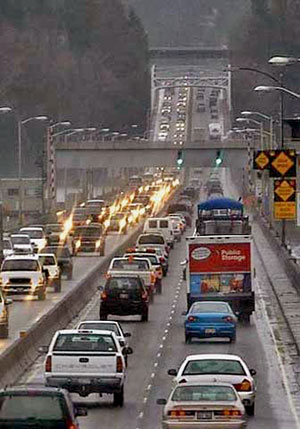
| Special to The Times | Northbound Interstate 5 is congested |
much of the day.
In November, voters in King, Pierce and Snohomish counties will decide on a joint roads-and -transit package that seeks all-ornothing approval of new taxes to support the transportation needs of the three-county region.
What is touted as a "balanced" roads and transit package is anything but. (Never mind that we currently are spending 52 percent of every transportation tax dollar in this region on public
While the RTID program will be completed and its bonds will be paid off by 2037, ST2 will have debt and large ongoing operations and maintenance costs that will likely require that taxpayers keep paying for ST2 through 2057.
If the roads-and -transit package is approved, it means Sound Transit's Sound Move (ST1) sales tax levy will be extended. By 2057, Sound Transit will have collected a whopping $141 billion in extended ST1 plus ST2 local tax revenues. In the combined RTID/ST2 package, only 10 percent of the total revenue is dedicated to roads.
In talking about its light-rail expansion, Sound Transit hasn't been accurate or forthcoming about the true costs and projected effect on congestion. I've spent the past two years closely examining ST2 and cutting through Sound Transit's financial fog and rosy talk. Here is what I've discovered:
• The real cost to households is extremely high. Sound Transit claims that the per-household costs of the roads-and -transit package will be $150 per year plus $80 per vehicle. This is a lowball estimate that claims only 40 percent of sales -tax revenues are paid by household taxpayers and consumers. The combined ST1, ST2 and RTID taxes will actually be $888 per household in 2008 and then inflate at Sound Transit's estimated 5.2 percent annually thereafter.
• ST2 light rail will have minimal impact on our region's traffic congestion. Sound Transit claims that its ST2 light rail will greatly reduce congestion. But the ST2 plan will result in a minuscule 0.5 percent shift of the region's estimated 16.4 million person-trips a day to transit by 2030.
• Sound Transit's claim that ST2 transit will serve 40 percent of all peak -period trips is a huge exaggeration. ST means that, by 2030, transit will serve 40 percent of work trips to downtown Seattle, where only 10 percent of the region's jobs are located. It will serve 9 percent of all other Seattle work trips, but only 2 percent of the work trips for the rest of the region, where 70 percent of the region's jobs are located. It's unconscionable and inexcusable to put forth what is essentially a Seattlecentric light-rail plan that will serve only a small portion of the region's work force.
• The ST2 light-rail program will run where express buses currently operate. That in itself is mindboggling. Why would you remove an effective transit mode and replace it with an expensive mode that will hardly reduce congestion?
• In its exuberance to maximize light rail, the Sound Transit board eliminated 27 of 33 proposed Regional Express Bus (REx) projects and 11 of 18 Sounder commuter-rail projects that were in the January 2005 ST2 project list draft. The shift from the REx projects in effect eliminated the Bus Rapid Transit program for the heavily used Interstate 405/Highway 167 corridor.
If approved, the RTID/ST2 package will hamper the ability of the governor and Legislature to enact any statewide transportation packages for many years.
There is a better solution to our region's transportation problems than what ST2 offers. The combination of a freeway high-occupancy vehicle (HOV) network (which is approaching completion) and well-funded and coordinated local bus systems (including Bus Rapid Transit enhancements) can do far more to alleviate our congestion problems than light rail can, at one -tenth the cost. It makes sense to continue expanding the bus -transit system that has placed our region eighth in the nation in share of work trips served by public transit.
Voters in King, Pierce and Snohomish counties should reject the flawed RTID-ST2 proposal and demand that our region's transportation leaders immediately craft a more-sensible, cost-efficient package that will accomplish our top transportation priority — reducing highway congestion.
Jim MacIsaac is a professional transportation engineer who has spent 45 years in the planning of the Puget Sound region's transportation systems.
Monday, March 10, 2008
Light Rail wont make any difference to congestion
by Jim MacIsaac and John Niles Many hopes and claims have been made as to what the light rail system planned by Sound Transit will do for Seattle. The most significant claim or implication is that it will reduce or at least stem the growth of traffic congestion. But those making this claim are leading with their hearts and hopes, not with the official government forecasts in the November 1999 Environmental Impact Statement (EIS) for the project. After several millions of dollars in studies and travel modeling, the EIS on page 3-5 (Section 3.1.2.2) states: "The Transportation Technical Report provides further information on traffic volumes across screenlines. In most cases, the traffic volumes across screenlines with light rail alternatives are within one percent of the No-build volumes. This small difference is generally within the reliability levels of regional models. Therefore, based upon traffic forecasts, the light rail system will not result in a significant difference in regional traffic volumes, but it will provide needed additional travel capacity. Peak hour volumes for the No-build and light rail alternatives are also expected to be similar across all screenlines." What the EIS is telling us is that there will be little effect on traffic volumes within the rail corridor, whether we implement the rail plan or do nothing (No-build). To illustrate this statement graphically, we have copied Figure 5.2-1 from the referenced Transportation Technical Report (page 96) from Sound Transit and presented it below on this page. The graphic is a simplified map of Seattle showing the major highways and the several Link light rail routes studied from S.200th Street to the Northgate shopping center area. It shows three drawn-in screenlines, each an artificial straight line that crosses several main highways or arterials that parallel the planned tracks of light rail. City of Seattle "concurrency guidelines" require analysis of future traffic volumes crossing these screenlines with and without a planned project. The estimates of total vehicles (cars, trucks and buses) crossing each screenline with "Light Rail" and without the rail project ("No Build") during the PM Peak Hour (late afternoon commuting time) of the day by year 2010 are shown to the right of each screenline location. The range of the estimates shown with "Light Rail" represent the range of difference in findings for the several alternative rail route alignments. All estimates reflect completion of the train line to Northgate. Result: The calculated future traffic volumes across each of the three screenlines with and without Link light rail are practically the same. For example, the top screenline at the Lake Washington Ship Canal shows an estimate of 45,789 vehicles crossing this screenline during the PM peak hour in 2010 under the "No Build" scenario. Full implementation of the Link Light Rail plan from S.200th Street to Northgate would result in a reduction of between 34 and 55 vehicle trips, or a traffic reduction of 0.1% (0.00098). Traffic reductions crossing the screenline South of I-90 are estimated between 0.3% and 0.7%. At the screenline North of I-5/SR518 the estimates show that there could even be a very slight increase in traffic after building light rail. There are a number of other tables in the EIS documents that evaluate vehicle-miles of travel, vehicle-hours of travel, effect on air quality and a number of other global environmental factors. They all result in findings of a fraction of 1% difference between the Build options and the No Build alternative. 3/7/04
Sound Transit EIS Document Predicts
Link Light Rail to Northgate Won't
Change Seattle Rush Hour Traffic in 2010

Where do the editors of the Public Interest Transportation Forum stand on building light rail? The calculations do not surprise us. Not enough people will ride the Seattle light rail train to make any difference in traffic. This has already been shown by light rail in other US western cities. The measured contribution of light rail to the level of traffic is very minor. Nobody can afford to build rail systems with tracks to enough of the places where people need to go.
Most people will need to travel by car or ride the bus to get from their home to a Link light rail station. This requirement limits the appeal of the system.
And what about building it anyway, in the words of the EIS, to "provide needed additional travel capacity"? Simply building more "seats" in a corridor does not mean they will be used. We already have three or more empty seats in most vehicles on our road system. Any program to utilize better those already available empty seats would be a much more cost-effective solution than investing in a rail project that appears headed toward more damage to the neighborhoods through which it passes than it will provide benefit. It is simply wasteful to spend billions of dollars to replace portions of what is considered one of the best bus transit systems in the country. Our answer on expensive "additional travel capacity" is negative. Don't build the Link light rail!
Even before we turn the first spade of dirt it is already looking like "WPPSS on Wheels." Sound Transit and supporters would tell you that in the long-run future, 10, 20, or 30 years beyond the year 2010, the high capacity of the new Link light rail will eventually be used. We would call that judgment a high-stakes gamble with our limited transportation tax dollars. There are less risky, less expensive, more effective ways to build a transportation system for the future, even here in a list of what we have earlier analyzed to be cost-effective elements in the 1996 Sound Transit Plan that could be expanded.
Light rail in Seattle should be killed now, and the money for it should be reprogrammed to solutions that will work
Sound Transit misstates Seattle Transit Tunnel numbers
Emory Bundy Letter Re: "He Said She Said" Reporting:
Seattle Light Rail
By Emory Bundy (2001.08.29)
Erica, as one who long lamented the inattention of the press to one of the largest public works project in our history, Link light rail, putatively addressing our leading urban challenge, I am grateful for the attention you have given the downtown tunnel. It exceeds that of your peers, and, for that, deserves commendation.
I respectfully object, however, to the following sentence and premise: "As usual, it's all in how you massage the numbers." You imply that Sound Transit and its critics each simply have a point of view, and that both sides work to manipulate data to prove their point. How even-handed of you.
As a manager and producer at KING, I formed a negative opinion of "he says/she says" reporting, in which both sides are considered equally reliable, or equally unreliable, get their counterpoint say, and that's the story. The reporter takes no responsibility to actually pursue and report on what the truth is, or at least some serious effort to approximate it. It's a lot easier to do that kind of a superficial job. It serves, not the public interest, but the comfortable interests of established power--particularly power that has immense resources to create, propagate, and spin its own messages, while plain citizens must rely on the diligence of the press.
Those of us who are alarmed about Sound Transit are desperate for journals and individual reporters who are diligent, and willing to pursue and report the facts. We welcome your scrutiny. But don't make facile assumptions that, because we've formed a point of view, it must be self-serving. Or that, because it has immense power and lots of money, Sound Transit is reliable.
Sure, last September 88 of us, from all walks of life and corners of the community, pleaded for an independent audit of Sound Transit, and said we feared the light rail project was at least a half-billion dollars over it's already-admitted quarter-billion dollar cost overrun. (The Sound Transit claim at that time was $1.9 billion [$1995]; the original projection was $1.67 billion.) We had and specified a credible basis for our suspicions, including work recently concluded by the Washington Research Council that seemed, and proved to be, very conservative.
Well, we got the back of the hand, with Ron Sims and Dave Earling leading the assault, which was generously reported by the daily newspapers. Earling pronounced Sound Transit had already been "audited to death," and that there were no cost overruns. He invoked an audit performed by Deloitte Touche to prove his point. (The firm's work is so satisfactory to the preferences of Sound Transit that recently it was awarded another, large contract.) He accused us of twisting the truth.
I supposed you can just take that as Sound Transit's massaging of the data, vs. ours, in the matter of cost overruns--as you have in this instance of the latest Sound Transit tunnel study vs. that of Integrated Transport Research. Everybody's got their own numbers, and some kind of self-interest to pursue, you aver. But I urge you to consider probing your assumptions, and suggest there are underlying facts that merit surfacing, without fear or favor. Reporting with the premise that Roger Pence, and an estimable figure like Jim MacIsaac, of ITR, are equals, in professional experience, expertise, or integrity, and should be considered equally reliable sources, is tragically misguided.
But don't take my word for it. Check it out.
Wednesday, August 8, 2007
Prop 1 Tax Authority amounts to $157 billion
8/8/07
Proposition 1 (Roads & Transit) Taxes
Sound Move Sound Transit RTID Combined Total Total Annual Total Annual
Year Phase 1 Taxes Phase 2 Taxes Road Taxes Tax Collections Tax/Capita Tax/Household
2008 358,052,600 $269,083,900 $76,272,000 $703,408,500 $255 $636
2009 375,377,700 $370,767,900 $242,975,000 $989,120,600 $350 $872
2010 392,257,600 $387,414,000 $254,100,000 $1,033,771,600 $361 $884
2011 410,588,600 $405,544,500 $277,000,000 $1,093,133,100 $377 $920
2012 431,271,900 $426,039,300 $298,000,000 $1,155,311,200 $393 $957
2013 453,586,400 $448,063,300 $324,000,000 $1,225,649,700 $412 $1,000
2014 477,186,800 $471,325,500 $348,000,000 $1,296,512,300 $430 $1,041
2015 502,228,700 $496,044,900 $352,000,000 $1,350,273,600 $443 $1,069
2016 528,465,100 $521,850,000 $385,000,000 $1,435,315,100 $465 $1,119
2017 555,398,700 $548,388,200 $420,000,000 $1,523,786,900 $487 $1,171
2018 582,591,600 $575,147,600 $441,000,000 $1,598,739,200 $505 $1,211
2019 610,869,300 $603,144,800 $456,000,000 $1,670,014,100 $521 $1,248
2020 641,075,900 $633,244,600 $457,000,000 $1,731,320,500 $535 $1,277
2021 674,484,900 $666,481,300 $461,000,000 $1,801,966,200 $552 $1,312
2022 709,650,900 $701,213,200 $481,000,000 $1,891,864,100 $574 $1,361
2023 746,333,100 $737,393,400 $497,000,000 $1,980,726,500 $596 $1,407
2024 784,959,000 $775,405,700 $519,000,000 $2,079,364,700 $620 $1,459
2025 825,708,400 $815,503,800 $556,000,000 $2,197,212,200 $649 $1,522
2026 868,856,900 $857,781,100 $577,000,000 $2,303,638,000 $675 $1,577
2027 914,404,000 $902,163,000 $616,000,000 $2,432,567,000 $706 $1,645
Subtotals 11,843,348,100 11,612,000,000 $8,038,347,000 $31,493,695,100 $9,900 $23,700
% S-Total 38% 37% 26% 100% $495 $1,185
MVET Eliminated ^--Avg Tax per Year--^
2028 962,498,100 $948,803,500 $625,856,000 $2,537,157,600 $730 $1,696
2029 800,657,100 $997,931,500 $660,535,700 $2,459,124,300 $701 $1,623
2030 842,173,300 $1,049,823,900 $697,140,300 $2,589,137,500 $732 $1,689
2031 885,861,400 $1,104,431,200 $735,777,100 $2,726,069,700 $763 $1,755
2032 931,823,700 $1,161,881,500 $776,559,000 $2,870,264,200 $796 $1,824
2033 980,241,400 $1,222,401,200 $819,605,200 $3,022,247,800 $830 $1,896
2034 1,031,332,200 $1,286,262,300 $865,041,800 $3,182,636,300 $866 $1,972
2035 1,085,329,400 $1,353,756,500 $913,001,700 $3,352,087,600 $904 $2,051
2036 1,141,422,100 $1,423,870,200 $963,625,100 $3,528,917,400 $943 $2,133
2037 1,200,444,300 $1,497,645,900 $1,004,510,400 $3,702,600,600 $981 $2,211
2038 1,262,861,200 $1,575,665,100 $0 $2,838,526,300 $758 $1,703
2039 1,328,903,500 $1,658,216,100 $0 $2,987,119,600 $790 $1,771
2040 1,398,721,700 $1,745,487,000 $0 $3,144,208,700 $825 $1,842
2041 1,471,455,300 $1,836,252,300 $0 $3,307,707,600 $860 $1,916
2042 1,547,970,900 $1,931,737,500 $0 $3,479,708,400 $896 $1,993
2043 1,628,465,400 $2,032,187,800 $0 $3,660,653,200 $934 $2,074
2044 1,713,145,600 $2,137,861,600 $0 $3,851,007,200 $974 $2,157
2045 1,802,229,200 $2,249,030,400 $0 $4,051,259,600 $1,016 $2,245
2046 1,895,945,100 $2,365,980,000 $0 $4,261,925,100 $1,059 $2,337
2047 1,994,534,300 $2,489,010,900 $0 $4,483,545,200 $1,105 $2,432
2048 2,098,250,000 $2,618,439,500 $0 $4,716,689,500 $1,152 $2,532
2049 2,207,359,000 $2,754,598,300 $0 $4,961,957,300 $1,202 $2,636
2050 2,322,141,700 $2,897,837,500 $0 $5,219,979,200 $1,254 $2,744
2051 2,442,893,100 $3,048,525,000 $0 $5,491,418,100 $1,308 $2,858
2052 2,569,923,500 $3,207,048,300 $0 $5,776,971,800 $1,365 $2,976
2053 2,703,559,500 $3,373,814,800 $0 $6,077,374,300 $1,424 $3,100
2054 2,844,144,600 $3,549,253,200 $0 $6,393,397,800 $1,486 $3,229
2055 2,992,040,200 $3,733,814,400 $0 $6,725,854,600 $1,550 $3,363
2056 3,147,626,200 $3,927,972,700 $0 $7,075,598,900 $1,618 $3,504
2057 3,311,302,800 $4,132,227,300 $0 $7,443,530,100 $1,688 $3,651
Totals $64,388,604,600 $76,923,768,100
$141,312,372,700 $16,100,000,000 $157,412,370,600 $41,400 $93,600
% Total 41% 49% 10% 100% $830 $1,870
^--Avg Tax per Year--^
Prepared by James W. MacIsaac, P.E. August 30, 2007