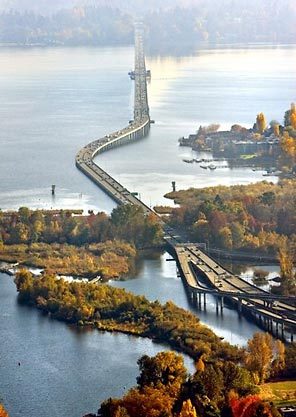
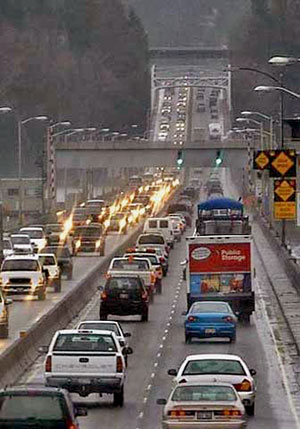
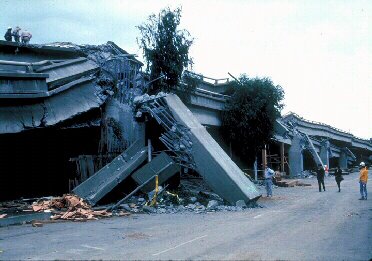
The phrase,'Unsound Transit', was coined by the Wall Street Journal to describe Seattle where,"Light Rail Madness eats billions that could otherwise be devoted to truly efficient transportation technologies." The Puget Sound's traffic congestion is a growing cancer on the region's prosperity. This website, captures news and expert opinion about ways to address the crisis. This is not a blog, but a knowledge base, which collects the best articles and presents them in a searchable format. My goal is to arm residents with knowledge so they can champion fact-based, rather than emotional, solutions.

Transportation

Showing posts with label 0.81 Governance Structure. Show all posts

Friday, April 18, 2008

Transit supporter thinks governance reform without funding wont work

Source Crosscut

A governor's commission suggests fixing our transportation problems by changing the governing board to a directly elected body, as in Portland. A skeptic says such a reform would be slow, reduce accountability, and probably make our transportation planning worse.

By Richard Borkowski

Fifteen months ago, a group appointed by Gov. Chris Gregoire called the Regional Transportation Commission (RTC) submitted its conclusions for a proposed makeover of the Puget Sound transportation agencies. The RTC's 112-page public report produced eight major findings, the essence of which is that the Puget Sound region is experiencing a severe strain in transportation caused by a lack of money, coordination, and prioritization.

These findings are well-documented and mostly undisputed. Who would argue that a $62 billion shortfall in funding is not a serious problem? More debatable is the recommendation by the RTC to solve this problem with a newly created 15-member agency that would plan, prioritize, and fund all modes of regional transportation in the four-county region (King, Kitsap, Pierce, and Snohomish counties). How a change in governance would close the $62 billion funding gap has yet to be explained.

The issue of a directly elected board vs. a federated board structure (as we now have) is the centerpiece of the RTC recommendations. What problem does this solve? And will it introduce other problems? Count me a skeptic.

The supporters say that a directly elected board allows the voters to "get at" their board members during an election, tossing them out if they fail to perform well. By contrast, with the current federated board, a voter might dislike the way, say, a Pierce County councilmember is performing on the Sound Transit board but love the way she or he is serving Pierce County.

However, there are lots of problems with this proposed cure. The districts would be huge (about 235,000 citizens in each one). Some fear that the elected directors would become like the Port of Seattle, a rubber-stamp arm of business and labor that leaves the public in the dark and draws little media or voter attention. A recent audit by the state's auditor provided evidence of this fear with the Port of Seattle. The devastating audit was made more difficult by port employees who were uncooperative with the state auditor. The problems raised in the audit have led to an investigation by the FBI.

Sound Transit, on the other hand, has been audited on a regular basis over the 15 years of its existence. Each time, the results were a clean audit. Such an audit is a strong accountability measure that provides much clearer oversight than an election every six years, and it certainly doesn't require a directly elected board of directors to achieve this accountability.

The call for governance reform is an old story around here. Whenever there are problems with agencies in Washington state, the idea of changing governance seems to surface quickly thereafter. When Sound Transit experienced a large cost overrun and accompanying loss of public confidence, pressure was applied to the Legislature to make the board of directors directly elected. Many critics said the only way for Sound Transit to regain public confidence was to have a revote of the project.

Instead, Sound Transit managed to regroup, find new leadership, and recover the confidence of the public with neither a public revote nor a directly elected board of directors. The continuing call for a directly elected board seems to be more of a remnant of that troubled time that is no longer relevant to an agency that has reformed itself.

Likewise, when the Seattle Monorail Project experienced a budget shortfall and loss of public confidence, critics again demanded a directly elected board. Similarly, after the 2004 election problems related to the Washington state governor's election, there was a call by critics to make the King County elections director elected directly by the public instead of appointed by the King County executive. The decision to move forward with a directly elected position in the elections department was made by the voters via initiative, and it will take years to complete. The complexities of restructuring transportation planning in Puget Sound would be similarly complex and long-drawn out.

Huge changes to transportation governance could slow the progress under way and paralyze transportation planning for years.

Even if we embarked on this complicated reform of governance, would directly elected officials be more accountable? I'm far from convinced, for several reasons. In practice, key positions in government are appointed as well as directly elected. Seattle City Light, for instance, is run by a director who is appointed by the Seattle City Council. The public has no direct role other than through public comment. Yet this seems to provide adequate results, and the public seems perfectly happy with this type of accountability. Few people have any idea who runs Seattle City Light, yet the agency keeps the electricity flowing to customers 24 hours a day.

In many ways, a federated board of elected officials (the present system for Sound Transit) allows the public to hold these officials accountable much better than if they were directly elected, since there are two points of accountability for every board member.

For instance, the mayor of Sumner serves on the Sound Transit board. He is accessible to the public and the media at every board meeting for Sound Transit as well as during his duties as the mayor of Sumner. This arrangement provides more transparency, and ultimately, more accountability than a directly elected board member serving 235,000 people and elected in low-profile races every six years.

Would a new board be any more successful in solving the massive $62 billion funding gap of proposed projects? If the desire is to put into place a regional transportation agency that can levy huge tax increases, tolling, congestion pricing, and privatization of our public infrastructure, then keep in mind that the recommendations of a new group of relatively obscure commissioners would be met with severe public resistance once the details are known. In 2005, the Economist magazine gave this region the dubious honor of having the "worst transport planning in North America." Some changes need to be made, but the rush to a directly elected board seems to ignore the biggest question of all. Namely, where is the $62 billion funding shortfall going to come from?

This question must be answered before any governance reform legislation is passed.

Richard Borkowski is president of People for Modern Transit, a grassroots coalition supporting public transportation in Puget Sound

Wednesday, March 12, 2008

Pierce County pours cold water on Regional Governance

Leaders face battle over highway plans
DAVID SEAGO; THE NEWS TRIBUNE
Published: January 6th, 2008 01:00 AM
Let’s face it: The term “regional transportation governance” is a real snoozer. Couldn’t be wonkier.

But RTG, as I call it, involves big bucks, big power and the very future of the Puget Sound metro region. If you take the bus, ride a Sounder commuter train, drive I-5 or Highway 512 to work, RTG is about your life.

When Proposition 1, the massive roads-and-transportation tax package, cratered at the polls in November, a 2006 blue-ribbon panel’s RTG proposal sprang back to life.

Headed by former Seattle Mayor Norm Rice and Seattle telecom billionaire John Stanton, the panel recommended creating a single regional transportation board to rule all planning for transit and highway construction.

In its current incarnation, the board would consist of nine directly elected members and six appointed members, and it would have the authority to impose tolls and taxes.

RTG is a tough sell in Pierce County. But Stanton and another panel member, former state transportation secretary Doug MacDonald, are giving it a shot at Wednesday’s meeting of RAMP. The Regional Access Mobility Partnership is a coalition of Pierce County business, port and government officials that tries to form a countywide consensus on transportation issues.

Although it was hyperbolic, rude and, to my mind, embarrassing, a letter Pierce County Councilman (and county executive candidate) Shawn Bunney sent the governor in late November expressed widespread county sentiment about regional governance.

“The scene is set for another contrived feeding frenzy in the Legislature, which will leave Pierce County with crumbs,” Bunney cried.

He all but demanded a meeting with the governor to dispute “a Seattle-centric” view of the world. He accused Seattle legislators of “siphoning $700 million in gas taxes out of Pierce County” in the past 15 years.

Bunney unloaded both barrels on the Highway 520 bridge replacement project, which the governor has declared her top transportation priority.

“To say that the 520 Bridge is a ‘safety’ project does not accurately portray the planned gold-plated entrances to the Emerald City and Clyde Hill-Medina. Current plans include $100 million for bike and pedestrian lanes, $250 million for five new parks created to muffle bridge noise, $700-$800 million for parks and lids on the east side of the lake, and a 50 percent capacity increase.

“The only thing missing is a giant archway from which trumpets can blare as Ron Sims enters and exits Seattle.”

Immoderate, to be sure, but the letter was meant to be a warning shot to RTG advocates.

Bunney was chairman of the Regional Transportation Investment District, the panel of local elected officials who devised the roads portion of Proposition 1.

On Wednesday, the RAMP group is also supposed to consider three possible scenarios for addressing Pierce County highway needs. All are “go it alone,” rather than regional, approaches.

One would be a Regional Transportation Investment District with just Pierce County or with another county (perhaps Thurston). Another would be a countywide transportation benefit district. The third would be imposing a countywide local-option gas tax.

The RAMP group is supposed to discuss its legislative priorities Wednesday. The Legislature convenes Jan. 14.

We might see a split in RAMP’s ranks. Pierce County Executive John Ladenburg, who has just stepped down as Sound Transit but still sits on the board, co-chairs RAMP. He has said he doesn’t favor a go-it-alone approach for Pierce County, but it’s not clear where he’ll come down on the governance issue.

Some transit advocates want to see the transit portion of Proposition 1 return to the ballot – separately – in November.

Another key RAMP player is Tacoma Port Director Tim Farrell. His overriding interest, presumably, is completion of Highway 167 from Puyallup to Interstate 5, a huge necessity for moving freight to and from the port. The county’s business community also strongly backs the project.

But the Highway 167 project, which is only a skimpy two-lane connector, is a $1 billion-plus job that would suck up most of the county’s local funding capacity. Completing it actually might be more likely under a regional funding scenario.

But who can tell? If the regional governance proponents have the upper hand in Olympia this year – and I think they may – it may not matter much what stand RAMP takes.

E-mail editorial page editor David Seago at david.seago@thenewstribune.com.

The Case for Regional Governance

Say no, then reorganize public transportation system

By SCOTT PRESTON
GUEST COLUMNIST

It would be to the betterment of the Puget Sound region if voters voted against Proposition 1 on Tuesday. Then, they should ask their legislator or representative in regional government to spend some time drafting an initiative to reorganize the entire regional public transportation industry. Reform and restructuring of this industry is badly needed and way overdue.

In the past 25 years, every major industry has gone through a restructuring and has reorganized in order to meet the changing demands of the changing marketplace. In order to be successful and cost-effective, they had to establish organizational designs that allowed for better efficiencies and to operate more effectively in the marketplace. Those businesses and organizations that made changes became more lean and mean and in turn became more successful and more economically sound. This includes the airline industry, the health care industry, the banking industry and many federal agencies.

The regional public transportation industry is operating under protocols and organizational structures that were established more than 50 years ago and have not changed with the changing transportation markets, the financial funding sources and changes in public transportation services and different modes of transit. This industry is self-regulating and is not accountable to any one regional governing body. It is analogous to having Col. Sanders protecting the chicken coop. There is no one agency to monitor how public tax funds are spent on transportation projects and programs.

The regional transportation industry is segmented with many different forms of governance with different objectives. From Olympia to Everett, there are more than 45 transportation-taxing districts, all of which have some authority to engage in raising public funds for public transportation projects or programs.

There are more than 12 different major public transit agencies providing bus services, along with light rail and commuter rail services. Each of those transit agencies has its own staff and administration; its own fleet of buses and bus routes; its own policies of fare structure; its own operational policies; its own buildings and facilities; its own objectives and goals; and they all compete for state and federal funding. Each transit agency is empire building to assure it gets its fair share of state and federal transportation funds.

Each year millions of dollars are expended by those agencies trying to coordinate planning of bus services and public transit-related programs. Each of those transit agencies is self-serving and focused only on meeting its own goals. A person traveling by bus from Olympia to Everett has to use bus services from as many as five bus agencies and can encounter five fare structures. This is a very cumbersome bus system for customers and does not support seamless travel in the region. For customers who want to use public transportation, it really isn't important what agency provides the bus service; it is the service that is important.

Scott Preston is a transportation economist with TranspoEcon Consulting (TranspoEcon@aol.com) in Seattle.
Soundoff (Read 23 comments)

Monday, March 10, 2008

Report of the 2000 StateTransportation Blue Ribbon Commission

The Blue Ribbon Commission on Transportation

Final Recommendations to the Governor and Legislature

adopted November 29, 2000

Final Recommendations

The Blue Ribbon Commission on Transportation

Final Recommendations adopted November 29, 2000

SUMMARY OF RECOMMENDATIONS

1. Adopt transportation benchmarks as a cornerstone of government accountability at the
state, city, county, and transit district levels.
2. Establish a single point of accountability at the state level, strengthening the role of the
state in ensuring accountability of the statewide transportation system.
3. Direct a thorough and independent performance review of WSDOT administration
practices and staffing levels.
4. Remove the barriers to achieving the transportation benchmarks for efficiency and sys-
tem performance by providing funding for a strong state and strong regional transporta-
tion system.
5. Invest in maintenance, preservation, and improvement of the entire transportation system
so that the transportation benchmarks can be achieved.
6. Provide regions with the ability to plan, select, fund, and implement (or contract for
implementation of) projects identified to meet the region’s transportation and land use
goals.
7. Achieve construction and project delivery efficiencies.
8. Incorporate the design-build process and its variations into construction projects to
achieve the goals of time-savings and avoidance of costly change orders.
9. Use the private sector to deliver projects and transportation services.
10. Reengineer the workplace to achieve greater efficiency, and consider the use of managed
competition for operations and maintenance functions.
11. Streamline permitting for transportation projects.
12. Link transportation funding to efficiencies.
13. Link maintenance and preservation funds to best practices.


page 1

The Blue Ribbon Commission on Transportation

14. Simplify funding distributions for best results.
15. Adopt a regional funding equity principle.
16. Seek a 90% farebox recovery for ferry system operational costs within 20 years.
17. Adopt a package of new revenues to fund a comprehensive multi-modal set of invest-
ments, which, taken together with the recommended efficiency measures and reforms,
will ensure a 20-year program of preserving, optimizing, and expanding the state’s trans-
portation system.
18. Begin action now to improve the transportation system, guided by the BRCT Early
Action Plan.
SUMMARY OF RECOMMENDED BENCHMARKS
1. Zero percent of interstate highways in poor condition.
2. Zero percent of major state routes in poor condition.
3. Zero percent of local arterials in poor condition.
4. Zero percent of bridges structurally deficient.
5. Complete seismic safety retrofits of all Level 1 and Level 2 bridges.
6. Traffic congestion on urban interstate highways will be significantly reduced and be no
worse than the national mean.
7. Delay per driver will be significantly reduced and be no worse than the national mean.
8. Maintain vehicle miles traveled (VMT) per capita at 2000 levels.
9. Increase non-auto share of work trips in urban centers or reverse the downward trend of


non-auto share of work trips in urban centers.

10. Administrative costs as a percent of transportation spending at the state, county and city
levels should improve to the median in the short-term and to the most efficient quartile nationally in the longer term.

11. Washington’s public transit agencies will achieve the median cost per vehicle revenue
hour of peer group transit agencies.


page 2

Final Recommendations

SUMMARY OF BENCHMARKS RECOMMENDED TO BE DEVELOPED
BY THE TRANSPORTATION ACCOUNTABILITY COMMISSION

1. Traffic Safety Benchmark: Traffic accidents will continue to decline.
2. Freight Mobility Benchmark: Freight movement and growth in trade-related freight
movement should be accommodated on the transportation system.
3. Air Quality Benchmark: Maintain air quality (carbon monoxide and ozone) at federally
required levels.
4. Project Cost Benchmark: Improve operations, maintenance, and project delivery costs.
5. Transportation Revenue Benchmark: Ensure that transportation spending keeps pace
with growth.
6. Person Delay Benchmark: Reduce overall hours of travel delay per person in congested
corridors.


page 3

The Blue Ribbon Commission on Transportation

RECOMMENDATIONS

Recommendation #1: Adopt transpor tation benchmarks as a cornerstone of g overnment accountability at the state , city, county, and transit district levels.

These benchmarks should measure results and monitor performance of the system. Transportation funding should be tied to progress in achieving the benchmarks.

With a focus on goals and results, benchmarks accurately quantify where Washington stands in comparison to other states. By giving a ‘baseline’ of current status, these measures can then be assessed for future action, and used as performance goals.

(The benchmarks are listed at the end of this report.)

Recommendation #2: Establish a single point of accountability at the state level strengthening the role of the state in ensuring accountability of the state wide transpor tation system.

a. The Washington Transportation Commission should negotiate a protocol with the Governor
on the procedures for the appointment of the replacement for the current Secretary of the Department of Transportation.

b. The Washington Transportation Commission should maintain its current authority until the
effective date of implementing legislation. At that time, the Commission should transition into the Transportation Accountability Commission, a single, independent, statewide point of accountability for reporting and monitoring the performance of the integrated state transportation system at all levels. The TAC should:

i. Take responsibility for overseeing attainment of the benchmarks addressed in Recommendation 1. ii. Provide a report card annually to the Governor and Legislature on:

• Progress toward achieving reform and efficiencies

• Progress toward accomplishment of the BRCT’s and the Legislature’s adopted investment
strategies

• Policy suggestions for furthering progress toward benchmarks and related transportation
policies

iii. The TAC should also review and advise on regional and integrated statewide transportation plans
and budgets and should advise the Governor in his or her exercise of plan certification responsibilities on whether plans are making adequate progress toward achieving benchmarks. Such reports should also be made to the Legislature.

page 4

Final Recommendations

iv. The TAC should be expected and encouraged to serve as an active “bully pulpit” for continuing
insistence on progress toward both adopting leading edge transportation strategies and achieving benchmarks. The TAC should report both successes and deficiencies.

c. From the effective date of implementing legislation forward, the Secretary shall serve at the
pleasure of the Governor, and subsequently, the Governor shall have appointment authority over the Secretary, with confirmation by the Senate. The authority of the Transportation Commission with respect to budget and policy will become advisory and the Governor will assume responsibility for the performance of the statewide transportation system, including proposing policies, plans and budgets to the Legislature and executing the policies, plans and budgets enacted by the Legislature.

d. The TAC membership should transition from the current Transportation Commission mem
bership in order to take advantage of its considerable expertise. In that transition, it should expand from seven to nine members, with no more than five out of the nine affiliated with a single political party. Three members shall be from Eastern Washington and six from Western Washington. Members should be appointed by the Governor and confirmed by the Senate. Terms of office should be six years, with terms staggered so three members are appointed every two years.

Recommendation #3: Direct a thorough and independent perf ormance r eview of WSDO T administration practices and staffing le vels.

a. Scale and size of accounting and management information systems division staffs.
b. Possible duplication of functions among regions
c. Possible application of computer and Internet technology for administration purposes.
d. Scale and size of other WSDOT support programs, including program D, S, T, and U func-


tions.

Recommendation #4: Remove the barriers to achieving the transpor tation benchmarks for efficiency and system perf ormance . Provide funding for a strong state and strong regional transpor tation system.

Recommendation #5: Invest in maintenance , preservation, and improvement of the entir e transpor tation system so that the transpor tation benchmarks can be achie ved.

a. Preserve the transportation system.


i. Prioritize and fund all maintenance, preservation, and safety needs of the existing transportation
infrastructure in the state, including operating and maintenance costs of rail, transit, and ferries. All agencies and jurisdictions should be required to demonstrate the use of maintenance management systems and, for roadways, pavement management systems, as a condition of receiving a baseline allocation of funding;

page 5

The Blue Ribbon Commission on Transportation

ii. Use the most cost-effective pavement surfaces available based on durability; iii. Phase out studded tires or establish a surcharge to recognize the cost of studded tire damage to
the roadways;

iv. Develop a utility cut ordinance for use throughout the state, or require jurisdictions to adopt a
utility accommodation ordinance that must include a section.

b. Optimize the transportation system.


i. Transportation system management (TSM) and intelligent transportation systems (ITS) policies
should be implemented where cost-effective.

ii. Transportation demand management (TDM) policies should be used to reduce demand on the
highway system.

iii. Jurisdictions should integrate transportation and land use planning. iv. Congestion pricing should be made a policy option for congested urban areas.

c. Make cost-effective system expansions in heavily traveled corridors.

i. Look to congestion. Congestion and accidents are key indicators of transportation dysfunction. ii. Look to corridors. Corridors are where congestion is likely to be, and congestion cannot be
effectively treated by isolated spot improvements.

iii. Use benefit-cost analysis to the extent possible, to analyze and communicate the value of invest
ment alternatives.

d. Improve the decision-making process for transportation investments.

i. Use cost-benefit analysis in selecting the most effective transportation investments. Multi-modal
benefit-cost analysis should be used to the extent possible as it develops. There is currently no institutionalized analytical approach to cost-benefit analysis across modes and regions. The method used for transportation projects necessarily differs from that used in private industry, taking into account societal costs and benefits. The state should encourage the development of the analytic tools to measure benefits and costs for all modes with a common methodology.
ii. Travel demand modeling tools should be enhanced and used by the state to evaluate investments. iii. Use a corridor approach in transportation planning and investing so the most heavily traveled
corridors are the highest investment priorities. The most effective mix of strategies in each corridor should be the goal.

iv. The state and local transportation authorities should invest in the human resources necessary to
supply the technical workforce capable of maintaining, preserving, and improving the transportation system.

Recommendation #6. Provide regions with the ability to plan, select, fund, and implement (or contract f or implementation of) pr ojects identified to meet the region’s transportation and land use goals.

a. The regional authority would have responsibility to program and prioritize, with selected state
and federal matching funds, state and regional roadway projects and regionally significant transit projects within the region.

page 6

Final Recommendations

i. A revenue package would be developed to implement a regional transportation plan, and the
authority would have increased funding for the transportation system improvements through an improved allocation of state and new revenues, using a regional equity principal.
ii. The authority would be able to contract with state, regional, and local jurisdictions for construc
tion and, where necessary, become the implementing agency. Other cost-effective and project delivery tools would be utilized, such as design/build and streamlined decision making.

b. Merged functions of any new authority may also include air pollution control. A regional
authority may be responsible for monitoring this commission’s indicator on air quality (among other things) to assess progress.

c. The governing board for the authority should include local and region-wide perspectives and
may have a directly elected or a federated membership. The authority would set goals, objectives, and standards, and monitor achievement and performance as part of its planning and funding responsibilities. With the principle of “no new bureaucracy,” however, our intention is to simplify and minimize structural redundancy rather than add new layers of government.

d. The size of the project or investment to be undertaken by the regional authority should de
pend upon its significance to the region. Standards for regional significance should be established for facilities; existing models are available via WSDOT’s defined facilities of ‘statewide significance,’ and those facilities defined in the Puget Sound Regional Council’s Metropolitan Transportation Plan.

Recommendation #7: Achieve construction and project delivery efficiencies.

a. Reduce engineering/construction cost ratio. WSDOT’s preliminary engineering and con-
struction engineering costs have recently been reduced from 26% to 20% of overall (‘hard’)
construction costs. We recommend that cost savings such as these continue at all levels of
government statewide.
b. Save money on materials and methods.
c. Use right-of-way ‘banking.’
d. Continue to assess prevailing wage survey techniques.
e. Make mitigation more cost-effective.
f. Provide incentives to encourage efficiencies.
g. Efficiencies will be realized by having predictable revenue sources to fully fund projects,


thereby eliminating starts and stops in design and construction which result in delays and increased project costs.

Recommendation #8: Incorporate the design-build process and its variations into construction projects to achieve the goals of time savings and avoidance of costly change orders.

page 7

The Blue Ribbon Commission on Transportation
a.

b. c. Grant statutory authority to transportation agencies to use design-build techniques and their variations, including design-build-operate, design-build-operate-own, design-build-ownoperate-transfer, and general contractor/construction management.

Provide methods by which public employees may participate in the design-build process. Provide increased education and training in alternative project delivery (ADP) concepts.

Recommendation #9. Use the private sector to deliver projects and transpor tation ser-
vices.
a. Continue pilot projects allowing the private sector to provide expertise and financing in
developing cost-effective transportation facilities.


b. Examine removing barriers preventing the private sector from providing transportation
services in light of some public expressed interest in alternative services, which could include ferry, bus, or monorail. A level playing field should be maintained between the public and private sectors. It is essential to take into account issues such as wages, health care and other benefits.

Recommendation #10: Reengineer the w orkplace to achieve greater efficiency , and consider the use of mana ged competition for operations and maintenance functions.

a. Place an emphasis on excellence in the workplace, through service, customer satisfaction, and a focus on results. Incorporate elements of total quality management into business practices.

b. Form partnerships with employer-employee organizations to develop apprenticeships and
training programs to ensure the availability of a skilled workforce to deliver projects and
services.


c. Under managed competition, private sector bids are sought for operations and maintenance
activities, and then compared to a bid from the public sector staff currently performing the service. Legislative authorization would be required to permit managed competition. Alternately, because managed competition is very restricted under current state law, it may be best to introduce a pilot program, perhaps through negotiation between labor and management. A level playing field should be maintained between the public and private sectors. It is essential to take into account issues such as wages, health care and other benefits.

Recommendation #11: Streamline permitting f or transpor tation projects.

a. Delegate 404 wetlands permit authority to the state. Section 404 of the Federal Clean Water
Act regulates the placement of fill in waters of the United States, including wetlands. In parts of Washington, the average time to acquire a permit from the federal government under this process is 1 to 2.2 years. Two states, Michigan (since 1984) and New Jersey (since 1994),

page 8

Final Recommendations

have been authorized to administer the Federal Section 404 program in parts of their states.

b. Write and apply substantive standards for transportation (road) projects to streamline permit
approvals thereby reducing process review delays. Based on the results of the pilot project, work toward a goal of one-stop permitting, using a single permit application. Use existing models to create an agency with powers to consolidate permit review for major transportation capital projects.

i. Identify highway projects of statewide significance to be eligible for review under this option. ii. Select a significant highway project as a pilot to plan and permit with an integrated steering
committee that includes project proponents, elected officials, agency staff, and public representatives (like the Trans-Lake Washington Project process). The ability to complete the project within two years of commencement should be a criterion in project selection.

iii. Evaluate the use of planning and permitting standards that encourage lower impact alternatives,
such as Smart Growth, transportation demand management (TDM), transportation system management (TSM), pricing, and transit, along with the HOV and general purpose roads proposed in the project.

iv. Accelerate the permit process for a project that uses low-impact development standards.

Recommendation #12: Link transpor tation funding to efficiencies.

a. Require WSDOT, counties, cities, and transit to demonstrate progress toward achieving benchmark efficiencies as a condition of receiving some portion of new baseline funding.

b. Require cities, counties and transit to demonstrate that they are not supplanting existing
transportation funds as a condition of receiving new funding.

Recommendation #13: Link maintenance and pr eservation funds to best practices.

a. Direct a baseline allocation of adequate funding to operations, maintenance, preservation and
safety functions for state highways, county roads, city streets, transit, ferries, and alternate
modes.


b. As a condition of receiving their baseline allocation of funding, require all agencies and juris
dictions to demonstrate the use of maintenance management systems and pavement management systems.

c. As a condition of receiving funding, require WSDOT, cities, and counties to demonstrate,
after an initial period of three years, that their preservation investments are based on lowest life cycle cost principles.

d. Require that available grant programs do not fund preservation projects that are already
funded out of baseline fund allocations.


page 9

The Blue Ribbon Commission on Transportation

Recommendation #14: Simplify funding distributions for best results.

a. Distribute pass-through funds according to a new formula that directs funds on a geographic
basis to counties and cities within counties, and takes into account lane miles, classification and pavement type, population, and utilization (for example, VMT), and is adjusted for changes in road jurisdiction at least once every five years.

b. Develop a new method for joint regional programming of federal funds, with the state, local
jurisdictions, transit agencies and other stakeholders participating in a regional prioritization process that directs federal funds to major corridors and facility clusters.

c. Require that federal funds be managed only by jurisdictions and agencies that are “certifica-
tion accepted.”


d. Create one-stop grant funding centers where all competitive funds, whether federal or state,
are disbursed under regional priority programming agreements and administered using a single application process.

Recommendation #15: Allow regions to retain funds they raise .

a. Adopt a regional equity principle for distribution of new funds to regions of the state, based
on the following three-tiers:


i. allocate sufficient funds statewide to all regions for basic operations, maintenance, preservation
and safety at a minimum agreed upon level;

ii. allocate all other new funds such that each region is guaranteed a minimum return of 85% of
funds generated in that region, and allocate remaining funds to a statewide equalization fund to be distributed to negative equity regions; and

iii. allocate all funds regionally authorized directly to the region in which they are generated.

Recommendation #16: Seek a 90% far ebox recovery for ferry system operational costs within 20 years.

a. Adopt the Ferry Tariff Policy Committee’s recommendation on a new ferry tariff policy,
including a new time-based route equity structure, premium pricing for passenger-only service, and 80% farebox recovery, phased in over the next six years. Seek to achieve a 20-year goal of 90% to 100% farebox recovery.

b. The Blue Ribbon Commission on Transportation recognizes ferries are an important part of
the highway system and recommends the Legislature give serious consideration to the Ferry Task Force’s findings on the needs of the ferry system.

page 10

Final Recommendations

Recommendation #17: Develop a package of new revenues to fund a comprehensive multi-modal set of investments, which, taken together with the r ecommended efficiency measur es and reforms, will ensure a 20-year program of pr eserving, optimizing, and expanding the state’s transportation system.

The Revenue Committee recommends a combination of the following revenue measures to comprise the elements of such a package:

a. Efficiency measures at the state, county, city, and transit agency levels.
b. Transfer from the state general fund transportation-related sales taxes, within the capacity
determined to be available.
c. Authorize the extension of the existing gross weight fee to all vehicles that use the roadway
system, including passenger cars, sport utility vehicles and recreation vehicles.
d. Authorize a surcharge to the existing gross weight fee for trucks, the proceeds to be dedicated
to freight mobility improvements.
e. Increase the motor fuel tax.
f. Extend the sales tax to motor fuels. The commission adopted a sales tax on gas to be imposed


on the wholesale commodity price of the fuel up to a set cap. The proceeds would be dedicated to all transportation purposes. The purpose of the price cap is to meet the commission’s goal of predictability in revenues and to reduce the potential for disruptive price swings. The choice of commodity price as the revenue basis is intended to avoid imposing the new tax on top of the existing motor fuel taxes. The tax would be collected at the ‘rack’ and paid by the distributor, like other fuel taxes.

g. Authorize a new surcharge on the wholesale sale of new and used vehicles, auto parts, and
accessories, the proceeds to be dedicated to transportation.

h. Adopt a new ferry tariff policy that includes premium pricing for passenger-only ferry service,
regional route equity pricing; adopt a new farebox recovery policy of 80% within six years and 90% within 20 years.

i. Authorize a local option vehicle mile traveled (VMT) charge to be used by regional entities in
congested regions of the state, and to be imposed on all vehicles registered in such a region.

j. Authorize new multi-modal transportation taxing authority for counties or regions that have
not been previously granted high capacity transportation taxing authority.

k. Expand the authority of counties to impose the local option motor vehicle license fee; repeal
the referendum provision; and authorize cities to impose the fee if the county in which they are located has not imposed the fee within two years of enactment.

l. Authorize bonding programs at the state and regional levels to achieve the funding levels
determined to be needed.
m. Authorize a local option regional sales tax dedicated to all transportation purposes.


page 11

The Blue Ribbon Commission on Transportation

n. Authorize to the state and to regional entities the implementation of all forms of value pricing,
including region-wide pricing and pricing on individual facilities.
o. Examine and, if appropriate, authorize the bonding of federal funds.
p. Examine and authorize the expansion of tax increment financing as a tool for transportation


and other development projects.

q. Examine all transportation revenue sources at least biennially and ensure that they are keep
ing pace with inflation and with growth according to benchmarked trends.

r. Extend the $30 license fee. The existing $30 license fee is applied only to passenger vehicles.
The commission adopted a recommendation to extend it to all vehicles including trailers.

s. Authorize a flat $20 traffic mitigation fee. (The existing $30 license fee would be increased to
$50. It should be a non-eighteenth-amendment restricted tax to ensure that it can be used for all transportation purposes.) A $20 charge would be imposed on all passenger vehicles and non-commercial trucks. The revenue generated could be used for any transportation purpose.

Recommendation #18: Begin action now to improve the transpor tation system, guided by the BRCT Earl y Action Plan

a. Act on accountability, efficiency, and governance recommendations.
b. Begin the first stage of investment in the 2001-2003 biennium by investing in actions that will


help the state reach the BRCT benchmarks.

i. Fund system maintenance and preservation throughout the state, ensuring continuation of effi
cient ferry and transit services.

ii. Optimize the current system using technology, and the most cost-effective demand management
techniques such as telecommuting and commute trip reduction tax credits.

iii. Fund cost-effective system expansions in all modes.

c. Set the stage for future investments by getting systems in place that will encourage best
practices, technical analysis to solve the toughest problems, and evaluation of performance by transportation agencies in delivering on the expected investments.

page 12

Final Recommendations

RECOMMENDED BENCHMARKS

Benchmark 1: Zero percent of interstate highwa ys in poor condition.

The benchmark committee found that slightly under five percent of the interstate highway was in poor condition in 1997.

Benchmark 2: Zero percent of major state r outes in poor condition.

The benchmark committee found that less than one percent of major state routes were in poor condition in 1997.

Benchmark 3: Zero percent of local arterials in poor condition.

Data were unavailable for current conditions of local arterials in Washington. A pilot project under the auspices of the Legislative Evaluation and Accountability Program (LEAP) is compiling the available data.

Benchmark 4: Zero percent of bridges structurally deficient.

The benchmark committee found that slightly fewer than twenty-five percent of bridges in Washington were in deficient condition in 1997. The benchmark applies to all bridges over 20 feet in length recorded in the State of Washington Inventory of Bridges (SWIBs).

Benchmark 5: Complete seismic safety retrofits of all Level 1 and Level 2 bridges.

The benchmark committee found that the state has been pursuing a program to retrofit bridges and structures identified by risk level. Levels 1 and 2 are the two highest risk levels. Over 300 bridges have been retrofitted to date at a cost of about $40 million. However, almost 1,000 bridges remain to be repaired in the two highest risk levels at a cost of $560 million, $350 million of which is contained in a single structure, the Alaskan Way viaduct in Seattle.

Benchmark 6: Traffic congestion on urban interstate highwa ys will be significantly reduced and be no worse than the national mean.

The benchmark committee found that between sixty and eighty percent of urban interstate highways are congested in Washington. The national mean is about forty-five percent urban interstate miles congested.

page 13

The Blue Ribbon Commission on Transportation

Benchmark 7: Delay per driver will be significantly reduced and be no worse than the national mean.

This benchmark calculates delay per driver by metropolitan region. Delay per driver is a calculated average based on the number of licensed drivers in a region. It does not attempt to distinguish between individuals actually experiencing delay and those traveling on non-congested roads or not traveling at all. The benchmark committee found the national mean to be about forty hours of average delay per driver annually. Data show that the Seattle-Everett metropolitan area experienced seventy hours of average delay per driver annually; Vancouver-Portland experienced over fifty hours of average delay per driver annually; Individual regions of the state may choose to track more detailed data such as person delay on specific corridors.

Benchmark 8: Maintain vehicle miles traveled (VMT) per ca pita at 2000 levels.

The benchmark committee found that VMT in Washington were about 9,000 miles per person per year in 1998. While Washington’s population has grown about forty percent over the past twenty years, VMT have grown sixty percent, or about half again as fast. VMT have been growing faster than population since the mid-1980s. However, VMT per capita have leveled off at about 1990 levels. The Transportation Accountability Commission will review this benchmark and raise the standard if necessary to reach other benchmarks.

Benchmark 9: Increase non-auto shar e of work trips in urban centers or r everse the downward trend of non-auto share of work trips in urban centers.

The benchmark committee found that the only reliable data for this benchmark was the U.S. Census Bureau’s journey-to-work surveys, the most recent of which showed a declining share of non-auto trips in the 1980-90 timeframe. Year 2000 census data will be available early next year, 2001. The new accountability board should set a target for this benchmark when the data are available. Nonauto travel includes ferry, transit, walking and bicycling; commuter and light rail should be added when data become available.

Benchmark 10: Administrative costs as a percent of transpor tation spending at the state , county and city levels should improve to the median in the short-term and to the most efficient quar tile nationally in the longer term.

The benchmark committee found that the state transportation agency’s administrative costs fell between the third and fourth quartile nationally, (the first quartile being the lowest), or at roughly ten to twelve percent of spending. The committee added that these costs were not all due to inefficiency, but also to Washington’s environmental ethic, culture of planning, neighborhood activism, and citizen involvement. The benchmark applies to all transportation agencies in the state.

page 14

Final Recommendations

Benchmark 11: Washington’s public transit agencies will achieve the median cost per vehicle revenue hour of peer gr oup transit agencies, adjusting for regional cost of living

The benchmark committee found that King County Metro and Pierce Transit’s cost per vehicle hour were thirteen percent and fourteen percent respectively, above their peer group transit agencies nationwide. The committee also found that transit-operating costs are highly dependent on wages of transit personnel, which in turn are related to the economy and cost of living in the region.

page 15

The Blue Ribbon Commission on Transportation

BENCHMARKS TO BE DEVELOPED BY THE TRANSPORTATION ACCOUNTABILITY
COMMISSION

The following benchmarks are recommended for further development by the proposed transportation accountability commission that monitors and tracks benchmark progress. The accountability commission should develop metrics and identify targets and responsibility for these benchmarks.

Traffic Saf ety Benchmark: Traffic accidents will continue to decline.

The committee found that Washington has slightly less than 1.5 fatalities per 100 million vehicle miles, which is less than the national average of about 1.7. All accidents, including those involving bicyclists and pedestrians, should decline.

Freight Mobility Benchmark: Freight movement and gr owth in trade-r elated freight movement should be accommodated on the transpor tation system.

The benchmark committee found that growth in trade-related freight movements by truck (up over seventeen percent annually in the 1991-98 timeframe) and by railcars (up about nine percent annually in the 1991-98 timeframe) exceeded other economic growth rates. The Freight Mobility Strategic Investment Board (FMSIB) should be involved in developing additional benchmarks of freight movement and the supporting data to monitor progress.

Air Quality Benchmark: Maintain air quality (carbon mono xide and ozone) at federally required levels.

The benchmark committee found a declining incidence of carbon monoxide and ozone (the components of smog) in the state’s urban areas since the 1970’s. However, recently our air quality has come close to exceeding allowable levels on several occasions. Federal law requires that regions be sanctioned by loss of federal funds if this happens. The transportation accountability commission is asked to consider measuring greenhouse gases, particulates, and visibility when data and appropriate standards are available.

Project Cost Benchmark: Improve operations, maintenance , and project delivery costs.

Create benchmarks for the operations and maintenance and capital project delivery functions of transportation agencies, parallel to that suggested for their administrative costs. The new accountability commission that monitors and tracks benchmark progress is directed to develop metrics to compare Washington’s project development, design, permitting and construction costs with best practices nationally.

page 16

Final Recommendations

Transpor tation Revenue Benchmark: Ensure that transpor tation spending keeps pace with growth.

Washington’s transportation system must not be allowed to fall behind the pace of its population and economic growth. The transportation accountability commission should develop a benchmark that monitors transportation revenues and how they track transportation needs.

Person Delay Benchmark: Reduce overall hours of travel delay per person in congested corridors.

The new transportation accountability commission should develop and track a benchmark of person delay that can be used across all modes of travel.

page 17

The Blue Ribbon Commission on Transportation

TOOL BOX OF ADDITIONAL EFFICIENCY RECOMMENDATIONS

1. Improve data collection for best decisions.

a. All transportation agencies should improve data collection and cost allocation. Without access to
comparative data, it is not possible to measure accurately the cost and quality of services. b. Implement the management and financial accounting system changes recommended by the Joint
Legislative Audit Review Committee (JLARC).

c. Refine budget accounting and record systems (BARS) codes at the state, city, county, and transit
districts into a consistent format for cost comparison purposes.

. Requires data collection and reporting at the city level, consistent with data collected at state,
county, and transit district level, and reported to a single repository for simpler access. e. Define consistent terminology for — administration, construction, maintenance, operations, and
preservation —across all levels of government in order to make correct comparisons.

2. Improve management practices.
a. Improve project management.
b. Take measured (appropriate) risks.
c. Use enhanced team planning/partnering.
3. Improve the permit process.
a. Develop an environmental cost model to document and monitor the costs of environmental
review, permitting, and mitigation on projects.
b. Do environmental review early.


i. Require early agreements including interagency agreements early in decision-making process. ii. Provide early involvement by stakeholders.

c. Establish standards for environmental reviews that are consistent across jurisdictions.
i. Work with local agencies and state agencies to coordinate review efforts. ii. Coordinate environmental mitigation strategies with other agencies.

iii. Coordinate with other federal, state and local agencies, and with non-governmental organiza
tions to develop comprehensive strategies.

iv. Coordinate mitigation across jurisdictions. d. Use watershed based planning.

e. Make better use of current environmental processes and available resources.
i. Better integrate NEPA/SEPA: to the extent possible, coordinate reviews at the federal, state
and local levels.


ii. Fund staff in resource agencies to review permits: Staff shortages are a principal cause of
delay in issuing environmental permits. Funding staff positions for specific projects or on an ad hoc basis will facilitate earlier project review.

iii. Set and honor timelines.

iv. Use project teams.

page 18

Does the Rice Stanton Group have the solution for Puget Sound

Beyond Proposition 1: A new consensus is emerging

12/18/07

A group headed by Norm Rice and John Stanton is gathering allies for a more rational and practical approach to the region's transit needs. Both supporters and opponents of the failed Proposition 1 are part of the effort.

By Ted Van Dyk, Transportation
Posted on December 18, 2007

"The voters are not fools." —political scientist V.O. Key

In the wake of Proposition 1's overwhelming rejection by King, Pierce, and Snohomish county voters, encouraging signs of rationality are beginning to appear in what has heretofore been the absurdist world of regional transportation planning.

Seattle Mayor Greg Nickels made effusive statements last week on the first run of the $52 million Allentown Trolley from Westlake Center to South Lake Union, regarding his vision of a trolley-system extension through all of downtown Seattle. Gov. Chris Gregoire, having committed $1 billion to a fixup of each end of the creaking Alaskan Way Viaduct, suddenly reversed herself on the issue of final repair or replacement and declared herself open to surface/transit options she previously had rejected. Sound Transit board members, now led by Nickels, were laying plans for resubmission, probably in 2010, of their soundly defeated proposal for an extended light rail system.

None of those outcomes (except possibly the adoption of a surface/transit solution on Alaskan Way) is likely to transpire.

Instead, momentum now has shifted toward more practical and affordable ways that the region's most pressing transportation needs can be met. For one thing, Gregoire has stated that repair or replacement of the Evergreen Point Bridge across Lake Washington will have high priority in the year ahead. Both the 520 bridge and the Alaskan Way Viaduct are state highways, and the governor, indeed, can address both definitively if determined to do so.

We also may see in 2008 a reform of the regional transportation planning and decisionmaking structures that have failed us often in the past.

The Gregoire-appointed Norm Rice-John Stanton commission a year ago proposed that Sound Transit and the Regional Transportation Investment District be superseded by a new, mainly elected, regional transportation body better able to make independent, cost-benefit-based proposals for balanced transportation systems. The proposal was well received in the Legislature but stalled in the face of full-court opposition by Sound Transit and those who are protecting turf or who benefit directly from Sound Transit contracts.

One reason that Sound Transit overreached so badly in seeking record amounts of tax dollars in Prop 1 was that it feared it might shortly be euthanized if the Rice-Stanton proposals were adopted, or that taxes reserved for Sound Transit would be raided for road building or non-Sound Transit bus systems. For Sound Transit, Prop 1 was Stalingrad. Without the fresh infusions of money, even its limited local light rail system lacks funds to get as far north as Husky Stadium.

Former Seattle Mayor Norm Rice and hi-tech executive/investor John Stanton have decided to press aggressively in 2008 for adoption of their proposal. They have been joined, initially, by a core group including of former U.S. Sen. Slade Gorton, Bruce Agnew of the Discovery Institute's Cascadia transportation center, Snohomish County transportation leader Reid Shockey, 2004 attorney general candidate Mike Vaska, and Steve Mullin, president of the Washington Roundtable and co-chair of the pro-Prop 1 campaign. This eclectic group includes previous Sound Transit and Prop 1 advocates. They are united in a belief that rationality and accountability must become cornerstones of future transportation policy.

The Rice-Stanton group already has met with the governor and key legislative leaders and reports no overt opposition to their proposal. They also have had informational meetings with Sound Transit and RTID leaders. According to Stanton, his group has no illusions regarding the support of these bodies, but they hope to at least blunt their opposition.

Rice, Stanton, et. al., shortly will form a committee — let us call it, for now, the Committee for Rational Transportation Decisions — to generate public support for their proposals and to bring pressure on the governor and legislative leaders during the coming short session of the Legislature. The effort, at least for now, will be directed toward legislation rather than a ballot measure, although the latter could remain an option. No legislative lobbyist has yet been hired.

The latest version of the Rice-Stanton proposal calls for the regional transportation authority's members to be directly elected (rather than appointed, as with the Sound Transit and RTID boards) and thus directly accountable to their constituents. It would be supplemented by six appointed members, with four to be appointed by the counties and two by the governor. Though the latter configuration could change, directly elected officials would form a strong majority on the body.

The Rice-Stanton group could also find itself working with Prop. 1 opponents such as Belltown financier Mark Baerwaldt and former state Supreme Court Justice Phil Talmadge. Baerwaldt and Talmadge have also publicly endorsed the notion of the new regional transportation agency to supersede Sound Transit and RTID. These forces, together, have the money, political juice, and potential public support to create the desired institutional change.

In all of this, a new consensus is emerging about a post-Prop 1 agenda. It centers on moving aside turf-oriented, self-serving agencies such as Sound Transit and transferring power to a more objective, more responsive regional body. It would stress immediate priorities such as addressing the urgent Alaskan Way Viaduct and Evergreen Point Bridge, which are aging and structurally vulnerable. It would not stop light rail construction in place, but it would limit construction to a line running from Seattle-Tacoma International Airport to either Convention Place, Husky Stadium, or Northgate. Future funding would be focused more greatly on express bus, bus rapid transit, and normal bus service; dedicated transit lanes; HOV lanes; tolling; and selective repair and expansion of long neglected local roads and lifeline highways. Citywide trolleys definitely would not be part of the scheme.

Things move slowly hereabouts. But finally they appear to be moving in the right direction on regional transportation policy. The coming year could actually be a good one for us in that regard.


The following comments were posted on crosscut in response


Crosscut Must Have a Death Wish
Posted by: ratcityreprobate on Dec 18, 2007 7:09 AM
For the umpteenth time Van Dyk subjects us to his Sound Transit rant. Now we learn that Cascadia transportation center will bring the Intelligent Designer to help the Rice Stanton clown car. What an absurd joke. Those two couldn't organize a one car funeral procession. A really nice guy but do-nothing mayor who went on to nearly bankrupt a Federal banking institution and a right-wing crank are going to lead us out of the wilderness. Please!

Hopefully Van Dyk has adult children living elsewhere who will come for him and place him in an appropriate living situation.

Tacoma News Tribune Weighs In


Posted by: dltooley on Dec 20, 2007 6:59 AM
Today's Tribune weighs in on this subject, with some more detail about what's planned regarding the issue of 'sub-area' equity.


Just because a sex predator changes from a red suit to a blue one doesn't mean they won't still be up to the same tricks. To be fair, the corporate welfare folks calling themselves upstanding democrats or upstanding republicans aren't necessarily caught up in the cycle of sexual abuse.

They do certainly use those poor souls, as well as the racially damaged, to their financial benefit. Some might tell you that is legal, I would disagree.

One crucial aspect is also the question of abuse of authority of any kind. FWIW it is my opinion that the folks who stand to continue to benefit from Sound Transit and the like have a multi-generational history of abuse within the development of their authority.

The best solution to that problem is certainly a matter of debate - the fact of the existence of this major problem is not.

Personally, I think the best standards to use are those standards of law misused by these very same folks. More on this later.

-Doug
Lincoln, Tacoma
Glad I read it, but
Posted by: dltooley on Dec 18, 2007 8:43 AM
Norm Rice is still incompetent. Just because he can steal somebody else's good idea and throw them in jail instead of recognizing their contribution, let alone pay for it, doesn't mean that he'll be able to actually make that idea work.

Rather, quite the contrary.

His hiring of Mike Vaska (A Foster Pepper Sheffelman Attorney - the firm just removed from 'power' at WAMU) is like Christine Gregoire hiring Mark Sidran or Jenny Durkan.

Well okay, he only hired one public shyster, instead of two like Ghetto Queen Christine, so give him that.

-Doug
Current funding
Posted by: summerwind on Dec 18, 2007 10:16 AM
Voters approved the nickel gas tax followed by the 9.5 cent gas tax if highway improvements including the 520 bridge and viaduct
There is a weight fee on our car tabs for transportation projects
There is a .3% sales tax fee on the sales tax for new cars for Transportation improvements
There is a .1% sales tax fee for improved Metro bus service
The RTA tax is still alive and well on our car tabs in King county
King County went into the Ferry business without a vote from the people in King County

It would be nice to review what we got for the current funding before new proposals with new taxes are brought forward.
About time!
Report a violationPosted by: Piper Scott on Dec 18, 2007 11:02 AM
Crosscut WriterI'm definitely not a Norm Rice fan, but even so any movement towards a de-Balkanization of transportation planning in the region is a good move, Norm or not. And taming the rabid beast of Sound Transit and getting it to both know and keep its place as being PART of regional transportation and NOT the whole ball of wax is also a good thing.
If you'll pardon the pun, it's time for ST to know that its place is at the back of the bus, not driving the damn thing!

I hope that whatever regional authority comes out of this new effort encompasses not just the immediate turf, but also where people will be in 10, 15, 20 +++ years from now. In other words, Skagit County through Thurston need to be fully included.

Maybe the Puget Sound region will grow up after all!

The Piper
The idea is good, but...
Report a violationPosted by: dltooley on Dec 20, 2007 7:07 AM
It won't necessarily solve the problem.

I've been talking about an elected solution for some time, perhaps as long as a decade, and certainly before even the start of the Rice/Stanton effort, most likely one 'brokered' by the incompetent Stanford Frat boy lawyer Mike Vaska.

What they are after is the end of sub-area equity in order to SUCK off the rest of the region to continue to support the heavy needs of the scam that professional Seattle has become.

What is needed is not just for Seattle to pay their own share of their ego - but for them to start giving back to the rest of the State. Top of the list of 'givers' should be the clients of Foster Pepper Sheffelman and Preston Gates Ellis, as well as those lawyers themselves. The list of their associations is long, perhaps best documented in a list of 'partner' law firms maintained by Sound Transit, and all of these folks need to pay.

FWIW, my interpretation of the law is that they have already volunteered to do exactly that.

Funny thing about the law, isn't it, how it applies the same to everyone. Perhaps the funniest are those lawyers who don't realize that Constitutional protections aren't something to try to figure out how to violate to your benefit - their provisions, in letter and spirit, are designed to avoid problems for those in power (by being fair, go figure). These STUPID FOLK actually think they've pulled one off....

-Douglas Tooley
Lincoln, Tacoma
No more new commissions
Report a violationPosted by: animalal on Dec 18, 2007 4:26 PM
Summerwind has it mostly correct by outlining most of the taxes that need to be 'performance audited' before anything else gets taxed or tax increased. And Piper Scott has it wrong; Sound Transit and its 377 overpaid, bloated, benefit and retirement seeking leeches and the ST board should be THROWN UNDER THE BUS! ST is evil, pure and simple.
Hear your pain animalal
Report a violationPosted by: steptoe.fan on Dec 18, 2007 4:53 PM
also, nice to hear people thinking FINALLY about some construction
for the transportation mode that OVER 90 % of us use everyday : the Auto .

light rail is not scaleable, re-configurable or even cost effective WITHOUT
MASSIVE SUBSIDY !
Joke
Report a violationPosted by: Tarl on Dec 18, 2007 8:15 PM
Thanks to Ted's support for this mysterious proposal we can all take comfort in understanding that it is an effort to sabotage Sound Transit and light rail. That's what it sounds like to me anyway. The messenger in this case is just as important as the message.

It also sounds like a set-up to support the Dino Rossi campaign. It looks like a bunch of republicans with money have bought off a few dumb democrats and called it bi-partisan.

It also sounds like a huge diversion from the real issues: getting something done on high priorities like 520 and the Viaduct. These guys all want to consume all the time and resources on their new big government so that Rossi can say the government didn't deliver on the big things.

Its an obvious diversion from the things real people care about. In other words, more of the same from pointy headed elites.
RE: No Joke
Report a violationPosted by: dltooley on Dec 19, 2007 9:55 AM
This is a good example of why lawyers calling for 'bipartisanship' is a joke.

Mike Vaska was Foster Pepper Sheffelman's attorney on the Sound Transit effort. As I recall his most significant contribution was the naming the agency, but perhaps it was just the Sounder train.

Vaska did run as a Republican - but his firm is definitely a democratic one, though definitely the highest of the 'limousine liberal' class. They got their start in public bond issues under Rice on a housing issue.

They may well put forth an image of 'diversity' but best believe there is none. I don't know about Stanton, but Rice and Vaska are definitely stinkers. You can see the incompetent arrogance everytime they look in your eyes.

Specific impressions/recollections of each:

There is a historical racial conflict on the UW Campus between the Frats and the various minority organizations. I've no doubt that he suffered some racist insults and no doubt either that some of those folks were from my own department. But continuing that battle with a young white male from that same department whose 'racial' credentials are unassailable is more than just stupid, no matter how much the legal establishment will try to use racial laws to manage hate.

I talked once about this same general subject - his response? 'It's a free Country'. Freedom to screw over everyone else at the benefit of your clients, after yourselves? Methinks not, me thinks rather that FPS and their current clients, no longer including WAMU, are certainly able to volunteer to have their 'standards' applied to themselves.

Rice was probably qualifed as a Councilmember. As a banker he was a good hire for Fannie Mae - but his lack of skill at running that public organization - well before the current mortgage mess - is adequate evidence for his failure as a mayor. I suppose he blames it all on the white male Econ graduates in the banking industry.

Saying yes when you should say no is every bit as racist (and harmful, no matter the context) as it is to say no when you should say yes. The limousine liberals of Seattle fell all over themselves over a black man with potential that the only result was messing him up. This mess up is perhaps the most significant single factor in Seattle's current situation.

FWIW I hear Larry Gossett had a few white male aquaintances at the UW, even as head of the Black Panthers (I think it was the Panthers). I'd guess Sims had a few at Central, a true 'Buffalo Soldier', if he doesn't mind the term.

-Douglas Tooley
Ugh!
Report a violationPosted by: hoohah on Dec 18, 2007 9:49 PM
First, Mr. VanDyk is wrong to say that absent fresh infusions of money from Prop 1, Sound Transit does not have enough money to get to Husky Stadium. Assuming they get the federal grant they've applied for (and for which they've received a very high rating), they'll have the money to get to Husky Stadium. Construction is scheduled to start toward the end of next year.

Second, Mr. VanDyk's "analysis" seems to consist of heaping approving characterizations (rational, practical, affordable, independent, balanced, accountable, objective, responsive) for the imagined new organization he favors and disapproving adjectives on his bete-noir Sound Transit (turf-oriented, self-serving). There is not much insight, thinking or enlightenment going on in this article.

Third, this new effort he promotes is made up primarily of people who want to expand roads and limit expenditures on transit. They want buses for transit -- the cheapest kind of transit there is and also, not coincidentally, the most inadequate and unsatisfactory, destined to get stuck in traffic just as they already are today.

The Discovery Institute has no credibility on transportation or anything else. This is the organization that led the fight against Darwinism nationally. Their transportation group continually advocates for outlandish plans such as building a new 405 further east to be called I-605 and pie-in-the-sky massive tunnel-building programs that could never be considered "rational" or "practical."

Please, Crosscut, find somebody with some knowledge, credibility and insight to write on transportation.
RE: Husky Stadium light rail line
Report a violationPosted by: jniles on Dec 19, 2007 12:23 AM
On the contrary, Mr. VanDyk is arguably correct in writing that the November 6th rejection of Prop 1 leaves Sound Transit with insufficient cash to build the Seattle subway light rail tunnel to Husky Stadium. Sound Transit claims everything is OK, but I've seen independently prepared spreadsheets derived from Sound Transit's financial model showing new, higher operating and maintenance cost assumptions from the Citizen Oversight Panel. These spreadsheets indicate ST's cash position in the coming decade of subway construction is too shaky to responsibly begin digging.

ST will work and rework the numbers in the year ahead as part of gaining approval for the $750 million federal grant, money that is not yet in the bag. The celebrated "highest rating" for the grant as previously received by ST is continuously updated in light of new information. Sound Transit has not submitted the final grant application paperwork to USDOT yet. Only when the big grant is approved next year, IF it is approved, will we have independent verification that ST is good to go on digging the tunnel from Pine Street to Broadway & John to Husky Stadium.

Sound Transit would have plenty of money for building light rail to Husky Stadium if the tax receipts from the Eastside were diverted to University Link. However, under the subarea equity policy, these funds are dedicated to projects that benefit the Eastside.
RE: Husky Stadium light rail line
Report a violationPosted by: Tarl on Dec 19, 2007 8:39 AM
Good point jniles. The way Ted describes this slick old idea, there'd be no more subarea equity - in other words no real way to assure anybody outside of King County that their taxes wouldn't be eaten up by the overwhelming needs of Seattle and King County.

It sounds like a stunt to let the state off the hook when it comes to making transportation a priority.
RE: Husky Stadium light rail line
Report a violationPosted by: dltooley on Dec 19, 2007 10:00 AM
All this is is an attempt by one of the two big Sound Transit law firms to hedge their bets. It does appear to be a bit of a competitive move against PGE through some shared motivation between Foster Pepper Sheffelman the Discovery Institute.

Both parties should be ashamed to have their names used in such a scam.

One thing for dang sure, when it comes to milking the public treasury FPS and PGE are nothing more tweedle dee and tweedle dum.

-Doug
Cascadia Center and I-605
Report a violationPosted by: jniles on Dec 19, 2007 12:19 PM
Cascadia Center of Discovery Institute has never advocated building the I-605 outer beltway. The Center participated in a WSDOT funded study some years ago of a railroad, pipeline, and trail corridor to the east of I-405 and the urbanized area to which others, not Cascadia Center, later attached a highway. None of this moved forward.

Cascadia Center's post Prop 1 ideas are posted at www.cascadiaproject.org. There is no mention of anything like I-605.

Cascadia Center's ideas on tunneling for highway right-of-way are also posted on the web. An important element of tunneling as described by this organization is non-governmental investment funding, with a payback on the investment from tolls. If one of the tunneling ideas pencils out as rational and practical for investors, it could happen. If not, no tunneling.
RE: Cascadia Center and I-605
Report a violationPosted by: hoohah on Dec 22, 2007 2:12 AM
jniles writes:
"Cascadia Center of Discovery Institute has never advocated building the I-605 outer beltway."

This simply is untrue. Here is an excerpt from a long history of the I-605 proposal, whose name was changed to the jazzier sounding "Commerce Corridor":

QUOTE:
"The Commerce Corridor, as a privately developed toll expressway and utility
system through and adjacent to the foothills of western Washington, would
be thoroughly dependent on freight in order to cover the enormous costs of
building and maintaining it....

The Cascadia Project, a division of Seattle's Discovery Institute, has been
a prime mover, politically and rhetorically, of the previously rejected and
now somewhat newfangled corridor concept. Rather than keeping it focused on
Pierce, King, and Snohomish Counties, as before, the latest grandiose
vision extends it north to Canada and south to Lewis County.
Cascadia's own report last year on Washington's transportation woes,
entitled "How Do We Get There From Here?: A Transportation Future for the
Puget Sound Region," advocated for new north-south truck highways on both
sides of the Cascades Range. Cascadia's true believer, Bruce Agnew, has
been working the stakeholders in Whatcom and Skagit Counties on this
project for years."
UNQUOTE

For the complete history, see http://tinyurl.com/2aabyr

The Discovery Institute report referenced above ("How do we get there from here?") was one tunnel proposal after another, including two tunnels for a new 520. Cost didn't seem to enter the equation anywhere. Their idea seems to be that if you privatize things, cost is never a problem.

You can see where the Discovery Institute is at by reading their own report:
http://tinyurl.com/3y6aer

I repeat: The Discovery Institute has no credibility.

For Whom the Bridge Tolls

Posted by: Stuka on Dec 19, 2007 12:56 PM
Unless we have competent engineers running the transportation system instead of committees of politicians, we're never going to get anywhere. Electing members to committees is better marginally, but doesn't address the problem of competence.

As much as I believe that ST is more or less a large transportation cancer, designed to be a cancer, and effective at being a cancer, in some respects its well run, and if its growth could be brought into concert with other transport spending, it's cancerous properties could go into remission and ST could become, someday, (dare I say it) cost effective.

But the race is not to the ST swift-boaters, nor to the ST Titantic deck chair rearrangers. One should ask instead, For whom the bridge tolls? Ultimately, accountable tolling, combined with a mixture of market-driven pricing (hot lanes up to $9.00 a trip, $3 for your average bridge trip on your average bridge) and social-benefit pricing (discounts for frequent users, the poor, service drivers, etc., not to mention global warming and transit subsidies) will transform the way we pay for things.

The reason this will happen is that pricing is reasonable and rational (which in politics is usually the kiss of death), but also politically doable. It may take 50 years to get to an automatically tolled transportation system, but we can easily start right now, and the technology is pretty much available in rudimentary form right now. Getting your infrastructure bill in the mail every month is the obvious way for things to go. It's where all utilities go when taxpayers revolt. The utilities ultimately become utilities ala sewers and power companies, and pay for everything out of one budget, instead of this nutty patchwork of sales, gas, RTID, and MVET taxes split across a bunch of jurisdictions.

Appointing the next guy in charge of regional transport problems is like appointing the next exchequer of Iraq. Maybe your guy won, and your enemy lost, but that battle is not the problem.

For your holiday (maybe even your Christmas) enjoyment, here's gift text from the Transportation 2020(?) study describing current tolling technology:

"1. DSRC RFID Schemes ... — Dedicated Short Range
Communication (DSRC) is the most common form of primary electronic road pricing technology in general use and is the standard on most free-flow toll facilities. The technology is based on the use of on-board vehicle units OBUs), sometimes referred to as transponders, which communicate with gantry-mounted equipment at defined charge or check points. These units can also incorporate a smart card facility for payment. The roadside equipment identifies and verifies each vehicle’s OBU and ... either processes a charge from its designated account or confirms its rights of access. In most systems, the DSRC system also locates the vehicle within its detection zone ...

2. Vehicle Positioning Systems (VPS) — Vehicle positioning systems (e.g., GPS, Galileo) use a satellite location system (generally a [GPS] system) to determine the vehicle’s position and measure location and distance travelled for the purposes of charging and access control. A limitation of vehicle-based systems is that in addition to the position system itself, they require an external communications system ... to periodically report [a] vehicle’s required charges. Germany’s truck toll system (the only adopted PS-based system currently in operation) uses cellular telephone technology, and its associated charges, to perform this task."

By the way, the study cites $25B in revenue that such a system could bring in over (if I recall correctly) 20 years. The obvious no-brainer for all, on all sides of this issue, is that taxation is a problem for transportation, and that tolling can be done corridor-by-corridor, can be made very accountable, and makes the future possible.

Paying it forward with the Tech

Posted by: dltooley on Dec 20, 2007 7:19 AM
Well said, Mr. Stuka.

One thing to keep in mind with both technologies is that they could be used not just for tolling, but also for additional purposes - all under the umbrella of what some call 'Intelligent Vehicle Systems'.

Most important of those are systems which provide a freeway based 'cruise' control which could greatly increase capacity via something called 'platooning' whereby following distances are reduce.

Such a system must have lots of redundancy in both the vehicle and the freeway. Having BOTH short term radio capability and vehicle based GPS is a good thing, and hopefully there are smart enough people out there working this so as to use the competing techs as prototypes of what hopefully will become a smart unified system.

Although I'm a Ford guy, this is an argument for GM, because of their long experience with ONSTAR. Ford has recently started to partner with Microsoft on entertainment, and I believe, navigation, computer systems. Although some aspect of Microsoft is likely to survive in the entertainment media field NO WAY IN HECK would I ever put my safety in the hands of a car relying on a Vista OS.

That's not even talking about the danger the relationship between the handlers of Microsoft and the government would have. Er, excuse me, that is the topic isn't it. Funny how it all ties together, must be god revealing himself, or perhaps just the fact that they've messed up so bad that you can't avoid no matter how you look at it.

The hand of God, indeed!

-Douglas Tooley
Lincoln, Tacoma
RE: For Whom the Bridge Tolls
Posted by: Tarl on Dec 20, 2007 8:03 AM
It's your dream, so you are free to keep dreaming it. Meanwhile serious people need to get a few things done.
Window Dressing
osted by: Digg Newsvine on Dec 19, 2007 2:12 PM
"It centers on moving aside turf-oriented, self-serving agencies such as Sound Transit and transferring power to a more objective, more responsive regional body."

All I can say is WOW! Mullin, Vaska and Gorton are all ultra-pro Sound Transit. Reid Shockey was nothing but a go-along to get-along type on the ST Citizen's Oversight Committee. Now they want to take power from ST? Doubtful.

ST'll be just fine, whatever that posse proposes. Window-dressing city.
rearranging the org chart boxes is not enough
Posted by: jniles on Dec 21, 2007 8:58 PM
Digg Newsvine write: "Mullin, Vaska and Gorton are all ultra-pro Sound Transit. Reid Shockey was nothing but a go-along to get-along type on the ST Citizen's Oversight Committee. Now they want to take power from ST? Doubtful. ST'll be just fine, whatever that posse proposes. Window-dressing city."

Bingo. There is a way to do "governance reform" that totally protects Sound Transit and its mission to build the largest light rail network in North America. You can bet that there will be focused crew going down that road.

Blowing up the current process is only one part of the reforms necessary to build cost-effective public transit around here. The other part is getting a focus on the mission of building cost-effective public transit. Building a six-mile long subway tunnel at $500 million per mile is not the way to get to cost-effective public transit. Sound Transit is hell-bent on digging that tunnel.

Why is this about Sound Transit?

Posted by: debo on Dec 21, 2007 10:31 PM
Mr. Van Dyk, please refrain from helping the restructuring effort. Your post may be a good illustration of your own Plan B, but has little to do with structural reform that Rep. Jarrett and I have been talking about and working on for several years now.

Our work centers on re-negotiating the existing contract that creates and empowers the Puget Sound Regional Council. If we intend to strengthen the land use-transportation linkage, to motivate sufficient density to abate the high cost of housing and to ensure environmentally-friendly mobility in this region, (instead of just talking about it, which we seem to enjoy) … well, then, that won’t happen by doing the same things that we’ve been doing for the last 20 years. While we’ve been wringing our hands, talking about how we don’t want to become L.A. … well, that traffic out there looks amazingly like L.A., don’t you think?

This whole discussion is about a lot more than Sound Transit, and eventually, we’ll collectively figure that out. But in the meantime, it makes for a good on-line conflict, huh?

Deb Eddy
RE: Why is this about Sound Transit?
Posted by: jniles on Dec 23, 2007 6:14 PM
Dear Rep. Eddy,

Thank you for your comment and for your service in Olympia.

Governance reform is about more than Sound Transit, but what to do about this agency is central to reform efforts, because of this agency's prodigious appetite for regional resources in today's system of governance.

For example, the recently failed Prop 1 could be viewed as the leadership-endorsed end product of a half decade or more of effort by all the various actors in the present system of regional transportation governance.

So how were resources allocated within Prop 1? Whether you measure the spending or the tax authorization, the money would have gone overwhelmingly to Sound Transit, our regional transit agency that in its 11th year of life is delivering 14 million trips annually in a place that experiences 12.5 milllion trips per day. Some voters thought the roads part of Prop 1 was the bad, but most of the requested money was for Sound Transit's light rail.

The role of Sound Transit is central to the mission assigned to the new governance system that you and Rep. Jarrett are working on. Is governance reform about keeping Sound Transit on course doing what it tried to do with Prop 1? Is 70 miles of light rail -- the largest light rail network in America -- the key to sustainable mobility, the key to reducing greenhouse gas emissions? Or, as some of us advocate, does Sound Transit's work need to be refocused? A close look at PSRC's numbers convinces some of us that the region is on the wrong path.

Sound Transit's current mission is to build a massive, separate alternative to the road network, but the market share achieved is low. The road and highway network carries the vast bulk of all people and goods movement in the region. As PSRC has documented, that road network now and in the future carries the vast majority of transit movement, even if Sound Transit's rail network were ever to be realized.

As shown in best practice examples of bus-rapid-transit techniques from around the world, there are many ways to make the streets, roads, and highways work much better for transit, but that's not the main place where Sound Transit is trying to go. (King County Metro, City of Seattle, Community Transit, and others are working on better bus mobility, but it's only a very small part of Sound Transit's work.)

Managing Sound Transit's appetite for resources to a proportion consistent with the share of their contribution to mobility has got to be key element of reform in the view of some of us. Refocusing Sound Transit's work toward buses that move faster on an expressway system and arterials that move faster for all traffic would be a useful change of mission for Sound Transit, a change that provides an alternative for achieving "integrated roads & transit" beyond the stinky mess of Prop 1 shot down by voters.

At the moment, PSRC rationalizes and endorses the insignificant transit performance delivered by Sound Transit. Regrettably, PSRC certified that the type of results seen from Prop 1 were adequate for the billions collected and spent by Sound Transit. So, Rep. Eddy, you and Rep. Jarrett are quite perceptive in rethinking the role of PSRC.

But don't stop there. It's Sound Transit that's wagging the PSRC dog's tail, not the other way around.

A simple and good first step from the legislature -- make the Sound Transit board directly elected by district.

John Niles
RE: Why is this about Sound Transit?
Posted by: Tarl on Dec 24, 2007 6:16 AM
So it turns out Ted is right. This Stanton Rice push is really all about taking over Sound Transit. It sounds like the Eddy/Jarrett idea is all about taking over the PSRC.

You can't have two government reforms of the government if your goal is to consolidate the same governments.

John Niles just added a third. Anybody have another idea? You bet. That's why this subject is the focus of so much wheel-spinning waste.

Do we really need another government like the Port of Seattle?
Further discussion on the same-old-same-old ...
Posted by: debo on Dec 29, 2007 7:13 AM
Tarl, I appreciate your passion, but you're shooting at trees in a very snarled-up forest. And that, of course, is part of the problem ...

PSRC is the agency by which all of us - cities, counties, states, agencies, modes, advocates, gadflies and etc. - set transportation policy for the URBAN region, i.e., the area the defies easy boundaries because it all pretty much runs together, figuratively and functionally. John's observation about PSRC's certification of ST plans is illustrative of how this all works, at present: one federated board approves the work of another federated board, and it's all rather obscure and politically invisible to the average person.

There is no "new" government being proposed, nor the willy-nilly consolidation of any governments, at least by Fred and me. We may well suggest that one or another of these boards be chosen differently, to improve political accountability and also to improve decisiveness (right now, lots of entities have essential veto authority, which is why is takes so long to come to agreement). And we will absolutely be looking at new performance expectations as part of PSRC's charge ... and that, frankly, is the really hard part, as there are cost/benefit analyses and external/internal trade-offs in every transportation decision.


The articles are posted solely for educational purposes to raise awareness of transportation issues. I claim no authorship, nor do I profit from this website. Where known, all original authors and/or source publisher have been noted in the post. As this is a knowledge base, rather than a blog, I have reproduced the articles in full to allow for complete reader understanding and allow for comprehensive text searching...see custom google search engine at the top of the page. If you have concerns about the inclusion of a specific article, please email bbdc1@live.com. for a speedy resolution.