Update On Sound Transit 1/1/01
by the Municipal League Regional Issues Committee.
In 1994, the Municipal League established a diverse RTA study committee to evaluate and recommend to the Board a position on the proposed Regional Transit Authority’s $6.7 billion three-county ballot measure for 1995. The Municipal League Board, after reviewing the RTA Study Committee’s Findings and Recommendations, agreed to support the 1995 and 1996 RTA ballot measures. Voters in the region turned down the first RTA proposal on March 14th by a vote of 46.5% to 53.5%.
After the 1995 loss, the RTA Board formed an Advisory Committee to get more public input and develop revisions for a new ballot proposal. The RTA significantly revised its previous proposal, and adopted “Sound Move”. It included a “sub-regional equity policy” which assured that funds from each of the five sub-regions could only be used within the sub-region of origin. With other changes and reductions in plan costs, they submitted a $3.9 billion proposal to regional voters on Nov.5, 1996.
By a vote of 57% YES to 43% NO, the voters authorized the RTA Plan with a .4% sales tax and a .3% regional motor vehicle excise tax to provide the regional funds for Phase 1 construction and operation of the Regional Express Bus, Sounder Commuter Rail and Link Light Rail systems.
Where is Sound Transit’s (RTA) Link Today?
In November 2000, Sound Transit’s Executive Director Bob White announced that the new estimated cost to complete the complex Link Tunnel from downtown to the University district had increased from the original $500 million to $800 million. The original budget was $2.6 billion By extending the schedule to 2009 rather than 2006, and increasing the budget $1 billion to 3.6 billion in year of expenditure dollars from the original 2.6 billion in 2006 dollars the entire Link Light Rail Phase I project could be completed.
The Executive Director recommended that negotiations with Modern Transit Constructors on the design/build contract for the Link Tunnel through Capitol Hill to the University District be suspended. The Board asked the staff for an explanation of why the tunnel cost estimate is different from what was budgeted for the project. A January 11, 2001 report was to include not just why the numbers are different, but also a review of the process that brought Sound Transit to this point. The Link Director Paul Bay resigned. Bay was replaced by the former manager of the Portland MAX light rail project, Tuck Wilson. He is the new acting director. In October 2000, Joni Earl, former county administrative officer for Snohomish County had been appointed to a new Sound Transit position, that of Chief Operating Officer (COO).
December 2000 ST Board Meeting
Under the direction of the COO and the acting Link Director the Sound Transit Board was presented with a “Central Link Briefing Book”, dated 12/14/2000, in response to the Board’s November request.
It documented the Reason for Link, the Project Status, the History of the Link Tunnel Cost Estimates, the Chronology of the Design/Build Tunnel Negotiations, the Revised Costs to Complete, the Affordability of the Project, the Route and Station Options., Schedule and Contracting Options, the $500 million first phase Federal Full Funding Grant, Information on Getting to Northgate, Public Outreach and a Decision Schedule.
The background history and current evaluation led to the following initial conclusions summarized by the staff in the December ST staff’s report to the Board and the community. The reasons given for the agency’s underestimation of tunnel costs were the following:
1.
Staff’s enthusiasm to remain optimistic about the original tunnel cost estimates and schedules and underestimating Link project contingencies;
2.
Limited competition on bidding;
3.
Pressures of the 2006 Phase I completion schedule that increased estimated overtime costs;
4.
New information on soil conditions, particularly under the ship canal;
5.
Costly third-party agreements with the U. of Washington, King County, Metro and Seattle;
6.
Overall, an unfavorable market due to many other regional construction projects.
7.
The inexperience of U.S. contractors with design/build rather than bid/build proposals on tunnels.
8.
Lack of an adequate system of Link project management cost controls.
Sound Transit’s goal in the period between December 14th and January 11, 2001 was to provide outreach to the public, receive public comments and hold a dialogue with communities affected by the project revisions. From January 11th to August 1St the goal was to provide a six months review with more information and open up public opportunities to participate in refining the Link Project, based upon decisions to be made at the January 11th Sound Transit Board meeting.
A report of an independent “Peer Review Committee consisting of four pubic finance professionals from the city of Seattle, King and Snohomish County and the Port of Seattle, and a member of the Citizen’s Oversight Panel was made available to Board members. In it they reported that the revised financial plan falls within the “range of reasonableness but in the high end range”. They concluded:
1.
The ST financial model was well designed and comprehensive. It assumes that the inflation rate will be stable and that tax (sales and regional MVET) revenues will grow faster than costs.
2.
They found that, without additional financial resources, the plan has no flexibility in the North King Sub-area through 2016. Currently there is no financial capacity for Phase II expansion of the rail system in the North King sub-regional area before 2016.
3.
The Plan assumes an aggressive effort to secure a second Federal Grant of $913 million in about 2004; if the grant is smaller, the plan’s scope and schedule would have to be adjusted.
4.
To recommend that ST staff subject the agency’s Financial Plan to an annual “stress test” to assess the implications of changes in financial and plan assumptions or conditions.
5.
They found that there was no consistency in the presentation of ST financial information to the public. They recommended that ST choose a consistent base of reporting and use that base in the future. Sound Transit staff recommended that, in the future, year of expenditure (YOE) dollars be the base to eliminate any confusion.
ST staff presented information from the updated January 2000 Link Briefing book. There was a discussion of the revised long range Financial Plan and ST Resolution #R2001-1, which authorized execution of a full-funding federal grant, amended the Link budget and the 10 year regional Transit Plan.
Statements in support of the Resolution were made by Board members and the Resolution passed on a vote of 14 to 1. (Board member McKenna voting in the minority.)
Sound Transit’s state enabling legislation and its adopted rules requires a two/thirds majority vote to make major changes to the Plan, Budget or Schedule.) ST Chair Dave Earling announced that two of the 3 absent Board members had stated to him that if they had been able to attend, they would have voted with the majority.
Transportation
Monday, March 10, 2008
Failed History of Sound Transit 1994 -2000


Wednesday, March 5, 2008
Traffics getting worse; congestion pricing takes off
Special to The Times
|


Pull over and consider this: The traffic could get even worse
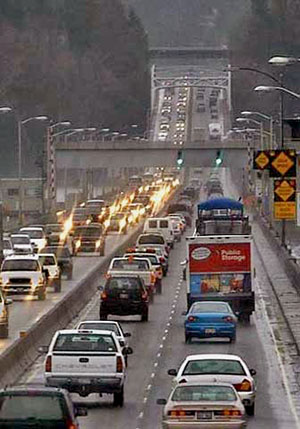
Residents of the Central Puget Sound region have been stuck in traffic for too long, and the situation is getting worse. Voter rejection of the Proposition 1 roads-and-transit measure should make us ask how we can make a difference — without waiting for a new package of projects that may take a decade to finish.
It is time to look at a broader policy of road pricing — to immediately improve mobility for everyone.
With the uncertainty of traditional revenue sources, we need a new approach that both addresses the growing demand for infrastructure and helps reduce greenhouse gas emissions, offers more alternatives to driving alone, and moves people and goods safely, reliably and on time.
One tool, which has seen only limited use in this state, would be charging for the use of roadways.
In the past, tolls have been imposed to support construction of major projects. We at the Municipal League of King County support a broader use of tolling to increase traffic flow through congested corridors, while at the same time recovering costs from those using the roads. This is how we price other goods and services when there is limited supply.
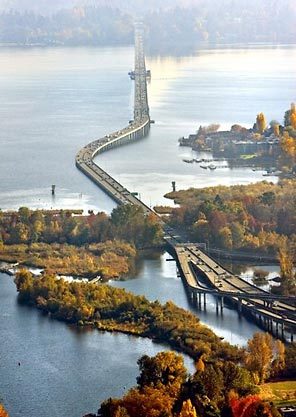
The Legislature is poised to pass a bill that would allow tolling to start soon on the Highway 520 Bridge in order to help fund construction of a new span and to meet the terms of a $135 million federal grant.
As an initial step, we support early tolling on the 520 Bridge, with variable pricing based on time of day and traffic conditions.
Higher pricing during high-use hours, lower pricing at less-congested times, has support across the political spectrum, in large part because it works so well to adjust supply and demand, and is paid by those actually using the roads. It is a user fee, not a general tax. Even users who initially opposed road fees embrace them because they reduce congestion and save time.
The concept is already familiar to anyone who uses a cellphone: Fees drop at times of day when the network is less busy.
Former Transportation Secretary Doug MacDonald has demonstrated with rice and a funnel how traffic in this area hits a tipping point: Add just a few more cars or trucks on a road at peak times and traffic slows to a crawl.
Studies by the U.S. Department of Transportation and the Puget Sound Regional Council indicate the same thing. They show that half the traffic at peak times is discretionary and that user fees work to encourage people to take those trips at other times. Moving as little as 8 percent of the trips to other times can increase flows dramatically.
Once road-pricing systems are in place, drivers have less need to add a "congestion cushion" to their trips in order to be on time for work, a flight or a meeting. Studies show that if a typical trip without congestion takes 20 minutes, drivers have learned that they need to allow 40 to 60 minutes, because they don't know when to expect a problem. This is wasted time, even when traffic ends up moving smoothly.
Variable tolls may be the one thing we can do that would have the most-positive effect, at the least cost, and take the least time to put into effect.
Reducing traffic jams not only saves time, but will save gas, lower carbon-dioxide emissions and help the economy by getting people where they need to be on time.
Many specifics are yet to be determined, including how to provide alternatives for those who can least afford to pay. The public should join the discussion on how to fairly and effectively implement variable tolls.
But, we should move quickly. Polls show that the No. 1 complaint in the region is traffic. Most feel that progress is far too slow to see any meaningful change for decades.
Variable road pricing could make a difference within months.
Bradley Meacham is the chairman of the Municipal League of King County. Steve Marshall, at right, is a member of the Municipal League's transportation committee.