The phrase,'Unsound Transit', was coined by the Wall Street Journal to describe Seattle where,"Light Rail Madness eats billions that could otherwise be devoted to truly efficient transportation technologies." The Puget Sound's traffic congestion is a growing cancer on the region's prosperity. This website, captures news and expert opinion about ways to address the crisis. This is not a blog, but a knowledge base, which collects the best articles and presents them in a searchable format. My goal is to arm residents with knowledge so they can champion fact-based, rather than emotional, solutions.

Transportation

Showing posts with label 1.52 Pierce County Admin. Show all posts

Wednesday, March 12, 2008

Pierce County pours cold water on Regional Governance

Leaders face battle over highway plans
DAVID SEAGO; THE NEWS TRIBUNE
Published: January 6th, 2008 01:00 AM
Let’s face it: The term “regional transportation governance” is a real snoozer. Couldn’t be wonkier.

But RTG, as I call it, involves big bucks, big power and the very future of the Puget Sound metro region. If you take the bus, ride a Sounder commuter train, drive I-5 or Highway 512 to work, RTG is about your life.

When Proposition 1, the massive roads-and-transportation tax package, cratered at the polls in November, a 2006 blue-ribbon panel’s RTG proposal sprang back to life.

Headed by former Seattle Mayor Norm Rice and Seattle telecom billionaire John Stanton, the panel recommended creating a single regional transportation board to rule all planning for transit and highway construction.

In its current incarnation, the board would consist of nine directly elected members and six appointed members, and it would have the authority to impose tolls and taxes.

RTG is a tough sell in Pierce County. But Stanton and another panel member, former state transportation secretary Doug MacDonald, are giving it a shot at Wednesday’s meeting of RAMP. The Regional Access Mobility Partnership is a coalition of Pierce County business, port and government officials that tries to form a countywide consensus on transportation issues.

Although it was hyperbolic, rude and, to my mind, embarrassing, a letter Pierce County Councilman (and county executive candidate) Shawn Bunney sent the governor in late November expressed widespread county sentiment about regional governance.

“The scene is set for another contrived feeding frenzy in the Legislature, which will leave Pierce County with crumbs,” Bunney cried.

He all but demanded a meeting with the governor to dispute “a Seattle-centric” view of the world. He accused Seattle legislators of “siphoning $700 million in gas taxes out of Pierce County” in the past 15 years.

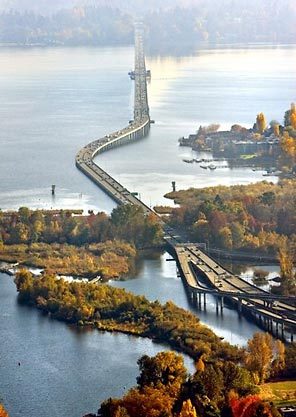
Bunney unloaded both barrels on the Highway 520 bridge replacement project, which the governor has declared her top transportation priority.

“To say that the 520 Bridge is a ‘safety’ project does not accurately portray the planned gold-plated entrances to the Emerald City and Clyde Hill-Medina. Current plans include $100 million for bike and pedestrian lanes, $250 million for five new parks created to muffle bridge noise, $700-$800 million for parks and lids on the east side of the lake, and a 50 percent capacity increase.

“The only thing missing is a giant archway from which trumpets can blare as Ron Sims enters and exits Seattle.”

Immoderate, to be sure, but the letter was meant to be a warning shot to RTG advocates.

Bunney was chairman of the Regional Transportation Investment District, the panel of local elected officials who devised the roads portion of Proposition 1.

On Wednesday, the RAMP group is also supposed to consider three possible scenarios for addressing Pierce County highway needs. All are “go it alone,” rather than regional, approaches.

One would be a Regional Transportation Investment District with just Pierce County or with another county (perhaps Thurston). Another would be a countywide transportation benefit district. The third would be imposing a countywide local-option gas tax.

The RAMP group is supposed to discuss its legislative priorities Wednesday. The Legislature convenes Jan. 14.

We might see a split in RAMP’s ranks. Pierce County Executive John Ladenburg, who has just stepped down as Sound Transit but still sits on the board, co-chairs RAMP. He has said he doesn’t favor a go-it-alone approach for Pierce County, but it’s not clear where he’ll come down on the governance issue.

Some transit advocates want to see the transit portion of Proposition 1 return to the ballot – separately – in November.

Another key RAMP player is Tacoma Port Director Tim Farrell. His overriding interest, presumably, is completion of Highway 167 from Puyallup to Interstate 5, a huge necessity for moving freight to and from the port. The county’s business community also strongly backs the project.

But the Highway 167 project, which is only a skimpy two-lane connector, is a $1 billion-plus job that would suck up most of the county’s local funding capacity. Completing it actually might be more likely under a regional funding scenario.

But who can tell? If the regional governance proponents have the upper hand in Olympia this year – and I think they may – it may not matter much what stand RAMP takes.

E-mail editorial page editor David Seago at david.seago@thenewstribune.com.

Monday, March 10, 2008

Endangered salmon put damper on construction in the Puget Sound area

Friday, April 21, 2000

By ROBERT McCLURE Mail Author
SEATTLE POST-INTELLIGENCER REPORTER

REDMOND -- Sick of sitting in traffic?

Can't find an affordable apartment?

Maybe you can blame it on salmon.

Thirteen months after federal officials declared Puget Sound chinook and eight other struggling salmon runs protected under the Endangered Species Act, a paperwork blizzard is stalling road-construction and efforts to build affordable housing, local officials told a U.S. Senate subcommittee yesterday.

None of the witnesses appearing at the Redmond hearing blamed the fish. At the heart of the problem, they said, is Congress' failure to provide enough money for the National Marine Fisheries Service and other agencies to deal with requirements of the Endangered Species Act.

"The amount of paperwork has just been stunning," Pierce County Executive Doug Sutherland told the Senate's interior appropriations subcommittee. "Even the simplest projects, it takes time for someone to take a look at it, make a determination and then move it to the next agency. . . .

"Just volume alone is enough to give you a pretty good case of constipation."

King County established a special office to deal with the law and loaned the fisheries service four workers. The state sent over seven extra people. Still, construction and road projects are slowed by the bottleneck. King County budgeted $86 million for road projects last year but could only get $53 million worth permitted, said King County Executive Ron Sims.

"Because of the extraordinary growth we're having here," Sims said. "What we're finding now is that federally funded affordable and low-income housing projects that are going through the for-profit and non-profit sectors (are) all being delayed."

Salmon once teemed in local waterways. But they have been reduced to a fraction of their former abundance by a variety of insults visited on them by civilization. Chief among them is pollution of clean, cold, fish-friendly streams with dirtier, hotter water.

That happens because of the way we build cities. Trees that once cooled streams are cut. Plants whose roots helped filter water gurgling into streams are replaced by streets and parking lots, where the water mixes with transmission fluid, oil and other impurities.

Listing salmon as "threatened" triggered automatic reviews of all construction involving federal money. The idea is to look for ways to minimize salmon-unfriendly building practices.

"When these projects get delayed, you're sitting in traffic," said Dan Klusman, public outreach manager for King County's endangered species office. "It's a good tradeoff -- you're sitting in your car a little longer to help fish."

Federal money is common in local construction projects, particularly when it comes to roads. For example, Sutherland said, the fisheries service had to review installation of a Puyallup stoplight that is a full mile from the nearest stream.

The same thing is happening all over Snohomish, King and Pierce counties, officials said. Add a turning lane to ease traffic congestion? The fisheries service has to look it over. Build a home for battered women? The fisheries service has to get a gander.

"It has had a fairly big effect on one project we're doing up in Bothell," said Tom Donnelly, a planner for Habitat for Humanity of East King County.

Habitat is building a shelter for battered women and some adjacent duplexes for low-income people near a stream in Bothell. It was one of the first projects to be reviewed under the new rules, Donnelly said.

"They were trying to figure out what they're doing. They had no structure," he said. "They didn't know what questions to ask us, so we didn't know how to respond. . . . The upshot of it all is, yes, this has been a fairly large delay."

Habitat and the county started wrestling with the situation in December and finally figured out a way to untangle it about two weeks ago, Donnelly said.

Will Stelle, regional director of the fisheries service, said the Clinton administration requested $30 million to help deal with the endangered species listings of West Coast salmon and similar fish, but Congress came up with only $9 million.

"We're continuing to ramp up slowly, but the funding is not there to get the job done," Stelle said.

It doesn't help that the fisheries service -- which specializes in managing fishing in the vast oceans -- must review construction in a sprawling metropolitan area.

"There's a significant learning process among all the agencies and jurisdictions," Sutherland told the subcommittee.

Private developers working without any federal money also face rules designed to protect salmon, but the rules are still being negotiated by the federal government and Pierce, Snohomish and King counties.

Agreement on the rules was expected before April 1, but the talks fell behind.

Why?

Sims and Sutherland say the National Marine Fisheries Service didn't have enough people to conduct the negotiations.

The articles are posted solely for educational purposes to raise awareness of transportation issues. I claim no authorship, nor do I profit from this website. Where known, all original authors and/or source publisher have been noted in the post. As this is a knowledge base, rather than a blog, I have reproduced the articles in full to allow for complete reader understanding and allow for comprehensive text searching...see custom google search engine at the top of the page. If you have concerns about the inclusion of a specific article, please email bbdc1@live.com. for a speedy resolution.