Environmental Impacts of Road Salt and Alternatives in the New York City Watershed
In our May/June 2001 issue, Janis Keating looked at what cities around the country are doing about deicing roads. This article takes a close look at salt’s potential impacts, with special focus on a single watershed.
By William Wegner and Marc Yaggi
The use of road salt as a deicer on roads and other impervious surfaces is the preferred method to promote safe motor vehicle and pedestrian travel during winter months. The most commonly used deicing salt is sodium chloride (NaCl), which is readily available and inexpensive and effectively depresses the freezing point of water to melt ice. But what are the impacts of road-salt application to drinking-water supplies and watershed ecosystems?
Historically, regulators in the management of nonpoint-source pollution have been concerned principally with heavy metals, nutrients, hydrocarbons, pathogens, and sediment that scour from road surfaces in stormwater runoff and contaminate groundwater and surface-water supplies. Recently, after more than half a century of its widespread use in North America, the application of NaCl and its environmental consequences have come under scrutiny by the environmental and scientific communities as well as regulators and legislators. Growing concern over roadside habitat degradation, wildlife kills, and water-quality issues in Canada prompted Environment Canada (EC) to conduct a comprehensive assessment of road-salt application to determine whether conventional deicers should be considered toxic substances under the Canadian Environmental Protection Act (EC, 1999). California and Nevada restrict road-salt use in certain areas to reduce chloride injury to roadside trees. Massachusetts turned to alternative road deicers to prevent sodium contamination of residential drinking wells. New York State legislators recently proposed a pilot study in the New York City watershed to examine road-salt alternatives that might be more protective of drinking-water quality.
Road salt is often applied in areas with narrow buffers to surface waters.
There are compelling concerns behind these legislative decisions. According to the National Research Council (NRC), road-salt use in the United States ranges from 8 million to 12 million tons of NaCl per year. Massachusetts, New Hampshire, and New York report the highest annual road-salt loadings, with Massachusetts the highest at 19.94 tons/lane-mi./yr. New York’s annual road-salt loading averages 500,000 tons/yr. or 16.6 tons/lane-mi./yr. (NRC, 1991). The New York State Department of Transportation (NYSDOT) requires a road-salt application rate of 225 lb./lane-mi. for light snow and 270 lb./lane-mi. for each application during rapidly accumulating snow (NYSDOT, 1993). What has been the fate of millions of tons of NaCl that has been deposited on impervious surfaces in close proximity to unfiltered drinking-water supplies? This article reviews the findings of several government and peer-reviewed road-salt studies and discusses them in the context of environmental and water-quality impacts in the New York City watershed.
New York City’s Watershed
Nineteen reservoirs and three controlled lakes in upstate New York provide more than 9 million consumers with 1.5 billion gal. of unfiltered drinking water daily. The reservoirs and lakes are located in three distinct watersheds–Croton, Catskill, and Delaware–covering 2,000 mi.2 of forested, agricultural, and suburban lands. There are approximately 6,000 mi. of paved roadways in the watersheds, where road-salt application ranges from 37 to 298 tons/lane-mi./yr. Two-lane town, county, and state roads receive 37 tons/lane-mi./yr. The Taconic Parkway, which travels through three watershed sub-basins in the Croton watershed, receives 75 tons/lane-mi./yr. Interstate 84 travels through two sub-basins in the Croton watershed and receives 298 tons/lane-mi./yr. (Heisig, 2000).
The 1997 New York City Watershed Memorandum of Agreement regulates land use and water-quality protection in the New York City watersheds. A comprehensive protection scheme signed by more than 60 watershed towns, New York City, New York State, USEPA, and five environmental organizations, the Watershed Agreement protects drinking water through land acquisition, land-use regulations, and partnership programs. Most of the regulations and partnership programs are framed to prevent pollutants from entering the water supply. Road salt, however, is a pollutant that received little attention in the Watershed Agreement. Aside from a partnership program in which New York City pays to construct salt and sand storage facilities in watershed towns, road salt is not specifically regulated in the Watershed Agreement.
Environmental Fate and Transport
Chloride salts are composed of approximately 60% chloride and 40% positive ion. Deicing operations use calcium, potassium, and magnesium chlorides, but to a lesser degree than NaCl. These salts may be applied in liquid or crystalline form, either of which can be used in conjunction with abrasives. Liquid salt solutions provide immediate deicing upon application to roads and sidewalks. Crystalline forms are slower and longer acting than liquid solutions. Sodium ferrocyanide is added to chloride salts to prevent clumping during storage and application. In water, sodium ferrocyanide can be photolyzed to release approximately 25% cyanide ions (EPA, 1971).
Runoff to surface waters and percolation to groundwater are the most common mechanisms for road salts to enter water supplies. Infiltration is more common for groundwater-based supplies. In the New York City watersheds, groundwater is a major contributor to streams. Groundwater discharge accounts for at least 60% of total annual stream flow in the Croton watershed. Chloride concentration in groundwater supplies exhibits a relatively linear relation to road-salt application rate or two-lane road density throughout the year. In surface-water supplies, chloride concentration depends on salting intensity, soil type, climate, topography, and water volume, with larger water bodies exhibiting lower concentrations through the process of dilution. Deicing salts applied to roads during winter are the primary source of solutes to groundwater in the Croton watershed, where chloride concentrations in baseflow of sampled streams ranged from 18 to 280 mg/l (Heisig, 2000).
NaCl dissociates in aquatic systems into chloride ions (CL-) and sodium cations (Na+). While sodium may bond to negatively charged soil particles or be taken up in biological processes, chloride ions are less reactive and can be transported to surface waters through soil and groundwater. Road salts applied to roadways can enter air, soil, groundwater, and surface water from direct or snowmelt runoff, release from surface soils, and/or wind-borne spray. These salts remain in solution in surface waters and are not subject to any significant natural removal mechanisms (EC, 2000). Their accumulation and persistence in watersheds pose risks to aquatic ecosystems and to water quality. Approximately 55% of road-salt chlorides are transported in surface runoff with the remaining 45% infiltrating through soils and into groundwater aquifers (Church and Friesz, 1993). Chloride ion exchange in soils is predicted to reach a steady-state concentration–the point at which input at the subsurface equals output in baseflow–of 400 mg/l within 200 years of initial salt application (Howard et al., 1993).
Soils
Soil biotic communities cycle nutrients, decompose organic matter, and increase soil aeration and water-holding capacity. EC (2000) reported soil chloride concentrations exceeding 200 mg/l as far as 200 m from roadsides. EPA has set the Secondary Maximum Contaminant Level (SMCL) for chloride at 250 mg/l in drinking-water supplies.
Exposure to NaCl inhibits some soil bacteria at concentrations as low as 90 mg/l, which ultimately compromises soil structure and thereby inhibits erosion control. Federal standards for turbidity require that a drinking-water supply not exceed 5 nephelometric turbidity units; however, the creation of friable soils from bacteria die-off can increase the suspension of sediment in runoff and contaminate drinking-water supplies to levels that exceed standards. These changes in soil conditions could lead to turbidity violations and trigger an automatic filtration order requiring New York City to construct a filtration plant at the cost of up to $8 billion.
Vegetation
Road salt eventually finds its way into Kensico Reservoir, one of New York's drinking-water sources.
Elevated sodium and chloride levels in soils create osmotic imbalances in plants, which inhibit water absorption and reduce root growth. Salt also disrupts the uptake of plant nutrients and inhibits long-term growth. EC (2000) cites numerous studies attributing tree injury and decline to road-salt application, concluding that NaCl can cause severe injury to the flowering, seed germination, roots, and stems of roadside plant species. Damage to vegetation can occur up to 200 m from roadways that are treated with deicing salts. Up to 50.8% of woody plant species are sensitive to NaCl, and many of these have disappeared from Canadian roadsides. Of the 15 principal tree genera occurring in Canadian forests, 11 have been rated as sensitive to road salt. Threshold values for woody and herbaceous plant forms can be as low as 67.5 ppm in soils, with pine seedlings being the most sensitive; 280 ppm in herbaceous tissues; and 200 ppm in woody tissues. Plants may be sensitive to concentrations of either or both salt ions present in soil. An Ontario study reported a soil chloride concentration of 1,050 ppm in soil taken from a highway median and 890 ppm in soil sampled 10 m from the highway (Hofstra and Smith, 1984). NaCl exposure as low as 100 ppm in soil inhibits seed germination and root growth rates for grasses and wildflowers. As a result of salt concentrations in roadside soils, salt-tolerant halophytic plant species, formerly endemic to coastal wetlands, now colonize inland roadsides (EC, 2000). These species include cattails and Phragmites, both of which can be indicators of degraded wetlands subject to excessive nutrient loading and/or salt contamination.
Damage to vegetation can amplify adverse impacts on drinking-water quality in the New York City watersheds. Degradation of soils and vegetation in buffer areas between roads and watercourses compromises the retention and processing of pollutants transported in stormwater runoff and diminishes the beneficial value of buffer zones to groundwater sources and reservoirs. Impacts to water quality can be particularly acute when high level-of-service roads are adjacent to drinking-water reservoirs insulated by narrow buffers, as is the case in several of the New York City watershed sub-basins.
Wildlife
Damage to vegetation degrades wildlife habitat by destroying food resources, habitat corridors, shelter, and breeding or nesting sites. Behavioral and toxicological impacts to wildlife also are associated with road salts. Sodium-deficient wildlife sometimes travel great distances to ingest road salt. Many animals tend to overshoot their salt deficit and then drink salty snow melt to relieve thirst, which increases salt toxicity in blood and tissues (EC, 2000). While wildlife impacts might not be construed as directly relating to water-quality impacts, kills and population declines among salt-sensitive species can be indicators of salt toxicity in aquatic ecosystems.
Mammals. In Jasper National Park, AB, road-salt ingestion is responsible for kills of elk and bighorn sheep. In northern Ontario and Quebec, ingestion of salty snowmelt is a major cause of moose/vehicle accidents. Salt toxicosis has not been documented in moose or deer, but moose drinking salty water lose their fear of vehicles and humans. Road-salt—related mortality of small mammals commonly killed by traffic, while probably significant, remains to be studied. The LD50 (lethal oral dose at which 50% of a population dies) for rats is 3,000 mg/kg body mass (EC, 2000), which is comparable to the lethal mean for birds.
Birds. EC (2000) cites 12 reports of bird kills associated with road salt in the US, Canada, and Germany. Two reports involved kills in excess of 1,000 birds. Seed-eating birds may not be able to distinguish between road-salt crystals and the mineral grit their diets require. Laboratory studies of sparrows consuming salt particles at the upper limits of their known preference range reveal that ingestion of 0.25 NaCl particles (266 mg/kg) results in a breach of homeostasis; ingestion of 1.4 particles (1,500 mg/kg) may result in death (median lethal dose = 2.8 at 3,000 mg/kg). This means behavioral abnormalities can occur in small bird species with ingestion of a single salt particle and death can occur with ingestion of two particles. Salt toxicosis in birds increases their vulnerability to car strike. The local human inhabitants near Mount Revelstoke Park, BC, refer to winter finches as "grille birds" because of the large numbers that collect on the grilles of moving vehicles. Although there is a high correlation between the distribution of winter finches and the Canadian road system receiving salt, risk characterization is difficult to assess in terms of kill frequency because of the various mechanisms–fatal attraction, toxicosis-induced car strike, lethal ingestion–that contribute to mortality. Nevertheless, EC concluded that transportation officials probably underestimated the contribution of road salt to wildlife kills.
Aquatic Biota. Road-salt loadings in surface waters vary with regional climate conditions, season, and air temperature fluctuation. Snowmelt may proceed gradually overall, but it increases dramatically following application of road salt. Shock loads of salt to aquatic ecosystems might last less than a day following application, with concentration decreasing thereafter. Salt held in solution in snow or deposited on surface soil layers is readily dissolved by rain and can be transported to receiving waters in runoff. Prolonged retention of salt in streambeds or lakebeds decreases dissolved oxygen and can increase nutrient loading, which in turn promotes eutrophication.
Toxicity responses of aquatic organisms to NaCl vary. Laboratory studies report that the LC50 for six freshwater fish and crustacean species exposed to NaCl for one day ranged from 2,724 to 14,100 mg/l with a mean of 7,115 mg/l (Cowgill et al., 1990). These values decreased significantly as exposure time increased. The LC50 for 17 species of fish, amphibians, and crustaceans exposed to NaCl for seven days ranged from 1,440 to 6,031 mg/l with a mean of 3,345 mg/l (EC, 2000).
Reports of chloride concentrations in highway runoff run as high as 19,135 mg/l. Salt tolerance of fishes ranges from 400 to 30,000 mg/l, greater than the salt concentration of seawater. A seven-day exposure of 1,000 mg/l is lethal to rainbow trout (NRC, 1991). While an estimated 10% of aquatic species will exceed their critical tolerance values for chloride with prolonged exposure to concentrations above 220 mg/l, many of the macroinvertebrates upon which the more tolerant species feed might exhibit lower tolerances. Stream studies in northern New York revealed that benthic diversity decreases as salinity increases and dominance of salt-tolerant invertebrates is synchronous with periods of road-salt application. Salinity stresses the periphyton community upon which benthic grazers forage and inhibits microbial processing of leaf litter (EC, 2000). Reduction of primary productivity causes repercussions at the top of the food chain in addition to the stress salinity imposes on the organisms themselves. The presence of salt in aquatic ecosystems also releases toxic metals from sediment into the water column and impairs distribution and cycling of oxygen and nutrients.
Human Health Impacts
New York State Department of Transportation plowing and spreading.
A Federal Highway Administration (FHWA) study concluded that the major objection to concentrations of sodium in public water supplies arises from the taste preference of consumers (Winters et al., 1985). EC agreed that the primary problem of road salt in drinking water is its adverse effect on taste. NRC’s Transportation Research Board reported a more serious concern of road salt’s impact on human health. Excess dietary sodium is associated with hypertension, and up to 30% of the US population could have borderline to pronounced hypertension. This amounts to nearly 3 million New Yorkers potentially affected by road-salt loading. EPA requires that sodium concentrations in drinking water not exceed 20 mg/l and requires monitoring and reporting of higher levels in public water supplies (NRC, 1991).
Infrastructure Impacts
In addition to the public health and environmental problems associated with chloride deicers, the corrosivity of road salt adversely impacts motor vehicles and infrastructure. Chloride ions in salt increase the conductivity of water, which induces and accelerates corrosion. In automobiles, corrosion can affect critical vehicle parts, such as brake linings, frames, and bumpers, and can cause cosmetic corrosion. Corrosion protection practices increase the cost of auto manufacturing by nearly $4 billion/yr. (NRC, 1991).
Although road salt rarely jeopardizes the structural integrity of bridges, its corrosivity damages bridge decks. Chloride ions penetrate concrete and corrode reinforcing rods, causing the surrounding concrete to crack and fragment. Installing corrosion protection measures in new bridges and repairing old bridges could cost Snowbelt states between $250 million and $650 million per year. Similarly, road salt causes reinforcing steel in parking garages to rust, thereby compromising the structural integrity of the surrounding concrete. Installing corrosion protection measures in parking garages and restoring damaged parking garages could easily cost Northeast and Midwest states between $75 million and $175 million per year. Other roadside hardware and some nonhighway objects near salt-treated roads also are affected by the corrosive properties of road salts (NRC, 1991).
Road-Salt Alternatives
Calcium Magnesium Acetate
NRC (1991) examined calcium magnesium acetate (CMA) as an alternative to road salt in deicing operations. CMA solution is prepared by dissolving solid CMA in water. Optimal concentration in solution is 25%. NRC concluded that CMA is relatively harmless to plants and animals, noncorrosive to metals, and nondestructive to concrete and other highway materials. Because of its low density and small particle size, CMA may be dusty during handling and storage and may blow off roadways after spreading. When exposed to moisture, CMA can clog spreading equipment.
The calculated ratio of CMA to salt for comparable ice melting is 1.7:1. In practice, however, the amount varies. An Ontario study lowered the ratio to 1.5:1 and found CMA to be effective in penetrating light snowpack and preventing pavement icebond (Manning and Crowder, 1989). A study by Wisconsin Department of Transportation (1987) reported application rates of CMA at 1.2-1.6 times greater than salt. CMA also functions as an effective anti-icer when applied prior to or at the outset of snow events at rates 20-40% higher than salt. Washington State uses CMA in anti-icing operations to reduce the volume of sand-based abrasives that enter salmon spawning streams in snowmelt and stormwater runoff (Washington State Department of Transportation, personal communication).
CMA acts more slowly and is less effective than salt in cold conditions. Notwithstanding the difference in application rate, CMA’s deicing performance is comparable to that of salt but less successful in melting accumulated snow and ice. The California Department of Transportation (1989) found CMA effective in preventing the formation of snowpack but less effective than salt treatments in removing heavy snowpack and less effective at temperatures below 23ºF. In general, nearly all studies of CMA rated the substance as an acceptable deicer but not as effective or consistent as salt when applied in equal amounts. As experience with CMA increases, some highway agencies predict its ratio to salt application will approach 1:1.
Health and Environmental Impacts. Comprehensive studies performed by Caltrans (Winters et al., 1985) and the National Cooperative Highway Research Program (NCHRP) found CMA to be much more environmentally benign than NaCl (Horner et al., 1988). The Caltrans study found few adverse impacts associated with CMA. CMA was less toxic to fish than road salt, although Caltrans associated CMA concentrations of 5,000 mg/l with slightly delayed hatching in rainbow trout. At high exposure levels CMA is more toxic to phytoplankton than sodium chloride. Inhibitory effects in algae occurred at CMA concentrations of 85 mg/l; algae did not exhibit any inhibition from sodium chloride at test concentrations. The CMA LC50 for rainbow trout is 18,700 versus the NaCl LC50 of 12,200 (Cheng and Guthrie, 1998).
In soils, CMA tends to exchange calcium and magnesium with other metals already present. CMA can extract iron, aluminum, sodium, and potassium from roadside soils but is less harmful to plants than road salt. Of 18 tree species tested, only the Russian olive was more sensitive to CMA than to NaCl (NRC, 1991). CMA may actually stimulate plant growth by improving soil structure and permeability (Cheng and Guthrie, 1998).
NCHRP reported that CMA decomposes within two weeks when in soils at temperatures above 50ºF. At 35.6ºF, decomposition time was around four weeks. Two potential problems associated with CMA are temporary oxygen depletion in water from CMA decomposition and the potential for phosphorous enrichment of surface waters that are exposed to high concentrations of CMA derived from agricultural products.
Costs. The average cost of road salt is $30/ton. NRC (1991) estimated the cost of CMA between $500 and $700/ton. The $500 figure represents use of a corn fermentation process to derive acetic acid, which reacts with dolomitic lime to produce CMA. Chevron Chemical Company produces CMA using acetic acid from natural gas and sells the product for $600-$700/ton delivered. Conversion to CMA would incur additional costs to municipalities in the modification of storage, handling, equipment and spreading operations.
Potassium Acetate
Potassium acetate (KA) is often used as a base for commercial chloride-free liquid deicer formulations. Its advantages include low corrosion, relatively high performance, and low environmental impact. Although less study information is available on KA, some of the findings are clear.
Health and Environmental Impacts. Health impacts of KA are slight. Inhalation of the substance may cause mild irritation to the respiratory tract. The Material Data Safety Sheet for KA documents no significant adverse effects from skin and eye contact with the product.
As with NaCl and CMA, KA can temporarily deplete oxygen in aquatic ecosystems but may stimulate plant growth. The 96-hour LC50 for rainbow trout is 1,500 mg/l. Along with CMA, KA is one of the most benign road-salt alternatives because it contains nonpersistent, biodegradable acids. Cryotech CF7, a commercial form of KA, has been selected for use in Yosemite National Park. KA is stable and is removed from application areas by flushing, dispersion, and dilution. Davis et al. (1994) concluded that KA does not penetrate groundwater aquifers and does not impact water chemistry. Cost of KA is $700-$800/ton.
Conclusions
Applying road salt in deicing operations could create significant adverse health, environmental, and infrastructure problems. Equally troubling is the fact that New York State applies up to 298 tons of road salt/lane-mi./yr. in the unfiltered drinking-water—supply watersheds for more than 9 million citizens. This level of salt use jeopardizes the health of consumers having heart or kidney disease, destroys protective vegetation and soil, and corrodes automobiles, bridges, and other infrastructure.
CMA and KA both appear to be viable road-salt alternatives. No significant health, environmental, or infrastructure impacts occur with the use of these alternatives. CMA is the most studied of all road-salt alternatives; more field studies should be performed using KA. Both products are preferable to road salt in the New York City drinking-water—supply watersheds, which supply drinking water to more than half of New York State’s population.
The biggest drawback to using CMA and KA is high cost. It will be a challenge to mandate or obtain buy-in from watershed communities to use these products at $500-$700/ton versus $30/ton for road salt. Perhaps some communities will recognize the cost savings to public health, the environment, and local infrastructure from using road-salt alternatives. At present, however, the most likely mechanism for introducing CMA and KA in the New York City drinking-water—supply watersheds is through legislative mandate.
References
California Department of Transportation. Technical Report: A Summary of CMA Use and Research and Development, Specifically in California. Division of Technology and Research, Sacramento, CA. 1989.
Cheng, K.C. and T.F. Guthrie. Liquid Road Deicing Environment Impact. Levelton Engineering Ltd., Richmond, BC. www.wsdot.wa.gov/fossc/maint/pns/EnvImpacts.pdf. 1998.
Church, P.E. and P.J. Friesz. Effectiveness of Highway Drainage Systems in Preventing Road-Salt Contamination of Groundwater: Preliminary Findings. Transportation Research Board. Transportation Research Record 1420. http://books.nap.edu/books/NI000009/html/3.html. 1993.
Cowgill, U.M. and D.P. Milazzo. "The sensitivity of two cladocerans to water quality variables: salinity and hardness." Arch. Hydrobiol. 120(2): 185-196. 1990.
Davis, G., S. Krannitz, and M. Goldstein. Phase II: A reconnaissance study of roadside tree injury and decline at 17 sites in interior British Columbia for the Roadside Tree Injury Committee. British Columbia Ministry of Environment, Lands and Parks, Victoria, BC. 1992.
Environment Canada. Priority Substances Assessment Report: Road Salts. www.ec.gc.ca/cceb1/eng/public/road_salts.html. 2000.
Heisig, P.M. Effects of Residential and Agricultural Land Uses on the Chemical Quality of Baseflow of Small Streams in the Croton Watershed, Southeastern New York. US Geological Survey Water-Resources Investigations Report 99-4173. http://ny.usgs.gov/projects/misc/WRIR99-4173.pdf. March 2000.
Hofstra, G. and D.W. Smith. "The effects of road deicing salt on the levels of ions in roadside soils in southern Ontario." Journal of Environmental Management. 19:261-271. 1984.
Horner, R. NCHRP Report 305: Environmental Monitoring and Evaluation of Calcium Magnesium Acetate (CMA). National Research Council. 1988.
Howard, K.W.F., J.I. Boyce, S.J. Livingston, S. Salvatori, and Groundwater Research Group at University of Toronto. "Road Salt Impacts on Ground-water Quality." GSA Today. Volume 3, Number 12. www.history.rochester.edu/class/roadsalt/home.html. December 1993.
Manning, D. and L. Crowder. Comparative Field Study of the Operational Characteristics of Calcium Magnesium Acetate and Rock Salt. National Research Council, Transportation Research Record 1246. 1989.
National Research Council, Transportation Research Board. Highway Deicing: Comparing Salt and Calcium Magnesium Acetate. Special Report 235. www.nas.edu/trb/publications/sr235.html. 1991.
New York State Department of Transportation. Highway Maintenance Guidelines; Snow and Ice Control. December 1993.
US Environmental Protection Agency. Environmental Impact of Highway Deicing. Edison Water Quality Laboratory, Edison, NJ. 1971.
Winters, G., J. Gidley, and H. Hunt. Environmental Evaluation of CMA. Report FHWA-RD-84-095. FHWA, US Department of Transportation. 1985.
Wisconsin Department of Transportation. Field Deicing Tests of High Quality Calcium Magnesium Acetate (CMA). Madison, WI. 1987.
William Wegner is a watershed analyst and Marc Yaggi is a senior watershed attorney with Riverkeeper Inc., a nonprofit environmental organization based in Hudson Valley, NY.
Transportation
Monday, March 24, 2008
WA uses CMA to de-ice which is 10 times more expensive than Salt


Wednesday, March 12, 2008
Green roads are just around the corner
PAVING THE WAY FOR GREEN ROADS
DURHAM, N.H. –Kevin Gardner sees green roads right around the corner.
“A lot of the infrastructure in this country needs to be re-built,” says Kevin Gardner, UNH Associate Professor of Civil Engineering and Director of the Environmental Research Group in Durham. “A lot of the infrastructure in this country needs to be re-built,” says Gardner, UNH Associate Professor of Civil Engineering and Director of the Environmental Research Group in Durham. “We have a real opportunity to re-build the infrastructure the right way with sustainable materials and socially sensitive designs that protect air, water, land, and human resources.”
Funded by the Federal Highway Administration and pooled state highway funds, as well as EPA grants for specific research projects, Gardner established the new Recycled Materials Resource Management Center (RMRC) at UNH in Durham on June 1, 2007. The RRMC is a collaboration between UNH environmental and social impact researchers and University Wisconsin-Madison geotechnical, or soil behavior, faculty. Working closely with a board of advisors composed of representatives from the EPA, the Federal Highway Administration and the American Association of State Highway and Transportation Officials, as well as numerous other stakeholders, one of the Center’s activities is to establish a green roads program that develops criteria for what makes a roadway green.
Similar to the green buildings program established by the U.S. Green Building Council, which triggered a boom in green building construction, a green roads program, it is believed, will give the green light to sweeping reforms in the way we build roads. The project is full of twists and turns. Today’s urban sprawl requires road builders to confront a range of sensitive issues involving air, water, land, building materials, energy use, biodiversity, and social capital—an index of social productivity and quality of life.
To jump-start the process, the RMRC faculty teamed up with the UNH Stormwater Center in Durham. Their task is to account for both environmental and social impacts of road-building, as well as establish better uses of recycled and virgin aggregate materials, such as crushed rock, much of which must be transported from New Hampshire. Green standards, according to Gardner, will give road builders the guidelines they need to effectively reduce the environmental impacts (such as carbon footprint, wetlands disturbance, and stormwater runoff generation) and improve the quality of life in communities affected by infrastructure re-construction.
The first step is to figure out how to reduce the 300 million tons of virgin aggregate materials mined in this country every year. The U.S. currently recycles 90% of used asphalt, but still uses a large percentage of virgin materials in the recycled mix. The question is, can pavement be made with 90% recycled asphalt, or does it have to be less than 40% or even 20% to get a roadbed that lasts? What happens to the modifiers that bind these materials over time? How recyclable are the recycled materials?
“The cost of building a road is not reflected fully in the price of materials,” Gardner adds. “The total cost of mining virgin materials, for instance, involves not only the cost of materials and labor, but also the environmental cost at the mining site, the environmental costs (such as air pollution and it’s associated health care costs) of transporting these materials to the building site, and the environmental costs of building the equipment to mine and transport material and build the roads.”
To account for these hidden costs, the RMRC created a computer model that Gardner’s Ph.D. student Alberta “Birdie” Carpenter uses to capture the full environmental, social and material costs of road-building. The model was recently “road-tested” in the Pittsburgh region to help identify the significant influence that materials recycling can have on regional air quality, hazardous waste generation, green house gas emissions and other environmental impacts.
Research and development of better ways to re-build infrastructure is only half the battle. The other half is education and outreach to developers, road-builders, and engineering students. In addition to publishing and publicizing the results of their research and green roads standards, the RMRC is now offering a sustainable engineering class at UNH and expects to have fellowship and Ph.D. programs by 2010.
“The first green roads will probably start with small housing developments and municipalities because developers and local developers have already seen the benefits of green building construction,” says Gardner, “but as the benefits and cost-savings begin to be realized on a bigger scale, we believe the RMRC green roads program will pave the way for rapid adaptation at all levels of road-building."
Monday, March 10, 2008
Asphalt Rubber reduces 520 road noise; no greater cost
12/17/07
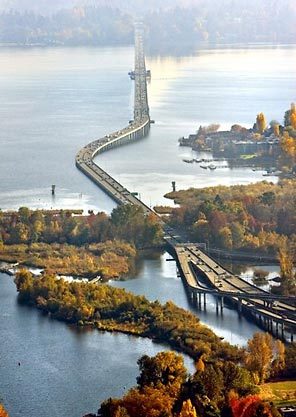
Listen closely: Our roads are getting quieter. Highway 520's sweet spot — a sliver of freeway near the eastern end of the Evergreen Point Floating Bridge — is so smooth and quiet even an ancient Geo Metro feels like a first-class cabin.
This is a test. This is only a test.
But to Walter Scott (see pic at bottom), those 2.25 miles between Hunts Point and Medina sound a lot like success.
Thanks in part to Scott's advocacy, the state Department of Transportation (DOT) is testing materials there designed to turn down the din of traffic.
The DOT calls them "quieter pavements."
Those who drive the highway or live nearby call it a huge improvement: "People who live along 520 are like, 'You are a godsend,' " Scott said.
Another test site is set up on Interstate 5 near Lynnwood, and next year workers will begin laying quieter-pavement sections on I-405 in Bellevue.
If the results are promising, Scott and others are hoping freeway noise will someday drop from a scream to a whisper.
The new materials, already being used in a half-dozen states and a handful of countries, contain tiny voids, like a Rice Krispies bar, that trap sound waves rather than letting them bounce around on the surface.
The tests will compare the new materials with existing ones to determine how long they would last, how much they would cost and how quiet they are.
Scott is optimistic.
Six years ago he sought a noise wall to block the constant drone at his Beaux Arts home from cars crossing the I-90 bridge. When that effort failed, he switched to ground-level technology and a grass-roots approach. Together with civic groups, city councils, state representatives and a host of individuals, he organized a coalition of advocates who asked Gov. Christine Gregoire to direct the DOT to test quieter pavements.
It worked.
Now when people assume residents of Hunts Point and Medina got a test section on 520 because they're rich, Scott is quick to respond.
"They got it because they asked for it," he says.
Noisy "tire slap"
Grab a friend. Go outside, stand 3 feet apart, and speak in normal tones.
If you can't understand each other, ambient noise has likely exceeded 66 decibels. When freeway sound gets that loud, the state will often try to mitigate it with noise walls, trees or earthen berms.
The problem is the pavement. "Tire slap" — the sound produced when rubber meets the road — accounts for about 70 percent of all noise on roads where speeds exceed 30 miles per hour.
When workers in Phoenix paved the city's potholes with crumbs of recycled tires in the 1960s, they accidentally discovered a way to decrease the impact of tire slap. The recycled rubber not only smoothed the streets, but it also dampened sound. Asphalt rubber was born.
Since 1988, the Arizona Department of Transportation has used asphalt rubber in more than 3,000 miles of pavement overlays. Arizona now recycles 70 percent of its used tires back into the highways, eating up about 1,500 tires per lane mile of highway.
Although the federal government doesn't recognize pavement types or textures as a form of noise mitigation, that hasn't kept asphalt rubber from oozing into California, Arizona, Texas, Florida, Alabama and Georgia.
Washington joined them in August 2006, paving 1.07 miles of asphalt rubber and an additional 0.77-mile strip of polymer-modified asphalt on southbound I-5 in Lynnwood, alongside conventional, dense-graded asphalt. In July of this year, the Washington state DOT installed similar test sections on Highway 520, between Hunts Point and Medina.
Next year, the agency will do more testing on I-405 in South Bellevue. That project will include 1.25 miles of rubberized asphalt and 1.25 miles of a polymer quiet pavement on northbound I-405 from Southeast Eighth Street to Coal Creek Parkway and southbound from I-90 to Coal Creek Parkway.
The biggest obstacle to quiet pavement's success here is the state's cool, wet climate, said Linda Pierce, the state's pavements engineer.
The extra air holes in asphalt rubber increase sound absorption but also let in more water and air. Pressure from air and water, both inside and outside the pavement, can loosen the aggregate.
Studded tires in the winter make it worse, picking away at the loose aggregate, Pierce said, so that "like a piece of wallpaper on a wall, you get one little piece of it and you can tear the whole thing down."
Earlier rubber trials
It's not the first time the DOT has put rubber in the road. In the 1990s, the agency added crumb rubber from recycled tires to a dense-graded asphalt south of Olympia to see whether it would cut down on cracking.
That material added 20 to 30 percent more to the cost, Pierce said, "and we weren't seeing a 20 to 30 percent improvement in pavement life."
Quieter pavements may be another story. The DOT is using a different mix of asphalt rubber with the goal of determining whether any of the new pavements are quiet enough, and last long enough, to justify the cost.
Pound for pound, asphalt rubber and polymer asphalt are more expensive than conventional asphalt, but since they're placed at half the thickness, they end up costing about the same. However, asphalt rubber's life span tends to be several years shorter, Pierce said.
To measure sound and compare results with those in other states, the DOT mounts a microphone on a rear wheel of a vehicle, about 2 inches above the pavement.
Recent tests show older asphalt registers about 105 decibels; brand-new conventional asphalt registers about 100 decibels, and new rubberized asphalt tends to be about 95 to 96 decibels.
States using asphalt rubber have reported it reduced road noise by nearly half. Recent test results on 520 showed new rubberized asphalt and a new polymer paving product also cut noise by about half, although road wear and weather could diminish this effect over time.
Shawn Gilbertson, the DOT acoustics special-studies manager, said his team is trying to get the best, most accurate data.
"Increasingly, WSDOT has to listen to what the public is saying," said Gilbertson, who acknowledges Scott's contribution to the push for quiet pavement. "Part of the reason we are looking into this technology is because people were asking us to do so."
If transportation corridors improve the environment and neighborhoods, people also may be more likely to support paying for them, an argument made by several state legislators in a letter to Gregoire last year urging tests of quieter pavement.
It will be five years or more before the DOT can tell how well the quieter pavements perform, but Pierce, the materials engineer, said there's reason to be hopeful. "I've spent the last nine months of my career on quiet pavement," she said. "This is what we do now."
Even if the tests are successful and the state finds a use for quieter pavement, repaving is an incremental process. It could be decades before it comes to a roadway near you.
The important thing, Scott said, is the state is taking a serious look at the new technology.
"WSDOT is now seen as the darling child for being innovative — and they should be," he said.
"It was the good idea that couldn't be killed."

KEN LAMBERT / THE SEATTLE TIMES
Walter Scott, of Beaux Arts, pressed the state to try paving materials that might reduce road noise. The state has responded, including a test stretch on Highway 520.
Testing 2 kinds of quieter pavement
In the 1960s, when most of the state's freeways were built, Portland-cement concrete — a strong but noisy material — was the standard. Some roads have since been overlaid with conventional asphalt. Here's what the state is testing:
Asphalt rubber: Is standard asphalt with granular rubber particles used to bind the aggregate together. Since asphalt rubber is usually 15 to 20 percent air — compared with about 4 percent in conventional asphalt — it has more spaces to trap sound waves than conventional asphalt.
Polymer-modified asphalt: An asphalt that uses polymer, a synthetic fibrous material, instead of rubber to bind the aggregate. Like asphalt rubber, it contains a greater percentage of air voids than conventional asphalt, enhancing its ability to absorb sound.
Seattle Times Eastside bureau