Environmentalists balk at roads plan
By Mike Lindblom
Seattle Times transportation reporter
Two environmental groups are criticizing this fall's proposed "Roads & Transit" ballot measure, making a tough sell more challenging for elected officials who seek its passage.
The Sierra Club says there are too many general traffic lanes, in spots such as Interstate 5 north of Federal Way, that would worsen global warming instead of solving safety problems.
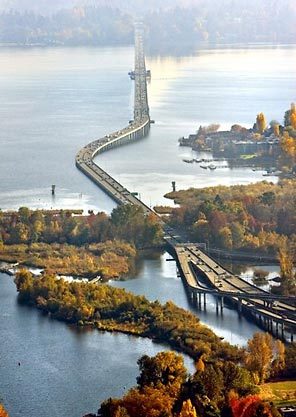
And the Transportation Choices Coalition believes a proposed six-lane Highway 520 floating bridge is too large through the Washington Park Arboretum and the state doesn't plan to raise the full $4.4 billion needed for construction, said executive director Jessyn Farrell.
At $31 billion, a joint roads-and-transit package is nearing its final shape, five years after the Legislature created the Regional Transportation Investment District to propose road improvements for King, Snohomish and Pierce counties.
State law requires new regional road and transit taxes to pass together, or they both fail. The Sierra Club prefers a separate public vote on Sound Transit's proposed light-rail extensions to Lynnwood, Overlake and Tacoma.
Plan supporters point to polls done for Sound Transit that indicate firm public support.
Officials are talking with the environmental groups. Roads-group Chairman Shawn Bunney, a Pierce County councilman, called the task "a fine balancing act."
Many road projects the Sierra Club dislikes are things that commuters in some communities insist upon, he said.
State Sen. Ed Murray, D-Seattle, said support from environmental groups "is one of the key components to a successful election. Their active opposition would make a campaign that much more difficult."
Transportation
Tuesday, March 25, 2008
Sierra Club opposes Prop 1 due to roads component


Wednesday, March 12, 2008
Pierce County pours cold water on Regional Governance
But RTG, as I call it, involves big bucks, big power and the very future of the Puget Sound metro region. If you take the bus, ride a Sounder commuter train, drive I-5 or Highway 512 to work, RTG is about your life.
When Proposition 1, the massive roads-and-transportation tax package, cratered at the polls in November, a 2006 blue-ribbon panel’s RTG proposal sprang back to life.
Headed by former Seattle Mayor Norm Rice and Seattle telecom billionaire John Stanton, the panel recommended creating a single regional transportation board to rule all planning for transit and highway construction.
In its current incarnation, the board would consist of nine directly elected members and six appointed members, and it would have the authority to impose tolls and taxes.
RTG is a tough sell in Pierce County. But Stanton and another panel member, former state transportation secretary Doug MacDonald, are giving it a shot at Wednesday’s meeting of RAMP. The Regional Access Mobility Partnership is a coalition of Pierce County business, port and government officials that tries to form a countywide consensus on transportation issues.
Although it was hyperbolic, rude and, to my mind, embarrassing, a letter Pierce County Councilman (and county executive candidate) Shawn Bunney sent the governor in late November expressed widespread county sentiment about regional governance.
“The scene is set for another contrived feeding frenzy in the Legislature, which will leave Pierce County with crumbs,” Bunney cried.
He all but demanded a meeting with the governor to dispute “a Seattle-centric” view of the world. He accused Seattle legislators of “siphoning $700 million in gas taxes out of Pierce County” in the past 15 years.
Bunney unloaded both barrels on the Highway 520 bridge replacement project, which the governor has declared her top transportation priority.
“To say that the 520 Bridge is a ‘safety’ project does not accurately portray the planned gold-plated entrances to the Emerald City and Clyde Hill-Medina. Current plans include $100 million for bike and pedestrian lanes, $250 million for five new parks created to muffle bridge noise, $700-$800 million for parks and lids on the east side of the lake, and a 50 percent capacity increase.
“The only thing missing is a giant archway from which trumpets can blare as Ron Sims enters and exits Seattle.”
Immoderate, to be sure, but the letter was meant to be a warning shot to RTG advocates.
Bunney was chairman of the Regional Transportation Investment District, the panel of local elected officials who devised the roads portion of Proposition 1.
On Wednesday, the RAMP group is also supposed to consider three possible scenarios for addressing Pierce County highway needs. All are “go it alone,” rather than regional, approaches.
One would be a Regional Transportation Investment District with just Pierce County or with another county (perhaps Thurston). Another would be a countywide transportation benefit district. The third would be imposing a countywide local-option gas tax.
The RAMP group is supposed to discuss its legislative priorities Wednesday. The Legislature convenes Jan. 14.
We might see a split in RAMP’s ranks. Pierce County Executive John Ladenburg, who has just stepped down as Sound Transit but still sits on the board, co-chairs RAMP. He has said he doesn’t favor a go-it-alone approach for Pierce County, but it’s not clear where he’ll come down on the governance issue.
Some transit advocates want to see the transit portion of Proposition 1 return to the ballot – separately – in November.
Another key RAMP player is Tacoma Port Director Tim Farrell. His overriding interest, presumably, is completion of Highway 167 from Puyallup to Interstate 5, a huge necessity for moving freight to and from the port. The county’s business community also strongly backs the project.
But the Highway 167 project, which is only a skimpy two-lane connector, is a $1 billion-plus job that would suck up most of the county’s local funding capacity. Completing it actually might be more likely under a regional funding scenario.
But who can tell? If the regional governance proponents have the upper hand in Olympia this year – and I think they may – it may not matter much what stand RAMP takes.
E-mail editorial page editor David Seago at david.seago@thenewstribune.com.
Thursday, September 27, 2007
Dont be fooled by the hype over Prop 1
September 27 07
The myth of gridlock
The Puget Sound transportation mess might be all in our head.
By Knute Berger
Transportation often defines our identity. In the early days of the shipping trade, Seattle was the portal to the Pacific and gateway to Alaska. With the rise of Boeing, we became the Jet City, the town that linked (and shrank) the world. In the late 1990s, we were known as a major stop on Bill Gates' information superhighway.
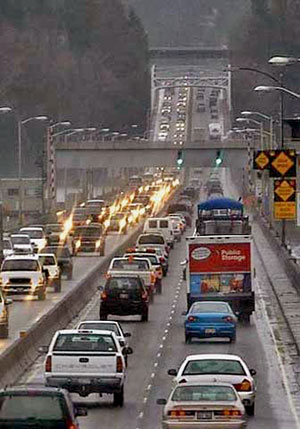
More recently, the conventional wisdom is that we're a town defined by gridlock, both real and political. Our transportation system is at the top of the civic to-do list, but, the complaint goes, we're not doing enough about it.
In practical terms, critics point out, we've been reluctant to embrace mass transit. Earlier this decade, Seattle voted for a citywide monorail system — 40 years after building the first demonstration project — then pulled the plug when the cost seemed too high and the financing scheme shaky. We cannot agree on the size or shape of a new Highway 520 bridge, the key road between Seattle and Microsoft. And in a vote earlier this year on the future of the Alaskan Way Viaduct, voters rejected both options on the ballot, a tunnel and a replacement for the tottering structure. For some, this no-no vote exemplified a city stuck in traffic.
Critics also point to governance. While we talk about Seattle, what we really mean is Pugetopolis, the vast commuter-shed of the central Puget Sound Basin (Olympia to Mount Vernon). We have no centralized authority that can tackle problems region-wide, thus many of the "fixes" are piecemeal and parochial.
As if that weren't enough, there is Tim Eyman, the insurgent initiative activist who pops up like Wile E. Coyote with various roadblocks — spending lids, rollbacks of the motor-vehicles tax — that have crimped the funding our roadrunners rely on. He'll have another antitax measure on the ballot this fall, Initiative 960.
As a result, some argue that indecision, inaction, and sabotage are stopping a dynamic city in its tracks.
But the fact is, such gridlock is mostly myth.
True, we didn't build mass transit a generation ago or expand the monorail, but our economy is doing exceptionally well. Regional growth is big and steady. The population of Pugetopolis (as of 2006) is 3.9 million, up 200,000 since 2000. Last year, the city of Seattle's growth rate was the highest since 1968. Our boom-and-bust cycles have mellowed and the economy has diversified. The skylines of Seattle and Bellevue are virtual forests of construction cranes.
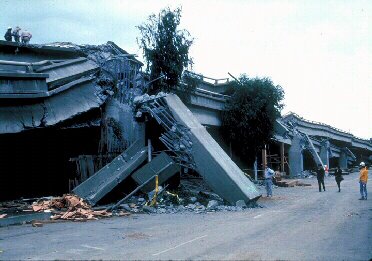
In terms of transportation, the critics give us little credit for what we have done. Sound Transit is building light rail. Seattle is laying trolley tracks in South Lake Union. We've raised the gas tax. Long before the Minnesota bridge collapse, we voted new taxes to repair the city's roads and bridges. We've voted to expand Metro bus service. Our per capita gas consumption is the lowest in nearly 40 years, and transit ridership is up. Even traffic congestion, annoying as it is, is pretty much what you'd expect. Our average commute time ranks 16th in the country — the same ranking as the greater metro area's size — and are only five minutes longer than that of Raleigh, N.C., which ranks 48th in commute time.
The voters are shy of mega-projects, and sometimes we need to consider ideas more than once. But at worst such prudence is benign; at best such caution may actually be an important part of why we're flourishing. We've yet to sink too far into any Big Dig fiascos like Boston's.
In November, the voters of King, Pierce, and Snohomish counties will have a chance to weigh in on a major roads and transit measure, Proposition 1.
It has two parts. One is called ST2 and provides funding for Sound Transit's second phase of light rail, extending it to North Seattle and the Eastside suburbs. The second is a Regional Transportation Investment District (RTID) package that contains funds for expanding Interstate 405 and replacing the 520 bridge, among other projects. The price tag: a whopping $18 billion (critics say that, with interest and financing costs, it really will be twice that).
If the measures pass, RTID estimates that traffic speed will increase by 10 percent and delays will diminish by 25 percent, despite more growth. If true, that's significant, but hardly transportation's Second Coming. RTID executive board chair Shawn Bunney says this "is a once-in-a-lifetime opportunity to assure the prosperity of our region for decades to come."
History suggests that's hyperbole. If the roads and bridges measure fails, it's safe to predict policy-makers will be back with another package soon. What looks like gridlock is sometimes measured progress — without the hype.