Rail transit ballot measures lost in Kansas City and San Jose, but won in Seattle, Sonoma-Marin counties, and Los Angeles. From the point of view of sensible transportation policy, the biggest disaster of the election was passage of the California high-speed rail measure.
Sometimes I think it is wonderful that we can live in a country that is so wealthy that we can afford to build rail lines that cost five times as much per mile as freeway lanes yet carry only one-fifth as many people. But, as it turns out, we really can’t afford to do so.
The bursting of the stockmarket bubble in 2001 would have sent us into a recession but for the increase in consumer spending that resulted from the housing bubble. Now that the housing bubble has burst, our weak economy stands naked and trembling for all to see. Yet this did not much dampen enthusiasm for ridiculous rail projects.
First, the good news. After rejecting light rail seven times, then approving a plan that turned out to be unworkable, Kansas City once again resoundingly defeated a new light-rail plan. It would be nice to think that after 56 percent of voters rejected this plan that it will stay dead and buried, but these things always come back.
As it came back to Santa Clara County, California, which in 2000 approved a sales tax increase for a BART line from Fremont to San Jose. But the line turned out to cost a lot more than expected, so votes were asked for another sales tax increase. The latest count says that 66.27 percent said yes, which means that it failed because California requires a two-thirds majority to pass tax increases. But it was painfully close.
In two other ballot measures, San Jose residents gave up what little oversight they have over the nation’s worst transit agency, the Valley Transportation Authority (VTA). Under VTA’s charter, the agency must submit its transportation plan to the voters every six years. In measure C, VTA asked voters to approve a plan that it had not yet completed. In measure D, VTA asked voters to repeal the requirement that it submit plans to the voters. Both passed by huge margins.
In Los Angeles, the “red” subway line is, by all accounts, a failure, costing 50 percent more to build than the original estimates and carrying less than half as many people as estimated. The Los Angeles County Metropolitan Transit Authority (MTA) was content to focus instead on light rail. But L.A.’s new mayor, Antonio Villaraigosa, wanted to complete the “subway-to-the-sea” line, and he managed to persuade 67.4 percent of voters to raise sales taxes to do so.
The “SMART” train is a proposed commuter-rail line in Sonoma and Marin counties that would end near (but not at) a San Francisco ferry terminal but otherwise not approach any major job centers. Voters twice before failed to muster the two-thirds majority needed to fund it, but in this case, the third time’s the charm.
Finally, California high-speed rail passed with 52.2 percent of the vote. This commits California to spend $9 billion starting construction on what ultimately will be a $50 to $60 or more billion megaproject.
Backers of the plan are counting on getting matching or even more than matching funds from the federal government. They may even get it, but not without starting high-speed rail crazes in other parts of the country.
It is widely agreed that government failure caused the current economic crisis (though not everyone agrees on just what that failure was). Ironically, as NBC anchor Brian Williams noted during Tuesday night’s election coverage, “There is evidence that more people are now viewing government as the solution and not the problem.” It will be sad indeed if we end up suffering from more government failures as a response to government failures of the past.
Transportation
Friday, November 14, 2008
Light Rail wins in Seattle, LA,; loses in Kansas City and San Jose


Tuesday, September 2, 2008
Too many eggs in the rail basket
A dramatic vote in favor of a rail transit plan
"We've dug ourselves a 40-year hole," said King County Council member Larry Phillips at the meeting of Sound Transit Thursday, July 24. Not long after, the board passed, 16-2, the latest effort to get out of this hole by putting a 34-mile extension of light rail on the ballot next November. The hole was created in 1968-70, when the region twice turned down a rail transit proposal and fell far behind the rest of the nation's big cities. There followed, Phillips said, four decades of analysis paralysis, during which "the perfect has been the enemy of the good."
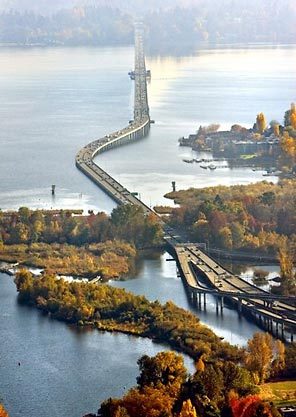
No one was saying the plan passed on Thursday was anywhere close to perfect. Putting rail across the Interstate 90 floating bridge is full of technical problems. Even though commuters are clamoring for more buses, this plan puts 67 percent of its $17.9 billion into light rail and only 2 percent into buying new express buses. It won't be completed until 2023. The bond measure might be cutting it close on margins of debt coverage, and the board narrowed those margins a bit more yesterday by front-loading the bus relief in the next few years. Spooked by the way voters rejected the bigger Proposition 1 package last year, this Sound Transit 2 (ST2) package does not really finish the job, since it does not get to Everett or Tacoma or Redmond.
But as a political compromise that got a strong vote from the board (only King County Executive Ron Sims and King County Council member Pete von Reichbauer of Federal Way voted against it), it's an artful package that might work. The packed chamber at Union Station applauded when the vote was finally taken. Now the measure goes to the public, and we shall see if the region can finally overcome the legacy of those 40 years. The opponents, who mostly favor buses or some of the newer devices of managing congestion through tolls, are ready to attack ST2 and may even outspend the dispirited forces for rail. And all the time spent getting to yesterday's decision means the pro-rail campaign is very late in getting started.
The dramatic vote not only looked back at all those years from the Forward Thrust defeats to the final passage of the starter rail system (opening next year), passed in 1996. It also provided some glimpses of future political leadership. One sad moment came when a partly researched measure introduced by Sims, with backing from state Department of Transportation Secretary Paula Hammond (and therefore, presumably, her boss, Gov. Chris Gregoire), drew lots of criticism and was rejected, 3-15. The Sims amendment would have given $120 million to Metro Transit to provide immediate relief for overcrowding. It had all kinds of problems: Sound Transit can't legally fund local bus service, and the Sims amendment threatened to take money away from expanded express service to Snohomish County, the key concession that made ST2 gain a majority. A face-saving compromise amendment, increasing Sound Transit express bus service, was passed, which seemed to be enough to bring Hammond, a bit surprisingly, over to the yes side. (Gregoire had been firmly advised that opposing ST2 was going to cost Seattle area support in her governor's race.)
If it was poignant to see Sims, himself a former chair of Sound Transit, so isolated and unpopular, it was also interesting to see the rise of the Snohomish County forces, especially the smooth young county executive, Aaron Reardon. Reardon played a strong game of poker with Seattle Mayor Greg Nickels, the Sound Transit board chair, gaining lots of bus service, some of it at Seattle's expense, before swinging to support ST2. He tried to help Sims with his clumsy amendment, and paused dramatically before voting against it in the end.
ST2 [1.1 MB PDF] definitely responds to many of the political criticisms that sank Proposition 1 (combining roads and transit into a whopping package). It adds performance audits. It says the taxes should be rolled back in 2038, when the phase has been built, not extended in an open-ended fashion. It has money (and a time limit for spending it) for building a short rail line on the Burlington Northern Santa Fe route on the Eastside. It envisions substituting a more modern tax, such as a carbon tax, for the sales tax component of ST2 sometime in the future. It has more tools to leverage partnerships with the private sector and local bus systems, as well as several mixed-mode transit nodes. It has more flexibility to adapt to changed market conditions.
In the end, though, ST2 will draw a lot of fire for putting so many eggs in the rail basket when so many people are demanding more bus service — right now. Phillips' "40-year hole" is one reason for having to spend so much on so few miles of rail — the costs of retrofitting rail into a built-up environment are huge. The Sound Transit people argue, with reason, that unless the system has a high-capacity spine, off which feeder services can play, it will never get ahead of the congestion woes, nor be able to shape much growth around station nodes. (Not much shaping, however, again a result of having waited so long.)
Perhaps the most plaintive point was made by Julia Patterson, a King County Council member from South King County. Only Sound Transit has any money to do anything about our transportation mess, she argued. The state is broke. Metro's taxing authority is used up. "Nobody is planning anything," she lamented. Underlying her argument is the political reality that with only Sound Transit having some real sources of money (unless tolling is found feasible), all the other strapped agencies wanting to repair bridges and add modern bus service will likely pick the pockets of Sound Transit in a coming session of the Legislature — unless ST2 is enacted by voters this fall.
Arguing emotionally that with 1.8 million people expected to move into the area and some of our key roadways already failing, Patterson said "we have a moral obligation to the voters and our grandchildren" to do something. It's an odd way to make the case for ST2 (spending $18 billion to make politicians feel better about all that dereliction), but nearly everyone in the room sensed the despair and guilt created by 40 years of not doing the job. We'll see if the voters concur.