Editorial
Rossi's road plan and what's missing
MIKE SIEGEL / THE SEATTLE TIMES
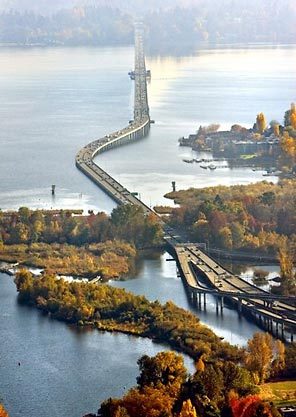
The Highway 520 Bridge: Should it have six lanes or eight?
Candidate for governor Dino Rossi's road-building vision is, for the most part, Gov. Christine Gregoire's road-building vision. The superiority of Rossi's plan is it has more money to build roads faster. The weakness is it pays for new roads by diverting revenue from other state programs and cha-chas around the question of what other things the state would do without.
One project is Rossi's own: building a waterfront tunnel to replace Seattle's Alaskan Way Viaduct. This used to be the financial sinkhole of Mayor Greg Nickels, and it nearly swallowed him. Why an Eastside Republican would pitch himself into this Funnel of Doom is baffling. Rossi should support whatever reasonable surface option has the largest vehicle capacity — a position that might not be much different from Gregoire's.On the Highway 520 bridge, Rossi proposes six lanes built on pontoons for eight. This is a promise in concrete to the eight-lane constituency. Given that Seattle will accept no more than six lanes after decades of negotiations, building pontoons for eight is a waste of money.
Rossi's cost estimates are troublesome. He offers one figure for a project in a big chart, then explains in footnotes that numbers are in 2007 prices for comparison purposes. His numbers may be technically accurate but they are misleading. At the very least, they minimize the effect on other state spending. The real project costs and the hit on other spending will be higher.
His project list is the state's wish list with a few variations. The projects include: widening Highway 9 near Snohomish; building a Highway 2 bypass around Monroe; widening Interstate 405 from Bellevue to Renton; connecting Highway 509 to Interstate 5 south of Sea-Tac; connecting Highway 167 to the Port of Tacoma; building the cross-base highway in Pierce County; building a new Columbia River crossing at Vancouver and a Highway 395 bypass east of Spokane.
Rossi is a get-it-done kind of candidate, and that is commendable. But the cost of getting some things done is other things are left undone. Here, Rossi is too mushy.
Most money for Rossi's road projects would come from the sales tax on cars, which feeds the general fund. This reservoir of tax money irrigates education, prisons and social services. Rossi's diversion would be $800 million in each two-year budget cycle.
The Republican candidate says he would cut $800 million out of current spending. People should believe him because he has done it before. In 2003, he and Gov. Gary Locke cut state spending to avoid a tax increase in a recession. They did it because they had to.
But the upcoming budget is forecast to be $2.4 billion in the hole. That's huge. Given that, it is difficult to imagine a Democratic-controlled Legislature allowing a Gov. Rossi to dig the hole $800 million deeper in order to fund roads.
Transit is invisible in Rossi's spending plan — it is a local function, he says — but it would get hit indirectly. The elimination of sales-tax money from construction would reduce tax revenue available to bus systems. That is a step backward.
Finally, there's the matter of tolls. For Highway 520, Rossi would have a toll of a little more than $1.50 in 2007 dollars, and charge the toll only when the bridge is completed. He relies on tolls less than Gregoire but only because he reaches into a currently untappable fund, Sound Transit's pot of gold. For Rossi to accomplish his goals, he would need a Republican Legislature.
We are left with Rossi's commitment to make road building a priority. The candidate has offered an important proposal that will change the discussion. But he needs to fill in many missing details so people can make an informed choice between roads and other programs.
Transportation
Sunday, April 20, 2008
Seattle Times editorial on Rossi's 2008 transportation plan


Tuesday, March 11, 2008
SeattleTimes says No on Proposition 1: wrong plan, wrong tax;
Seattle Times Editorial
11/1/07
This page has already stated its opposition to Proposition 1, the roads-and-transit package that would raise the sales tax to about 9.5 percent in the three-county Sound Transit district. We state that opposition again, and add further reasons.
We do not object to the road improvements in Proposition 1, such as the widening of Interstate 405 between Renton and Bellevue, the widening of Highways 9 and 522 in Snohomish County, Highway 167 in South King County or Highway 704 in Pierce County. But financially, Proposition 1 is mostly a light-rail vote. That is where five-tenths of the six-tenths of a cent of new sales tax goes. This page objected to the first light-rail line because it would cost so much and do so little. Even if people ride it, it is only one line, Sea-Tac Airport to downtown Seattle, and it will soak up money that could be used to better effect all over the region.
The region could have buses with dedicated lanes and more-frequent service, van pools, bike lanes, flex hours, congestion pricing, traffic-signal alignment and, here and there, more road lanes. This is our first and best reason for opposing Proposition 1: It is wasteful.
Our second reason is that it buys more light rail with a half-cent addition to the sales tax, and the sales tax is the wrong tax. A tax for transit improvements should be tied to use of the road. Since the 1920s, we have funded roads with a gasoline tax. We undertook to fund the ill-fated Seattle Monorail Project with a car-tabs tax. That made some sense, even if the monorail did not. It makes no sense to fund light rail with a sales-tax increase.
And further, at 9.5 percent, and 10 percent at restaurants, the sales tax would be getting very high. A tax that high is not good for retail business or the consumer, and particularly not good for people with low income.
Our third reason for opposing Proposition 1 is that so much of the light-rail investment goes to places that even the supporters of light rail privately agree make no sense. That includes the segment from Sea-Tac Airport to Tacoma, and from Northgate more than halfway to Everett.
The proposed line to the Eastside has a different problem: It takes up two center lanes on the Interstate 90 Floating Bridge. Those lanes could carry more people in buses, because buses can drive a few lengths apart, whereas trains have to have several-minute "headways."
Rail on I-90 would leave two lanes empty most of the time, even at rush hour. And, that means light rail will reduce the capacity of the bridge, particularly to people from Sammamish and Issaquah, since the light rail wouldn't go there.
All good reasons to vote "no."
Sunday, March 9, 2008
The ill-adviced war against cars continues

The Evergreen State in more than name
NO more good intentions. Washington state is committed to a purposeful response to climate change.
The Legislature has bravely and aggressively moved down a path to limit greenhouse-gas emissions, pare back vehicle miles traveled and prepare for the employment opportunities of an environmentally-attuned economy.Passage of House Bill 2815 takes the goals outlined a year ago by Gov. Christine Gregoire and transforms them into an action plan. As captured in the title of a report by her Climate Advisory Team, the state is leading the way.
Key state agencies will report back to the Legislature by December with the tools and best practices to help everyone get started and make progress.
Directions from lawmakers make it plain they view climate change as real, and they want a sharp shift from goals to substantive public policy.
As legislative analysis noted, "reporting requirements are a good first step for reducing greenhouse gas emissions, and the details on reporting need to be clear." Establishing a benchmark to measure future progress is basic. So is the spirit of creating requirements that can be understood and embraced by the public. Do not skimp on brainpower and creativity in making it easy to comply.
At least half of the challenge from greenhouse-gas emissions is tied up in the phrase "vehicle miles traveled." Reducing emissions is a mix of driving less and creating smart transportation incentives and alternatives.
The stick of tolls, congestion pricing and creative limits on parking supply needs to be matched with the carrots of more transit options and broader availability of plug-in technology for hybrid cars. All are anticipated, along with licensing and insurance regulations linked to miles driven and vehicle weight.
The law emits a laser focus on so-called green-collar jobs, with an eye toward training, access and incentives for employment retooled to a green-built economy.
Through all of the rule-making and policy-drafting, Gregoire and lawmakers need to be sensitive to the allies they have in industry, business and commerce. Give them incentives and a clear understanding that they can do well by doing good. There is money and environmental progress to be made in smart, manageable climate-change policy.
In the absence of federal environmental leadership and action, the states must lead. Washington has stepped up admirably.