Eastside sounds off about Sound Transit's new plans
By Lisa Chiu
Seattle Times Eastside Bureau
Just a week before Sound Transit's board of directors meets to determine whether it prefers a Seattle-to-Redmond light-rail line or bus rapid-transit system that can convert to light rail in the future, Eastside residents and community leaders are debating the merits of both.
The city councils of Kirkland and Redmond have endorsed the light-rail option, while Bellevue City Council will consider a recommendation Monday.
By the end of the year, after community input, the Sound Transit board will decide on a more detailed plan and funding package that will go before voters in November 2007.
The fast-paced growth of the region has spurred many on the Eastside to consider alternatives to alleviate traffic.
It's estimated that by 2030, the area's biggest job and housing centers will be Bellevue, Redmond and Seattle, according to the Puget Sound Regional Council.
Your voice
For comments or questions, write to:
Sound Transit, 401 S. Jackson St., Seattle, WA 98104.
For more information or to fill out a comment form on the Web: www.soundtransit.org/st2
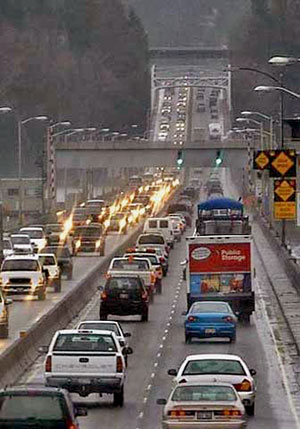
Also by 2030, the number of vehicles that cross Lake Washington on both bridges will grow from 250,000 a day to 330,000, said Sound Transit CEO Joni Earl.
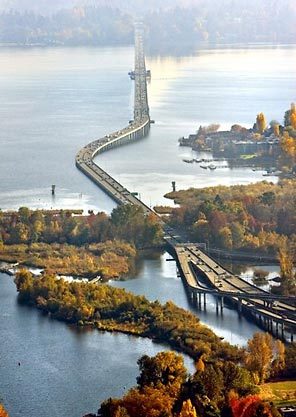
Both a light-rail system and a bus rapid-transit convertible system would take up an exclusive right of way across Interstate 90 from Seattle to Bellevue and then connect to the Highway 520 corridor to Redmond.
Sound Transit's 18-member board — made up of local elected officials and the state secretary of transportation — will decide on its preferred choice next Thursday.
Eastside representatives include Bellevue City Councilwoman Connie Marshall, Kirkland City Councilwoman Mary-Alyce Burleigh and Issaquah Deputy City Council President Fred Butler.
In addition to studying growth patterns, environmental effect and funding options, the Sound Transit board has asked cities for feedback on which option they prefer.
Both proposals would alleviate traffic, increase commuter reliability and provide alternative modes of transportation for special events, Sound Transit officials say.
But the differences between the systems are stark.
Light rail vs. bus rapid transit
Bus rapid transit: The system would have a dedicated lane, would average 24,500 Redmond-to-Seattle riders on a weekday and would cost up to $3.4 billion — but converting to light rail would add up to $960 million.
Light rail: The system would run on tracks, would average 35,000 Redmond-to-Seattle riders on a weekday and would cost up to $3.9 billion.
Source: Sound Transit
• A light-rail system would run on tracks with an overhead electrical-power system, while a convertible BRT system would use custom buses with doors on both sides to provide access to center or side platforms at stations.
The BRT dedicated lane would be built big enough to accommodate light rail in the future.
• The number of estimated riders on a BRT system from Redmond to downtown Seattle would be about 10,000 fewer than those on light rail, according to Sound Transit.
• Travel time from Bellevue to Westlake Center, the University of Washington and Northgate would be 13 minutes faster on light rail than on a BRT system, while travel time from downtown Seattle to Bellevue, Bellevue to Redmond, and Bellevue to Seattle-Tacoma International Airport would be three minutes faster on light rail than on a BRT system.
• A convertible BRT system would likely be cheaper, costing up to $3.4 billion compared with a light-rail system at up to $3.9 billion.
However, the cost to convert the BRT into light rail could be as much as $960 million in 2005 dollars. Converting the BRT would also close the lane for a period of time and significantly affect ridership, Earl said.
Bellevue's perspective
There are supporters and opponents on both sides.
While the Bellevue Chamber of Commerce has not taken a position, its government-affairs director, Shannon Boldizsar, said its members question the use of rail and believe that more focus should be placed on connecting Eastside communities to each other.
"Is rail really worth doing at the sake of being able to do little else on the Eastside?" Boldizsar said at a recent public hearing. "Our members say they are recruiting talent throughout the suburban crescent. That's where their commute is, and it's not necessarily between Bellevue and Seattle."
But Jim Long, a managing director at Equity Office Properties in Bellevue, said light rail would provide greater connections to increase regional business growth.
"More than 15,000 people work in our buildings each day. It's critical that our employees and customers on both sides of Lake Washington are able to commute to work easily and effectively," Long said. "Investing in rail-oriented mass transit is the only way we can continue to evolve as a world-class region."
In addition to high-capacity transit, the Sound Transit board will consider adding more parking at park-and-ride lots along the I-405, Highway 520 and Highway 522 corridors, as well as building transit centers, pedestrian bridges, direct access ramps and transit lanes as part of the transit package that will go to voters next year.
At the same meeting the board also will release for public review up to five possible funding packages for the preferred choice, each with a different tax rate.
The highest rate would mean a sales-tax increase of up to 50 cents per $100 purchase. By the end of the year, the board will pick one package to put on the November 2007 ballot.
Beyond the debate between light rail and BRT on the Eastside, many residents also are concerned about the effects that either alternative would have on their neighborhoods.
Residents of the Surrey Downs neighborhood in Bellevue have spoken out strongly against any option that would run along 112th Avenue Southeast, citing neighborhood and environmental effects. They favor a system that follows I-405 instead.
"The majority of our neighborhood would not be opposed to light rail; many would like to use it," said Joseph Rosmann, president of the Surrey Downs Community Club board of directors, who added that if 112th Avenue is part of the route, he'd oppose the measure.
"We don't want to incur major social and economic costs on our community. [Light rail or BRT] should come to the city on a route with minimal neighborhood impact, noise and unsavory characters coming to the community."
While Sound Transit has studied 112th Avenue Southeast as part of the general corridor for expanded transit, it is a long way from determining the exact route that a light-rail or BRT system would take — nor would a preferred route be determined before the measure goes before voters in 2007, said Don Billen, Sound Transit's east-corridor project manager.
Sound Transit had used a sample alignment to estimate potential costs and ridership that included Bellevue Way, 112th Avenue Southeast, 116th Avenue Northeast and portions of Bellevue-Redmond Road, Billen said. None of those are preferred routes, Billen added.
Public input
Once the board decides on light rail or BRT, Sound Transit will begin to study multiple street options for the project, including I-405.
The public will play an important role by suggesting alternative routes to study during a public-comment period that will begin late this summer and end in the fall, Billen said.
Those suggestions will become part of a draft environmental-impact study that could be published by mid-2008, with a final environmental study published as early as 2009.
However, voters in King, Snohomish and Pierce counties will cast their ballots in November 2007, long before the study is done.
The Sound Transit measure also will be voted on alongside an estimated $7 billion highway package by the Regional Transportation Investment District.
The Legislature requires that the two measures, one for public transit and the other for roads, must both pass in order for either to go forward.
Lisa Chiu: 206-464-3347 or lchiu@seattletimes.com
Transportation
Tuesday, March 25, 2008
Sound Transit Grossly Misstates the case for Light Rail


Tuesday, March 11, 2008
Profile on Joni Earl CEO Sound Transit
Sound Transit
A Sound Investment
Posted: February 5th, 2007 03:03 PM EDT
Remember that corny Star Trek spoof with Tim Allen from a few years ago? The one with the motto, "Never give up! Never surrender!" That may as well have been Joni Earl's motto as chief executive officer of Sound Transit. Since she came into the position, it's been a fight along the way, one she intended to win — and did.
FROM THE FRYING PAN…
Sound Transit doesn't have the pedigree of most agencies around the country. A little more than a decade old, it's an infant compared to other industry monoliths. That said, it's been through its trial by fire and Joni Earl has been there from the beginning.
"I first met Sound Transit through the startup part," says Earl. "After the vote was successful in 1996, I helped the then executive director, Bob White, think about some different organizational models. And I was one of the people he kind of checked in with about just how to set up an organization as a new one. So that was my first introduction."
White would call on Earl a few years later when he convinced the board to create a new position within the company. A second-in-command position, the chief operating officer, would report to White and help with the management side of the business.
"[White said] I've just gone to the board and gotten permission to create a new No. 2 position, a chief operating officer, so I don't need somebody with a transit background, I need somebody who knows how to run an organization. I've got lots of transit experts," remembers Earl.
After looking at the position and asking White about it, Earl thought it sounded like a cool job. And after discussing it with her husband, she applied and in October of 2000 she accepted the position and began her career with Sound Transit.
Wanting to finish up work at her current position, Earl had six weeks between when she accepted the position and when she actually started at the agency. In that time rumors began to swirl that Sound Transit's plans for a light rail project were in trouble. Outside critics were even calling for audits of the agency.
"I would call in periodically and say you know I am giving up a perfectly great job, is there something you need to tell me?" says Earl.
"And [Bob] kept saying, no Joni I want you to focus on the organization, everything is fine, I am working on the light rail project."
Earl made the decision to go with White's assurances and move into the position at Sound Transit. A decision she would soon think twice about.
…AND INTO THE FIRE
Earl wasn't on the job as Sound Transit's chief operating officer a month when everything fell apart.
"So I came and it was like three weeks later when all Hell broke loose at the project level — on every level possible," says Earl.
"So Bob asked me to look at the project with fresh eyes. I didn't have any light rail transit experience, but I have a lot of capital project experience from building different projects from jails, to city halls, to courthouses, to roads.
"So I was tapped in with a consultant who came in and the two of us kind of organized everybody and just looked at everything from top to bottom."
What Earl found would leave a lump in anyone's throat. The agency was going to miss the date and budget for the project … by a wide margin.
"I had been here two months when I announced to [White] and the board that we had a $1.1 billion cost overrun and we were going to be three years late."
Earl says it was a very hard time for the agency. It had just received a $500 million New Starts grant from Congress and with it being the last year of the current administration, the agency was presented with a slew of questions.
"We had to resubmit all of the stuff, and I've been told the very last piece of paper signed by the Clinton administration was our New Starts grant with the new cost and schedule numbers in it," says Earl, but the bad news was just beginning.
NEW TITLE, NEW TROUBLE
With the grant in place, Earl thought she could finally settle into her job, maybe even take a breather. Neither was going to happen.
"So the board called me into executive session and said Bob just resigned and we want to appoint you acting [CEO]. OK, now I've been here three months," says Earl.
"The message that we had heard, he was willing to resign at any point after this happened, but the message we heard out of D.C. was a big change at that point would maybe put the grant more at risk because of uncertainty about the agency. So he hung in there till the grant was awarded the first time and then he resigned, which I didn't exactly know was going to happen."
Earl describes her first three months at Sound Transit as a whirlwind. But what came next would knock the wind right out of her.
"Two weeks later the new chair of the House Transportation Committee called for an Inspector General investigation. Norm Minetta was the brand new Secretary of Transportation appointed by President Bush and he held up our money."
While the investigation was happening the government held up the agency's grant, which threw all of its projections out the window. So Earl had to go back to the board and tell them that the information she had just given them was wrong. They could no longer afford what she had told them at all.
"So then we had to go back over the next basically five months and completely retool the project and shrink it from the 21 miles to 14," says Earl.
"We put ourselves through some additional audits. We revamped cost estimating systems and project control. It was literally 20 hours a day. I took off Christmas and New Year's and didn't have another day off for five months, including Saturdays and Sundays. And not just me, lots of other people in the organization as well."
GETTING BACK ON TRACK
By this time public sentiment for Sound Transit was horrible. Earl says the agency's problems were front page, headline news for weeks between the cost overrun, the inspector general's investigation and her taking over as CEO in April of 2001. Just five years after it had been formed, the agency's approval rating had dropped from 54 percent to 41 percent and the Washington state legislature had started looking its way. Interestingly enough, public sentiment for light rail never diminished at this time, always hovering around 60 percent in favor.
"It was anti-Sound Transit. They didn't have confidence in the agency. But in terms of the projects that we were doing, they wanted the projects, but they weren't too sure about the agency," says Earl.
"We needed to change the way we were doing business here — and pretty drastically and pretty fast. And the board absolutely blessed all of it. They laid out the path. They wanted more controls after we put in a new cost estimating system and all that.
"The board then had an independent outside auditor come in and audit the new system we installed so that they would have confidence before they approved the new budget scope and schedule. So in my view it was a really strong partnership. The board gave me a lot of authority. They gave me a lot of confidence. They had confidence in me."
With this newfound confidence Earl was able to see that the problems didn't stem from an agency that had jumped the rails, rather it never had rails to begin with.
"This was the case of an agency that hit the ground running in 1996 with a 10-year plan to build three new kinds of service, a $4 billion capital program, who didn't take the time in that aggressive schedule to build an infrastructure about how to track their costs, how to know their assumptions," says Earl.
"I mean the stuff you take for granted in any existing organization, especially the government, which is where everybody came from, either a private sector organization or a government organization that already had an existing infrastructure to do that. We didn't have that.
"So it was pretty clear to me we had to focus on the basic infrastructure of projects. It's pretty simple: scope, schedule and delivery is how you build projects. And you've got to know where you are on each one all the time," says Earl.
As part of this the agency worked with its staff to install project controls, which before this had been seen as getting in the way of project management. Earl would bring in outside consultants to work to change the agency culture and install the ideas that no one department builds a project, it takes everyone pulling together to do it.
"So there were a lot of conversations, a lot of systems changes, getting the various players in the room. And just working through each of the types of systems that we needed to change. We put in a new project management system, new cost methodology, a risk assessment process, which now FTA has picked up and is using in the New Starts program.
"In fact, sometimes I joke with my peers around the country that I'm sorry for some of the new rigor in the New Starts process because I think we contributed a lot to the changes because of what happened here," laughs Earl.
COMMUNICATION IS KEY
Earl says that when she arrived, the agency had been focused on a $300 million problem, not realizing it had a $1 billion one.
"While they were focused on one cost proposal and one $300 million problem, the board was told, yeah we can work this out. So the board would say, no we don't need any audits, no we don't need to do this, everything is fine. And it wasn't."
This communication problem was as much internal as external. At both times no one knew what was going on, yet there always seemed somebody willing to talk about it.
"What was happening was our media people were buried in the HR department," says Earl.
"They had no direct line to the executive director. They had no direct line to the board. And so media was moving all around this agency and talking to whomever they could. And there was no central organized theme to what it was we were trying to communicate externally, what was important. Even fact checking around here wasn't good."
After working to get the staff in line and start working together to communicate better internally, Earl set about creating an external communications strategy to provide a directed view of the agency to the public.
"We started doing these milestone reports in 2002. We started doing daily media reports. We still to this day send a memo to the board every day if there is any media contacts in case there is a story, so they are not surprised. We got the media smarter on these really technical issues," says Earl.
"It was a multi-pronged approach. All of our communications people pretty much left during the crisis, some by their choice, and others not by their choice, but mostly by choice because they were so burned out.
"We had a public relations consultant, a co-owner of a local public relations firm, she took a leave of absence and came in and was my acting communications director during the crisis. She was very helpful to put a strategy together to start to stop the bleeding externally with the public."
IMPROVING PUBLIC SENTIMENT
With the public behind Sound Transit's projects, but not the agency, Earl was faced with trying to win back support that it had lost along the way. How did it do it?
"Performance.
"We kept building projects. We kept delivering projects. Two good things happened before the crisis hit. We had a lot of bus service on the street and we were opening bus projects. And Sounder commuter rail started right before all this started. So we had other pieces of Sound Transit that were going well. We were starting to see more projects delivered. So the fact that two-thirds of the work we do in terms of service was out on the street and building over time that helped a lot. Our regional express bus service being all around the three counties really helped a lot," says Earl.
Then the region got its first real taste of light rail with the opening of Tacoma Link in 2003. People in the southern part of Sound Transit's service area got to see a major new project for the first time and liked what they saw.
Along the way the agency kept pointing out the milestones it hit and was very open and transparent with the public.
"One of the other things we did was when the Tacoma Link cars arrived, we brought one up for the holiday season and planted it in downtown Seattle so people could touch and feel what light rail was going to look like. And we said the cars are going to be way bigger and all that, but here's what it looks like," says Earl.
Earl proudly notes that last October its tracking showed its approval rating had not only reached its initial level, but increased by more than 10 points to 65 percent. For Sound Transit, honesty was the best policy.
"We weren't defensive. We didn't hide behind the errors," says Earl.
"We still have critics today that bring it up. And I'm like, yeah well.
"You know when I say to the public now that we are on time and on budget, most will say that's great. But the people who haven't liked us from the beginning will say, well not when you compare yourself to Sound Move [Sound Transit's initial plan]. And I'm like, yep, you're right. But, you know, when you have that kind of a screw-up and that's what you are always measured against, then you will always have screwed up.
"Had Sound Transit been more transparent when the first crisis hit, I don't think we would have had quite the credibility deficit that we thought. But they were so busy trying to solve the problem they weren't looking at the consequences. They were in a denial mode. So I think we took an extra credibility hit that we were perceived to be in denial for the first three or four months when the rumors started."
ST EXPRESS
Anyone who does the routing for an agency can tell you how difficult it is. Now try doing that through four counties while connecting up with seven other local agencies. Sound Transit's ST Express bus system is set up as a long haul, urban center to urban center two-way transit service. This allows it to operate in conjunction with local agencies without duplicating their service.
Community Transit is the only local transit agency running service into Seattle from outside the county other than Sound Transit. While Community Transit does operate in the same area, it starts at different park and rides.
"There is only one or two park and rides I think where we both come out of," says Earl.
"The reason we do that is because the volumes are so high by [both agencies] affording to do some of the service we're able to just put more buses on the street in that corridor from south Snohomish County to Seattle. But even when it comes into Seattle, they route differently.
"[For example], I used to take a Community Transit bus because the second stop was about two blocks from [Sound Transit's headquarters]. I would be the last stop on a ST bus and the second stop on a CT bus, so they worked it so that together they weren't just following each other in the corridor. They met different needs for different people in terms of the stops.
"So actually I think we've done a pretty good job on the coordination so that on the customer end they can do easy transfers," says Earl.
Earl says the agency has had a flexpass since it was created that was good on all four of the major agencies in the region and is working on creating a smartcard that would work on every agency in the region.
"So we've tried to make it seamless and easy to understand for the public," says Earl.
"Overall ridership in the region is up for all of us. We're still trying to get better on all fronts about feeding the commuter rail system and restructuring some local routes. I think everybody has that fear that when you bring in rail, you're stealing bus passengers, and that hasn't proven to be the case with commuter rail. So some people, yes, are moving from one to the other, but overall ridership on bus and rail is up. So I'd say what we're doing is getting more out to everybody."
FREIGHT RAIL?!
What I didn't realize when I first toured the Sound Transit was that while it has built the system, it does not operate it. The ST Express buses are operated by the local agencies they serve, but that wasn't as shocking as the agency's Sounder commuter rail service. It's operated by BNSF, the area's major freight rail company. I had to ask, a freight company running passenger trains?
"The good thing about BNSF is they know how to run trains," says Earl.
"They are very good at it and they know how to do capital infrastructure because we are doing both with the commuter rail, where we're adding to the infrastructure that is beneficial to both freight and passenger service. That was part of the condition.
"I would describe it as early on it was tough with BNSF, they're tough negotiators. They're expensive — it was expensive to buy our way on to a freight corridor. But once those agreements were in place I would say they have been excellent partners.
"They've helped us bring on service earlier, they've been flexible with hours at the same time that the freight volumes in this region have really increased. So there has been a lot of pressure on the whole corridor to get all of the freight through, but they've honored the agreement with us. And they've been absolutely great partners.
"We're starting to see more people make choices as a result of these fixed rail investments, especially Sounder," says Earl.
"Because I ride the train, I talk to customers a lot. There was a guy I just started chatting with, and he said his wife and he wanted to live more in the country. They've always been in Seattle and wanted to raise their children in a more suburban-type setting. And he said the only way that made it possible was Sounder."
Earl says that the Sounder commuter rail service hasn't reached full capacity yet. Sound Transit is still making corridor improvements. Seven more round trips are planned between the northern and southern corridors, but past that no plans are in place to add more service because future plans revolve around increased light rail focus.
ROADS & TRANSIT
The next step in the Sound Transit plan is a ballot initiative going out for a vote in 2007 that will ask voters to approve $18 billion for joint funding for the agency and a regional roads package with about $11 billion going to the agency. It wouldn't add a new tax to the region, but be a continuation of an existing tax that Sound Transit uses for funding.
"We were actually planning to be on the ballot in 2006. And then last year the legislature and the government blocked us from going to the ballot because they didn't want transit to go alone. They felt that what needed to happen to the Puget Sound region was a joint integrated effort between roads and transit. So a few years ago the legislature created the Regional Transportation Investment District (RTID). RTID's job on the road side is to complete some projects that the state has partially funded through two recent gas tax increases," says Earl.
"So they passed legislation that said Sound Transit has to be on the ballot in November 2007 instead of 2006. RTID has to be on the ballot. They have to go together. And the current legislation says that both have to pass for either to go forward.
"The public gets that roads and transit together is a good investment. So that's kind of the conundrum we're in right now."
Earl says they started the ST2 plan two and a half years ago with more than 500 transit ideas from the public. What the public wanted were extensions of the light rail spine along the I-5 corridor. They also wanted to ease some congestion in Sounder stations and park and rides, but the plan the agency is focused on now has 40 miles of light rail extensions over the next 20 years.
"There really is two things going on," explains Earl.
"One is we are building out a plan the current board really doesn't have a lot of say in because it was already approved by the voters. They're just helping facilitate getting it done. And then we have the ST2 plan.
"But our board does act pretty regionally. I'm proud of this board. They have local interests, but they act regionally when they walk into that room," says Earl.
PUGET SOUND TRANSIT INVESTMENT
Joni Earl went through more in her first six months at Sound Transit than most directors do in six years. She is the first to admit to the agency's mistakes, but she is also candid about its hard work, the quality of effort her people put out and the bright future ahead for not just the system, but the region thanks to the agency's efforts.
"And that's the story. I can't change the past, but we can sure be transparent and accountable and direct with the public on how we are doing in the present," says Earl.
"We know from all of the talking I do out there, all of the polling we've done in the past, the level of support, people just get what we're doing is important."
Monday, March 10, 2008
Failed History of Sound Transit 1994 -2000
Update On Sound Transit 1/1/01
by the Municipal League Regional Issues Committee.
In 1994, the Municipal League established a diverse RTA study committee to evaluate and recommend to the Board a position on the proposed Regional Transit Authority’s $6.7 billion three-county ballot measure for 1995. The Municipal League Board, after reviewing the RTA Study Committee’s Findings and Recommendations, agreed to support the 1995 and 1996 RTA ballot measures. Voters in the region turned down the first RTA proposal on March 14th by a vote of 46.5% to 53.5%.
After the 1995 loss, the RTA Board formed an Advisory Committee to get more public input and develop revisions for a new ballot proposal. The RTA significantly revised its previous proposal, and adopted “Sound Move”. It included a “sub-regional equity policy” which assured that funds from each of the five sub-regions could only be used within the sub-region of origin. With other changes and reductions in plan costs, they submitted a $3.9 billion proposal to regional voters on Nov.5, 1996.
By a vote of 57% YES to 43% NO, the voters authorized the RTA Plan with a .4% sales tax and a .3% regional motor vehicle excise tax to provide the regional funds for Phase 1 construction and operation of the Regional Express Bus, Sounder Commuter Rail and Link Light Rail systems.
Where is Sound Transit’s (RTA) Link Today?
In November 2000, Sound Transit’s Executive Director Bob White announced that the new estimated cost to complete the complex Link Tunnel from downtown to the University district had increased from the original $500 million to $800 million. The original budget was $2.6 billion By extending the schedule to 2009 rather than 2006, and increasing the budget $1 billion to 3.6 billion in year of expenditure dollars from the original 2.6 billion in 2006 dollars the entire Link Light Rail Phase I project could be completed.
The Executive Director recommended that negotiations with Modern Transit Constructors on the design/build contract for the Link Tunnel through Capitol Hill to the University District be suspended. The Board asked the staff for an explanation of why the tunnel cost estimate is different from what was budgeted for the project. A January 11, 2001 report was to include not just why the numbers are different, but also a review of the process that brought Sound Transit to this point. The Link Director Paul Bay resigned. Bay was replaced by the former manager of the Portland MAX light rail project, Tuck Wilson. He is the new acting director. In October 2000, Joni Earl, former county administrative officer for Snohomish County had been appointed to a new Sound Transit position, that of Chief Operating Officer (COO).
December 2000 ST Board Meeting
Under the direction of the COO and the acting Link Director the Sound Transit Board was presented with a “Central Link Briefing Book”, dated 12/14/2000, in response to the Board’s November request.
It documented the Reason for Link, the Project Status, the History of the Link Tunnel Cost Estimates, the Chronology of the Design/Build Tunnel Negotiations, the Revised Costs to Complete, the Affordability of the Project, the Route and Station Options., Schedule and Contracting Options, the $500 million first phase Federal Full Funding Grant, Information on Getting to Northgate, Public Outreach and a Decision Schedule.
The background history and current evaluation led to the following initial conclusions summarized by the staff in the December ST staff’s report to the Board and the community. The reasons given for the agency’s underestimation of tunnel costs were the following:
1.
Staff’s enthusiasm to remain optimistic about the original tunnel cost estimates and schedules and underestimating Link project contingencies;
2.
Limited competition on bidding;
3.
Pressures of the 2006 Phase I completion schedule that increased estimated overtime costs;
4.
New information on soil conditions, particularly under the ship canal;
5.
Costly third-party agreements with the U. of Washington, King County, Metro and Seattle;
6.
Overall, an unfavorable market due to many other regional construction projects.
7.
The inexperience of U.S. contractors with design/build rather than bid/build proposals on tunnels.
8.
Lack of an adequate system of Link project management cost controls.
Sound Transit’s goal in the period between December 14th and January 11, 2001 was to provide outreach to the public, receive public comments and hold a dialogue with communities affected by the project revisions. From January 11th to August 1St the goal was to provide a six months review with more information and open up public opportunities to participate in refining the Link Project, based upon decisions to be made at the January 11th Sound Transit Board meeting.
A report of an independent “Peer Review Committee consisting of four pubic finance professionals from the city of Seattle, King and Snohomish County and the Port of Seattle, and a member of the Citizen’s Oversight Panel was made available to Board members. In it they reported that the revised financial plan falls within the “range of reasonableness but in the high end range”. They concluded:
1.
The ST financial model was well designed and comprehensive. It assumes that the inflation rate will be stable and that tax (sales and regional MVET) revenues will grow faster than costs.
2.
They found that, without additional financial resources, the plan has no flexibility in the North King Sub-area through 2016. Currently there is no financial capacity for Phase II expansion of the rail system in the North King sub-regional area before 2016.
3.
The Plan assumes an aggressive effort to secure a second Federal Grant of $913 million in about 2004; if the grant is smaller, the plan’s scope and schedule would have to be adjusted.
4.
To recommend that ST staff subject the agency’s Financial Plan to an annual “stress test” to assess the implications of changes in financial and plan assumptions or conditions.
5.
They found that there was no consistency in the presentation of ST financial information to the public. They recommended that ST choose a consistent base of reporting and use that base in the future. Sound Transit staff recommended that, in the future, year of expenditure (YOE) dollars be the base to eliminate any confusion.
ST staff presented information from the updated January 2000 Link Briefing book. There was a discussion of the revised long range Financial Plan and ST Resolution #R2001-1, which authorized execution of a full-funding federal grant, amended the Link budget and the 10 year regional Transit Plan.
Statements in support of the Resolution were made by Board members and the Resolution passed on a vote of 14 to 1. (Board member McKenna voting in the minority.)
Sound Transit’s state enabling legislation and its adopted rules requires a two/thirds majority vote to make major changes to the Plan, Budget or Schedule.) ST Chair Dave Earling announced that two of the 3 absent Board members had stated to him that if they had been able to attend, they would have voted with the majority.
Thursday, February 21, 2008
Olympia Kills Plan to Give Sound Transit Roads
Sound Transit expansion denied
Lawmakers kill plan to give agency highway development responsibility
Last updated February 21, 2008 10:26 p.m. PT
By LARRY LANGE
P-I REPORTER
A measure to enlarge Sound Transit by giving it highway development responsibilities died in the Legislature, failing to get enough support from skeptical lawmakers and others.
Several groups, including environmentalists, local transportation officials and Sound Transit itself questioned the measure, Senate Bill 6772.
"It's dead for the session," said the measure's prime sponsor and Senate Transportation Committee chairwoman, Sen. Mary Margaret Haugen, D-Camano Island. Given other concerns over ferries, mountain pass closures and winter floods, "we can't get anybody to focus on it."
Haugen and four other senators introduced the proposal in late January, and Haugen's committee held one hearing on it, but committee members wouldn't send it to the full Senate.
Several unsuccessful attempts have been made at setting up a regional transportation agency, a move recommended in 2000 by a state blue-ribbon commission and in early 2007 by a second commission organized to look at the question.
Advocates of an agency that would plan and coordinate transportation projects say it could unclog the political logjam that has stopped many projects, and help raise local taxes and finance projects, because the state won't do it alone.
Haugen argued that a larger agency could better focus money on the most needed projects, including both roads and transit. A problem with the recently rejected Proposition 1 transportation funding measure was its scope -- spreading money over too many projects to please too many representatives of three counties, she said.
Local officials, who said they can manage transportation projects the way things are organized now, opposed it.
"Local governments think they're doing a wonderful job (and say) just give us more money, we can do it," Haugen said.
Some also said the bill didn't go far enough because it didn't include in a single agency the planning authority now held by the Puget Sound Regional Council, whose director, Bob Drewel, also was skeptical of the idea of a larger agency.
The bill would have reduced Sound Transit's board of directors from 18 members to 12, with seven elected by voters, including six from geographic districts and serving six-year terms. Currently, the agency's board members are local elected officials appointed to the board by county executives.
Sound Transit Executive Director Joni Earl told lawmakers her agency hadn't taken a position on the measure but that changing the board makeup could jeopardize the federal government's commitment to providing grant money to the agency.
Jessyn Farrell, director of the pro-transit Transportation Choices Coalition, said she thinks lawmakers should "leave Sound Transit alone while it's completing Phase 1" of its light rail line.
Haugen said the subject will come up again in next year's session for consideration, because other metropolitan areas have formed regional transpiration agencies to manage projects.
A related measure, Senate Bill 6771 to eliminate regional transportation investment districts such as the one that wrote part of the ill-fated Proposition 1, has been changed to delay further investment district elections until November 2009. The bill narrowly passed the Senate and is now in the House.
THE NEXT STEP
Sound Transit Thursday began asking residents in urban areas of King, Pierce and Snohomish counties what they think should be on another transit ballot measure. Agency officials haven't yet decided whether to attempt another one. They are asking about priorities, how ambitious the new version might be and how soon another measure should be on a ballot. Residents can take the survey through March 9 at soundtransit.org or by calling 1-866-511-1398. Voters in November rejected a ballot measure that included $30.8 billion in light rail and other transit projects.