See: The Puget Sound Regional Council's Vision 2040 plan?www.psrc.org/projects/vision/
Seattle Times
The combined populations of Seattle and Bellevue could grow by nearly 300,000 under a plan that attempts to direct much of the region's projected growth to its largest cities.
Vision 2040, adopted overwhelmingly Thursday by elected officials from four counties and more than 40 cities, also opposes building any more "fully contained communities," such as Redmond Ridge, in rural areas.
The Puget Sound Regional Council's 40-year blueprint for slowing sprawl and speeding up downtown renewal discourages high-density islands outside the urban growth line "because of their potential to create sprawl and undermine state and regional growth management goals."
Tacoma City Councilmember Mike Lonergan, who headed the planning effort, said fully contained communities are "an oxymoron" because they overwhelm rural roads as the new residents drive elsewhere to work, shop and attend school.
Cities and counties aren't required to comply with policies in Vision 2040, an update of the Vision 2020 plan that was adopted in 1995. But the Regional Council's role in allocating some federal road-building funds gives it influence over local land-use decisions.
Snohomish County Executive Aaron Reardon voted in committee last month against language discouraging fully contained communities. Snohomish County currently is considering a 15,000-resident planned community in the rural Lake Roesiger area.
King County Executive Ron Sims, saying Redmond Ridge was a mistake, supported the Vision 2040 goals.
Sims adviser Karen Wolf called Vision 2040 "fabulous" and said it will allow King, Snohomish, Pierce and Kitsap counties to grow by 1.7 million people without moving the urban growth boundary.
The plan would locate one-third of those new residents in the region's five largest cities: Seattle, Bellevue, Everett, Tacoma and Bremerton. Smaller cities would take 41 percent of the growth, and areas outside cities 28 percent.
Only one city — University Place in Pierce County — voted against the plan, and Kitsap County split its vote, with one commissioner in favor and one against.
University Place Mayor Linda Bird said the City Council supports the plan's goals but isn't convinced the city of 31,000 can handle 23,000 more residents, as the plan suggests.
Kitsap County Commissioner Jan Angel, who also voted no, said she fears jurisdictions could lose federal road-building money allocated by the Regional Council if they fail to comply with the plan. "My concern is the lack of local control," she said. "This will be another level of regional government."
Vision 2040 projects that Tacoma, a city of 193,500, would grow by 127,000 residents and Everett would nearly double by adding 89,000.
Bellevue City Councilmember John Chelminiak and Seattle Mayor Greg Nickels' spokesman Marty McOmber welcomed the goal of bringing 294,000 more residents into those two cities. Seattle now has 563,400 and Bellevue 109,600. That growth target will be apportioned between the cities through a separate county planning process.
But even as those ambitious growth targets were being adopted, former state Transportation Secretary Doug MacDonald questioned whether they are realistic without new efforts to attract more families with children to the largest cities.
From 2000 to 2007 — the first seven years of the Vision 2040 planning period — MacDonald said, only 13 percent of King County's growth went into Seattle and Bellevue, well below the target of 32 percent.
Lonergan drew applause from the PSRC "general assembly" members when he responded to MacDonald by saying, "Yes, we need to do better, but, yes, we are headed in the right direction."
Transportation
Tuesday, May 6, 2008
2040 Vision for Puget Sound includes growth of 1.7 million people.


Tuesday, April 8, 2008
Seattle's plans to cope when Viaduct closes for construction
Is viaduct traffic heading to a street near you?
Rerouting calls for more trolleys, fewer I-5 ramps
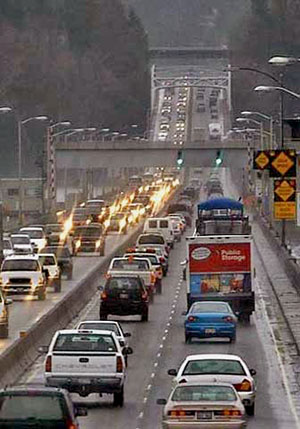
Moving people and goods around the construction shutdown of Seattle's Alaskan Way Viaduct might be done with new streetcars or trolleys, widening key city streets or even closing some freeway ramps.
Now the question is whether those possibilities -- and many others -- make sense and can be financed before the state firms up its plans for the viaduct.
Members of the Seattle City and King County councils, in an unusual joint session, heard Monday about dozens of ways to handle diverted traffic if the viaduct is permanently removed or while its replacement is constructed.
Ideas centered on increasing the capacity of Interstate 5 through downtown, making more traffic on side streets possible, and increasing east-west connections across the city. All or some part of the 103,000 vehicle trips on the viaduct daily would have to be diverted or eliminated during construction or after a permanent teardown.
Some options examined by city and state officials already are raising questions, including:
Officials said none of the ideas has been analyzed enough to determine its effects during a reconstruction or teardown of the viaduct. Officials expect to begin considering possible solutions, including combinations of steps, by July.
"The question is, what are the logical combinations" of measures, said Steve Pearce, manager of a city urban-mobility project related to the viaduct replacement.
City Councilman Richard McIver said that because the state is replacing the viaduct, it should consider financing part of the city-street improvements, but state officials have not committed to such funding.
The state previously has offered $50 million toward the $168.5 million cost of widening the Spokane Street Viaduct and $30 million toward the purchase of buses to carry some commuters. Other financing will "come up as we look at alternatives," said Ron Paananen, state viaduct project director.
Gene Hoglund, leader of the pro-elevated highway group Families for an Elevated Solution, questioned eliminating freeway ramps and rerouting trucks onto Fourth Avenue.
"It's a dream. Evidently they plan on limiting cars coming into the city," he said. "That's the only way I can see this working."
Although council members praised their staffs for collaborating with the state for the first time since last year's citywide viaduct advisory vote, they asked for cost figures on proposals to expand transit.
Expansion would cost King County more in operating expenses.
"We could never pay for everything that was presented today, but we could do a lot of it," County Councilman Dow Constantine said.
Friday, April 4, 2008
Mercer Street Costs Continue to Rise
Nickels' street projects plan hits roadblock
Questions on financing delay action in council
Mayor Greg Nickels' new financing plan for the Mercer and South Spokane Street improvement projects raised a long list of questions Tuesday at City Hall, prompting members of a key City Council committee to postpone action for at least two weeks.
Members asked whether these are the right projects and what the likelihood is that the city could find more state and federal money to help pay for them.
City Councilwoman Jan Drago, chairwoman of the Transportation Committee, wouldn't predict whether the committee and the full council will approve the plan.
"It's a big 'ask,' " she said.
The mayor proposed a new plan to raise $274 million for the two projects after the failure of last fall's three-county transportation measure, Proposition 1. That measure included $373 million for Mercer and Spokane Street Viaduct widening work and for a new rail crossing on South Lander Street.
All are intended to improve cross-city traffic flow to downtown, particularly during construction work on the Alaskan Way Viaduct. The city has since shelved the Lander Street project and focused on the Mercer and Spokane work, which Nickels has called critical to easing two traffic bottlenecks.
His new plan calls for using cash from a voter-approved 2006 city transportation levy and from recently enacted parking and employment taxes to raise $120.2 million in bonds for the two projects.
The plan would have city agencies pay $26 million in utility relocation costs for the Mercer project and would attempt to raise a $97.1 million from the federal and state governments.
An additional $36.2 million would be raised for the Mercer work from adjacent landowners, possibly in the form of development mitigation fees or construction easements.
Administration officials say this could be done without using money from other projects promised in the 2006 levy or from the city general fund. They say they have commitments for $87.8 million for the two projects.
But one committee member, Richard McIver, wondered whether the two projects would be enough to spread traffic through the city that's diverted from the Alaskan Way Viaduct once its replacement is being built. McIver said improvements may also be needed on the surface Alaskan Way to handle the construction traffic.
And, "we've got other neighborhoods that need (transportation) work," he said in an interview.
Gene Hoglund, a board member of the Magnolia Community Club, told the committee the club is urging the city to spend money to replace the earthquake-damaged Magnolia Bridge "before a slide or an earthquake takes it down."
A city study said the Mercer project would save drivers a few minutes heading west from Interstate 5 but actually lengthen the eastbound drive. Hoglund, speaking to the committee, argued, "It's not going to improve traffic flow."
City officials have disputed this, saying the Mercer widening would benefit all modes of travel. Responding to McIver's question about I-5, city Transportation Director Grace Crunican said the projects are designed to make cross-city travel as convenient as possible and "we're trying to get (traffic) out of the way of construction" on the Alaskan Way Viaduct.
But the council's staff has raised several other questions to explore. Among them is the risk of seeking other government grants. A council staff memo said the mayor's plan "indicates that the remaining external funding gap for Spokane and Mercer will not close prior to beginning scheduled construction."
Council staff members said they plan to analyze the city's past successes in receiving transportation grants, examine why the Mercer and Spokane projects were given high priority and identify other projects that might need money as well.
The committee will discuss the proposal again April 15.
The city plans to begin the Mercer widening work and most of the Spokane Street project by the second quarter of next year. Separately, it says it has the money for a new ramp to Fourth Avenue South from the Spokane Street Viaduct and plans to begin building the ramp this fall.
Costs of both projects have risen dramatically since last year, with the increases attributed by Crunican to generally escalating construction costs.
The Mercer project's estimated cost has increased by 40 percent, from $137.3 million last year to $192.9 million now. Spokane Street improvement costs have risen 9 percent, from an estimated $154.3 million last year to $168.5 million now.
The estimated price of the Lander Street crossing has more than doubled since last year, from $71.2 million to $152 million.
Monday, March 24, 2008
Port of Seattle drives another major business out of the city
Potential Port tenant, and 600 jobs, to leave, blaming officials
Korry Electronics cites better deal
Friday, March 21, 2008
Last updated 3:47 p.m. PT
By KRISTEN MILLARES YOUNG
P-I REPORTER
By the time the Port of Seattle came around to offer Korry Electronics Co. the Interbay lease it wanted, it was too late.
Too late to keep Korry's 600-plus jobs in Seattle, despite the city's newly strengthened zoning laws meant to encourage industrial development here.
Too late to salvage the Port of Seattle's reputation as being more intent on remaking its 99 acres north of Terminal 91 at Interbay into a mixed-use development branded as "North Bay" than in preserving industrial land for industrial jobs.
"It became a pretty uncomfortable, disheartening situation with the port," Korry Electronics President Dan McFeeley said of his company's decision to move to a 14-acre property outside of Seattle in an as-yet-undisclosed location. "It's not for lack of wanting to stay, but it just got too scary and too risky."
Since 1937, Korry has been manufacturing parts for airplanes in Seattle. Now a subsidiary of Bellevue-based Esterline Technologies Corp., which specializes in aerospace and defense, Korry continues to be a major Boeing Co. supplier.
For the past several years, Korry's management has been eyeing the 2011 end date of its lease on a 189,000-square-foot building on Dexter Avenue North. Sources close to the transaction say that nearly two years ago, Korry approached the port through its representative, Craig Kinzer of Kinzer Real Estate Services, only to be put off by proposed lease rates more suited to downtown office space than to manufacturing.
By Feb. 27, the port had a better offer: a 250,000-square- foot building on 10 acres for $2.30 to $2.50 per square foot. After matching Korry's list of lease requirements, the port waited for a response from Korry that never arrived.
Tired of wrangling, Korry had found a better deal.
"I can't speak to the port's intentions, just their actions: The delays were endless enough that we lost faith," McFeeley said. "They rarely had decision makers at the table with us ... and it led to roadblocks."
McFeeley said the only difference between the port's offer and that of his new landlord is that the new deal offers lower lease rates -- and the promise of more reliability.
Port spokeswoman Charla Skaggs said the public agency -- which oversees 4,000 acres of land, including its seaport terminals and Sea-Tac Airport -- is "deeply saddened" by Korry's decision.
Industrial advocates said the port's contrition is poorly timed.
"They lied to us, telling us that there was no industrial interest in the North Bay property when there was a lot of interest," said Eugene Wasserman, president of the North Seattle Industrial Association.
"They want to play real estate gods or something and do other kinds of development, which I don't think are part of the reason they exist."
Dave Gering, the executive director of the Manufacturing and Industrial Council, said Seattle's losses of Korry and of the Ballard-based aerospace company University Swaging indicate that reform is needed.
"The message that's been sent with the Korry episode ... is that it took two years, and they couldn't get it done," Gering said. "It is very hard for outsiders to put much faith in the port" -- though he wants to give the port's new, widely respected chief, Tay Yoshitani, a chance.
McFeeley said his new landlord will have completed the pending lease within 45 days of opening the dialogue, in contrast to his company's 18-month- long negotiation with the port. A Seattle resident, McFeeley said he was unhappy about leaving the city but had made up his mind by December that he needed to begin looking elsewhere.
Korry had spent the previous summer helping the port lobby the City Council for mayor-backed zoning changes at the North Bay property, which would allow for large-scale office and retail development in addition to the manufacturing uses already allowed there. McFeeley supported the overlay but said the port tied signing the lease to its passage.
The City Council nixed the overlay, citing Seattle's extremely low vacancy rates on industrial land and the importance of manufacturing to the city's jobs and tax base. While the city wanted the port to sign Korry, the deal remained undone.
Within that tightly squeezed market yawns the port's 57 acres of vacant property north of the Magnolia Bridge at Terminal 91, next to existing major tenants Trident Seafoods and City Ice Cold Storage. That is likely to continue for the foreseeable future: Port Commission President John Creighton said the port, which has spent more than $7 million to redevelop North Bay, is no longer anticipating building a biotech hub as once envisioned by retired port Chief Executive Mic Dinsmor
Saturday, March 15, 2008
Dialling for Dollars in Seattle
Seattle eyes other sources to pay for big road project
Left without $323 million in cash because a ballot measure failed, Seattle is looking to sources like private landowners to finance the widening of Mercer Street and the Spokane Street Viaduct.
The Nickels administration proposes to tap part of its recently enacted parking and employment taxes to help make up the shortfall.
Voters in November rejected the Proposition 1 roads and transit ballot measure, which included funding for the Mercer and Spokane projects and a railroad overpass on South Lander Street.
All three projects were justified as ways to improve street-level traffic flow during construction to replace the Alaskan Way Viaduct. Looking for support, administration officials said Friday they're focusing on finding more money for the Spokane and Mercer projects, though Lander remains a priority.
Of the newly estimated $192.9 million cost of the Mercer widening, the city now hopes to raise $36.2 million from private sources in the neighborhood, possibly from mitigation fees or providing needed property or construction easements. Officials said they've not proposed a specific method yet.
Bob Powers, deputy director of the city Department of Transportation, said the plan is to raise another $70.6 million in bonds using money from the 2006 street-improvement tax levy and from city parking and employment taxes, which officials said are producing more cash than anticipated.
Another $26 million, for utility relocation and improvements, would come from city agencies, and the city will seek $51.7 million in additional state and federal grants. About $8.4 million already has been secured.
The Mercer cost estimate has increased $78 million since late last year, chiefly because of inflation and advanced design work that now includes property costs. The project would widen Mercer between Dexter Avenue and I-5 but not include reconnecting streets above Aurora Avenue.
Some $78.9 million has been secured for the Spokane widening, now estimated to cost $168.5 million, which includes $3.4 million from the Port of Seattle; new ramps would connect the Spokane Street Viaduct to the waterfront.
The new plan, subject to approval by City Council members, is to find another $40 million from state and federal sources and $49.6 million from the street-improvement, parking and employment levies. Inflation and advanced design have increased the estimated Spokane project cost by $16.2 million since the last quarter of 2007.
The $26 million in utility costs for the Mercer project would be paid for city-wide. Officials said that's normal practice. They also said the new plan wouldn't take money from other street work to be financed by the 2006 transportation levy.
A city study said the Mercer widening would decrease some travel times and increase others. Powers said it will improve transit service and "benefits all modes of transportation."
Seattle City Council President Richard Conlin and Transportation Committee Chairwoman Jan Drago both said they were pleased the administration had developed a plan. Conlin wouldn't predict approval before reviewing it. Drago said her committee will discuss the proposal April 1.
Thursday, March 13, 2008
Nickels using greenhouse gas to bully small business;
Seattle's taxis going green? Kermit's objections aside, it is easy being green, at least according to Ford Motor Company. Making cities green is getting easier too, as Ford Motor Company expands its Escape Hybrid taxi program to more cities across the country. Announced at the 2006 Chicago Auto Show by Escape hybrid "spokesfrog," Kermit the Frog, Ford told the city of its plan to expand its hybrid taxi program to the Midwest's largest city. Chicago's Escape hybrid test taxi program involves a one-year evaluation of one Escape hybrid taxi given to the Department of Consumer Services. The department's plan is to use the hybrid taxi to educate the public and cab drivers about the benefits of hybrid taxis before the city's June 2007 mandate that taxi companies incorporate hybrids into their fleets. "Mayor Daley's goal is to make Chicago the greenest city in America. Adding hybrid taxis will help Chicago meet this goal. Allowing and encouraging Chicago to use hybrids as taxis brings us one step closer to having one of the best taxi industries in the country," said Norma Reyes, Commissioner of the Department of Consumer Services. Ford is the only American company with two hybrid vehicles in production and on the road; both Escape and Mercury Mariner compact SUVs currently offer hybrid variants. By 2008, the automaker plans to increase that number to six by adding hybrid versions of the Ford Fusion and Mercury Milan midsize cars and Ford Five Hundred and Mercury Montego large cars to that list. Last week, Kermit was back in Chicago to give the Escape hybrid's keys to the city, kicking off Ford's eight-city Escape hybrid education tour. The purpose of the tour is not only to educate the public about the benefits of hybrid taxis, but also to increase awareness about hybrid technology in general. "Ford is providing this as a tool to educate the public about this type of technology and we hope this vehicle will help companies invest in hybrid technology," Reyes said. According to Ford, the advantages of the hybrid taxi program are numerous and benefit everyone involved. Escape hybrid taxi operators in New York and San Francisco are saving an average of $30-$35 a day in gas costs versus driving a shift in a Ford Crown Victoria taxi. They are also able to spend more time driving fares and less time filling up with Escape hybrid's 500 mile-per-tank range. Ford also stresses the environmental pluses of the program, claiming one Escape hybrid driven 100,000 miles saves 1,666 gallons of gas and prevents 32 pounds of carbon emissions from being released into the air. The automaker also comes out ahead as taxi drivers, like San Francisco's Yellow Cab Escape hybrid cabbie, Paul Gillespie, become spokespeople for both hybrids and Ford. "If this vehicle didn't work, I wouldn't be here today. Credibility and dependability is important in this line of work," said Gillespie. A Yellow Cab Company driver for 15 years, Paul Gillespie has been driving an Escape hybrid since February of 2005 in San Francisco and believes that everyone "has to start pushing the envelope a little in terms of clean technology." Logging almost 135,000 miles, Gillespie credits his hybrid cab with saving him $3,000 in gas money each year. His passengers like it too. "You have to explain that I don't need to stop and plug it in or that the engine didn't just die out and now we have to walk home," Gillespie said of familiarizing his customers with the hybrid cab.
By Sharon Pian Chan
Seattle Times staff reporterTo reduce greenhouse-gas emissions, Seattle Mayor Greg Nickels proposed Wednesday that all of the city's taxis get at least 30 miles per gallon.
Most of the 643 cabs in the city average 18 miles per gallon, and the mayor said upping fuel efficiency could cut the cabs' carbon emissions by 40 percent.
"It doesn't matter if your cab is orange, yellow or gray. We think they should be green," Nickels said.
City Council approval is required to make the change, and council President Richard Conlin said he likes the proposal.
Ford Crown Victorias make up most of Seattle's cabs, and as taxis they last three to seven years. As the cars are retired, the city would only issue new licenses for fuel-efficient vehicles. Nickels wants the switch to take place by 2013.
Nickels is not proposing a specific type of car, although he featured a Toyota Prius hybrid at his news conference under the Space Needle. He said cities such as Chicago, San Francisco and New York already have made their taxi fleets more green.
Nickels also wants to increase the number of cabs in Seattle by 50 percent. The current cap on taxi licenses is 667, and he proposed raising it to 1,000.
Cab owners criticized the mayor's proposal, saying it would hurt the small-business owners.
Driver Gurminder Kahlon, who owns his taxi, said, "It is very difficult for a driver to buy a $25,000 car."
"There is a recession, and Sound Transit opens next year." He was referring to the start of light-rail service between downtown and Seattle-Tacoma International Airport, which could cut into the taxi business.
Nickels said the city would work with banks to provide special lending programs for cab owners as they buy new vehicles. He also said he would discuss raising fares to help offset the cost of new cars.
City officials estimated taxi owners could save $10,000 in gas over three years if they make the switch. Kahlon said the savings may not cover higher maintenance costs for hybrid vehicles.
Several taxi drivers at the news conference who lease their cars said they supported the proposal. They said issuing more licenses would expand opportunities for them to own and license cabs, and the legislation would prohibit owners from shifting costs to drivers.
Nickels emphasized the importance of the cab industry as an economic foothold for immigrants. Eighty-nine percent of the city's cab drivers were born outside the U.S., he said.
Bashi Hassan, a driver who leases his cab, said the mayor's proposal is a "fabulous idea for economics, the environment" and driver protection.
King County started a program to protect the cab drivers' right to form a labor union and to promote green technology, but it was stopped in February by a restraining order after the license-bidding process was challenged. The county is seeking new proposals for licenses.
Sharon Pian Chan: 206-464-2958 or schan@seattletimes.com
.
Why would the Mayor of Seattle not be promoting American cars such as this Ford Escape?
Both San Francisco and New York City are already on board. San Francisco's hybrid Escape taxi program started in February 2005 with a taxi fleet of 40 vehicles. New York's 20 hybrid Escape taxis have been in service for almost a year. The latest city to put the Escape hybrid to task with around-the-clock, stop-and-go use in some of the most grueling, pothole-ridden traffic in the country is Chicago.
Chicago is using Ford's hybrid Escape taxi for one year to evaluate how it would do on the city's streets. The city plans to make every taxi company incorporate hybrid vehicles into its fleet by June 2007.
Escape's gasoline-electric hybrid model came to market in 2004 for model-year 2005. It has the ability to run on just the electric engine, the gasoline-powered engine, or a combination of both. In mild acceleration below 25 miles per hour, the compact SUV is powered entirely by the electric battery, using no gasoline. At a stop, the engine shuts off to further save fuel. Consumer Guide's test Escape hybrid averaged 28.4 miles per gallon during mixed city/highway driving.
The Ford Escape hybrid taxi driven by San Francisco cabbie Paul Gillespie (bottom) saves him $30-$35 a day in gas.
On hand to interview Escape hybrid cabbie Paul Gillespie was Escape "frogperson," Kermit the Frog, who had to clear up one question right away. "When is Yellow Cab planning on changing its name to Green Cab?"
Spokesfrog Kermit passes the Escape keys from Ford's Director of Sustainable Mobility, Nancy Gioia (right), to Chicago's Commissioner of the Department of Consumer Services, Norma Reyes (left).
While Ford hasn't released plans to expand the program to other metropolitan areas, the automaker's Director of Sustainable Mobility, Nancy Gioia, is optimistic that more cities are in Escape hybrid's future. "The Escape hybrid's success with both the taxi drivers and the public represents a real-world example of the Escape hybrid's capability, reliability, and dependability," she said.


Wednesday, March 12, 2008
Seattle Taxis Fare Badly
Seattle Times 22 March 1996
SEATTLE CABS FARE BADLY IN REPORT
Experts rank city's taxis on 'low end' in service, cost
By Peter Lewis
Seattle Times Staff Reporter
A new report bashes Seattle's taxi industry - citing poor service, drivers who don't know their way around town, junky cabs and inconsistent tares - and calls for major changes to let the city regain control of the industry.
The report, to he presented to a Seattle City Council committee today - reaffirms what other recent studies have found: Seattle's taxi industry is fraught with problems.
"In general we all agreed that Seattle was definitely on the low end of cities that we're familiar with, which includes quite a few," said Barbara Lupro, taxi administrator with the Metropolitan Transit Development Bard in San Diego.
Lupro and two other industry experts - Sandi Avants, who recently retired as the regulator of taxis in Las Vegas. and Gorman Gilbert, former commissioner of taxicabs and limousines in New York City - visited Seattle for three days last fall.
They interviewed more than 25 people - public officials, independent taxi operators and fleet operators, representatives of the hospitality industry, the transit system, the Chamber of Commerce and the riding public.
Categories of problems they identified include:
# Service: Some customers were unable to hail taxis; cab availability was poor in some areas, such as West Seattle; there were too few cab stands, especially in busy areas; response times were slow; there were fights over passengers and refusals to take short trips.
# Drivers: Some were unable to find landmarks or other common destinations; some were unable to communicate in English; some were unclean, had a poor attitude toward customers, were unsightly or were rude.
# Fares were sometimes inconsistent between the city and the county, from one operator to another, and for trips between the same two points; and wait times and traffic-delay charges were sometimes excessive.
# Vehicles: Some were in poor condition, old or dirty inside and out.
# Discrimination: Some drivers passed up African-American customers.
# Image: Some cabs and drivers present a poor image to business, convention and tourist visitors, littering and engaging in nontaxi-relat- ed activities in front of hotels and at other stands.
# Enforcement: A sense that enforcement of industry regulations was nonexistent, inadequate or ineffective.
Joe Young, owner of Pioneer Cabs, said yesterday the taxi industry in Seattle had declined after it was deregulated in 1979 and hasn't yet recovered. He disagreed that the situation is worse here than anywhere else, but acknowledged that the industry is being hurt by drivers who don't know English well and don't know their way around town.
It was because of such conditions that the Westin Hotel last year established its own taxi-enforcement program, refusing to let cabs that didn't meet its standards serve its guests, an action other hoteliers envy, according to the report.
The report recommended a radical restructuring of the industry, away from the current approach, in which the city regulates individual drivers and vehicles, to an organized approach, in which it would deal with companies, associations or cooperatives.
In Seattle today, there are nearly 640 licensed cabs and about 1,000 drivers.
The recommended strategy also envisions setting up franchises in which individual companies or associations would bid for exclusive rights to serve parts of town, or for a limited number of citywide franchises.
The report's findings and recommendations are consistent with those of a Seattle-area advisory group whose membership includes the same stakeholders interviewed in the peer-group report, according to Mel McDonald, an advisory-group member who is also division director in the city's Finance Department, with responsibility for taxis.
The group has been meeting since late last year to solve the city's taxi problems, he said. He expects legislation to be drafted that would force all cabs to join associations, which, in turn, would be responsible for enforcing standards.
"Now," McDonald noted, "only owners and drivers have responsibilities. It's a subtle change with a dramatic effect.
Back to the Taxi-L Regulation Page
Tuesday, March 11, 2008
Government self-interest permeates Alaskan Way Viaduct
ALASKAN WAY VIADUCT IN-DEPTH: PREVIOUS UPDATES from Seattle Channel
1/6/07
Viaduct traffic could increase with I-5 construction
The Alaskan Way Viaduct could see more traffic this month as transportation crews perform a major overhaul on I-5 just south of downtown. Washington State Department of Transportation (WSDOT) will replace expansion joints and repave 1.13 miles of I-5 North between Spokane Street to the I-90 interchange.
While the distance may not be that long, traffic tie-ups are considered immense. WSDOT officials will shut down several lanes of northbound traffic starting August 10 through August 29. Drivers are encouraged to take alternative routes, such as the Alaskan Way Viaduct or utilize public transportation.
The road work will prevent monthly maintenance on the 40-year old stretch of pavement. It'll also provide a smoother, safer ride for drivers on the I-5 corridor. During the upcoming Alaskan Way Viaduct construction, I-5 is expected to absorb much of the traffic from the south. Traffic officials are hoping repairs to I-5 will make the Viaduct construction reroutes easier for commuters.
Learn more about the WSDOT I-5 construction project.
Viaduct sinks another quarter-of-an-inch
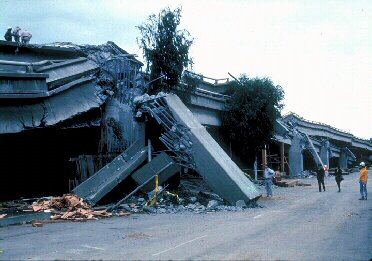
The latest quarterly inspection of the Alaskan Way Viaduct revealed the aging roadway has sunk another quarter-of-an-inch between Columbia Street and Yesler Way. That section has sunk a total of five inches since the 2001 Nisqually Earthquake.
While state transportation officials are concerned about the continual sinking, they say the Viaduct is still safe for drivers. They plan on beginning work this fall to reinforce the foundations of several columns that are settling. Repairs include drilling steel rods into the ground surrounding the columns. The rods can carry a 95-ton load and will prevent further settlement into the ground.
Work isn't expected to disrupt traffic and no lane closures are planned. The project is estimated to cost $5 million and should take five to six months to complete. It's just one of six improvement projects planned to replace or repair parts of the Viaduct. The next inspection is scheduled for October.
Replacement plan given the green light
The best way to move people - not cars - efficiently should determine how to replace the aging Alaskan Way Viaduct, according to Council Member Peter Steinbrueck. That was one of his arguments as the council voted on the latest way to deal with the controversial topic.
During a Committee of the Whole meeting, members voted to approve a surface option known as the Urban Mobility Plan. The $8.1 million plan gives the Seattle Department of Transportation (SDOT) the go ahead to begin planning for Viaduct traffic on Seattle streets.
"This ordinance calls for not another study, but a new plan," Steinbrueck said. Steinbrueck also serves as the Transportation Vice-Chair.
A surface option would include improving mass transit to help absorb the number of commuters who regularly use the Viaduct. Leaders also hope it'll improve the downtown street grid, HOV lanes, bicycle and pedestrian access and include other traffic management techniques including trip-reduction strategies.
SDOT now has 45 days to work with the Washington State Department of Transportation and King County to produce the Urban Mobility Plan for the Council. If approved, City leaders hope to have the first part of the plan finished by summer 2008.
Watch the Full Council/Committee of the Whole meeting on the Urban Mobility Plan.
Governor announces $900 million viaduct update
A new Alaskan Way Viaduct project was announced Wednesday, March 14 by State and Seattle leaders - one they both agreed on. Governor Chris Gregoire announced the $900 million plan which will strengthen several parts of the aging waterfront structure. Citing safety, capacity, mobility and fiscal responsibility, the governor said that work on the solution to the viaduct must happen now. The new plan comes in the wake of the March 13 Seattle advisory vote in which Seattle residents rejected both the viaduct rebuild and tunnel options.
Appearing at a press conference alongside Mayor Greg Nickels and King County Executive Ron Sims, the governor said the project will involve the collaboration of state legislative and transportation leaders, city leaders and the Port of Seattle. The $900 million project will begin immediately with work first concentrating on engineering and design. The physical work will start this summer.
Proposed changes include a new interchange on the Viaduct's south end to improve freight transit mobility. Additionally, a road section will be replaced between Holgate Street and Royal Brougham Way and steel structures will be reinforced from Lenora Street to the Battery Street Tunnel. Also, seismic and fire suppression upgrades will occur in the Battery Street Tunnel.
Cost estimates included in March Viaduct ballot
In response to a request by Governor Gregoire, the city-wide viaduct advisory ballot choices will now include cost estimates. Ballot wording previously passed by the City Council on January 19 did not include cost numbers. City Attorney Tom Carr later rewrote the ballot to include the price proposals.
The ballot measure will consist of yes or no answers to the two viaduct replacement options: the $3.41 billion Surface-Tunnel Hybrid Alternative and the $2.8 billion Elevated Replacement Alternative option.
The Mayor and city transportation officials scaled down the original six-lane tunnel proposal after lawmakers in Olympia voiced concerns over the billion-dollar price tag. The new tunnel proposal is now four lanes with two lanes each direction, side-by-side instead of the double-decker six-lane version. Transportation officials say the new tunnel design will still be able to carry the same amount of traffic with the two shoulders converting into extra lanes during peak travel times.
The vote will take place on March 13 and be conducted exclusively by mail-in ballots.
Licata proposes Alaskan Way Viaduct vote date
March 13 may be the day Seattle residents get their opportunity to speak up about which option they prefer to replace the Alaskan Way Viaduct.
City Council President Nick Licata and Council member David Della announced Friday, January 5, they are drafting a ballot proposal that would give voters two options: replace the viaduct with an elevated structure or tunnel. The costs of both projects would also be listed on the ballot.
Licata also wants the ballot to include information that would help voters understand that residents will be responsible for picking up cost overrides on both options. The elevated rebuild is estimated to cost $2.8 billion and the tunnel option is estimated to cost $4.6 billion. So far, state and federal funds secured for the project amounts to $2.4 billion. "We have to be honest with Seattle voters about the additional $2 billion needed to build a tunnel," Licata said.
In mid-December Governor Christine Gregoire announce she'd like to see a city advisory vote on the controversial multi-billion dollar project. She believes the project is at a stalemate and wants to hear what Seattle residents have to say about the project. She called for the vote to happen sometime this spring, before the legislative session ends in mid-April.
Council member Jan Drago is also working on an alternative proposal that might negate the need for a special vote. She's hoping to find an alternative that is acceptable to supporters of both the elevated structure and the tunnel. Drago believes that an indecisive advisory vote by residents won't do the city any good.
The Alaskan Way Viaduct ballot issue will be the topic of special meetings of the Full Council on Thursday, January 18 and Friday, January 19.
Viaduct decision falls to Seattle voters
Governor Gregoire calls for special spring election
After months of speculation over tunnel, rebuild or possible surface option to replace the aging Alaskan Way Viaduct, the decision still isn't clear. One thing is for sure, the Governor wants Seattle voters to decide.
Governor Christine Gregoire announced Friday, December 15 that Seattle residents should vote for either the rebuild or tunnel option. Gregoire stated the surface option and retrofit were both unacceptable alternatives. Now City and Legislative officials must both agree with the public vote.
Mayor Greg Nickels said he welcomes a public vote. Nickels stongly supports the cut and cover tunnel option.
Gregoire said the financing plan for the rebuild option was sufficient, but financing for the tunnel option wasn't complete. If voters opt for the cut and tunnel option, Gregoire stated city leaders and tax payers would be responsible for finding any additional funds needed for the tunnel replacement.
She also felt that the state was at a "political stalemate" over the debate for a tunnel or a rebuild and that hearing from Seattle voters was a must before going forward with the massive construction project. While the exact date for the vote hasn't yet been set, it will take place before the Legislative session ends in April.
Current estimates have the tunnel rebuild option costing more than $4 billion dollars. Estimates for the rebuild put the project at $2.8 billion. The Governor hopes to have a viaduct decision by mid-2007 and construction underway by 2008.
Tunnel supporters believe this is a chance to reclaim the waterfront for residents by putting the major roadway underground. Opponents say the project is too costly and will cause too much of a disruption for businesses, residents and commuters.
The 2.2 mile double-decker Alaskan Way Viaduct carries about 110,000 vehicles per day. It was damaged in 2001 by the 6.8 Nisqually Earthquake.
Democrats denounce tunnel option
On November 16, 30 members of the House Democratic caucus sent a letter to Governor Christine Gregoire supporting the construction of an elevated highway to replace the Alaskan Way Viaduct. The letter stated that the tunnel option will results in costs "the taxpayers of Washington cannot afford."
The letter was signed by House Speaker Frank Chopp (D-Seattle), and House Appropriations chair Helen Sommers (D-Seattle) and others. In September Chopp sent a similar letter to the expert review panel as they were looking at funding options for replacing the aging Viaduct. Gregoire will consider the letter, according to her spokesperson.
She is expected to make her decision on the Viaduct by the end of the year. This decision is then subject to approval by the state legislature.
Gregoire has stated that she will only consider the tunnel or a rebuild of the existing viaduct.
Viaduct decision heads to Olympia
In a 7-1 vote, City Council members told state leaders, they preferred the cut and cover tunnel option to replace the aging Alaskan Way Viaduct. Council President Nick Licata voted against the tunnel option, while Council Member David Della was absent from the September 22 special meeting.
But the cut and cover tunnel still isn't a done deal. Now the fate of one of Seattle's main arteries lies with Governor Christine Gregoire. She had asked city leaders to either put the decision to voters, or make an advisory decision. She'll now have until the end of the year to make the call.
News of the vote comes the same day as the revised cost estimates for the replacement project were announced. The Washington State Department of Transportation (WSDOT) issued revised estimates for the tunnel replacement ranging from $3.6-$5.5 billion. An aerial replacement option was estimated between $2.2-$3.3 billion. Initial reports tagged the tunnel as costing anywhere from $3.0-$3.6 billion and the replacement option from $2.0-$2.4 billion dollars.
State leaders say the funding is available for a rebuild, however, if Seattle leaders wanted a cut and cover tunnel, they needed to find the financing for the rest of the money. Now, Gregoire is considering using a toll to provide for extra funding on the cut and cover option. So far, no toll prices have been announced, but joint legislative hearings will be held over the next few months to further discuss and explore the tolling option.
.
Expert Review Panel releases Viaduct report
The group charged with taking a closer look at the proposed cut and cover Alaskan Way Viaduct tunnel said funding looks to be "generally sound" with no "fatal flaws."
The Expert Review Panel released their report of Washington State's Department of Transportation stating, "We accept the project's funding assumptions as reasonable." The report was released on August 31.
Mayor Greg Nickels cheered the report. As a staunch supporter of the cut and cover tunnel replacement option, Nickels believes tearing down the aging viaduct and giving Seattle residents direct access to a new and improved waterfront is a once and a lifetime opportunity.
But opponents of the tunnel still claim there is some vagueness to the finances of project. Estimated to cost upwards of $3.6 billion, the cut and cover option could face cost over runs, according to Council President Nick Licata. He wants to see a resolution where Nickels would ask the state who will be responsible for those cost over runs.
Currently, state officials have said they will contribute $2.4 billion for a rebuild of the current viaduct structure. After that, any financing would need to be secured by city officials.
Despite their disagreements, all players say a decision needs to be made to replace the viaduct soon. The City Council has until September 22 to decide whether or not to place the viaduct issue on the November ballot.
Governor Christine Gregoire has stated she wants Seattle voters to have an accurate estimate of what the cut and cover option could ending up costing. She has asked the Department of Transportation to re-evaluate the tunnel costs estimates again.
Waterfront Plan On Wednesday, July 26, Mayor Greg Nickels unveiled his plans to reclaim Seattle's waterfront as a gathering place for people while preserving the environment for generations.
The plan calls for a 70-foot wide promenade along parts of the waterfront. The walkway would provide a connection for pedestrians looking for a relaxing stroll from the Pike Place Market to Pioneer Square. Shoreline restorations and beach access for environmental education would help reconnect the city directly with Elliott Bay. The plan also calls for several viewing areas and public gathering areas.
While Nickels' plan is a concept, he feels reclaiming the waterfront is a once-in-lifetime opportunity for Seattle residents. The waterfront plan is based on the aging Alaskan Way Viaduct coming down and being replaced by a cut and cover tunnel. His waterfront plan will be sent to the City Council for full consideration in September.
On June 22, Mayor Greg Nickels unveiled his funding plan for the Alaskan Way Viaduct Tunnel construction project estimated to cost between $3 billion and $3.6 billion. The Mayor's plan identifies $5 billion in potential funding.
The plan relies on the passage of the Regional Transportation Investment District (RTID) ballot measure which will come before voters in 2007. If approved, RTID would give Nickels' plan $800 million. Charging a toll for drivers of the busy roadway is another funding source currently being explored. While no set fee has been established, a possible $2 one way fare could raise $150 million dollars over 20 years. Other sources of funding include; increased taxes for waterfront property owners, utility relocations and the Port of Seattle.
More than $2.4 billion dollars has already been secured for the project. The state has enough funding to rebuild an elevated structure, larger and more seismically sound than the current viaduct. But several Seattle city leaders are pushing for the tunnel option, which would open up more potential park space along the downtown waterfront.
In early June, an independent panel was created to review the construction and finance options of the Alaskan Way Viaduct/Seawall and SR 520 floating bridge projects. The panel consists of eight experts in the fields of planning, engineering, finance, law, emerging transportation technologies, geotechnical and economic fields. Governor Chris Gregoire convened the panel since millions of state, local and federal dollars will be used to complete the projects.
The panel is expected to begin meeting in late June or early July. Some of their meetings will be open to the public, but others will be a closed work session. They are expected to submit their report in September that will help inform state and city officials whether the plans to replace the two main arteries through the Seattle area are achievable.
For more information on the Expert Review Panel, visit their Web site.
On Wednesday, March 26, City Council members authorized a $15 thousand study to evaluate a surface option proposal to replace the aging and damaged Alaskan Way Viaduct. The surface option, presented by the People's Waterfront Coalition, would put two lanes, in both directions, along the waterfront, while leaving open space for people to enjoy the views, shoreline and nature along Elliott Bay. While most council members and Mayor Greg Nickels say they prefer the tunnel option, council members wanted to learn more about the option and what other cities have built under similar circumstances. The study is expected to take about five to six weeks, at which point council members will evaluate whether the option deserves a more in-depth analysis
Source Seattle Channel
Monday, March 10, 2008
Street Car for two-way Mercer Street?
11/3/04 The transportation plans of Mayor Greg Nickels and billionaire Paul Allen for the South Lake Union neighborhood keep advancing, despite glaring flaws. On Monday, Nov. 1, the Seattle City Council authorized a study of the plan to turn Mercer Street into a two-way boulevard. In doing so, the council made clear that it doesn't matter that the $200 million plan will not improve traffic flow in the area. Rather, the council signed on to the fantasy that a two-way Mercer Street will help South Lake Union become a 24/7 biotech wonderland. On Oct. 28, the Puget Sound Regional Council became the latest government to fall under the spell of the biotech booster virus that is sweeping governments across the nation when it put up $4.3 million in federal transportation dollars toward the $45 million needed to build a 1.3-mile streetcar from downtown to South Lake Union, which Nickels and Allen are promoting. The Nickels administration has now identified $36.5 million of the streetcar's costs, the bulk of which would come from a special tax on South Lake Union property owners. The streetcar, like a two-way Mercer Street, has dubious transportation utility, but Allen and other developers lust after it as a way to make the neighborhood more attractive to new businesses. Being as how the city's transportation infrastructure has been neglected for years, citizens might hope the City Council would serve as a check on the raid of public transportation dollars for one developer's agenda. But such hopes are rapidly being dashed. GEORGE HOWLAND JR.
Gregoire: "Watch me tear Viaduct Down!"
Gregoire: 'Watch me' tear down the viaduct
Governor tells the city she won't let issue be pushed to back burner 1/3/08
By CHRIS McGANN
P-I CAPITOL CORRESPONDENT
OLYMPIA-- With or without Seattle's approval, the state will tear down the earthquake-damaged Alaskan Way Viaduct in 2012, Gov. Chris Gregoire said Thursday.
"It's coming down in 2012. I'm taking it down -- the middle," she said, referring to the elevated portion of the span that runs roughly from Battery Street Tunnel to Pioneer Square, which has been the most vexing and controversial piece of the transportation puzzle.
"That's the timeline. I'm not going to fudge on it. And if we don't have some alternative by then, boy are we going to have a mess on our hands because it's coming down."
Asked if she, as governor, could trump the state's largest city and county and unilaterally tear down a highway that carries more than 100,000 vehicles a day through the heart of Seattle, Gregoire said:
"Yeah, watch me."
The governor set a hard deadline after a tortured and unsuccessful attempt to resolve the issue last year. At that time Seattle, King County and the state fought and floundered in their attempts to produce a viable option for replacing or rebuilding the viaduct.
Instead of a new $2.8 billion elevated highway similar to the current viaduct the state wanted, Seattle Mayor Greg Nickels fought for a more expensive tunnel and King County Executive Ron Sims wanted a street-level solution that would have included much more transit.
Last year Gregoire twisted arms and issued her recommendation but ultimately deferred the decision to Seattle voters, who rejected both a proposed elevated rebuild and a more expensive tunnel along the waterfront. The surface option was not on the ballot.
In the end, elected leaders agreed to a truce and opted to begin demolition and utility relocation on the south end of the roadway.
That gave everyone until 2012 to agree about how to replace the double-decker section through the heart of the city.
Now Gregoire said she's not letting the issue get pushed to a political back burner.
Seattle Deputy Mayor Tim Ceis said setting an inflexible deadline is unrealistic.
"This is not just an issue for the city of Seattle to ensure that the system functions when it comes down, this is an issue for the entire state of Washington, because this is the economic center for the state," he said.
If the statement was intended to be a threat, Ceis said, it would be out of character to Gregoire.
"I find it hard to believe that she is issuing a threat right now because we are all working so well together. ... It's everybody's objective to get the viaduct down as soon as is possible and practical. But in order to do that, you have to ensure that projects have been funded and completed that allow the transportation system to continue to function if you cut off that corridor."
He said the city and the state are making good progress toward crafting a workable solution the people will agree on.
"No matter what, the state has to be a constructive partner in this project," Ceis said. "The state has the funding and we need to be able to make those fixes to the rest of the system in order for the viaduct to come down by 2012."
Ceis said the timeline was not, in itself, impossible, "but it's going to take a real push by all parties involved."
As for the sticky question of how to pay for the project, Gregoire said the state would keep its commitment to provide $2.8 billion. Any more would have to come from other sources.
Although she plans to team up with other governors to appeal to the federal government for increased investments in state infrastructure projects, Gregoire said that money would not be secured in time for the viaduct replacement.
Sims applauded the governor's hard deadline and her openness to addressing the problem with a much more comprehensive solution.
"The viaduct has to come down. It's not safe," Sims said. "I support (Gregoire's) position on that. It is a tough decision to make ... but it's the smart thing to do."
In the past, Gregoire opposed a surface option, but in recent months she has said she's now open to the idea.
In last year's debate, Speaker of the House Frank Chopp, D-Seattle, was unbending about his desire to rebuild an elevated viaduct.
"I'm comfortable with her statement," he said. "That project has got to get resolved; it cannot just go on forever."
He said Gregoire had already made her deadline clear.
"I remember her telling me that a long time ago because obviously, it's a safety issue," he said.
As the discussion continues about a surface option, leaders are careful to explain they aren't simply talking about a ground-level highway along the waterfront.
The viaduct traffic would have to be dispersed and otherwise addressed through a wide swath of Seattle.
"What Greg (Nickels) and Ron (Sims) and I have talked about is: 'Let's stop thinking about replacement of the Alaska Way Viaduct and start thinking about how do we do transportation in all of Seattle from I-5 to the waterfront,' " Gregoire said.
"We really are fundamentally not efficient and effective now. Our offramps from I-5 are not efficient to the flow of traffic. What international city do we know of that would have two-way traffic in downtown? What international city do we know of that would have street parking in the middle of downtown?
"We have not stepped back, collectively ... and said, 'How can we make this a user-friendly, international city?'
"That's why a 'surface option' is on the table now," Gregoire said. "If we simply say replace the viaduct, and if that's all we do, the surface option won't work. I still stand by that. I've looked at it, the ramifications to the waterfront are terrible. We won't have any legitimate freight mobility. ... The surface option works only (and I don't know if it does) but only if you look at the totality."
Seattle doesn't want to encourage traffic by widening 520
Sunday, November 12, 2006
Evergreen Point Bridge: Build it green
SEATTLE POST-INTELLIGENCER EDITORIAL BOARD
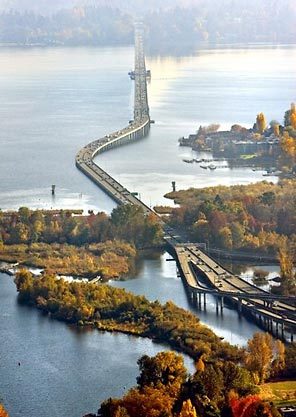
The state has laid out plans for a new, larger Evergreen Point Bridge that is six lanes, with capacity for evermore cars. The Seattle City Council is under pressure to go along.
But there is no six-lane plan that meets three city and regional essentials: preserving the Washington Park Arboretum, protecting the southeast corner of the University of Washington's campus from becoming a traffic dumping ground and keeping the Montlake neighborhood livable.
The City Council should push the discussion in a healthier direction. It should insist on a four-lane alternative, adding no new lanes but still helping the bridge accommodate more vehicles as ramp improvements, wider lanes, tolls and the like help buses and cars move more efficiently. The council also would show it is serious about controlling greenhouse gas emissions.
As state planners conclude, a four-lane alternative protects the public by replacing the current quake- and storm-prone bridge. The state environmental study concluded four lanes would meet other key goals: "improving ... reliability and protecting and enhancing neighborhoods and environmental values." In fact, the preference for six lanes rests on one criterion: a greater increase in "mobility for people and goods." That's bureaucratic for "cars and trucks still come first in our hearts."
Holding the line against an enlarged river of traffic will win the council few friends among those who reflexively bow to the car culture's voracious demands for land, water and public subsidy. Key council members like a six-lane option, called the Pacific Street interchange, which helps Montlake but risks UW and Arboretum harm.
The council has two intelligent options. First, there is the state's four-lane proposal, which needs adjustment but provides a starting point. Activists have also developed a four-lane option that emphasizes the ways transit improvements can be made more cost-effectively than with six lanes, provides intermittent shoulders on the bridge for stalled vehicles and demands strong mitigation measures. The cheaper "green alternative" also could help address an expert review panel's finance questions.
Jeannie Hale, president of Seattle Community Council Federation, told the City Council recently, "It's beyond me why the city of Seattle wants to encourage more automobile traffic." Four lanes will work, financially and environmentally
Tuesday, March 4, 2008
Very good chance Sound Transit will seek money on fall ballot
By C.R. Douglas on Crosscut
A levy-less election?
What if there was a big election season, and Seattle didn't ask its citizens for a property tax increase? Believe it or not, our levy-loving city — there have been four in the last six years alone — is likely to be levy-less come this fall.
It's especially surprising given that a presidential election year, when turnout is strongest, is the friendliest environment for local ballot measures. High turnout means lots of younger voters, who generally favor tax measures.
Why would the city let this golden opportunity go by, even though there are so many causes needing money?
Can you say "light rail?""There's a very good chance Sound Transit will go this fall," says Richard Conlin, city council president and Sound Transit board member. The three-county agency wants a second try at extending the light rail line, which was defeated last November. And local leaders seem to be giving that plan the right of first refusal when it comes to securing ballot real estate.
Says Conlin: "If we have a Sound Transit issue on the ballot, we ought to be very careful about whether we put any other issues on the ballot." That sounds like no city levy to me.
Seattle politicians, who have much to gain from a light rail extension, don't want to jeopardize its chances by adding a money measure of their own to the mix. Taxing has its limits — even in Seattle.
Interestingly, even if Sound Transit decides to hold off for another year or two, the city may still end up without a ballot measure this fall.
That's because the three most likely levy ideas — Parks, Seattle Center, and Pike Place Market — are still jockeying for who's most deserving of attention. And it's getting late.
Renewing the popular pro parks levy would seem a promising idea, but the mayor is steadfast against it. While he likes what it has accomplished, he thinks there are better priorities going forward. Most councilmembers are inclined to support a renewal, but without the mayor's backing, it won't make the ballot.
Seattle Center is talked about. Certainly it needs a cash infusion. But, according to City Councilmember Jan Drago, "it's not ready yet." And no wonder. So much is still up in the air about the Center's future, including what to do about Key Arena (with or without the Sonics); whether the Center can tear down Memorial Stadium (now controlled by the School District); and whether Center House should stay or go. Much more needs to come into place before a plan can go before voters. Fall is likely too soon.
Finally, there's Pike Place Market. It's "ready to go," says City Councilmember Sally Clark of the $80 million upgrade plan. But that may not be enough to get it on the ballot. Because it's so iconic, there will be pressure to give it "coattails" and pair it with something like Seattle Center that would have a harder time going alone. But that would mean waiting until the weaker link is ready.
Tellingly, the mayor chose not to announce a levy for this fall in his recent State of the City speech. In the past, he has used that forum to launch money measures.
Seattleites are arguably fatigued with levy requests. After all, they've approved a whopping $735 million since Nickels became mayor. With an economic downturn likely upon us, there is a strong case to be made for taking a pause. Still, it seems surprising that a ripe opportunity to hit up voters might actually come and go without them even being asked.

Tuesday, June 5, 2001
Please don't let light rail ``go south'', and steer clear of I-5
June 5, 2001
Honorable Paul Schell
Mayor, City of Seattle
Dear Mayor Schell,
My name is Jonathan Dubman. I am an active member of the Montlake Community Club and I have been closely following Sound Transit and other regional transportation issues and engaging many others in discussions on these important topics. I have generally supported your agenda from early on, but I was recently very disappointed to hear of your enthusiasm for "going South" with Link, if we assume the entire system can't be built at once.
Furthermore, I understand you have expressed some degree of support - and please correct me if I'm wrong - for an eventual alignment north of downtown close to I-5.
There are a great many reasons why that is an inadvisable approach.
Simply put, the University Link segment would be an enormous boon to the transportation infrastructure to the region, a belated success. The segments to the south, if built first, would be so ineffective, and manufacture such a coalition of enemies, as to doom future phases of this important system.
Transit must first go where the lion's share of the people and the jobs are: First Hill, Capitol Hill, the University District, Northgate, and of course, downtown. There are the designated urban hubs of the region. These are the areas that have been accepting growth, and all the attendant traffic, with the expectation that light rail was going to come and solve some of our mobility problems. These are the areas with land use that best supports light rail.
Southeast Seattle has a transit-dependent population with high Metro ridership, but let's be frank about it - it's the redevelopment potential that would give that region the density to justify the large expense of constructing light rail. And that could take a long time to develop, at the possible expense of affordable housing there. Why not start light rail where the existing density is, and build a system that will convince the region that even the starter light rail is a big success, and higher density can afford a high quality of life, and we're serious about transportation concurrency?
Many within Rainier Valley have been very vocal against at-grade light rail through their community. I respect both sides of this issue. Whether or not their fears are justified, a lot of people there really don't want it. Tukwila doesn't want it down route 99. The airport won't be ready for light rail for years, and even if we did build light rail to the airport, Metro express route 194 would still be faster from downtown. Sound Transit's own operating plan calls for half the frequency south of downtown than north of downtown, and that is because north is where the ridership is. The Federal Full Funding Grant Agreement was made for the north segment first because that's the segment that's easiest to justify.
Those arguments seem to make a strong case for University Link as the first segment of light rail in the region, if cost weren't an issue. But is University Link the most cost effective segment? The answer is a resounding "yes"!
The Executive Summary of the recently released Central Link Board Workbook bears this out. University Link is by far the most cost effective segment of the Central Link light rail system. While it's admittedly easy to oversimplify here, let's take a quick look at the numbers, straight from this document:
* University Link: Cost of $2,250 million (today's estimate) for ridership of 85,000, or $26,000 per daily rider.
* CPS to Henderson: Cost of $1,580 million (conservatively using the low estimate) for ridership of 27,000, or $58,000 per daily rider.
* CPS to South 200th: Cost of $2,250 million (again, using the low estimate) for ridership of 51,000, or $44,000 per daily rider.
* Capitol Hill to Henderson: $2,150 (again, using the low estimate) for ridership of 60,000, or $35,000 per daily rider.
These are construction costs, not including operating expenses, but operating expenses should not vary that greatly among these various routes.
While the projected revenue service dates vary, they do not vary by much. University Link is projected to open Fall 2009. The earliest projected opening date is mid 2008 for CPS to Henderson, perhaps 15 months earlier, but that system has less than half the cost-effectiveness of University Link by the straightforward calculations above.
In the interim, Southeast Seattle can be served reasonably well with a new in-city express bus route or routes - call them "7X" and "9X" - that run frequently, with few stops, from downtown or Capitol Hill along MLK with traffic signal priority. This could be done in the relatively short term to provide improved service for Southeast Seattle much faster than with Link, and feed into University Link when that is complete. With this plan, Southeast Seattle could see big improvements sooner than anyone else, and there won't be any injury statistics or lawsuits related to at-grade rail down MLK.
There are those who support the "Ride Free Express" or some other solution involving buses. The biggest problem is, in the north direction there is no uncongested right of way for buses to travel on, and I-5 doesn't even have two-way HOV operation. Where would these buses go?. How do we expect to handle transit north of downtown if we don't build Link? If you think another technology could be the answer here, I'm happy to consider that, but it seems clear that buses aren't going to cut it.
There are those who think that Capitol Hill has good bus service now, so why is Link necessary? While Capitol Hill may have excellent bus service to downtown and decent bus service to the University District, try getting from Capitol Hill to downtown Bellevue, or to Northgate. Even to the University District, buses snake through a lot of congestion. Capitol Hill transit service is not as great as it's cracked up to be.
Next to University Link, Capitol Hill to Henderson is the segment under consideration that makes the most sense (except for well-publicized reservations about at-grade operation in the Rainier Valley). But this would make sense only as a very interim solution. It seems like folly to construct a hugely expensive rail system that doesn't cross the biggest bottleneck in the city, the ship canal. We would still need generous bus service from the University to Capitol Hill. Direct service downtown would also be required. Downtown is the place that's already the easiest to get to from Capitol Hill, and route 9 does directly serve First Hill and Rainier Valley from Capitol Hill.
And of course, the place we really want to end up is Northgate, itself an urban hub, but also within shot of rapidly growing south Snohomish County, which generates a lot of the traffic south into Seattle. It is going to be much harder to effectively serve South King County than North King County with light rail any time in the foreseeable future, given that it's 7 miles from Northgate to downtown, with just a handful of stops, and about 15 miles just to get to Sea-Tac, which will still be 40 minutes away from downtown by light rail. We may want to build great infrastructure everywhere, but we have to start where it's going to be most effective.
There are those who support an I-5 alignment for north Seattle. I used to think the same myself, until I realized that between downtown and Northgate, this alignment would service not one major center of activity. How will Eastlake and Portage Bay / Roanoke Park feel about more transportation infrastructure, and another huge bridge, in front of their doors? They strongly oppose the idea. A station stop at Campus Parkway instead of Pacific Street has lower ridership and requires disruptive cut-and-cover construction in the already suffering University District. And a station stop near I-5 makes no sense at all. It would be the death knell for the University District as we know it today. How many transit users want to visit the Blue Moon Tavern on 45th near I-5, versus the University and the Ave? How would we shuttle everyone to where they are going? With more buses that travel down traffic-choked arteries? Are we planning to redevelop the station areas near I-5 with high rises to justify light rail? Imagine the effects on I-5 of all the light-rail related pedestrian and vehicle traffic next to the exits. The topography, the comparatively low density of the built environment, the dominance of low-density zoning (much of it single-family), the high levels of traffic and noise, and the limited pedestrian crossings in the vicinity of I-5, to say nothing of the complexity and costs of constructing a light rail system in this overburdened corridor, all point to the fact that I-5 is not only not the best but perhaps the worst choice for an alignment north of downtown. Can we build adjacent to I-5 while keeping I-5 open the whole time? Can we visualize the effect of closing part of I-5 and the bus tunnel at the same time? That would be a good time to get out of town.
I encourage you to consider very seriously the possibility of routing University Link under the Montlake Cut to save $50 million and raise the level of the stations in the University District. A station could be built near Rainier Vista, the UW Medical Center and Husky Stadium, and would service the University population very well. Moreover, such a station would interface much more readily with transit across SR-520, the forgotten stepchild of Seattle's transportation infrastructure, which is considering a tunnel connecting the Eastside directly with this very spot. If we could intercept buses from the Eastside at a University District station, perhaps we could get them off the downtown streets, off of congestion on I-5, and make up for the fact that they are no longer in the tunnel.
Please forgive me if there's a critical piece I'm missing here, but with all this in favor of University Link, why would you support another segment of this crucial piece of our transportation infrastructure in the region?
The only reason I can see to postpone the segment north of Capitol Hill is to refine the alignment, perform the necessary study for the Montlake Cut alignment, and coordinate with the Trans-Lake Washington Project. If that is your motive, I strongly respect that, and support Capitol Hill to Henderson as the next best way to get started on this important north-south artery. Please let me know your reasons for your current stance, how strongly you take that stance, and if you might be willing to reconsider in light of the arguments above.
Thank you,
Jonathan Dubman
2014 E Calhoun Stre