Article from Moving People, Nov., 1996. Index.
Seattle's Surprise Rail Victory
EVEN VICTORS HAD NO CLUE THEY WERE WINNING
Seattle-area voters surprised nearly everyone on November 5 by approving a 10-year, $3.9 billion mass-transit plan, including light rail, commuter rail, and a regional express-bus network.
The plan, prepared by the Central Puget Sound Regional Transit Authority (RTA) and dubbed "Sound Move," attracted a 57% "yes" vote. This was Seattle's fourth try at winning approval for rail transit development. A 1968 heavy-rail proposal for Seattle's King County attracted a 51% "yes" vote, but state law requires a 60% majority for bond issues. A similar plan in 1970 received only 46% in favor. King County voters endorsed rail development in 1988 by 69% in favor, but this advisory referendum had no specific plan or financing proposal. RTA, created in 1993, attempted to secure approval for a regional LRT, commuter rail and express bus plan in March 1995, but this attracted only 47% of the vote. A revised, scaled-down version of this plan was successful.
Commuter-rail service would operate during peak periods on existing BNSF tracks between Everett, Seattle, Tacoma and Lakewood, 81 miles. Plans outline nine Seattle-Lakewood and six Seattle-Everett services during peak periods, some of them "reverse-commute." Commuter trains might reach Tacoma by 1999 and Everett by 2000, with service to Lakewood following track improvements. The completed network would serve 14 stations; more may be built if funding permits. Total capital and operating cost over 10 years: $669 million.
Heavy Duty Light Rail
Two separate LRT segments will be built. The first of these will link a planned commuter-rail and bus center near the Tacoma Dome with downtown Tacoma, 1.6 miles. In Seattle, LRT will extend from NE 45th St in the University District, serving the University of Washington, Capitol Hill, the First Hill medical center, and use the existing transit tunnel through downtown. Trains will continue southward via the Rainier Valley, Boeing Access Road, Tukwila and Sea-Tac Airport to S 200th St in the city of SeaTac. The Seattle LRT line will serve 20 stations, including those in the downtown tunnel. Startup is planned to follow five to seven years of construction, with completion by 2007. Cost: $1.8 billion. If additional funding becomes available, an extension would reach three miles northward from the "U District" to Northgate shopping and transit center. Further expansion would require voter approval of financing for subsequent phases.
RTA will fund construction of 12 access ramps for buses and ride-sharing vehicles to freeway "HOV" (high-occupancy vehicle) lanes. These will be extended and improved by the state Department of Transportation to create a 100-mile "HOV Expressway" network. RTA will also fund a 20-route regional express bus system, connecting major regional centers with two-way, all-day service using the HOV network. Initial service might begin by 1998 if RTA can reach interim agreements with existing transit agencies. RTA-funded HOV access ramps are estimated to cost $377 million, and the express bus network $361 million.
Local transit facilities such as transit centers, park-ride lots, and amenities such as passenger shelters will receive $255 million under RTA's "Community Connections" program. A $280 million "Regional Fund" will provide for regional fare integration, planning, and design work for future phases, including final engineering for the Northgate LRT extension. $171 million would be used for debt service.
The 10-year Sound Move program will be financed by local taxes and federal grants. Within the RTA service district (including parts of King, Pierce and Snohomish counties), the sales tax will be increased by 0.4%, generating an estimated $1.54 billion over 10 years. The annual motor vehicle excise tax will be increased by 0.3%, generating an estimated $440 million. RTA is expected to impose the former by April and the latter by June. A "typical" four-member family with an annual income of $35,000 will pay an estimated $104 per year, according to the Washington Research Council. RTA anticipates federal grants of $727 million, or 33% of LRT and commuter-rail capital costs, and plans to sell up to $1.052 million in bonds. No state funding is anticipated.
As state law requires, RTA "cost" estimates include cumulative operating costs as well as capital costs, and the financial plan includes estimated fare revenues: $155 million over 10 years.
Slicing Up the Pie
Under RTA's "equity principle" for distribution of tax revenues, expenditures would match taxes raised in each of five "sub-areas." No funds generated in one area would be used to directly benefit taxpayers in a different region. Any cost "overruns" in one area would have to be paid by that particular area, or made up through curtailment of some portion of the "sub-area" plan. Total expenditures planned for each of the sub-areas are: Seattle-North King County, $1.6 billion; South King County, $829 million; Pierce County, $575 million; east King County, $567 million; and Snohomish County, $362 million.
If voters decline to approve financing for subsequent phases, RTA will reduce the local taxes to levels sufficient to pay operating and maintenance costs and debt service.
An Unexpected Victory
Supporters and opponents alike were stunned by the 58% vote in favor of Sound Move. The 1995 plan would have required exactly the same tax increases, although it had a longer time frame (16 years), a higher total cost ($6.7 billion) a larger rail component (69-mi LRT, all-day commuter rail) and fewer express-bus routes (eight). The 1995 plan also was handicapped by its submission at a special election which attracted a low (33%) turnout of registered voters and a high percentage of absentee votes. Although it attracted a 62% "yes" vote in Seattle and a slight majority in King County overall, support from suburban voters was weak. The "yes" vote was no greater than 40% in the most populous suburban cities. Support was particularly weak in King County's "Eastside" and in Pierce and Snohomish counties. In Everett, where the mayor campaigned against the proposal, the "yes" vote was less than 20%. Nearly two-thirds of the 2.4 million RTA district residents live outside of Seattle.
This time, the response from suburban voters was dramatically different, although the victory was shaped in part by a strong turnout of registered voters, Democrats in particular. In Snohomish County, where local officials campaigned for approval, the result was 55% in favor. South King County voted 53% in favor, while Pierce County voted narrowly against. The strongly Republican Eastside suburbs voted 54% in favor, while the plan attracted a 70% "yes" vote in heavily Democratic Seattle.
Following rejection of the 1995 plan, RTA cut its staff by 50% in response to a 70% reduction in its budget. It changed its focus to a "broader mix" of transportation improvements and conducted nearly 400 meetings to seek community input. In an attempt to win support from suburban politicians and business interests, RTA proposed using $160 million to fund completion of the regional HOV lane network. Suburban interests liked the idea but did not support the overall package, while transit supporters and environmentalists cried "foul." The RTA board eventually decided that HOV lane construction is a state responsibility, but did include funds for new access ramps.
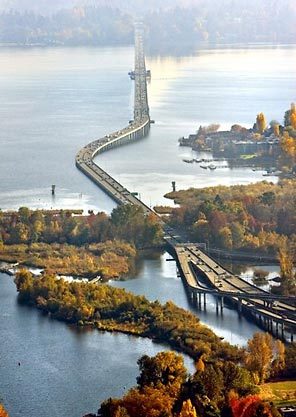
Eastside business interests wanted RTA funds for a study of how to increase capacity across the Evergreen Point Floating Bridge ("SR-520"), which has only four lanes. Residents living along the connecting freeways, who have long blocked expansion, turned out to voice strong opposition, and the board turned this idea down.
Business Support Key to Victory
The business community, led by Boeing, the largest regional employer, provided strong support and substantial funding for the campaign for approval, significantly more than in 1995. Boeing, which seldom takes public positions on ballot measures, issued a company position paper in favor. Even more uncommon was public expressions of support by Boeing's top executive. In June, Boeing issued a statement that it "is impossible to run an efficient company when your workers are stuck on the commute to work." However, attempts to forge a unified coalition of business interests failed, due largely to opposition from Eastside interests led by Kemper Freeman, developer of the Bellevue Square shopping mall.
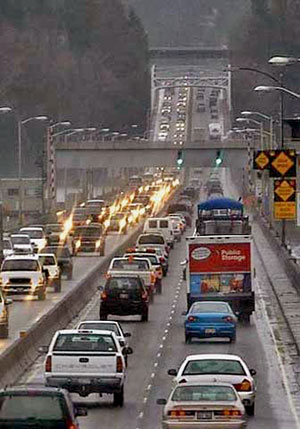
The campaign for approval was organized as "Regional Express". Its slogan, featured in TV ads showing rush-hour freeway jams, was "Regional Express -- It's Time".) The Seattle Chamber of Commerce provided much assistance in organizing the campaign, and a Chamber of Commerce vice-president served as treasurer. Regional Express did not tailor its campaign to the suburbs, but did organize steering committees for the five RTA sub-areas. It managed to win more support from local councils and business groups than before. By late October, the Pierce and Snohomish county councils had endorsed the plan, together with local councils in most cities and towns within the RTA district. Among these were Everett and Renton, which opposed the previous plan.
The RTA board had voted 15-2 in May 1996 to send the plan to voters. The two "no" votes came from King County Council members, who attempted to submit a "no confidence" motion in September. This attempt to "unendorse" the RTA plan was an exercise in partisan politics, with Republicans in favor and Democrats opposed. The council held three sessions, but did not bring the proposal to a vote in response to heavy lobbying from business interests, led by Boeing and the Seattle Chamber of Commerce.
RTA opponents did not fade away, but organized a group titled "COST" -- Citizens Opposed to Sitting in Traffic. They argued that the plan would not "reduce congestion", that costs would greatly outweigh benefits, that federal funds would not materialize, and that other strategies would increase transit ridership at less cost.
The opposition attempted to discredit RTA's cost and patronage estimates, claimed that rail systems had failed in other cities, and lambasted supporters for claiming that the plan would reduce congestion. Just before the election, opponents filed a complaint with state authorities against Regional Express, charging that its campaign ads contained "deceptive" claims, such as removal of 53,000 cars per day from freeway rush-hour traffic by 2010.
Highway interests and some businesses, who want an increase in the state's fuel tax to offset a large shortfall in state road funds, regarded the RTA plan as competition and worked for its defeat. But Regional Express raised far more money, nearly twice the amount raised in 1995. Supporters contributed nearly $500,000 by mid-October, while COST had raised $200,000. Supporters outspent opponents by about 4-to-1, according to COST, which did not manage to field a significant media campaign. Perhaps more significantly, opponents failed to articulate any real alternative, other than "pie-in-the-sky people movers and other fanciful technology better suited to amusement parks," as a Seattle Times editorial put it. Freeman, on the lecture circuit, advocated construction of more freeways, an idea which few take seriously. As things turned out, Eastside voters ignored local business and political leaders and supported the RTA.
RTA did not conduct a pre-election poll as it had no funding for this. In fact, since the agency's funding was to expire at the end of 1996, all staff were given 60-day advance layoff notices shortly before the election. Regional Express conducted polling which anticipated a 52 to 53% "yes" vote. COST anticipated strong opposition from Pierce and Snohomish county voters, whom it had targeted with a mail campaign. Someone conducted a survey in mid-October, reported by local television news and on the Internet, which found 57% in favor -- a figure which sounded wildly optimistic.
Seattle now joins Atlanta and Los Angeles as the only cities which have won voter approval for rail transit after initial proposals were defeated. Only Los Angeles and Seattle have managed to win approval following successive defeats. This took 12 years in L.A., but 26 years in Seattle. In addition, RTA won against the most substantial opposition ever fielded against a rail-transit ballot measure in the U.S. COST raised far more money than rail opponents have managed elsewhere.
Making Tracks in Seattle
RTA Executive Director Bob White has outlined several goals for the initial 14 months, including adoption of a six-year development plan, negotiations with public agencies and railroads, award of contracts for engineering and architectural work, coordination with existing transit agencies, and adoption of a uniform fare system for public transit in all three counties.
RTA faces a number of challenges regarding its rail development program. In particular, most of the Seattle LRT line is likely to stir controversy as planning advances toward construction. Many local residents are not convinced that tunneling from downtown Seattle beneath Capitol Hill to the U District is a good idea. The south line is planned for construction on elevated structure over the northern part of Rainier Avenue. Farther south, the line would be built on surface-level alignment along Martin Luther King Jr Way as far as Boeing Access Road.
Beyond there, the alignment has not been selected. The Port of Seattle, which owns and operates Sea-Tac Airport, wants the airport station built at least three blocks away from the terminal and parking garage. Even preliminary engineering for the prospective Northgate extension is likely to stir contention over whether or not to build this in tunnel.
RTA must also work hard to secure federal funds. A $300 million authorization from 1992 will have to be renewed, and an additional $427 million secured over the next 10 years.
Bus Tunnel a Quandary
Perhaps the most significant challenge will be conversion of the downtown Seattle transit tunnel for rail operation. Contrary to common impression, much more will be involved than connecting the existing rails to new LRT lines. In fact, the existing rails were installed without cathodic protection, according to Tom Matoff, who served as RTA's first Executive Director. Hence, they will have to be removed and replaced with new rails in a fully-protected design. In addition, major reconstruction of Convention Place station, at the north end of the tunnel, would be needed to permit connection with a new subway crossing under the Interstate-5 freeway and its retaining wall.
Rail planning carried out during the early '90s anticipated conversion of tunnel stations to high platforms. This would require closure during the construction period with buses returning to surface streets. But Matoff and staff chose an alternate strategy, using low-floor vehicles. This would require a slight increase in platform height, from eight to ten inches, and would permit joint rail and bus operation for an interim period. Matoff wrote that "an intelligently conceived bus-to-rail transition program" in the tunnel would permit incremental upgrading of transit services rather than an "agonizing construction period" of a decade or more.
Mixing Modes Underground
Joint use by rail and bus is possible, for buses share the Mt. Washington trolley tunnel in Pittsburgh, and dual-mode vehicles operate through LRT subways in Essen, Germany. During the early '90s, Seattle planners studied joint operation and found it "feasible", but did not develop a detailed operations plan. This is one of the tasks now facing the RTA.
RTA's LRT plans specify a peak-hour "capacity requirement" of 10,000 - 12,000 pass/hr, which implies 6-car trains operating every 3.5 to 5 minutes. It is difficult to imagine how such an intensive service can be scheduled -- reliably -- with continued operation of buses through the tunnel, given the different safety standards for rail and road vehicles. Road vehicles typically operate beyond the "safety limit" (at a given speed, the safe stopping distance is greater than the average spacing between vehicles), facing a greater risk of rear-end collisions.
King County's 236 Italian-built dual-mode buses are now halfway through their 12-year useful life, and their replacement will have to be addressed during RTA's Phase 1 program.
Unfavorable aspects of their service record are not well known outside Seattle. They exceed legal axle-weight limits with just the driver aboard. The rash of mechanical failures experienced during initial years has been reduced, but not eliminated. It is not uncommon to see (or hear) dual-mode buses operating under diesel power in the tunnel.
Less common, but hardly rare, is the sight of conventional diesel buses in the tunnel. This occurs if sufficient dual-mode buses are not available to cover scheduled runs, particularly during the pm peak. Separate statistics on tunnel operating costs have not been published, but dual-mode operating costs are said to be very high.
Monorail Mania
Improbably, Seattle will have another rapid-transit plan on the November 1997 ballot. The Seattle Monorail Initiative proposes expansion of the existing 1.2-mile Alweg monorail line, built for the 1962 World's Fair, to a 40-mile, automated, "X"-shaped network serving 26 stations. This was drafted by a local taxi driver and tour bus operator, Dick Falkenbury, who attempted to gather sufficient signatures prior to the 1995 RTA vote. A second attempt, prior to the most recent election, was successful -- surprisingly, in light of Falkenbury's low-key efforts at signature gathering.
The city council placed the monorail initiative on the November 1997 ballot, as state law requires when sufficient signatures are gathered, but council members expressed skepticism on several counts. Critics point out the plan's lack of technical and financial details, lack of integration with neighborhood and regional planning, and lack of attention to legal details (state law precludes establishment by cities of transit services competing with King County Metro without the county's permission).
No detailed cost analysis or financial plan has been prepared for the monorail initiative: Falkenbury's $850 million estimate was based on a recent Las Vegas monorail project connecting two casinos. The new municipal monorail agency would first seek to raise private funds; if not successful, the city would be required to issue bonds or raise its business and occupation tax. Falkenbury believes that Seattle voters are willing to pay for expanding the monorail. He also believes that RTA "cost overruns" will enhance the appeal of the project, which, he says, will be completed before the RTA has finished planning. However, voter approval appears a long shot at best, given resistance to new taxes and construction of a city-wide elevated network.
Transportation
Tuesday, March 11, 2008
Big Surprise Victory for Sound Move


Monday, March 10, 2008
History of Sound Transit
Sound Transit -- A Snapshot History
HistoryLink.org Essay 8002
1/1/07
Sound Transit is the agency responsible for building and operating high-capacity public transit systems in the heavily populated areas of King, Pierce, and Snohomish counties. Officially the Central Puget Sound Regional Transit Authority (RTA), Sound Transit operates light rail, commuter rail, and express buses. It also builds high-occupancy vehicle (HOV) lane improvements, transit stations, park and ride lots, and related facilities. Sound Transit has been headquartered in Seattle's historic Union Station since November 1999.
Growing Needs, Early Planning
Until 1940, the Puget Sound region had a well-developed rail and bus system linking Everett, Seattle, Tacoma, and intermediate points, but it fell out of favor and was replaced by a growing highway system. As traffic congestion and suburban sprawl increased, repeated attempts were made to re-create a regional rail-transit system, but King County voters rejected various options proposed in 1958, 1962, 1968, and 1970.
Metro Transit, an all-bus system now operated by King County, was approved in 1972, and an advisory ballot measure supporting development of a rail system passed in 1988. The state's 1990 High Capacity Transportation Act authorized King, Pierce and Snohomish counties to create a single agency to plan, build, and operate a high-capacity transit system within the region's most heavily used travel corridors. The three-county Joint Regional Policy Committee, created in 1990 to plan for a regional transit system, grew into the RTA, which held its first board of directors' meeting in September 1993. The name Sound Transit was adopted in August 1997.
On March 14, 1995, voters rejected the RTA's $6.7 billion plan for a regional transit system, but on November 5, 1996, they approved a scaled-back version valued at $3.9 billion by a 56.5 percent to 43.5 percent margin. The measure received a majority of votes in each of the three counties in the Sound Transit district (58.8 percent in King County, 54.4 percent in Snohomish County, and 50.1 percent in Pierce County).
The 1996 plan, known as Sound Move, included new regional bus routes, commuter trains, light rail, and a number of transit center, park-and-ride lot, and HOV access projects. The vote authorized a local 0.4 percent sales tax and 0.3 percent motor-vehicle-excise tax (MVET) to finance the construction and operation of the regional transit system, making it one of the largest public works projects in the region’s history.
Light Rail
Light rail, a modern version of the trolleys and trams that have run on city streets throughout the world for more than a century, was envisioned in both Seattle and Tacoma as part of the 1996 plan. The $80.4 million, 1.6-mile Tacoma Link light rail line opened on August 22, 2003. It runs from S 9th Street in the downtown theater district through the business district, and ends at the Tacoma Dome Station, where passengers can connect to Sounder commuter trains and buses. The Tacoma Link light rail system runs at street level at posted street speed limits (25 miles per hour). Despite its limited length and some disruptions during construction, ridership has exceeded projections.
The initial light rail line in Seattle, scheduled for completion in 2009, will travel under downtown in the transit tunnel completed in 1990 and used only by buses until 2005. (Despite having been built with rail in mind, the tunnel had to be reconfigured to meet modern track and platform standards, and is closed for construction from 2005-2007.) The line, known as Central Link and Airport Link, totals 15.7 miles and will connect downtown Seattle, the SoDo/stadiums area, Beacon Hill, Rainier Valley, Tukwila, and Seattle-Tacoma International Airport.
Getting to the airport has not been easy for Sound Transit. The initial estimates turned out to be significantly less than the reality, with the initial cost for a 21-mile line growing from $2.4 billion to $4.2 billion. In the wake of this revelation, Paul Bay, Sound Transit's director of Link light rail resigned in November 2000, followed by Bob White, the agency's executive director, in January 2001. Joni Earl, formerly the chief operating officer of Sound Transit, was appointed in an acting capacity, and was given permanent status in June 2001.
In April 2001, the U.S. Department of Transportation's Inspector General released a report criticizing the project's financial planning, which led to Federal grant funds being suspended. In late May, Sound Transit's Executive Director told the agency's board of directors that the light rail project might need to be abandoned. But in November, the Sound Transit board approved a shortened, $2.4 billion, 14-mile line that started in downtown, eliminating Capitol Hill, First Hill, and the University District, and cut the line about a mile short of the airport, potentially leaving light rail riders needing to take a shuttle bus from S 154th Street in Tukwila to the airport terminal. But in October 2003, the Federal grant was finally released, and in early 2005, bids for construction came in sufficiently under budget to allow the airport extension to be added again to the project, ending the jokes about building a "line to nowhere."
By that time, however, disruptions related to construction were being felt at all points along the line, especially in Beacon Hill and the Rainier Valley. As of February 2006, 44 of the 274 businesses along Martin Luther King Jr. Way, where much of the line's construction is taking place, were no longer operating, despite $7.5 million in "mitigation funds" from the Rainier Valley Community Development Fund. And local minority construction workers had staged rallies protesting that African Americans were not receiving an equitable share of construction work for the project. Adverse weather and unexpected soil conditions had also delayed construction; nevertheless, by February 2006 the line was reported to be more than one-third complete, and was on schedule for opening in 2009.
In April 2006, the Sound Transit board approved the route for the second Seattle light rail line, called University Link, which would extend from the end of the first line at the Convention Center, through Capitol Hill to Husky Stadium on the University of Washington campus. Construction is planned to begin in 2008 and be completed in 2016.
Preliminary planning is also underway for the "East Link" line from Seattle to Bellevue. This line would require placing rails on the Interstate 90 floating bridge, and there had been concerns that the bridge could not bear the weight of the train cars. So in September 2005, a test simulating the weight of the trains was undertaken, and the results indicated that the line could be built on the bridge if it was modified by removing some of the concrete, a task estimated to cost $31 million. The total cost for East Link had not yet been determined.
Commuter Rail
The "Sounder" commuter rail service began in September 2000 with two trains in each direction between Tacoma and Seattle’s King Street Station every weekday. The two-level Sounder passenger cars featured comfortable seats, restrooms, cup holders, water fountains, work tables, protected outlets for laptop computers and storage areas for bicycles, wheelchairs and strollers. On its first day, Sounder carried more than 1,100 passengers. In April of 2001, Sounder began running Sounder trains to Sunday Seattle Mariners baseball games. The “Home Run” service quickly became popular, and was expanded to serve Seattle Seahawks football games in August 2002.
The Tacoma-Seattle service is one leg of an 82-mile commuter rail system with 12 stations using existing railroad tracks between Everett, Seattle, Tacoma, and Lakewood. Service from Everett to Seattle was delayed during protracted negotiations for use of the line between Sound Transit and the Burlington Northern Santa Fe (BNSF) railroad, which owns the tracks. BNSF wanted Sound Transit to pay for the cost of improving the line, including building a second track along portions of the line that had only one track, and a $250 million agreement between Sound Transit and BNSF was signed on May 29, 2003. On December 22, 2003, Everett-Seattle Sounder service finally began with one train running south from Everett to Seattle's King Street Station in the morning and one train running north in the afternoon. Each train also stopped in Edmonds.
Delays also occurred as the tracks, which run along the shores of Puget Sound for much of the distance between Seattle and Everett, were blocked by mudslides caused by heavy rains several times in 2004 and 2006.
Ridership on Sounder has been lower than expected, but as of 2006 the agency was operating four round-trips daily between Tacoma and Seattle, and two daily between Seattle and Everett. It had also made an agreement with Amtrak that allows Sound Transit commuters to use Amtrak's Seattle-to-Everett trains. Two additional Tacoma-Seattle trips are planned for September 2007.
Commuter Buses
While perhaps receiving the least attention of its services, Sound Transit's express bus service aimed at commuters was the first of the agency's operations to begin. In September 1999, Sound Transit began operating nine new ST Express regional bus routes. Drivers from King County Metro, Snohomish County's Community Transit, and Pierce Transit actually operate the buses. By 2006, Sound Transit operated approximately 25 separate routes.
Sound Transit is funding freeway HOV direct-access ramps. This unique partnership, in which a regional transit agency is underwriting improvements to state highways, is intended to ensure fast and reliable local and regional bus service, encourage carpool and vanpool use, and eliminate the need for buses and carpools to weave through general traffic at freeway entrances and exits.
Sound Transit has also participated in public-private partnerships for "transit-oriented development," communities that incorporate transit into their planning. Such developments as the Village at Overlake Station, which was billed as "King County's first combination apartment complex/transit station," (Singer) are designed to encourage transit use and reduce sprawl.
Equal Slices of the Pie
Because it was recognized that voter approval for significant transit improvements would be stronger in urban areas, only voters in the most congested areas of King, Pierce, and Snohomish counties were asked to approve -- and pay for -- the regional transit system. The agency's service boundary generally follows the urban growth boundaries created by each county in accordance with the state's 1990 Growth Management Act.
In addition, safeguards were built into the plan ensuring that tax revenues from specific areas would be used to benefit projects in those areas. This concept, known as "subarea equity," divided the Sound Transit service area into five districts: Snohomish County, North King County, South King County, East King County, and Pierce County. Simultaneous work has been undertaken on projects in each of the subareas, but services and fares are being integrated throughout the region.
Sound Transit is governed by an 18-member Board of Directors; 17 members are local elected officials, and the 18th member is the Washington State Department of Transportation Secretary. Local elected officials include mayors, city council members, county executives, and county council members from within the Sound Transit District. Currently, the Sound Transit Board includes three members from Snohomish County, 10 from King County, four from Pierce County, and the State Transportation Department secretary.
Governor Veto's Congestion Relief Legislation
FINAL BILL REPORT
ESB 6628
PARTIAL VETO
C 199 L 98
Synopsis as Enacted 6/11/98
Brief Description: Clarifying transportation planning.
Sponsors: Senators Benton, Finkbeiner, Anderson, Zarelli and Schow.
Senate Committee on Transportation
House Committee on Transportation Policy & Budget
Background: In 1993, the Washington State Department of Transportation, in conformance
with federal requirements, was required to develop a statewide multimodal transportation
plan that would ensure the continued mobility of people and good s in a safe, cost-effective
manner. This multimodal plan, commonly known as Washington’s Transportation Plan,
identifies transportation needs for all modes, provides financial targets for the Transportation
Commission, and identifies responsibilities for its implementation. Washington’s
Transportation Plan addresses transportation modes in two broad categories: a state-owned
component and a state-interest component.
The state-owned component guides state investment in state highways, including bicycles and pedestrian facilities, and state ferries. Both the state highways element and the state ferries element are structured to have maintenance, preservation, and improvement programs.
These elements are required to first assess strategies to enhance the operational efficiency
of the existing system before recommending system expansion.
The state-interest component defines the state’s interest in aviation, marine ports and navigation, freight rail, intercity passenger rail, bicycle transportation and pedestrian walkways,and public transportation. The state-interest component is developed in conjunction with the appropriate public and private transportation providers to ensure the state’s interest in these modes is being met. The state-interest component has different program structures,
depending upon the needs and functions of each transportation mode.
Washington’s Transportation Plan(WTP) includes long-range transportation plans and invest-
ment needs for each mode; it does not compare combinations of modal investments within
a state transportation corridor. Comparison between transportation modes is difficult because
of different service objectives, program structures, and funding mechanisms between the
state-owned transportation component and the state-interest transportation component.
In addition, the development of the different transportation components within WTP places
a primary emphasis on the improvement and integration of all transportation modes to create
a seamless intermodal transportation system for people and goods. There is a concern that
WTP does not specifically prioritize congestion relief, the preservation of existing
investments, traveler safety, and the efficient movement of freight and goods. In addition,
there is concern that the state-owned component of WTP does not emphasize congestion
relief within its capacity and operational improvement element.
As part of addressing congestion relief, the Central Puget Sound Regional Transit Authority
(RTA) is proceeding with a ten-year, high capacity transit plan approved by voters in
portions of King, Pierce and Snohomish counties in November 1996. That plan calls for
improvements in regional express bus service, direct access facilities to the high occupancy
vehicle lane system, a commuter rail element, and a light rail transit system.
The RTA-planned system is estimated to cost $3.9 billion in 1995 dollars. This expenditure plan assumes $727 million in federal funds. This total expenditure includes $1.8 billion for light rail and $670 million for commuter rail. Train sets and other rolling stock for these rail services total $160-$200 million for light rail and $120 million for commuter rail.
Federal Transit Administration regulations preclude geographic preferences for grantees’
purchases, except where federal statutes expressly mandate or encourage those preferences.
At present, such preferences could jeopardize federal participation in the RTA project.
Currently, two Talgo train sets are being constructed in Seattle for the state of Washington.
These train sets were funded with state funds, and a condition of any contract let for such
acquisition by the state was that the manufacturer of the trains has the obligation of
establishing a corporate office in Washington State. The manufacturer is also obligated to
spend a minimum of 25 percent of the total purchase price of the train sets on the assembly
and manufacture of parts of the train sets in Washington State.–
Summary: The statewide multimodal transportation plan is directed to place a primary emphasis on congestion relief, the preservation of existing investments, the improvement of traveler safety, and the efficient movement of freight and goods.
The state-owned facilities component of the statewide multimodal transportation plan
(Washington’s Transportation Plan) is required to identify the most cost-effective
combination of highway, ferry, passenger rail, and high-capacity transportation
improvements that maximizes the efficient movement of people, freight, and goods within
state transportation corridors.
The state-owned component, capacity and operational improvement element is directed to
place a primary emphasis on congestion relief. The intercity passenger rail plan, which is a state-interest component of the statewide multimodal plan, is required to include a service preservation element, and a service improvement element. The service preservation element must outline trackage, depots, and train investments needed to maintain and establish service levels. The service improvement element must establish service improvement objectives that outlines the trackage, depot, and train investments needed to meet improvement service objectives.
The RTA is required to consult with the Department of Community, Trade, and Economic
Development to explore the potential for developing contracting methods that encourage
development of a manufacturing base in Washington for commuter and light rail train sets
and components. The RTA must report its findings to the Legislative Transportation
Committee by January 1, 1999.
Votes on Final Passage:
Senate
49 0
House
88 0 (House amended)
Senate
(Senate refused to concur)
House
(House refused to recede)
House
77 21 (House amended)
Senate
48 1 (Senate concurred)
Effective: June 11, 1998
Partial Veto Summary: The requirement for the state-owned facilities component of the
statewide multimodal transportation plan to identify the most cost-effective combination of
highway, ferry, passenger rail, and high capacity transportation improvements that maximize
the efficient movement of people, freight, and goods within transportation corridors is
removed.
The requirement for the state-owned component, capacity and operational improvement element to place a primary emphasis on congestion relief is removed.
The requirement for the intercity passenger rail plan to include a service preservation
element, and a service improvement element is removed
Friday, March 7, 2008
The 1996 Case for Rapid Rail (STARRT) v Light Rail
STARRT, an alternative to the RTA proposal.
3/11/96
by David E. Carnes
The Puget Sound area is roughly the same size as the
greater San Francisco Bay area; about 60 miles by 35 miles;
the population is roughly comparable. This being the case,
any rail transit system under consideration for this area
should have the same SERVICE MODEL.
The builders of the BART (Bay Area Rapid Transit)
system in the San Francisco Bay Area took as their service
model a high-speed, isolated-route system. By using BART,
it is possible to travel from Hayward to San Francisco (a
thirty-mile distance) in about 30 minutes. Because of a
similar geographical challenge (a body of water that limits
the number of routes into the primary city in the area),
commuting by car is not as practical because of traffic
snarls that can pop up at any time and cause major delays.
Since all Bay Area Rapid Transit system tracks are
elevated, underground (or underwater) or surface-level
behind fences, trains cruise between stations 4-5 miles
apart at 80+ mph. If the system were being designed today
instead of in the 1960's, the speed between stations would
most likely be 120-150 mph.
The system construction cost including the eight-mile
Trans-Bay tube was well under $1,000,000,000.00 (1 billion)
when completed; the equivalent 1994 cost, allowing for
inflation, is $3,900,000,000.00 (3.9 billion). Opponents of
the system have stated on numerous occasions in numerous
forums that the BART system isn't economically viable; the
often-flouted principle of contrary motion has resulted in
the construction of 50 miles of new track (from Hayward to
Livermore and from Concord to Antioch) to the BART system.
The Regional Transit Authority (RTA) has decided not to
pursue an isolated-track, high-speed rail transit system;
reasons for rejecting this approach have been given as
excessive cost, or the impossibility of integrating rail
transit into the landscape (one representative on the RTA
Board told me that the BART elevated stations are just sooo
ugly!... with the implication that street-level light-rail
stations are preferable in their aesthetic-non-offensiveness
rating).
The RTA plan (rejected by voters in March of 1995)
called for a light-rail system which would occupy the left-
turn lane area of Highway 99. A single track would run from
downtown Tacoma to Sea-Tac Airport; the rest of the run into
Seattle would be of double-track design.
This extreme design compromise would result in a
commute time of 70 minutes minimum between Tacoma and
Seattle; a distance of thirty miles. What must be noted at
this point is that the time estimate comes directly from the
RTA - not from myself or any other opponent of this
particular design. Estimated cost in 1994 was
$6,300,000,000.00 (6.3 billion) - and the debacle
surrounding the repair of the Kingdome roof shows that the
true cost of the system could -and certainly would - be much
higher.
Instead, the RTA is taking the Portland, Oregon MAX
system as its service model for the Puget Sound area; low-
speed, street level light-rail. Using the MAX, it takes 45
minutes to travel a distance of 15 miles (personal
experience; and this was on a Saturday morning, with no rush-
hour traffic crossing the tracks!). Stations are 1-2 miles
apart. Trains must stop at all traffic lights, observe all
traffic laws, and have a maximum speed of about 25-30 mph.
The RTA will resubmit the light-rail proposal for a
second vote in 1996 or 1997. If the RTA plan is accepted,
the residents of Puget Sound will be saddled with a light-
rail system that will be obsolete on the day that it opens.
The reasons are clear: it will take too much time to travel
from Tacoma to Seattle, and the equipment will be too narrow
for long-distance comfort. In addition, the idea of having
a station every mile to cover all neighborhoods means that
you would spend more time sitting in a station than
travelling toward your destination.
If the RTA plan is rejected for a second time, it is
extremely unlikely that any form of rail transit will be
considered for another twenty years. In the intervening
years, we will have to live with the increasing commute time
penalties of that decision.
The STARRT System Proposal:
"All the world's best intentions won't get it built"
may be sad but is also true. The following paragraphs
describe a plan that is a better alternative to the RTA
plan. The question of construction cost is the central
issue and obstacle to completion; but the answer to this
issue is seen in the I-90/Mercer Island Floating Bridge
project - i.e., if it's considered important enough, funds
will be requisitioned at the Federal level.
For instance, the EPA has proclaimed this area in
violation of Clean Air Standards. That being the case,
funds are (or can be made) available if the correct statute
is invoked, showing that a rail transit system is a vital
component in reducing emission of pollutants in the area.
Ultimately, residents of the greater Puget Sound area
must bear a portion of construction and operating costs.
Taxpayer impact could be made easier by constructing the
STARRT system over a ten-to-fifteen-year period, in the
following order:
Phase One
When initial funding is secured, work is begun on Main
Lines One (complete line, Olympia to Everett), Two (complete
line, Alderwood Mall to McChord/Tacoma International
Airport) and Three (partial line, Issaquah through
Seattle/Main to White Center) as soon as possible.
Environmental Impact Statements have already been performed
for most of the locations for Lines One and Two and would
not need to be repeated.
(A note on place names is in order; the "Seattle/Main"
station would be located at or near the site of the Metro
International District/King Street tube station - it would
be the "heart" of the system, the central station where two
of the rail lines cross. It is possible that the system
administrative offices would be located there. McChord/TIA
is based on the idea that decreased military funding will
eventually cause the base to be returned to the City of
Tacoma; this would also relieve congestion at Seattle/Tacoma
International Airport by making the controversial idea of a
third runway a reality without the associated construction
costs. International and/or freight flights could operate
from TIA, while domestic traffic continued to operate from
Sea/Tac. Accessability would be guaranteed between the two
major airports, since the STARRT system would provide a fast
rail link.)
Phase Two
When final funding is secured, work is begun on the
Line One North Extension, from Everett through Mt. Vernon
and Bellingham to Vancouver B.C. Airport (note that funding
for this line comes from areas north of Everett), and the
Line One South Extension, from Olympia through Centralia and
Kelso to Portland, Salem and Eugene, Oregon (funding from
Olympia south to Eugene from non-RTA sources). Please note
that not every train from the central portion of Line One
continues north past Everett or south past Olympia - most
turn around at that point and go back.
At the same time, the Line Three tunnel is completed
from White Center to Southworth/Harper by tunneling under
the north end of Vashon Island, connecting King and Kitsap
counties (and adding a Vashon station if island residents
should change their minds) with the line surfacing at
Southworth and continuing through Port Orchard, Bremerton
and Silverdale to Bangor (optional extension to Port
Angeles). The STARRT system is now complete per its
original design goal.
---------------
Instead of planning a system which is designed down to
meet a certain budget, the transit system for this region
should be designed up to reach a more practical long-range
goal: operational viability for the next 100 years. Rather
than picking a random amount of time off the wall, consider
that New York City has had subways for 100 years; so
anything built here should have an expected service lifespan
at least as long. Next, one should ask; in that amount of
time, how will the population of this area change? Where
will new subdivisions and communities be built?
Space is fast running out near Puget Sound; within 25
years, Enumclaw (at the western edge of the Cascades and a
pleasant back-water in 1995) could become a city with a
population of 75,000 with major industry, 20-storey office
buildings, and quarter-million dollar bungalows. If this
sounds incredible, consider what the Valley between Renton
and Auburn looked like in 1969, and what it looks like
today; it has gone from farmland to industrial and high-tech
manufacturing in a 25-year timespan.
Whether we like it or not, many companies have their
offices in downtown Seattle, yet their employees are living
in Marysville, North Bend, Puyallup, or even Bremerton, and
for a variety of reasons: housing costs, liking the view,
it's where they grew up, etc. The transit system under
development will not serve any of these communities 20 years
from now, even though people are driving back and forth
everyday of the week, contributing to ever-increasing
gridlock.
I am wondering how long the future residents of this
region will wait before they are forced to tear out an
inadequate LRS system and replace it with what should have
been built in the first place.
----------------------
If the preceding has urged you to some form of action,
you should contact your elected representatives who are
listed on the Internet at House of Representatives,
Senate Roster, committees by commitee, at the state and
national level urging the course of action described above.
The "STARRT" acronym, the "Seattle-Tacoma Area Rapid
Rail Transit" name, and the text of this document are ©1995
by David E. Carnes. This article may be reproduced in whole
or in part only if unaltered in any way (no quoting out of
context), and if attributed solely to the author. Opinions
expressed are strictly those of the author, and are
not those of any member of the RTA. Many
thanks to Ken and Malcolm at Peninsula Computers in Gig
Harbor for their generous assistance.