The phrase,'Unsound Transit', was coined by the Wall Street Journal to describe Seattle where,"Light Rail Madness eats billions that could otherwise be devoted to truly efficient transportation technologies." The Puget Sound's traffic congestion is a growing cancer on the region's prosperity. This website, captures news and expert opinion about ways to address the crisis. This is not a blog, but a knowledge base, which collects the best articles and presents them in a searchable format. My goal is to arm residents with knowledge so they can champion fact-based, rather than emotional, solutions.

Transportation

Showing posts with label Greg Nickels. Show all posts

Friday, April 4, 2008

Mercer Street Costs Continue to Rise

Nickels' street projects plan hits roadblock
Questions on financing delay action in council

By LARRY LANGE
P-I REPORTER

Mayor Greg Nickels' new financing plan for the Mercer and South Spokane Street improvement projects raised a long list of questions Tuesday at City Hall, prompting members of a key City Council committee to postpone action for at least two weeks.

Members asked whether these are the right projects and what the likelihood is that the city could find more state and federal money to help pay for them.

City Councilwoman Jan Drago, chairwoman of the Transportation Committee, wouldn't predict whether the committee and the full council will approve the plan.

"It's a big 'ask,' " she said.

The mayor proposed a new plan to raise $274 million for the two projects after the failure of last fall's three-county transportation measure, Proposition 1. That measure included $373 million for Mercer and Spokane Street Viaduct widening work and for a new rail crossing on South Lander Street.

All are intended to improve cross-city traffic flow to downtown, particularly during construction work on the Alaskan Way Viaduct. The city has since shelved the Lander Street project and focused on the Mercer and Spokane work, which Nickels has called critical to easing two traffic bottlenecks.

His new plan calls for using cash from a voter-approved 2006 city transportation levy and from recently enacted parking and employment taxes to raise $120.2 million in bonds for the two projects.

The plan would have city agencies pay $26 million in utility relocation costs for the Mercer project and would attempt to raise a $97.1 million from the federal and state governments.

An additional $36.2 million would be raised for the Mercer work from adjacent landowners, possibly in the form of development mitigation fees or construction easements.

Administration officials say this could be done without using money from other projects promised in the 2006 levy or from the city general fund. They say they have commitments for $87.8 million for the two projects.

But one committee member, Richard McIver, wondered whether the two projects would be enough to spread traffic through the city that's diverted from the Alaskan Way Viaduct once its replacement is being built. McIver said improvements may also be needed on the surface Alaskan Way to handle the construction traffic.

And, "we've got other neighborhoods that need (transportation) work," he said in an interview.

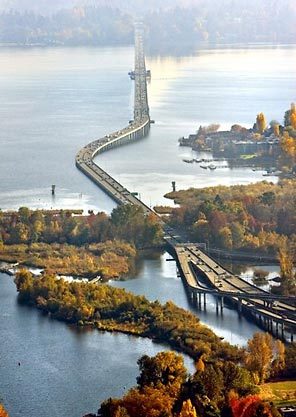
Gene Hoglund, a board member of the Magnolia Community Club, told the committee the club is urging the city to spend money to replace the earthquake-damaged Magnolia Bridge "before a slide or an earthquake takes it down."

A city study said the Mercer project would save drivers a few minutes heading west from Interstate 5 but actually lengthen the eastbound drive. Hoglund, speaking to the committee, argued, "It's not going to improve traffic flow."

City officials have disputed this, saying the Mercer widening would benefit all modes of travel. Responding to McIver's question about I-5, city Transportation Director Grace Crunican said the projects are designed to make cross-city travel as convenient as possible and "we're trying to get (traffic) out of the way of construction" on the Alaskan Way Viaduct.

But the council's staff has raised several other questions to explore. Among them is the risk of seeking other government grants. A council staff memo said the mayor's plan "indicates that the remaining external funding gap for Spokane and Mercer will not close prior to beginning scheduled construction."

Council staff members said they plan to analyze the city's past successes in receiving transportation grants, examine why the Mercer and Spokane projects were given high priority and identify other projects that might need money as well.

The committee will discuss the proposal again April 15.

The city plans to begin the Mercer widening work and most of the Spokane Street project by the second quarter of next year. Separately, it says it has the money for a new ramp to Fourth Avenue South from the Spokane Street Viaduct and plans to begin building the ramp this fall.

Costs of both projects have risen dramatically since last year, with the increases attributed by Crunican to generally escalating construction costs.

The Mercer project's estimated cost has increased by 40 percent, from $137.3 million last year to $192.9 million now. Spokane Street improvement costs have risen 9 percent, from an estimated $154.3 million last year to $168.5 million now.

The estimated price of the Lander Street crossing has more than doubled since last year, from $71.2 million to $152 million.

Friday, March 28, 2008

Nickels wants to add 60% more people in Seattle by 2040

Growing smart March 07

Population growth doesn’t have to overwhelm us — especially if we move it to North Dakota.

By Knute Berger

If the 19th and 20th centuries in Seattle were about promoting growth, the early 21st century is about coping with it. Gridlock, sprawl, and skyrocketing population suggest that we are firmly stuck in the era of the so-called growth paradox, that conundrum that stipulates an attractive region will spoil its quality of life by attracting more people than it can sustain.

The old boomtown mentality is still alive, though. Take Mayor Greg Nickels. The Puget Sound Regional Council has projected that central Puget Sound will grow by almost 1.5 million more people in the next three decades. A couple of hundred thousand of those folks will settle in Seattle. But that’s not enough for Nickels. He’d like an additional 350,000 people in the city by 2040. That’s 60 percent growth over our current population of 575,000.

As Richard Morrill, a retired University of Washington geography professor, told The Seattle Times in response to Nickels’ growth goals, “That magnitude of change hasn’t happened anywhere except maybe Beijing.” Welcome to Seattle, world-class megalopolis.

Much of the debate focuses on how to accommodate growth with more density, smarter development, bigger highways and mass transit. The underlying assumption is that — as former Seahawks owner and onetime big-time Eastside developer Ken Behring once predicted — a “tsunami” of growth is headed our way. The only thing that could stop that tsunami is, apparently, a real tsunami, which — along with a Mount Rainier lahar or major quake along the Seattle Fault — could, geologists say, wipe us out New Orleans style. But isn’t there a less catastrophic way to slow growth? I think so.

Let me be Lesser Seattle’s Horace Greeley for a moment and suggest that this is the right time to say, “Go East!” Just as the government once encouraged Americans to “go West” with free land and federal subsidies, we could do something similar today by pointing current and wannabe Seattleites back east to the heartland, where there are rural areas in need of boosting — indeed, communities that are desperate for new settlement.

Let me introduce you to North Dakota, for one.

North Dakota is one of the only states that has a declining population — a real achievement in a country that just hit the 300-million mark. North Dakota is 47th in population and is going backward; the U.S. Census Bureau projects it will be 48th by 2025.

Part of the problem is that the state is cold, bleak, and colorless — but winter in Seattle is no picnic either, especially for serotonin junkies. Yet Seattle and North Dakota have enough in common that the High Plains might appeal to some of the same immigrants. That depressing climate? Think of it as an incubator for the next grunge scene.

North Dakota is virtually the same age as Washington (both became states in 1889), and no place is more Middle American. Rugby, N.D., is the exact geographical center of North America. The state eschews glitz: Lawrence Welk was born there; Lewis and Clark were the last real celebrities to pass through. The state beverage is milk. Its license plates declare the state’s identity: North Dakota is the “Peace Garden State.” Wholesome, middlebrow, and peace loving — the place screams Seattle potential.

And it’s available at bargain rates: According to Coldwell Banker, Minot, N.D., has the most affordable housing in America. The average home price is only $162,000, which in Seattle — land of the $600,000 bungalow — would buy a Frango box. In a town served by rail and known for its lutefisk and meatball church socials, would-be Seattleites would likely find the kind of warm, urban village lifestyle they’ve been seeking in Ballard but for less than half the cost.

The most interesting thing about North Dakota is the New Homestead Act, a proposed law sponsored by North Dakota Democrat Sen. Byron Dorgan and other rural politicians. It is designed to offer incentives to folks willing to help gentrify declining rural areas. In short, it proposes to pay people to move to North Dakota. Under the legislative proposal, if you make the move, the government would pay off 50 percent of your college loans, give you a $5,000 tax credit for buying a house, and set up matching-fund savings accounts in your name. Plus, it would establish a $3 billion venture capital fund to help rural-bound entrepreneurs start new businesses. Heck, that beats Microsoft stock options.

So go East, prospective Seattleites! Go East, high-techies! The North Dakota grubstake is one Greg Nickels can’t match.

Monday, March 10, 2008

Street Car for two-way Mercer Street?

11/3/04 The transportation plans of Mayor Greg Nickels and billionaire Paul Allen for the South Lake Union neighborhood keep advancing, despite glaring flaws. On Monday, Nov. 1, the Seattle City Council authorized a study of the plan to turn Mercer Street into a two-way boulevard. In doing so, the council made clear that it doesn't matter that the $200 million plan will not improve traffic flow in the area. Rather, the council signed on to the fantasy that a two-way Mercer Street will help South Lake Union become a 24/7 biotech wonderland. On Oct. 28, the Puget Sound Regional Council became the latest government to fall under the spell of the biotech booster virus that is sweeping governments across the nation when it put up $4.3 million in federal transportation dollars toward the $45 million needed to build a 1.3-mile streetcar from downtown to South Lake Union, which Nickels and Allen are promoting. The Nickels administration has now identified $36.5 million of the streetcar's costs, the bulk of which would come from a special tax on South Lake Union property owners. The streetcar, like a two-way Mercer Street, has dubious transportation utility, but Allen and other developers lust after it as a way to make the neighborhood more attractive to new businesses. Being as how the city's transportation infrastructure has been neglected for years, citizens might hope the City Council would serve as a check on the raid of public transportation dollars for one developer's agenda. But such hopes are rapidly being dashed. GEORGE HOWLAND JR.

Gregoire: "Watch me tear Viaduct Down!"

Gregoire: 'Watch me' tear down the viaduct
Governor tells the city she won't let issue be pushed to back burner 1/3/08
By CHRIS McGANN
P-I CAPITOL CORRESPONDENT

OLYMPIA-- With or without Seattle's approval, the state will tear down the earthquake-damaged Alaskan Way Viaduct in 2012, Gov. Chris Gregoire said Thursday.

"It's coming down in 2012. I'm taking it down -- the middle," she said, referring to the elevated portion of the span that runs roughly from Battery Street Tunnel to Pioneer Square, which has been the most vexing and controversial piece of the transportation puzzle.

"That's the timeline. I'm not going to fudge on it. And if we don't have some alternative by then, boy are we going to have a mess on our hands because it's coming down."

Asked if she, as governor, could trump the state's largest city and county and unilaterally tear down a highway that carries more than 100,000 vehicles a day through the heart of Seattle, Gregoire said:

"Yeah, watch me."

The governor set a hard deadline after a tortured and unsuccessful attempt to resolve the issue last year. At that time Seattle, King County and the state fought and floundered in their attempts to produce a viable option for replacing or rebuilding the viaduct.

Instead of a new $2.8 billion elevated highway similar to the current viaduct the state wanted, Seattle Mayor Greg Nickels fought for a more expensive tunnel and King County Executive Ron Sims wanted a street-level solution that would have included much more transit.

Last year Gregoire twisted arms and issued her recommendation but ultimately deferred the decision to Seattle voters, who rejected both a proposed elevated rebuild and a more expensive tunnel along the waterfront. The surface option was not on the ballot.

In the end, elected leaders agreed to a truce and opted to begin demolition and utility relocation on the south end of the roadway.

That gave everyone until 2012 to agree about how to replace the double-decker section through the heart of the city.

Now Gregoire said she's not letting the issue get pushed to a political back burner.

Seattle Deputy Mayor Tim Ceis said setting an inflexible deadline is unrealistic.

"This is not just an issue for the city of Seattle to ensure that the system functions when it comes down, this is an issue for the entire state of Washington, because this is the economic center for the state," he said.

If the statement was intended to be a threat, Ceis said, it would be out of character to Gregoire.

"I find it hard to believe that she is issuing a threat right now because we are all working so well together. ... It's everybody's objective to get the viaduct down as soon as is possible and practical. But in order to do that, you have to ensure that projects have been funded and completed that allow the transportation system to continue to function if you cut off that corridor."

He said the city and the state are making good progress toward crafting a workable solution the people will agree on.

"No matter what, the state has to be a constructive partner in this project," Ceis said. "The state has the funding and we need to be able to make those fixes to the rest of the system in order for the viaduct to come down by 2012."

Ceis said the timeline was not, in itself, impossible, "but it's going to take a real push by all parties involved."

As for the sticky question of how to pay for the project, Gregoire said the state would keep its commitment to provide $2.8 billion. Any more would have to come from other sources.

Although she plans to team up with other governors to appeal to the federal government for increased investments in state infrastructure projects, Gregoire said that money would not be secured in time for the viaduct replacement.

Sims applauded the governor's hard deadline and her openness to addressing the problem with a much more comprehensive solution.

"The viaduct has to come down. It's not safe," Sims said. "I support (Gregoire's) position on that. It is a tough decision to make ... but it's the smart thing to do."

In the past, Gregoire opposed a surface option, but in recent months she has said she's now open to the idea.

In last year's debate, Speaker of the House Frank Chopp, D-Seattle, was unbending about his desire to rebuild an elevated viaduct.

"I'm comfortable with her statement," he said. "That project has got to get resolved; it cannot just go on forever."

He said Gregoire had already made her deadline clear.

"I remember her telling me that a long time ago because obviously, it's a safety issue," he said.

As the discussion continues about a surface option, leaders are careful to explain they aren't simply talking about a ground-level highway along the waterfront.

The viaduct traffic would have to be dispersed and otherwise addressed through a wide swath of Seattle.

"What Greg (Nickels) and Ron (Sims) and I have talked about is: 'Let's stop thinking about replacement of the Alaska Way Viaduct and start thinking about how do we do transportation in all of Seattle from I-5 to the waterfront,' " Gregoire said.

"We really are fundamentally not efficient and effective now. Our offramps from I-5 are not efficient to the flow of traffic. What international city do we know of that would have two-way traffic in downtown? What international city do we know of that would have street parking in the middle of downtown?

"We have not stepped back, collectively ... and said, 'How can we make this a user-friendly, international city?'

"That's why a 'surface option' is on the table now," Gregoire said. "If we simply say replace the viaduct, and if that's all we do, the surface option won't work. I still stand by that. I've looked at it, the ramifications to the waterfront are terrible. We won't have any legitimate freight mobility. ... The surface option works only (and I don't know if it does) but only if you look at the totality."

P-I reporter Chris McGann can be reached at 360-943-3990 or

Nickels want Sound Transit on ballot in 2008

Nickels wants new light rail vote next year
Poll: Road, transit plans might have passed separately

11/9/07 By CHRIS McGANN
P-I CAPITOL CORRESPONDENT

Seattle Mayor Greg Nickels says Sound Transit should rebound from Tuesday's drubbing at the polls and come back with a new light rail plan for voters on the 2008 ballot.

"This is a critical problem, we need to do the work, but we shouldn't take two years or three years or four years to make this decision," Nickels told the agency's board of directors on Thursday.

On Tuesday, Puget Sound voters rejected both the roads and the transit plans in Proposition 1. Those were listed separately on the ballot, but voters had to approve both to pass the multibillion-dollar tax measure.

Even before all the votes were tallied, people began second-guessing linking the two proposals and speculating that it would be years before a new transportation plan appeared on the ballot. Indeed, new polling suggests pairing the roads and transit measure was a mistake.

Nickels said he was open to running a stand-alone transit plan but wasn't ruling anything out.

"I'm not making any assumptions about what that package looks like," he said. "I don't think the voters were saying, 'We don't want to invest in transportation, and it's not a problem.' But I think they were clearly telling us something, and we need to spend some time going out and listening."

Though voters rejected Proposition 1, an extensive poll commissioned by the Sierra Club showed that if the transit element of the measure had appeared on the ballot alone, it would have passed.

The Sierra Club joined forces with the anti-transit crowd and campaigned against Proposition 1, believing the measure included too much freeway expansion, relied on general taxes, including the sales tax, and did not address global warming.

According to the poll, 52 percent of voters say they would have voted for the transit portion had it been presented alone.

The poll also indicates that if the roads portion of the ballot measure had been presented independently, it might have passed as well.

Forty-five percent of those surveyed said they would vote yes and 16 percent were undecided on the package of road improvements in King, Pierce and Snohomish counties.

The poll surveyed 5,004 voters and had a margin of error of 1.4 percentage points.

Nickels said better voter turnout in 2008 could turn the tables for either or both plans. This year nearly 70 percent of the registered voters didn't cast a ballot.

"I recounted to (the Sound Transit Board) what happened in 1995 when the first Sound Transit plan was turned down, and I think that it offers us a pretty good lesson," Nickels said. "We went back to the ballot in 1996, in a presidential election, with the second Sound Transit plan and it was very different than the first one ... and we won going away."

Sound Transit officials haven't said yet when or if they'll put something back before voters.

John Taylor, spokesman for the Regional Transportation Investment District that created the roads plan, said he had not seen the poll and that it was too early to predict the next step.

Nickels said it doesn't make sense to relegate transportation measures to off-year elections. In the past, Democratic leaders in Olympia have resisted allowing transportation tax packages on the ballot in on-year elections.

House Majority Leader Lynn Kessler, D-Hoquiam, said the Legislature won't be inclined to rush out with a new tax measure.

"I don't think anybody today thinks the public is ready to go vote for a new tax," Kessler said. "I think everyone is getting together and talking about what, if anything, we should do and before we do anything we need to start talking about the 520 Bridge."

Kessler said that House Speaker Frank Chopp, D-Seattle, typically proceeds with caution when it comes to tax measures.

The results of the Sierra Club poll contradict what transportation planners from the roads and transit camps thought -- that voters would not support just roads or just transit.

Pollster Thomas Riehle from RT Strategies said the exit poll revealed a concern that voters had that could have changed Proposition 1's outcome.

"We found that there was a group of voters who we would describe as pro-transit defectors," he said.

This new class was identified by cross-tabbing voters who said they would have voted yes to a transit-only plan with those who voted no on Proposition 1.

"The single largest reason they gave (for voting no) was environmental impacts like global warming," Riehle said.

Ric Ilgenfritz, Sound Transit's director of planning and public affairs, acknowledged that twinning the roads plan with the transit plan turned out to be detrimental.

"The strategy was to build a big-tent coalition to support a comprehensive approach and try to do roads and transit together," he said. "That was obviously a heavy lift. It drove us to a larger package and took us into that zone where people start to get nervous."

TRANSPORTATION POLL: THE NUMBERS

Voters in King, Pierce and Snohomish counties on Tuesday rejected Proposition 1, a multibillion-dollar tax package to fund road improvements and mass transit. A poll taken Nov. 4-6 found:

52% percent of voters said they would have voted for the transit portion of Prop 1 had it been presented by itself.

AMONG ALL 'NO' VOTERS

45% objected to higher taxes.

20% objected to Prop 1's impact on the environment.

Source: Poll of 5,004 voters commissioned by The

Sierra Club. Margin of error of 1.4 percentage points.

The articles are posted solely for educational purposes to raise awareness of transportation issues. I claim no authorship, nor do I profit from this website. Where known, all original authors and/or source publisher have been noted in the post. As this is a knowledge base, rather than a blog, I have reproduced the articles in full to allow for complete reader understanding and allow for comprehensive text searching...see custom google search engine at the top of the page. If you have concerns about the inclusion of a specific article, please email bbdc1@live.com. for a speedy resolution.