The phrase,'Unsound Transit', was coined by the Wall Street Journal to describe Seattle where,"Light Rail Madness eats billions that could otherwise be devoted to truly efficient transportation technologies." The Puget Sound's traffic congestion is a growing cancer on the region's prosperity. This website, captures news and expert opinion about ways to address the crisis. This is not a blog, but a knowledge base, which collects the best articles and presents them in a searchable format. My goal is to arm residents with knowledge so they can champion fact-based, rather than emotional, solutions.

Transportation

Showing posts with label 7.22 Stormwater runoff. Show all posts

Monday, March 10, 2008

I-405 expansion will relieve some of State's worst congestion

8/2/07

I-405 upgrades just around the bend

  • Projects will add lanes, bus rapid transit and park-and-ride spaces
  • By COLLEEN GANTS

    Commuters traveling the Interstate 405 corridor this summer are seeing proof that their transportation investments are hard at work.

    The Washington State Department of Transportation has five separate I-405 projects currently under construction and three more are scheduled to start construction in 2009. When you count Sound Transit’s Totem Lake Freeway Station and Canyon Park Freeway Station, it adds up to seven I-405 construction projects this summer alone.

    These construction projects are part of a 2002 master plan for the 30-mile I-405 corridor. When carried out, the I-405 master plan improvements are designed to reduce congestion by accommodating as many as 10,000 person trips a day — in cars, buses, carpools and HOV/managed lanes.
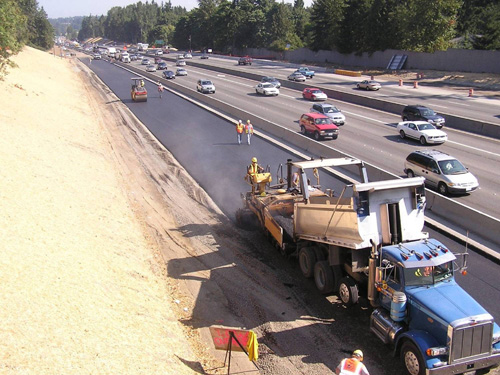
    Photo courtesy of WSDOT [enlarge]
    Crews from WSDOT and Kiewit are nearing completion on a project to widen I-405 through Kirkland.

    The I-405 master plan includes new vanpools, increased transit service, new park-and-ride spaces and introduces modern traveler information systems. A new bus rapid transit system with frequent stops will be an integral part of I-405. Stormwater runoff and salmon habitat will also be significantly improved.

    The funded construction projects are the first steps to carrying out the larger master plan, not only by adding two new lanes in each direction, but also using the lanes more efficiently.

    For example, I-405 direct access stations in Bellevue, Kirkland and Bothell are the first of nine proposed to coordinate with a future bus rapid transit line. Today, these direct access stations are being used by carpools and buses for more efficient trips and less weaving.


    I-405 corridor improvements
    Cost: $1.5 billion (currently funded projects)

    Start: 2006

    Completion: 2017

    Information: www.wsdot.wa.gov/projects/i405


    This fall, drivers will see two new lanes open on I-405 through Kirkland — ahead of the original schedule and under budget. Construction on new lanes through Bellevue, Renton and Tukwila is just beginning.

    WSDOT is finishing the environmental analysis on funded projects in Kirkland, Bellevue, Renton and an unfunded project between Renton and Bellevue.

    Projects under way

    The state Legislature has committed nearly $1.5 billion for I-405 improvements. This means significant progress toward carrying out specific projects from the master plan that are designed to reduce congestion and improve safety.

    The first project, the Kirkland Nickel Stage 1 Widening Project, includes adding one new lane in each direction between Northeast 85th and Northeast 124th streets and improvements to the Northeast 116th Street interchange. The design-build contractor is Kiewit and the project will be complete in late 2007.

    Crews from WSDOT and Atkinson Construction working on the I-405 South Bellevue Widening Project have started their first phase of construction work between 112th Avenue Southeast and Interstate 90, adding lanes and widening structures to make way for the ultimate widening of four miles of I-405 from 112th Avenue Southeast to Southeast Eighth Street. This work, which also includes environmental enhancements at the Kelsey Creek wetlands and an innovative, quieter pavement, will be complete in the summer of 2009.

    The Bilfinger/Tri-State joint venture contractor team is beginning construction activities on the Interstate 5 to state Route 169 Stage 1 Project, which addresses the congestion between Tukwila and south Renton. When complete in 2010, these improvements will provide:

    • Increased speeds between I-5 and state Route 167

    • Improved safety and operations:

    — at northbound I-5, where traffic will be able to directly enter northbound I-405, and the existing merge will be replaced by a new freeway lane.

    — at the state Route 181/I-405 northbound ramp intersection, where WSDOT is adding a second northbound SR 181-to-northbound I-405 left-turn lane.

    — at the northbound off-ramp to SR 167, where traffic destined to northbound and southbound SR 167 will have their own exit lanes.

    Future projects

    The next I-405 projects being considered for funding address the congestion in and around the I-405/SR 167 interchange, including a new direct-connector ramp linking HOV lanes on both freeways, and two new lanes in the highly congested section of I-405 between Renton and Bellevue.

    WSDOT’s annual congestion report regards the I-405 commute between Tukwila and Bellevue as the most congested in the state. Read more about how WSDOT is addressing congestion around the state online at www.wsdot.wa.gov/accountability/default.htm.

    Our quality of life and economic prosperity depend on a transportation system that provides choices to the traveling public and keeps our region moving. The I-405 corridor projects represent a new way of thinking about system-wide transportation solutions that focus on moving people and goods to maximize the efficiency of our personal and public financial resources.

    Sierra Club Briefing on the Importance of Wetlands

    1/1/ 07Wetlands Protect Us All
    Protection from flooding
    Habitat for fish and wildlife
    Recreational opportunities

    America's wetlands provide something for everyone. Wetlands protect us all in many ways -- they filter pollutants from our drinking water, protect our homes by storing floodwater, and provide homes for fish, shellfish, and wildlife.
    Wetlands help prevent flooding


    Wetlands help prevent flooding.

    Although the true value of wetlands cannot be put into a dollar figure, Americans should be aware of the societal and economic benefits of wetlands. Wetlands are crucial for clean water, serving as a natural filter absorbing water-borne pollutants and damaging nutrients before the water enters our rivers, lakes, and streams. Clean water is important to Americans. For example, when choosing a place to live, Money Magazine readers ranked "Clean Water" as the top concern in all but one year since 1990. Wetlands also protect us from flooding, act as nurseries for fish, shellfish, provide homes for wildlife, and create recreational opportunities for all of us.

    Wetlands protect our families and our property from flooding

    * Wetlands act like sponges, soaking up rain and storing floodwater runoff. Wetlands slowly release flood waters back into streams, lakes, and groundwater; making flooding impacts less damaging. One acre of wetlands can store more than 360,000 gallons of water if flooded to a depth of one foot. States that have lost 80% or more of their wetlands, (Ohio, Kentucky, California, and Missouri, for example), have experienced the worst flooding in the last four years.

    * Wetlands save billions of dollars in property damage by absorbing flood waters and serving as buffers during coastal storms. The National Weather Service estimates annual flooding costs are up to $3.1 billion per year. Flood damage has tripled in constant dollars since 1950.

    * Destroying wetlands and converting the land to agriculture increases water runoff from fields by 200 to 400 percent. Conversion to roads and pavement increases runoff even more (Scientific Assessment and Strategy Team, 1994). Wetlands remove pollutants from runoff and keep clean waters clean.

    * Studies have shown that natural wetlands filter out pollution and remove sediment from surface water.

    Wetlands act as nurseries for fish, shellfish, and provide homes for wildlife

    * Most fish and waterfowl species are born in wetlands. The U.S. Fish and Wildlife Service estimates that up to 43% of the threatened and endangered species need wetlands for their survival. For many other animals, such as the wood duck, alligator, and heron, wetlands are primary habitats. For others, (more than half of the nation's migratory birds), wetlands provide important seasonal habitats where food, water, and cover are plentiful (Academy of Natural Sciences).

    * Fishing is big business in this country. The destruction of wetlands threatens the viability of the $45 billion commercial fishing industry. The National Marine Fisheries Service scientists estimate that nearly 70% of the annual commercial fish catch depends upon inshore-wetland habitats.

    * Nowhere in the nation is the link between wetland habitat and fish production more obvious than in the Gulf of Mexico, where National Marine Fisheries Service scientists estimate that 98% of the harvest comes from inshore, wetlands-dependent fish and shellfish. Gulf shrimp head the list of the region's wetland dependent species according to the EPA.

    * Nearly one out of every three shellfish beds were closed or restricted during 1994 (EPA, 1996) due to pollution and habitat destruction.

    Wetlands create recreational opportunities for wildlife watching, fishing, canoeing, and hunting

    * Wetlands are nature's efficient pollution fighters, helping keep our waters clean. Because of their position between water and land, wetlands provide a buffer zone that intercepts polluted runoff before it contaminates lakes, rivers, and coastal waters.

    * Poor water quality threatens the $380 billion recreational/tourism industry, whose most popular destinations are beaches, lakes, and rivers (EPA, 1996). In 1995, coastal and Great Lakes beaches were closed or had advisories posted warning against swimming on more than 3,522 occasions (NRDC, 1996). [Wetlands for Clean Water, 3].

    * Wetlands are critically important to maintaining healthy fisheries. Fishing has always been a favorite outdoor recreational pastime for Americans. Over 49 million Americans spend $24 billion a year on sportfishing, for striped bass, flounder, trout and other species.

    * Wetlands provide opportunities for popular activities such as hiking, fishing, and boating. For example, an estimated 50 million people spend approximately $10 billion each year observing and photographing wetlands-dependent birds (EPA, 1995).

    * Ducks and other birds that depend on clean water and wetlands also generate economic activity for the recreation and tourism industry. Roughly 3 million waterfowl hunters spend over $600 million annually in pursuit of wetlands-dependent birds (EPA, 1995).

    Currently, Congress offers limited protection for wetlands under the Clean Water Act. However, a 1997 survey by the U.S. Fish and Wildlife Service reports that roughly 120,000 acres of wetlands are being destroyed annually. Thus, it is clear that Congress must strengthen clean water and wetlands protection programs in order to preserve and protect our valuable remaining wetlands.

    The articles are posted solely for educational purposes to raise awareness of transportation issues. I claim no authorship, nor do I profit from this website. Where known, all original authors and/or source publisher have been noted in the post. As this is a knowledge base, rather than a blog, I have reproduced the articles in full to allow for complete reader understanding and allow for comprehensive text searching...see custom google search engine at the top of the page. If you have concerns about the inclusion of a specific article, please email bbdc1@live.com. for a speedy resolution.