The phrase,'Unsound Transit', was coined by the Wall Street Journal to describe Seattle where,"Light Rail Madness eats billions that could otherwise be devoted to truly efficient transportation technologies." The Puget Sound's traffic congestion is a growing cancer on the region's prosperity. This website, captures news and expert opinion about ways to address the crisis. This is not a blog, but a knowledge base, which collects the best articles and presents them in a searchable format. My goal is to arm residents with knowledge so they can champion fact-based, rather than emotional, solutions.

Transportation

Showing posts with label 0.62 Dino Rossi's Plan 08. Show all posts

Saturday, October 25, 2008

Rossi acknowledges WA State budget deficit would defer his transportation plan

Dems blast Rossi for admitting policies will take time to implement

State Democrats are pouncing on an article by the Everett Herald's Jerry Cornfield published Wednesday revealed that, in light of the state's projected budget deficit, Republican gubernatorial candidate Dino Rossi admitted that two of his top priorities, his massive transportation plan and repealing the estate tax, would be placed on the back burner.

Cornfield writes that although Rossi still touts these plans on the campaign trail, he has come to acknowledge their delay in interviews because of the priority of the state budget. Still, Rossi is far from abandoning them entirely.

"I have to right this ship first," Rossi said in the article. "We are going to get all the projects started within the first four years. The whole goal is to get all of them finished in 12 years."

Meanwhile both Gov. Gregoire's campaign and the state Democratic Party are calling Rossi's admission deceitful, and implying that the budget is the reason that Gregoire has refrained from making similar plans.

Gregoire has pointed out the additional financial burden Rossi's transportation plan would have on the state's projected budget deficit numerous times, including during some of the debates.

"Why does Rossi continue to tout his broken promises on the stump and in his ads? Breaking campaign promises even before the campaign is even over must be pretty embarrassing," said Aaron Toso, spokesman for Gregoire for Governor, said in a statement. "Voters shouldn't believe anything he has to say."

Rossi has made similar claims about Gregoire's campaign promises dating back to the 2004 campaign and stem cell research facilities.

The state party, as usual, released a more harshly worded statement condemning Rossi's acknowledgement.

"Republican Dino Rossi has demonstrated he will do or say anything to get elected, offering such ridiculous promises and outrageous claims that he's been forced to abandon them before the election even occurs," said Washington State Democratic Party spokesman Kelly Steele. "While Gov. Gregoire has maintained a budget surplus and has already taken fiscally-responsible action to cut any projected deficit in half, Republican Dino Rossi continues his used car salesman-like pitch to voters - saying whatever he thinks they want to hear - even after admitting he can't deliver on his promises. Quite simply, there's no reason to believe a single word Rossi says."

Wednesday, October 22, 2008

Rossi will defer his transportation plan due to WA state economic crisis

Two of his big plans -- money for roads and eliminating the estate tax -- would take back seat to a balanced budget, the candidate says.

By Jerry Cornfield
Herald Writer
OLYMPIA -- Voters counting on Dino Rossi for a quicker fix to transportation problems and demise of the death tax may be waiting longer than they expect.

Republican gubernatorial candidate Rossi is delaying pursuit of those two key promises separating him from Democratic Gov. Chris Gregoire, blaming a worsening state budget outlook as the cause.

"First off we have to right the ship, financially," Rossi said.

If elected, Rossi said he won't try to divert hundreds of millions of dollars in sales tax into road projects in the next two years because the money may be needed to help overcome a projected $3.2 billion shortfall.

Likewise, he will wait at least two years before proposing to eliminate the estate tax -- a source of roughly $105 million a year since 2005.

"We are going to be facing a tough biennium. He realizes the first thing he'll have to do in office is to balance the budget," said Jill Strait, Rossi's campaign spokeswoman.

Changing how the state funds transportation and erasing the estate tax are two of the most established planks in Rossi's platform.

He acknowledges his shift in position on them in interviews. In front of crowds, he's still touting his transportation plan and his commitment to repeal the estate tax, without mentioning any delays.

It's a significant new shift, said Gregoire's campaign spokesman Aaron Toso. Those have been two of Rossi's few specific proposals in this campaign, he said.

"Rossi is breaking his campaign promises before the campaign is even over," Toso said. "There isn't a reason for voters to believe anything Rossi has to say."

Toso added, "At least Rossi finally agrees that his campaign promises would create an additional $1.3 billion 'Rossi deficit' on top of any projected shortfall."

Rossi's adjusted stance won't matter for voters because at this stage, emotion, more than any issue, is influencing them, said Republican political strategist Dave Mortenson.

"At this point in the campaign voters are tired of the rhetoric. It boils down to what their gut feeling is," he said.

Terry Thompson, a campaign consultant for Democratic candidates, said he didn't think it will sway many voters either and shows Rossi is "exercising caution" in his positions at this stage.

Rossi made a big splash in April when he laid out a $15 billion transportation plan. The majority of the cost is for major road projects to be finished in the next 12 years. The list includes $600 million worth of improvements on U.S. 2.

Roughly half the money for Rossi's plan comes from using 40 percent of the sales tax collected on the sale of new and used cars. That money, estimated at about $400 million a year, now goes into the general fund for programs such as education and health care, rather than roads.

Since April, the deficit projection grew from $2.5 billion to its current $3.2 billion, prompting him to rethink his strategy, Rossi said.

"I have to right this ship first," Rossi said. "We are going to get all the projects started within the first four years. The whole goal is to get all of them finished in 12 years."

Rossi did not say how he will generate money for those projects like U.S. 2 that are not now funded in the state transportation budget. Strait said it is his goal to be tapping into the sales tax by the end of his first term.

The inheritance tax is a defining issue for the candidates.

In 2005, after a state Supreme Court decision invalidated an old estate tax law, Gregoire had it rewritten and pushed for its reinstatement. Voters later affirmed it.

According to the governor's budget office, 99.5 percent of estates do not pay the tax.

Since it came back on the books May 17, 2005, 808 estates have paid $314.5 million, said Glenn Kuper, spokesman for the Office of Financial Management. The money is earmarked for education.

Rossi wants to get rid of the tax and to scale back taxes paid by businesses. While campaigning, he says taking those steps will help small companies and create jobs.

Yet in an interview, he said he will put off reducing any taxes until the state starts taking in more money than it is spending.

"Once we get that on the right plane, there will be monies available above the line of spending that could be available for potential tax reductions," he said.

Strait said that will not likely occur until at least 2011.

Tuesday, April 29, 2008

Ex WST commissioner sees flaws in Rossi's plan

Serious flaws in Rossi's plan

By Aubrey Davis

Special to The Times


MORE traffic, more taxes and fewer choices are what Dino Rossi's transportation proposal would mean for area commuters.

Rossi's proposal has two serious flaws — among many — that would have drastic consequences for the future of transportation in our region, particularly for East King County.

As a central part of his proposal, Rossi wants to resurrect a long-ago rejected idea to construct an eight-lane replacement for the Highway 520 Floating Bridge. This extremely expensive and complicated project is riddled with engineering and economic problems.

I spent several years chairing a regional 520 executive committee that produced a very strong east-west consensus on the six-lane alternative with later capability for additional high capacity transit. Some mitigation issues in Seattle are now being worked out and the governor has directed that the new bridge be completed by 2014 with all six lanes in service by 2016.

When we considered constructing eight lanes of new concrete across Lake Washington, we concluded it would have severe consequences for our commutes on Interstate 5 and I-405, not to mention our environment, local communities and our wallets.

Engineering studies show that dumping eight lanes of traffic from 520 onto an already congested I-5 and I-405 would virtually shut down both freeways and create gridlock across the region. I-5 and I-405 would become the most expensive parking lots on Earth. Connecting an eight-lane 520 to I-5 and I-405 would be like trying to connect a fire hydrant to a garden hose, and the ones getting wet would be us, the taxpayers.

It has been estimated that billions of dollars in new lanes on I-5 and I-405 would be needed to make this fire hydrant-to-garden hose connection that Rossi proposes even remotely possible. These costs are not accounted for in Rossi's plan and funding is not available.

Furthermore, Rossi claims to be able to build an eight-lane bridge for less money than the planned six-lane bridge — a claim that not only runs counter to common sense, but one that doesn't jibe with detailed state cost estimates.

The second major flaw of Rossi's proposal involves the future of light rail and improved bus service in East King County.

In 1996, local taxpayers agreed to pay for and build key transit projects that are carrying thousands of people to work and back each and every day. Fortunately, in this first phase East King County has built up a down payment that will help us afford more light rail and bus service in the next phase of construction. This down payment could mean light rail across I-90 to Bellevue and beyond and more bus service and more park-and-ride lots throughout the Eastside.

Rossi's proposal hijacks this down payment and spends it on a 1950s-style transportation plan that's heavy on concrete and void of any reliable transit alternatives.

Rossi suggests redirecting East King County's current transit down payment to more state highway lanes. While there are many legal complications involved with redirecting local transit dollars to state roads, I'll stick to covering the policy implications.

By taking money dedicated to East King County light rail and express buses and spending it on highway lanes, Rossi is in effect telling this generation of Eastside residents that light rail and superior bus service aren't in our future, ever. With our region approaching $4 a gallon gas, we need more transit options, not fewer.

Anyone who has even just peeked across the lake at the massive construction cranes dominating the city of Bellevue's skyline knows that Bellevue is a city growing toward a 2050 land-use and community vision, not a 1950s automobile-dominated past. With more downtown workers and residents, Bellevue and its surrounding Eastside cities need more transit service, not less. Rossi's transportation proposal would give East King County 50 more years of the same crowded highways and limited choices for getting to work, school and home.

After years of neglect, our region and state are making progress in chipping away at the long backlog of road and transit projects. There is no doubt that much more work remains. To stay on track, we must pursue transportation projects that are affordable, doable and forward-thinking. Dino Rossi's proposal is none of the above.

Sunday, April 20, 2008

Seattle Times editorial on Rossi's 2008 transportation plan

Editorial
Rossi's road plan and what's missing


MIKE SIEGEL / THE SEATTLE TIMES

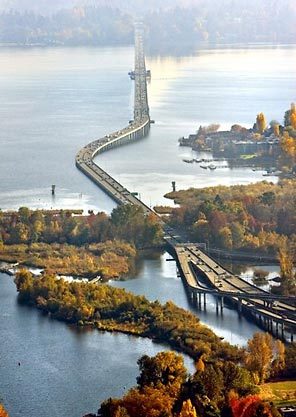
The Highway 520 Bridge: Should it have six lanes or eight?

Candidate for governor Dino Rossi's road-building vision is, for the most part, Gov. Christine Gregoire's road-building vision. The superiority of Rossi's plan is it has more money to build roads faster. The weakness is it pays for new roads by diverting revenue from other state programs and cha-chas around the question of what other things the state would do without.

One project is Rossi's own: building a waterfront tunnel to replace Seattle's Alaskan Way Viaduct. This used to be the financial sinkhole of Mayor Greg Nickels, and it nearly swallowed him. Why an Eastside Republican would pitch himself into this Funnel of Doom is baffling. Rossi should support whatever reasonable surface option has the largest vehicle capacity — a position that might not be much different from Gregoire's.On the Highway 520 bridge, Rossi proposes six lanes built on pontoons for eight. This is a promise in concrete to the eight-lane constituency. Given that Seattle will accept no more than six lanes after decades of negotiations, building pontoons for eight is a waste of money.

Rossi's cost estimates are troublesome. He offers one figure for a project in a big chart, then explains in footnotes that numbers are in 2007 prices for comparison purposes. His numbers may be technically accurate but they are misleading. At the very least, they minimize the effect on other state spending. The real project costs and the hit on other spending will be higher.

His project list is the state's wish list with a few variations. The projects include: widening Highway 9 near Snohomish; building a Highway 2 bypass around Monroe; widening Interstate 405 from Bellevue to Renton; connecting Highway 509 to Interstate 5 south of Sea-Tac; connecting Highway 167 to the Port of Tacoma; building the cross-base highway in Pierce County; building a new Columbia River crossing at Vancouver and a Highway 395 bypass east of Spokane.

Rossi is a get-it-done kind of candidate, and that is commendable. But the cost of getting some things done is other things are left undone. Here, Rossi is too mushy.

Most money for Rossi's road projects would come from the sales tax on cars, which feeds the general fund. This reservoir of tax money irrigates education, prisons and social services. Rossi's diversion would be $800 million in each two-year budget cycle.

The Republican candidate says he would cut $800 million out of current spending. People should believe him because he has done it before. In 2003, he and Gov. Gary Locke cut state spending to avoid a tax increase in a recession. They did it because they had to.

But the upcoming budget is forecast to be $2.4 billion in the hole. That's huge. Given that, it is difficult to imagine a Democratic-controlled Legislature allowing a Gov. Rossi to dig the hole $800 million deeper in order to fund roads.

Transit is invisible in Rossi's spending plan — it is a local function, he says — but it would get hit indirectly. The elimination of sales-tax money from construction would reduce tax revenue available to bus systems. That is a step backward.

Finally, there's the matter of tolls. For Highway 520, Rossi would have a toll of a little more than $1.50 in 2007 dollars, and charge the toll only when the bridge is completed. He relies on tolls less than Gregoire but only because he reaches into a currently untappable fund, Sound Transit's pot of gold. For Rossi to accomplish his goals, he would need a Republican Legislature.

We are left with Rossi's commitment to make road building a priority. The candidate has offered an important proposal that will change the discussion. But he needs to fill in many missing details so people can make an informed choice between roads and other programs.

Saturday, April 19, 2008

Seattle PI critique of Rossi plan

Rossi plan moves light rail funds to car pool lanes

>
Candidate projects extra cash from Sound Transit
P-I REPORTER

Besides resurrecting proposals for a Seattle tunnel and an eight-lane Evergreen Point Bridge, GOP gubernatorial candidate Dino Rossi's transportation plan contains another controversial idea: getting Sound Transit to build more car pool lanes with cash it might otherwise spend extending light rail to the Eastside.

This element, part of the plan Rossi unveiled this week, estimates that Sound Transit will collect enough unplanned tax revenue in the next 30 years in its Eastside district to produce $690 million for HOV projects on Interstate 405 and state Route 520.

Sound Transit's extra cash would "be used for what it was intended -- to finance transit-related infrastructure on the Eastside," Rossi's plan says. In an interview Friday, Rossi said Sound Transit has "many buses, so we should have a place for them."

The agency's Eastside area extends from the North King County limits south to Renton, east of Lake Washington.

Sound Transit officials called Rossi's idea another move to build more road lanes and said the money could otherwise help extend rail service.

But Rossi is not proposing that money be spent on car pool lanes at the expense of more light rail, he said. With or without that money, "it's going to take a lot more" than that amount to extend light rail across Lake Washington.

"If they can move more people (with light rail) than you can in a general-purpose (highway) lane, I'm all on board," Rossi said. "The numbers have to prove it out."

He said his plan attempts to find other transportation funding sources, since gas taxes are expected to decline because of increasing car fuel efficiency and more transit use.

Rossi favors giving commuters options, including rail, but, "if it's necessary for them to drive a car, there's going to be a need to do this, too."

Sound Transit wouldn't confirm the surplus tax revenue projections in Rossi's plan. The agency confirms that tax collections from the Eastside are higher than forecast and predicts an unspent balance of $560 million in Eastside-area tax collections left over from the first phase of light rail, to be completed in 2016.

Since Sound Transit's first phase started in the late 1990s, Eastside tax collections are about $100 million more than expected, according to agency spokesman Geoff Patrick, who said the additional money must be spent as dictated by an as-yet incomplete plan that must be approved by voters, or to reduce Sound Transit's tax levy.

Rossi's plan doesn't specify HOV projects, but campaign spokeswoman Jill Strait said they include two HOV connections in Renton: one to I-405 at North Eighth Street and another between HOV lanes on I-405 and on state Route 167, the Valley Freeway.

Pro-bus organizations such as the Coalition for Effective Transportation and the Eastside Transportation Association support the plan, but officials of those groups said they didn't propose the idea to Rossi.

"The general idea of spending Sound Transit's transit money on cross-lake infrastructure (for) making buses work better across the lake is a good one," said John Niles, the coalition's technical chairman.

Rossi's proposal, however, hasn't gone over well with Sound Transit board members.

The chairman, Seattle Mayor Greg Nickels, said through a spokesman that he doesn't support Rossi's idea. "That money is going to be very useful for expanding transit service on the Eastside, light rail and bus service," Marty McOmber said.

McOmber said spending the greater-than-expected tax receipts on particular projects would require a public vote.

Seattle City Councilman and Sound Transit board member Richard Conlin said Rossi's plan appears to focus on building highway lanes, which is the state's responsibility.

"What we're looking for is to try and get some really good transit options on the Eastside," Conlin said, including light rail on Interstate 90 and high-frequency bus service on the Evergreen Point Bridge.

Kirkland City Councilwoman and Sound Transit board member Mary-Alyce Burleigh said that if the extra money is committed to HOV projects, it "would be very difficult" to complete light rail and other transit improvements on the Eastside. Rossi's proposal is "a whole departure from what has been the plan from the get-go," she said.

Rossi said that if he is elected, he'll try to persuade Sound Transit board members to adopt his idea. The text of his plan said it "will dedicate" half of the extra tax collections to HOV projects but he said in the interview that he'll change that language to indicate he'll ask for the change.

Responding to board members, Rossi countered that Sound Transit already has helped finance HOV ramps that connect HOV lanes to park and ride lots.

"They know it helps their buses," he said of Sound Transit.

P-I reporter Larry Lange can be reached at 206-448-8313

Friday, April 18, 2008

Tacoma News Tribune Editorial on Rossi's Transportation plan

From Rossi, a road map to Puget Sound polls
THE NEWS TRIBUNE
Published: April 18th, 2008 01:00 AM
Dino Rossi’s new transportation plan was barely released Tuesday before Democrats started nipping at its weak points like a pack of wild dogs.

No wonder: The plan itself was designed to nip at Gov. Chris Gregoire’s vulnerabilities in the November election.

Rossi is saying that he can use existing taxes to build “megaprojects” the Puget Sound region has never been able to win funding for. That claim carries a big burden of proof, and he hasn’t met it. In some cases, his cost estimates appear low. He proposes to use state general fund money without specifying what state services would be cut to compensate. These flaws are easy targets.

But the plan as a whole is an attack on the powers-that-be who’ve been unable to deliver crucial highway improvements. Puget Sound drivers desperately need both Interstate 405 and Highway 167 widened, and the Highway 520 bridge and the Alaskan Way viaduct replaced. Pierce County’s economy needs Highway 167 extended to the Port of Tacoma; it needs the creation of a cross-base highway to link the Frederickson area with Interstate 5.

These projects and others are stuck in what seems an endless holding pattern. As always, the problem is lack of money. Last November’s Proposition 1 was supposed to raise – from the region’s taxpayers – billions of dollars needed to pay for the megaprojects, but the voters rejected it.

Its failure is hardly Gregoire’s fault – though it’s easy for Republicans to blame her. In reality, both Republicans and Democrats share responsibility for the fact that no real plan now exists to tackle the region’s most critical highway priorities.

The Rossi package zeroes in on that vacuum. For example, it proposes to replace the tottering viaduct with what would inevitably be a hugely expensive tunnel. The tunnel looks needlessly costly, but it is something concrete. Neither Gregoire nor Seattle’s leaders have been able to settle on anything so specific.

The plan’s most politically appealing (and dubious) feature is that it would not raise taxes – not regionally, not statewide. That’s quite a stretch, even given Rossi’s optimistic assumption that only $402 million a year would have to be squeezed (from unspecified programs) out of the general fund.

Details, details. The point here to to attack the common assumption that Puget Sound taxpayers must dig deep into their pockets to pay for the region’s major infrastructure improvements. He argues that these are state projects that ought to be paid for with state revenues. Realistic or not, that will be a sweet sound for some of the voters who hate being stalled in traffic but balked at the cost of Proposition 1.

Those voters live in Snohomish, King and Pierce counties, where the governor’s race will be decided this fall. Whatever its merits as a transportation package, the political merits of Rossi’s plan are obvious.

Wednesday, April 16, 2008

Everett Herald leads with Rossi's plan to fix I-2 Killer Highway

Rossi has plan to fix U.S. 2

Candidate would tap general fund for work

By Jerry Cornfield
Herald Writer

SULTAN -- Republican gubernatorial candidate Dino Rossi drove one of the deadliest stretches of U.S. 2 on Tuesday and then pledged to residents and community leaders to deliver $600 million to make the road safer.

Rain fell and temperatures dropped as Rossi said those dollars could pay for projects such as a bypass around Monroe and wider ramps linking the highway with I-5 or other ones desired by the community, he said.

"Highway 2 has become very dangerous. This has been languishing for too long," Rossi said to about 50 people gathered at the gazebo in River Park.

Rossi discussed U.S. 2 as part of a broader plan for transportation policy he outlined Tuesday in Sultan and Bellevue. Today he continues the roll out in Spokane as it becomes clear the issue of transportation will be a cornerstone of his campaign to unseat incumbent Democratic Gov. Chris Gregoire.

"My opponent has no plan," he told those in Sultan. "There is no plan out there right now, because there is no funding source."

Rossi laid out a list of $15.4 billion in projects that could be finished in 12 years and insisted he can pay for them all -- though not with a means accepted by the Legislature's Democratic majority.

To finance the work, Rossi wants to divert hundreds of millions of dollars from the general fund starting in 2009. The state presently relies on gas taxes for its transportation needs.

He's suggesting using a portion of sales tax paid on new and used cars and on transportation construction projects. If it did, Washington would join 33 other states already tapping their general fund for roads, he said.

"I think his plan is bogus," said Aaron Toso, a Gregoire campaign spokesman. "He's taking $10 billion out of the general fund. He'll either be raising taxes or cutting education and health care."

Rossi anticipated such criticism. He said revenues into the state continue to grow each year.

"Nobody has to lose any funds. There will not be one dime less" for education and health care and other programs, he said.

Much of Rossi's plan is not new.

His call for widening Highway 9 in Snohomish County was in the Proposition 1 ballot measure rejected by voters in November.

He also backs building a tunnel to replace the Alaskan Way Viaduct and making a new Highway 520 bridge eight lanes wide, two other much-discussed ideas.

On U.S. 2 specifically, one of Rossi's proposals is grinding rumble strips in the center median on a 15-mile stretch between Monroe and Gold Bar. The state is already paying to grind that stretch plus 30 miles more of the highway.

He vows to overhaul the running of the state ferry system. He said new car and passenger ferries slated for construction will be built on time and on budget and the work contracted to non-Washington firms if that's what it requires, he said.

He promises hundreds of culverts blocking the travel of salmon will be opened up and transit and transportation planning in the Puget Sound will be placed under control of one superagency.

Gregoire also supports a single regional transportation agency but the Democratic-controlled Legislature turned it down this year.

Most folks Tuesday wanted to hear Rossi talk about U.S. 2, where 49 people have died in crashes since the late 1990s.

Rossi said despite the deaths, Gregoire came up with only $3.6 million and the Legislature added another $10 million. He said his funding plan is the vehicle for getting to $600 million.

Thomas Cock, whose teenage son died in a crash on U.S. 2 in December, spoke at the event at Rossi's invitation and said the GOP candidate's plan is the type of change for which he's been advocating.

"We should demand safer roads," Cock said.

Fred Walser of Monroe, leader of the U.S. 2 Safety Coalition and a Democratic candidate for state Senate, attended and said Rossi's proposal sounded good. "Whether it's feasible or not, I can't say."

He praised Gregoire for pushing through the money, saying the area's three Republican lawmakers did not secure funding for the highway in 2003 and 2005, when the Legislature committed to billions of dollars of improvements with new gas taxes.

"The governor deserves credit for responding. I don't think there is any quick-and-simple fixes," he said.

His wife, Monroe Mayor Donetta Walser, said beforehand that she's disappointed that the road's safety is becoming a political issue.

"It is about saving lives," she said. "People that die, I don't think of them as Democrat, Republican or independent. They are members of our community."

Rossi also said Tuesday he would fire Secretary of Transportation Paula Hammond because she's not made erasing traffic snarls the department's highest priority.

"We have to have somebody onboard who is interested in congestion relief," he said.

Gregoire appointed Hammond in November and the state Senate confirmed her appointment this session.

In response, Hammond said, "I think it's harsh. But it's his prerogative to hire who he wants for his cabinet."

Reporter Jerry Cornfield: 360-352-8623 or jcornfield@heraldnet.com.

Rossi Plan as reported by Tacoma Tribune

Rossi plan would move $15.4 billion for roads
CURT WOODWARD; The Associated Press
Published: April 16th, 2008 01:00 AM
Republican gubernatorial contender Dino Rossi unveiled a $15.4 billion transportation plan Tuesday, saying he’d help traffic-weary drivers by diverting sales taxes to expand highways and fix bridges.

Heaping criticism on Gov. Chris Gregoire and the Democrat-dominated Legislature, Rossi said at Bellevue news conference that he’d also pour more money into ferries, offer a tax break on “green” cars and push for a tunnel to replace Seattle’s aging Alaskan Way viaduct. He would use the money to build two major highway projects in Pierce County: the cross-base highway and an extension of Highway 167 to the Port of Tacoma.

But, as predicted by Democrats, Rossi spared the details of how he’d make up for the lost sales tax revenue, which flows into the state’s main checking account and funds education, prisons and social services. The former state senator couldn’t offer specific strategies for getting his no-new-taxes plan through the Legislature, where similar GOP notions of repurposing transportation-related sales taxes have foundered.

He did point to his track record of working with Democrats – he helped write a bipartisan budget for the lean years of 2003-2005 – and said an urgency to fix the state’s lingering transportation problems would fuel his plans for reform.

Rossi said his plan was superior because the financing wouldn’t be subject to the same pressures as the state gas tax, which is now the primary funding source for state highway improvements. Gas tax revenue has flattened as fuel prices have risen.

“My opponent has no funding source, so therefore she has no plan,” Rossi said. “It’s not a plan unless you have a funding source. Otherwise, it’s just yapping. It’s just talking.”

Rossi said he would pay for the plan’s 30-year, $7.7 billion diversion of 40 percent of automobile sales taxes by scouring the state budget for savings. Without offering specifics, he said education and care for the vulnerable would be spared any spending cuts.

His financing package would divert from the general fund $2.4 billion in sales taxes that are usually paid on transportation projects, and it would tap a Sound Transit reserve for about $700 million. Tolls and existing project money would cover the balance.

The Gregoire campaign and state Democratic Party officials dismissed Rossi’s plan as a lot of fuzzy math, particularly the lack of specifics on how the GOP candidate would replace the sales tax revenue.

“When you cut through the baloney and the snake oil, Rossi’s plan means higher taxes, bigger tolls, and more traffic – all while blowing a hole in the budget that robs from education, health care and public safety,” state Democratic Party spokesman Kelly Steele said in a statement.

The heart of Rossi’s plan is an $11 billion list of nine road and bridge projects, with a priority on easing traffic congestion amid continued growth in the Puget Sound area and other populous regions of Washington.

In Pierce County, he would spend $1.7 billion to extend Highway 167 from Puyallup to the Port of Tacoma. He would spend $252 million on the cross-base highway, a four-lane, six-mile link between Interstate 5 and Highway 7.

Other projects include a new Highway 520 bridge across Lake Washington, more lanes on Interstate 405 between Renton and Bellevue, and improvements on U.S. 2 across Stevens Pass.

Rossi’s hoped-for 520 bridge blueprints would allow expansion to eight lanes, although he said the cost of that additional asphalt is uncertain. The state’s current plans for the bridge call for six total lanes.

Rossi wouldn’t collect tolls on the bridge until completed, whereas Gregoire and the Legislature are moving toward imposing tolls before the project is built.

Rossi’s plan would put more money into ferry construction and a long list of road projects that are delayed or short of money under the state’s 16-year gas-tax program.

The Rossi plan also has “green” features, with a 10-year sales-tax break for owners of hybrid, electric or other alternative-fuel cars, a push to convert the state fleet to environmentally friendly vehicles, and more money to open up salmon-blocking stream culverts.

And while it’s heavy on roads and bridges, Rossi’s plan would leave transit planning to local officials. He would, however, combine Sound Transit and other Puget Sound-area transit and road agencies into a new regional board.

News Tribune staff writer Joseph Turner contributed to this report.

Sound Politics reviews local media coverage of Rossi Plan

The Gubernatorial Meta Story of the Week

Somewhat lost in the immediate partisan examination of Dino Rossi's transportation plan has been the net effect of the news coverage. In general, it has been copious and remarkably fair. For Republicans, that tends to be about as good as it gets in the Puget Sound region.

The Seattle Times gave the story exceptionally prominent placement on front of the local section.

The Everett Herald splashed "Rossi has plan to fix U.S. 2" at the top of its front page with a pretty decent picture too.

The P-I gave prominent attention to Rossi's belief that "Seattle ought to get back their waterfront."

The TNT's coverage was decent and balanced.

Local radio and TV coverage seemed equally abundant and reasonably well balanced, discussing Rossi's plan and noting the critics.

All that crosses two important thresholds:

1) The enduring theme of all the coverage was that Rossi has a transportation plan. Like all such plans in this state and region, it has its critics. But, it comes across as a legitimate attempt to discuss a highly identifiable problem.

Keep in mind that a notable portion of the general populace has reached a default mindset that Republicans don't have a plan on transportation, or other kitchen table issues, other than opposing tax increases. Fair or not, that perception has been a problem for Republicans and they have the legislative minority to prove it.

Thus, simply having a serious, well-publicized plan is an important step forward.

2) The other threshold crossed is that many in the voting public see a demonstrable void in leadership capable of producing transportation solutions at the state and regional level. The current crew of elected officials isn't getting the job done on this issue. The public gets that. Rossi now has to convince them he can credibly fill the void, even though he's one of those knuckle-dragging Republicans. Putting out a serious transportation plan is a start.

Sure, the usual cast of characters have and will object. The anti-sprawl, pro-transit activists. The urban-enviro crowd. And all public officials with a "D" next to their name. Yet, the objections of these denizens of the left-of-center status quo are fundamentally objecting to Rossi's plan because it deviates from that very Democratic establishment thinking.

That garners earnest nods at party meetings and interest group gatherings. But at a certain point, real voters without a serious partisan bone to pick just want their concerns addressed. Rossi's rollout this week was an important step forward in a long process of laying out his case to that demographic, despite the challenging baggage of running in a Democratic state.

Tuesday, April 15, 2008

Rossi announces a progressive transportation plan for the State

Rossi announces his plans for viaduct and 520, other transportation initiatives

Seattle Times staff reporter

Republican gubernatorial candidate Dino Rossi this morning released a transportation plan that calls for replacing the Alaskan Way Viaduct with a tunnel and building a new Highway 520 floating bridge that can hold eight lanes of traffic.

Overall, the proposal would spend $15 billion on transportation projects in the state, according to Rossi, who is running against Democratic Gov. Christine Gregoire.

In addition to his plans for the viaduct and the 520 bridge, Rossi proposes widening Interstate 405 from Renton to Bellevue, and building a new four-lane, six-mile highway from Interstate 5 to Highway 7 in Pierce County.

Rossi proposed paying for the work in part by spending a portion of the state sales taxes on new and used vehicles on transportation projects — a total of $7.7 billion over 30 years for transportation.

That tax revenue currently goes to the state's general fund where it's spent on other programs. Rossi's plan doesn't say how he'd make up that money in the general fund.

His plan also calls for converting state government vehicles to hybrid and plug-in electric cars by 2015 and eliminating the sales tax on the purchase of hybrid, electric and alternative-fuel vehicles for the next 10 years.

"Our state is experiencing a transportation crisis that is impacting our quality of life and hindering economic growth," Rossi said in a prepared statement. "My vision for transportation is rooted in freedom and the ability of people to make good choices for themselves."

Many of his proposals, such as building a new 520 bridge that can hold eight lanes, have been highly controversial in the past and would likely run into intense political opposition.

Wednesday, March 12, 2008

Governor wants to eliminate Subarea equity

Gregoire is taking the lead in recasting transportation plans

By David Brewster

Nothing like a close election to focus the mind of political leaders. The best current example is Gov. Chris Gregoire, stung by defeat of Proposition 1 and the still-unresolved Viaduct and 520 decisions. She's suddenly acting courageous and creative about forging some new plans for central Puget Sound transportation.

Some interesting minds are also trying to create a package for Dino Rossi, running against the governor. So the new forum for the debate about roads and transit will now shift to the campaigns. That could be progress.

On Tuesday, Gov. Gregoire paid a visit to the Tacoma News Tribune's editorial board, saying very interesting things, according to editor David Seago's blog. She said she was prepared to look seriously at bills creating an overall regional transportation governance body, putting roads and transit authority in one largely elected body for King, Snohomish, and Pierce counties. Then this bombshell:

And the notion of "sub-area equity," Gregoire said emphatically, has got to go. That gave us a little shudder, because the principle that the money raised in each county should be spent each county is pretty much Holy Writ in Pierce and Snohomish counties.
The problem with sub-area equity, Gregoire contended, is that local goodies get piled atop the most serious regional priorities, for reasons of local politics, that the total cost of any package balloons and it topples of its own weight.
A pretty good description, I admit, of what happened with Proposition 1 on both the transit and road sides. But, as I told the governor, "we little people in the sticks" have a legitimate fear of getting little more than table scraps while the Seattle-centric mega-projects get taken care first.

Combine these remarks with Gregoire's recent change of mind on the Viaduct, where she now is open to a surface-plus-transit solution, and you have the makings of a broader, more modern approach to transportation planning in the Greater Seattle area. Opponents of Prop. 1 are cheered and will probably be welcome at the new planning table.

The first political showdown will be Sound Transit's decision next February whether to go back to the ballot in 2008, this time with no roads component. House Speaker Frank Chopp opposes the 2008 submission, fearing that some of his Democratic candidates in the suburbs will be forced to take a stand on a tax increase. Olympia has threatened Sound Transit that if they go ahead with the 2008 vote, they can expect to be punished by enactment of a regional governance entity that will weaken Sound Transit's autonomy and its dedicated taxes. Waiting to 2010 for the Sound Transit II vote may also give enough time for the regional governance entity to be enacted.

The other political question is whether Rossi will actually craft a comprehensive roads/transit/congestion plan, thus forcing Gregoire to have a better one. Rossi advisors are split over letting Dino run against Gregoire's record with no explicit plans of his own, or showing leadership by pulling together a detailed plan. He'll probably only get specific if polling shows he's behind.

Monday, January 1, 1990

Label place holders

Holder

The articles are posted solely for educational purposes to raise awareness of transportation issues. I claim no authorship, nor do I profit from this website. Where known, all original authors and/or source publisher have been noted in the post. As this is a knowledge base, rather than a blog, I have reproduced the articles in full to allow for complete reader understanding and allow for comprehensive text searching...see custom google search engine at the top of the page. If you have concerns about the inclusion of a specific article, please email bbdc1@live.com. for a speedy resolution.