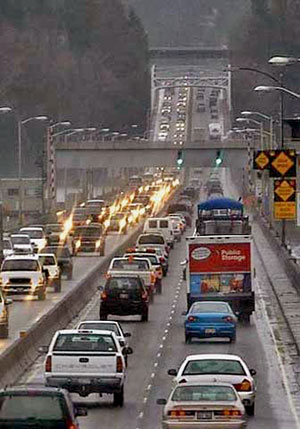
Traffic Congestion Solutions February 9, 2007 by Diana Furchtgott-Roth What if Mayor Bloomberg were to announce that on-street parking in New York City would be free, with no time limits? Initially New Yorkers might be pleased. But they would soon discover that no spaces were available, because cars would stay parked for long periods of time. That's what happens with free goods, in this case, curbside parking places: People consume too much of them, far more than if they would pay for them. Similarly, in much of Manhattan and on some streets in other boroughs, traffic is a nightmare because motorists don't pay the full cost of road use. Although New Yorkers pay gas taxes, these don't cover anywhere near all costs. Drivers pay about 2 cents a mile in gas taxes, whereas travel-costs in congested areas — those costs imposed by each additional driver on other drivers — can be between 10 and 40 times as much. Because roads are underpriced, they are so packed that drivers can move only at a snail's pace. As the secretary of transportation, Mary Peters, recently said, "Today, congestion is choking our cities, clogging our highways and airways, and complicating our lives. … gridlock is taxing our economy and our environment." President Bush, after enjoying six years of speedy motorcades, wants to improve the flow of traffic for everyone. In his 2008 budget, the president asked Congress to allocate $175 million to state and local governments to reduce traffic congestion, on top of $130 million for 2007. The Department of Transportation has asked state and local governments for proposals. Here's Mayor Bloomberg's opportunity to snag some funds and get traffic moving. The only effective way to reduce traffic congestion is to use pricing. This is increasingly accomplished by electronic tolling so drivers don't have to stop. Driving at peak hours, or along certain congested roads, would cost more, so that less-urgent trips would be rescheduled or rerouted. New York City could impose higher tolls for bridges and tunnels during rush hours and charge for cars entering lower Manhattan in the morning rush, or for cars traveling within lower Manhattan during the business day. Alternatively, New York could opt to charge for distance driven. It might copy GPS-based distance measurements being developed in Oregon, or the mandatory meters inside cars in Singapore. Ideally, charges would reflect miles driven in congested areas. Other states have improved traffic flow through road pricing. In Florida, a 25-cent discount on a 50-cent rush hour toll induced 71% of drivers to change the time of their trip at least once a week. Minneapolis allowed drivers to pay a toll to use speedier high-occupancy vehicle lanes, which resulted in a 50% reduction in rush-hour congestion and a 12% decrease in crashes. Southern California's SR 91 has express lanes with electronic tolling at variable prices. These lanes — which are used by all income classes and are particularly popular with women due to their speed and lower accident rate — carry twice as many vehicles as free lanes during hours with the heaviest traffic. And vehicles go three times faster than in free lanes. Some on the political left claim tolls are unfair to lower-income drivers. To resolve this, Alameda County, Calif., and Atlanta, Ga., are experimenting with Fast and Intertwined Regular lanes. Drivers in fast lanes pay tolls, and drivers in slow lanes receive credits. Such credits can be used toward payment of tolls for future trips, or for other transit-related activities. In New York, credits could be given to lower-income drivers through license plate numbers. But it's not tolls that are particularly detrimental to the poor, because they can be rebated — it's congested roads. Congestion lowers mobility, making it harder to travel to much needed jobs. Converting some highway lanes to toll lanes gives low-income drivers a valuable choice of more time. A waiter on his way to pick up a child from day care might find a toll cheaper than a late fee. An objection from the right is that President Bush is breaking his no-tax pledge. However, like parking charges, tolls are not a tax. They are a user fee for road space. Toll revenues can be used not only to ensure that road space is not overly crowded and available when people most need to use it, but also to finance road improvements. One example is new truck-only highways, such as a new tunnel from Brooklyn to New Jersey. Only in the past decade has technology to price road use become widely available and reasonably affordable. The potential benefits to Americans in time and fuel savings are enormous. State and local governments have an obligation to use this new tool to enable traffic to flow freely. Americans rely on prices for a stable supply of food, clothes, water, energy, and telecommunications. Why should roads be an exception? Pricing can improve the usefulness of existing roads and attract funds for improvement. New York should give it a try. This Op-Ed was featured in <em>The New York Sun</em> edition of February 9, 2007.
Transportation
Tuesday, March 11, 2008
In Favor of NYC Congestion Pricing


Monday, March 10, 2008
President Bush's Budget includes $100 million for University Link
Sound Transit may get $100 million boost 2/5/08
Sound Transit's University Link could receive a $100 million boost, thanks to an announcement made Monday by the Bush administration.
President Bush has included $100 million in his fiscal year 2009 budget for the 3.2-mile light rail extension from downtown Seattle to the University of Washington -- an unprecedented single-budget allocation for the light rail project, Sound Transit officials said.
The money is a vote of confidence and will allow groundbreaking to proceed on schedule this fall, said Ric Ilginfritz, Sound Transit's executive director for policy and public affairs.
"It's tremendous news; this is absolutely what we'd hope for," Ilginfritz said. "It makes the north line viable ... and we'll be able to roll from construction of the south line right into construction of the north line."
Bush's budget also proposes spending $36 million to help complete a project to deepen 103 miles of the Columbia River sooner than expected.
The president's budget request would boost annual spending by $6 million to complete the channel deepening next year, instead of 2010 as planned.
Northwest lawmakers hailed the proposal, which they said would save money and allow the region to reap the economic benefits of the deepening project a year earlier than expected. A deeper Columbia River "means more jobs, more trade and smarter use of energy," said Rep. Greg Walden, R-Ore.
But the Columbia project was one of the few bright spots for the Northwest as President Bush released his final spending request.
The $3.1 trillion plan would slash funding for the Forest Service, for cleanup of the Hanford Nuclear Reservation and for the restoration of Puget Sound, among other projects, Northwest lawmakers said. Bush is relying on spending cuts to Medicare, Medicaid and other programs to help ensure the budget blueprint is balanced, at least on paper, in a time of war.
Congressional Democrats said they would make major changes before the plan, which covers the budget year that begins Oct. 1, is adopted.
Rep. Norm Dicks, D-Wash., chairman of the House Appropriations Interior Subcommittee, called cuts proposed for the Forest Service "breathtaking," adding that Bush's plan could result in a layoff of nearly 1,200 employees -- 10 percent of the agency's work force
Sen. Patty Murray, D-Wash., the second-ranking Democrat on the Senate Budget Committee and a senior member of the Senate Appropriations Committee, said that with his final budget request, Bush "gave us more of the same. More promises, fewer dollars. More rhetoric, less investment in America."
Bush's plan would cut spending for Pacific salmon recovery from $67 million this budget year to $35 million next year, a figure Murray said would threaten efforts to restore and protect salmon habitat.
But Sound Transit's Ilginfritz said the allocation also bodes well for Sound Transit's hopes for a $750 million Full Funding Grant Agreement to complete the light rail line. The Federal Transit Administration is expected to make a final decision on the grant by late spring or early summer. The FTA has already given the rail line its highest rating for proposed transit projects nation-wide.
Sound Transit is expected next year to open its 15.6-mile south line from downtown Seattle to Sea-Tac Airport. The president included $28.8 million to finish that line, the final installment of a previously awarded $500 million grant.
Sunday, February 16, 2003
Sound Transit Exaggerates Benefits
Sound Transit Sounds Off
After Years of Taking The Stranger's Abuse, Sound Transit's Spokesman Fights Back
3/16/03
by Josh Fe
.
Sound Transit's chief communications officer, Ric Ilgenfritz, sent me an e-mail last week titled "Cuppa Joe?" He was fed up with the bad press we'd been heaping on his agency, and wanted to chat. I was suspicious, but agreed to meet at King Street Station. The conversation led to a full-fledged interview two days later at The Stranger's offices.
[Tim Eyman's Initiative 776 got overturned], but you're still fending off a lawsuit that says Sound Transit's 14-mile, $2.4 billion plan--scheduled to open between 2009 and 2011 and serve 42,000 daily riders--is not what voters approved. The plaintiffs have a point. Voters approved a 21-mile, $2.1 billion plan scheduled to open in 2006 and serve 127,600 daily riders. How do you sit at a bar with a voter and say, "We're asking for more money for a shorter line that will open five years later and serve one-third of the original ridership, but we're still doing what you asked for"?
I reject the premise of the question. The question is not: "You're paying more to go less far and carry fewer people." Read the Sound Move plan. It contemplates that we will build a 21-mile system in two segments--the first one from downtown going south, then north to the University District. The [current] 14-mile segment is the southern segment, and will capture the same ridership that was envisioned in that segment of the plan. The other two-thirds of it is in the north. We're still committed to doing it. The southern segment is not a stand-in for the 21 miles. It's building the first part of the plan.
We're doing an [environmental impact study] to find a cheaper way to get north. This is going to play out beyond 2006, and that's a legitimate question, to the extent that the plan was billed as a 10-year plan. But the question to the voters in '96 was: "Do you want to levy these taxes for the purposes of building a regional transit system?" The question was obviously answered in the affirmative, overwhelmingly. [Voters] constituted the board, giving it the authority to build the system. So that's where we find ourselves. It's going to cost more than originally thought. It's going to take longer than originally thought. But the ability to deliver the project as originally defined is still within our grasp and on our table.
So your position is: Phase One was approved and Sound Transit's taxing authority exists to get us from the U-District to the airport, even though it will cost more than the dollar amount approved in 1996. What check do voters have? Would you be willing to put a cap on the taxes? I'm a little nervous because in King County Superior Court you argued that you could levy the tax in perpetuity.
The judge did a thorough reading of the law. We're obligated to stop building at the end of Phase One. If we're going to build new projects, we have to ask the voters whether they want to keep going and approve additional taxes. The real question is, are we ever in this region going to decide that it's time to do something about the transportation problem? This is the best opportunity we've had in 30 years to add meaningful capacity to the regional transportation system, and the board isn't going to backtrack on that opportunity.
Can you give us a sense of what the northern route will cost?
We have sifted through multiple routes, looking for the ones that have cost savings. But until the technical and ridership [data] is put together, I'm not going to speculate. By May, we'll have three alternatives, one of which is the original plan. That will trigger a process including public outreach; we'll identify a preferred alternative sometime in the summer, and work toward a formal route adoption and finance plan.
The original plan went across Portage Bay. The new ones are right under I-5 to the west, and under the Montlake Cut to the east. So back to your guy sitting on the barstool. He has every right to be pissed that it's going to cost more and take longer. [But] that's the situation we find ourselves in. Show me a major capital project that doesn't have similar problems. The fact is, we're building what was described in the plan.
Where's the money to get to the airport? You have about $21 million left, according to Sound Transit's 2002 financial plan.
We're not going to put out any cost estimates on any part of our project until we know those are numbers we can stand behind.
Could it be less than $21 million?
I think it'll be more than that. As the design process goes forward, we'll be able to develop a reliable cost estimate. At that point, the board will decide how they're going to do it. We have a number of tools. We've got financial revenues from that sub-area, and there are other pots of federal funding. The Port has other pots of local and federal funding. We're looking to cost-share on the alignment.
This highlights Eastside King County Council Member Rob McKenna's question about sub-area equity. He's afraid that Sound Transit will violate its governing principle of sub-area equity by borrowing revenues from his district [East King County] to pay for things like the airport extension in South King County. He's got a point. When you look at Sound Transit's 2002 financial plan and the federal grant application, Eastside bonding capacity is held up as proof of Sound Transit's ability to cover the federal loan. The feds think, "Okay, Sound Transit has the money." Based on that, Sound Transit could be contractually obligated to the feds for money it doesn't have.
If you look at the East King sub-area, it's piling up money. It's the richest sub-area, and nobody foresaw that in 1996. But their project list won't come close to spending the amount of money they have. Sub-area borrowing occurs. If people are worried about getting their money back, it's a legitimate worry when they're doing some loaning. But there's no movement afoot or support on the board to violate the principal of sub-area equity. If they were going to change the policy, it would require a supermajority.
Sub-area borrowing enables us to manage our cash flow in the most efficient way possible to fund our projects in the order we're sequencing them. We have to square the books at the end of every year. So if there's a project under development in South King and there's a loan to that project from North King, they have to pay that back at the end of every year. If they need it again next year, they borrow it again. But there's a check every year. At the end of the project, all the books have to square--that's a statutory requirement, as opposed to just a policy of the board.
The Seattle Popular Monorail Authority's 14-mile, above-grade monorail plan is penciling in cheaper per mile than Sound Transit's at-grade, 14-mile line. Shouldn't we just go with one system that offers a more efficient rapid technology?
Monorail is an intermediate-capacity transit system that works very effectively in a dense urban environment. Light rail is a high-capacity system more appropriate for moving large numbers of people within a regional context. [Our] trains can carry 600 people at two-minute headways. They're designing their system, their platforms, and their stations for trains that are going to carry 150-200 people.
And light rail is not just an at-grade system. We have at-grade construction, tunnel construction, and elevated construction. We're going to be running 55 mph in our grade-separated alignments. At [Martin Luther King Way], we're running at the posted speed limits, but our trains [will] have the ability to jump signals. So the aggregate average speed is about 28 mph, which is probably a mile or two an hour faster than [monorail]. When you say, "It's cheaper, it's faster, it's more efficient," I don't think the facts bear that out.
There's a bill in Olympia to have an elected Sound Transit board. What do you think?
We're required to go to every jurisdiction we cross and get permits. The theory behind our board [structure] is that we have people who represent the jurisdictions we're in, and they're in a position to facilitate the permit process. If we didn't have that, we'd be in a very adversarial posture with every jurisdiction we came through.
Five hundred million dollars in federal money is assumed in the current 14-mile plan. Where is that money?
The president's budget, released this week, proposes $75 million--our third draw on the total $500 million. That clearly tips the administration's hand on what they think about this project. The final decision on the full grant will be made in early summer.