Wednesday, November 9, 2005
Initiative 912: Urban strongholds successfully keep gas tax
By CHRIS McGANN
SEATTLE POST-INTELLIGENCER CAPITOL CORRESPONDENT
Big city big shots who bankrolled the $3 million campaign to defend the new gas tax celebrated Tuesday night as they defeated Initiative 912.
They were underdogs early on as voters from Anacortes to Zillah and the rural reaches in between blasted the 9.5-cent-a-gallon increase and overwhelmingly voted yes on I-912, which would have repealed the levy.
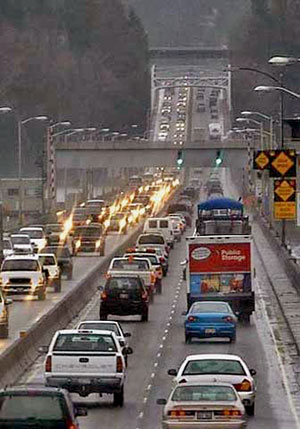
But King County voters pushed back even harder to protect the tax that state lawmakers approved earlier this year, indicating they'd rather pay more at the pump than put off a payment plan for the Alaskan Way Viaduct and the Evergreen Point Bridge.
As of Tuesday night, I-912 trailed slightly, but that was enough to send a shock wave through a star-powered party at the Westin Hotel in Seattle.
"I can't tell you how delighted I am that we have come as far as we have," Gov. Christine Gregoire told the crowd that included officials from Microsoft, Boeing, labor unions and the environmental community.
Rick Bender, president of the State Labor Council, said after voters soundly defeated a gas tax increase in 2002, the close I-912 race represented a landslide of support for transportation.
All eyes were on the state's urban strongholds, King, Pierce and Snohomish counties, which were the swing areas that many experts predicted would be decisive in determining I-912's fate.
Snohomish voters joined their neighbors to the south in strongly opposing I-912. Pierce County voters were splitting evenly.
No on 912 campaign spokesman Mark Funk appeared stunned at his apparent good fortune. He said he expected Eastern Washington to vote for the initiative.
"But we're breaking even in Clark County. We're breaking even in Walla Walla County. We have a solid lead in Snohomish County. And we have a really solid lead were it counts, King County!" Funk said.
"If we can keep our numbers high in King County, we're in good shape," Funk said.
Western Wireless Chief Executive John Stanton was one of the biggest contributors to the No on 912 campaign.
He actually thanked the folks that put the initiative on the ballot.
"This has made a huge difference, it's given us an opportunity to have this conversation," Stanton said. "This really represents an opportunity for people to weigh taxes versus transportation and it looks like people are saying transportation is important."
The initiative emerged this spring after the Legislature passed the new tax and omnibus $8.5 billion highway improvement plan it would help pay for.
Initiative 912 spokesman Brett Bader was confident the allure of cutting taxes would prevail, despite expensive TV ads paid by the other side.
But as the election drew near, support cooled as business, labor and environmental groups launched their media blitz to sell the new tax and 274 safety and congestion relief projects as imperative to a healthy future for the state. [Note: The number of projects has been corrected since this article was originally published]
In the aftermath of Hurricane Katrina, Gregoire compared Washington's highway system to the levies that failed in New Orleans. She said failure to maintain Washington's transportation infrastructure could also prove catastrophic in a strong earthquake.
King County's strong opposition to the initiative indicates that message had traction.
Gregoire and the No on 912 campaign chained up for the icy reception east of the Cascades and were counting on Puget Sound-area votes.
Within the Republican Party, I-912 was also seen as a referendum on last year's controversial governor's election, Gregoire's first months in office and what its leaders call tax-and-spend politics in Olympia.
If it had passed, I-912 would have stripped $5.5 billion from the $8.5 billion highway plan. It would have sent transportation planners, who are counting on $2 billion earmarked for repairing the earthquake-damaged Alaskan Way Viaduct, back to square one and lawmakers who supported the plan back to Olympia with a major defeat as they head into an election year.
Throughout the campaign, Bader, the Initiative 912 spokesman, railed against the state Department of Transportation as a wasteful, ineffective bureaucracy in need of reform.
He said he was disappointed in the outcome Tuesday night but did not concede. "There are still a lot of votes to count," he said.
Bader said the key weaknesses in the campaign were a worse-than-expected result in King County and the loss in Snohomish County.
"That's what kept us from surviving," he said. "We hit all our other targets."
Bader said despite the disappointing results, the campaign was worthwhile.
"We said all along that the citizens should get a vote on this -- and they got one," Bader said.
He said lawmakers also need to reform the Department of Transportation and policies that increase costs on highway projects.
"They need to consider getting rid of the sales tax on road construction," Bader said. "They need to consider changes to legislation so that it's easier to get projects built and most importantly, they need to plan for the state. Whether it's funded with new gas taxes or not, that is more in tune with what people want: traffic congestion relief in Western Washington and upgrades and safety improvements in Eastern Washington."
Bader said he didn't expect strong support in King County, where nearly half of the $8.5 billion would be spent.
Transportation
Monday, March 10, 2008
Initiative 912 - Repeal the 9.5 cent Gas Tax fails


Initiative 912 - Repeal the 9.5 cent Gas Tax failed in 2005
Initiative 912 Fuels Debate Over New Gas Tax
by John Barnes, Policy Analyst
05-08 8/6/05
This election Washington citizens will vote on Initiative 912, a proposal to repeal the new 9.5 cent gas tax recently passed by the legislature. This Policy Note briefly describes the Initiative and summarizes the main arguments for and against it.
In April the state legislature passed and Governor Gregoire signed a bill to increase the state gas tax by 9.5 cents in four stages: raising it by three cents in July 2005 and July 2006, by two cents in July 2007, and 1.5 cents in July 2008. Initiative 912 would repeal about $5.5 billion in new gas tax revenues, leaving in place $3 billion in new revenues from higher vehicle weight taxes, higher drivers’ license fees, and other fees.
More than half of the legislature's 16-year $8.6 billion statewide transportation plan is earmarked for King County. Pierce County comes in second with an allocation of $769 million, with other counties around the state receiving various lesser amounts. Chief among the projects that would receive funding are the Alaskan Way Viaduct ($2 billion), Interstate 405 ($992 million), and the Highway 520 bridge ($500 million). These allocations only partially fund the targeted projects. Localities are expected to raise additional revenue for finishing the projects.
The new tax is the largest single gas tax increase in state history. Washington began taxing gasoline in 1924 at the rate of two cents a gallon. Today that rate is 31 cents per gallon (including the July 2005 phase-in of the recently-passed increase), giving Washington the tenth highest state gas tax in the nation. The federal government taxes gas at 18.4 cents a gallon, making the combined gas tax in Washington 49.4 cents a gallon. Under the Legislature’s plan, by 2008 Washingtonians will be paying a combined state and federal gas tax of 56 cents a gallon. The chart below shows the history of the gas tax in Washington (figure 1.1).
Not long after the new gas tax became law, opponents started a website, www.NoNewGas-Tax.com, and began the push for repeal with Initiative 912. They had no difficulty finding support for their cause. Organizers gathered more than 420,000 signatures in just over 30 days, without the use of paid signature gatherers. The groundswell of support arose in response to what many see as a misguided transportation plan with the wrong priorities.
Initiative 912 supporters say "traffic congestion won't get any better" because of the tax hike and the projects it will fund. "We need to send them [lawmakers] back to the drawing board if we are ever going to solve this problem," says one Initiative backer. Supporters' central argument is that lawmakers should not have enacted an $8.6 billion tax increase that will not relieve traffic congestion. The projects financed through the plan center around infrastructure maintenance, not capacity expansion.
Supporters of Initiative 912 are also angry that the legislature attached an emergency clause to the bill, which prevented the voters from overturning it via referendum. The number of signatures required to put a referendum on the ballot is half the number required for an initiative. This move, many argue, reflects lawmakers' distrust of their own constituency.
Initiative 912 opponents have started their own website, www.KeepWashingtonRolling.com. Several of Washington's largest companies, labor unions and trade associations have thrown their weight behind the effort to defeat Initiative 912. The new tax, they say, is a small price to pay for the increased safety that will come from the more than 200 road projects the new tax would fund, projects such as highway and bridge upgrades for earthquake safety. Congestion relief would have to come above and beyond all of that, and at additional cost. Initiative 912's opponents also argue that these projects will create thousands of new jobs over the next several years, although this assumption does not account for jobs lost due to the higher tax.
While Initiative 912 supporters say the Department of Transportation needs to do a better job of managing the funds it already has, Keep Washington Rolling points out that the gas tax bill includes measures to do just that. To obtain key Republican support for the tax increase bill, lawmakers appropriated $4 million to the state auditor to conduct independent performance audits of the Department of Transportation. Even if Initiative 912 passes, the performance audit provisions would remain in place.
Keep Washington Rolling says the average Washington driver will pay only 41 cents more per week under the new tax increase ("average" in this case means driving 12,070 miles per year in a car that gets 17 miles per gallon). Opponents of the tax increase counter the math by pointing out that when such incremental arguments are used every time the government wants to raise taxes, a little bit here and a little bit there adds up to a significantly larger tax burden in the long run.
Revenue from the state gas tax has increased over the years, as shown in the chart below (figure 1.2).
Gas tax collections increased five percent above inflation between 1995 and 2004. Two factors have contributed to this trend. The state tax rate has gone from two cents per gallon in 1924 to 31 cents today—an increase of more than 1,500%. Additionally, state residents now consume three times as much gasoline as they did in 1960, and the number of vehicle-miles-traveled has doubled since 1980. While a gallon is the same size today as it was in 1924, the fiscal reality is that there are many more vehicles on the road driving more miles, thereby generating more revenue for state coffers.
If Initiative 912 passes in November, it will be the second time in three years citizens voted down a large gas tax increase. In 2002 voters overwhelmingly defeated Referendum 51, which would have raised the tax by nine cents per gallon. Responding to the anti-tax sentiment that killed Referendum 51, the legislature in 2003 approved a lower increase of five cents a gallon.
Off-year elections tend to produce lower voter turnout due to the paucity of measures and candidates on the ballot, but 2005 could very well buck that trend. If the grassroots support behind Initiative 912 and the scale of organizations opposing the measure are any indication, the Initiative is sure to draw large numbers of voters to the polls in November.
For more information, see the Transportation chapter of Agenda 2005: The Guide to Public Policy Issues in Washington State at www.Agenda2005.org.
Monday, November 7, 2005
Text of Initiative 912
1
INITIATIVE 912
I, Sam Reed, Secretary of State of the State of Washington and
custodian of its seal, hereby certify that, according to the records on
file in my office, the attached copy of Initiative Measure No. 912 to
the People is a true and correct copy as it was received by this
office.
AN ACT Relating to reducing the motor vehicle fuel tax rate;
1
amending RCW 82.36.025 and 46.68.090; and creating new sections.
2
BE IT ENACTED BY THE PEOPLE OF THE STATE OF WASHINGTON:
3
POLICIES AND PURPOSES
4
NEW SECTION.
Sec. 1. In 2002 voters overwhelmingly rejected a
5
nine cent per gallon increase to the motor vehicle fuel tax rate.
6
Since that time, politicians have voted to increase the motor vehicle
7
fuel tax rate by fourteen and one-half cents per gallon. This measure
8
would repeal the most recent increase to the motor vehicle fuel tax
9
rate of nine and one-half cents.
10
REPEALING THE 9 AND ONE-HALF CENT INCREASE
11
IN THE MOTOR VEHICLE FUEL TAX RATE
12
Sec. 2. RCW 82.36.025 and 2005 c ... (ESSB 6103) s 101 are each
13
amended to read as follows:
14
(1) A motor vehicle fuel tax rate of twenty-three cents per gallon
15
applies to the sale, distribution, or use of motor vehicle fuel.
16
Page 2
2
(2) Beginning July 1, 2003, an additional and cumulative motor
1
vehicle fuel tax rate of five cents per gallon applies to the sale,
2
distribution, or use of motor vehicle fuel. This subsection (2)
3
expires when the bonds issued for transportation 2003 projects are
4
retired.
5
(((3) Beginning July 1, 2005, an additional and cumulative motor
6
vehicle fuel tax rate of three cents per gallon applies to the sale,
7
distribution, or use of motor vehicle fuel.
8
(4) Beginning July 1, 2006, an additional and cumulative motor
9
vehicle fuel tax rate of three cents per gallon applies to the sale,
10
distribution, or use of motor vehicle fuel.
11
(5) Beginning July 1, 2007, an additional and cumulative motor
12
vehicle fuel tax rate of two cents per gallon applies to the sale,
13
distribution, or use of motor vehicle fuel.
14
(6) Beginning July 1, 2008, an additional and cumulative motor
15
vehicle fuel tax rate of one and one-half cents per gallon applies to
16
the sale, distribution, or use of motor vehicle fuel.))
17
Sec. 3. RCW 46.68.090 and 2005 c ... (ESSB 6103) s 103 are each
18
amended to read as follows:
19
(1) All moneys that have accrued or may accrue to the motor vehicle
20
fund from the motor vehicle fuel tax and special fuel tax shall be
21
first expended for purposes enumerated in (a) and (b) of this
22
subsection. The remaining net tax amount shall be distributed monthly
23
by the state treasurer in accordance with subsections (2) through (7)
24
of this section.
25
(a) For payment of refunds of motor vehicle fuel tax and special
26
fuel tax that has been paid and is refundable as provided by law;
27
(b) For payment of amounts to be expended pursuant to
28
appropriations for the administrative expenses of the offices of state
29
treasurer, state auditor, and the department of licensing of the state
30
of Washington in the administration of the motor vehicle fuel tax and
31
the special fuel tax, which sums shall be distributed monthly.
32
(2) All of the remaining net tax amount collected under RCW
33
82.36.025(1) and 82.38.030(1) shall be distributed as set forth in (a)
34
through (j) of this section.
35
(a) For distribution to the motor vehicle fund an amount equal to
36
44.387 percent to be expended for highway purposes of the state as
37
defined in RCW 46.68.130;
38
Page 3
3
(b) For distribution to the special category C account, hereby
1
created in the motor vehicle fund, an amount equal to 3.2609 percent to
2
be expended for special category C projects. Special category C
3
projects are category C projects that, due to high cost only, will
4
require bond financing to complete construction.
5
The following criteria, listed in order of priority, shall be used
6
in determining which special category C projects have the highest
7
priority:
8
(i) Accident experience;
9
(ii) Fatal accident experience;
10
(iii) Capacity to move people and goods safely and at reasonable
11
speeds without undue congestion; and
12
(iv) Continuity of development of the highway transportation
13
network.
14
Moneys deposited in the special category C account in the motor
15
vehicle fund may be used for payment of debt service on bonds the
16
proceeds of which are used to finance special category C projects under
17
this subsection (2)(b);
18
(c) For distribution to the Puget Sound ferry operations account in
19
the motor vehicle fund an amount equal to 2.3283 percent;
20
(d) For distribution to the Puget Sound capital construction
21
account in the motor vehicle fund an amount equal to 2.3726 percent;
22
(e) For distribution to the urban arterial trust account in the
23
motor vehicle fund an amount equal to 7.5597 percent;
24
(f) For distribution to the transportation improvement account in
25
the motor vehicle fund an amount equal to 5.6739 percent and expended
26
in accordance with RCW 47.26.086;
27
(g) For distribution to the cities and towns from the motor vehicle
28
fund an amount equal to 10.6961 percent in accordance with RCW
29
46.68.110;
30
(h) For distribution to the counties from the motor vehicle fund an
31
amount equal to 19.2287 percent: (i) Out of which there shall be
32
distributed from time to time, as directed by the department of
33
transportation, those sums as may be necessary to carry out the
34
provisions of RCW 47.56.725; and (ii) less any amounts appropriated to
35
the county road administration board to implement the provisions of RCW
36
47.56.725(4), with the balance of such county share to be distributed
37
monthly as the same accrues for distribution in accordance with RCW
38
46.68.120;
39
Page 4
4
(i) For distribution to the county arterial preservation account,
1
hereby created in the motor vehicle fund an amount equal to 1.9565
2
percent. These funds shall be distributed by the county road
3
administration board to counties in proportions corresponding to the
4
number of paved arterial lane miles in the unincorporated area of each
5
county and shall be used for improvements to sustain the structural,
6
safety, and operational integrity of county arterials. The county road
7
administration board shall adopt reasonable rules and develop policies
8
to implement this program and to assure that a pavement management
9
system is used;
10
(j) For distribution to the rural arterial trust account in the
11
motor vehicle fund an amount equal to 2.5363 percent and expended in
12
accordance with RCW 36.79.020.
13
(3) The remaining net tax amount collected under RCW 82.36.025(2)
14
and 82.38.030(2) shall be distributed to the transportation 2003
15
account (nickel account).
16
(4) The remaining net tax amount collected under RCW ((82.36.025(3)
17
and)) 82.38.030(3) shall be distributed as follows:
18
(a) 8.3333 percent shall be distributed to the incorporated cities
19
and towns of the state in accordance with RCW 46.68.110;
20
(b) 8.3333 percent shall be distributed to counties of the state in
21
accordance with RCW 46.68.120; and
22
(c) The remainder shall be distributed to the transportation
23
partnership account created in RCW 46.68.--- (section 104, chapter ...
24
(ESSB 6103), Laws of 2005).
25
(5) The remaining net tax amount collected under RCW ((82.36.025(4)
26
and)) 82.38.030(4) shall be distributed as follows:
27
(a) 8.3333 percent shall be distributed to the incorporated cities
28
and towns of the state in accordance with RCW 46.68.110;
29
(b) 8.3333 percent shall be distributed to counties of the state in
30
accordance with RCW 46.68.120; and
31
(c) The remainder shall be distributed to the transportation
32
partnership account created in RCW 46.68.--- (section 104, chapter ...
33
(ESSB 6103), Laws of 2005).
34
(6) The remaining net tax amount collected under RCW (( 82.36.025
35
(5) and (6) and)) 82.38.030 (5) and (6) shall be distributed to the
36
transportation partnership account created in RCW 46.68.--- (section
37
104, chapter ... (ESSB 6103), Laws of 2005).
38
Page 5
5
(7) Nothing in this section or in RCW 46.68.130 may be construed so
1
as to violate any terms or conditions contained in any highway
2
construction bond issues now or hereafter authorized by statute and
3
whose payment is by such statute pledged to be paid from any excise
4
taxes on motor vehicle fuel and special fuels.
5
MISCELLANEOUS
6
NEW SECTION.
Sec. 4. The provisions of this act are to be
7
liberally construed to effectuate the intent, policies, and purposes of
8
this act.
9
NEW SECTION.
Sec. 5. If any provision of this act or its
10
application to any person or circumstance is held invalid, the
11
remainder of the act or the application of the provision to other
12
persons or circumstances is not affected. If the repeal or reduction
13
of any tax in this act is judicially held to impair any contract in
14
existence as of the effective date of this act, any unused taxing
15
authority shall be repealed as of the effective date of this act and
16
the repeal of pledged revenues shall apply to any other contract,
17
including novation, renewal, or refunding (in the case of bond
18
contract).
19
NEW SECTION. Sec. 6. Part headings used in this act are not part
20
of the law.
21
--- END ---
Saturday, October 22, 2005
Left wing Activist opposes Inititiative 912
Initiative 912
This measure would repeal motor vehicle fuel tax increases of 3 cents in 2005 and 2006, 2 cents in 2007, and 1.5 cents per gallon in 2008, enacted in 2005 for transportation purposes.
I recommend a NO vote on Initiative 912.
This fall, we’ve had a lesson in infrastructure investment, or in what happens when you don’t invest in infrastructure. Hurricane Katrina overwhelmed the levees in New Orleans, resulting in catastrophe, but even Hurricane Rita exposed infrastructure difficulties. As Rita spun out in the Gulf, a Category 5 hurricane bearing down on Galveston, many Texans, mindful of what had happened with Katrina, sought to evacuate. So many, in fact, that the roads through and out of Houston were gridlocked.
The only way out for residents in the low-lying areas between Houston and the Gulf, was through roads just barely sufficient for regular, daily traffic.
Hurricanes (or typhoons, as the Pacific equivalents are called) can’t happen here; ocean temperatures are too cold, but the Pacific Northwest is not immune to natural disaster. Were an earthquake to hit Seattle, key elements of the transportation infrastructure would be at risk.
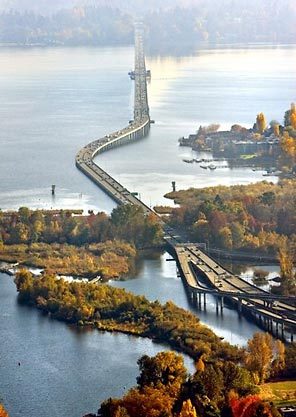
Recognizing this, the Washington state legislature passed a 9.5 cent gas tax for highway projects all across the state, but most notably to replace the Alaskan Way Viaduct and the Evergreen Point Floating Bridge.
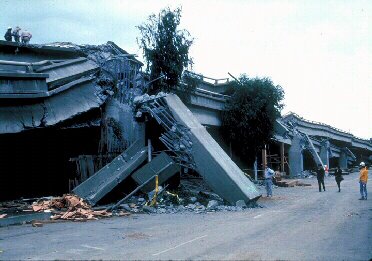
How desperate is the situation for the Alaskan Way Viaduct? It’s an aging elevated double-decker freeway, built on fill with a deteriorating seawall. The freeway design is a similar design as the Cypress structure in Oakland, CA, which collapsed in the 1989 Loma Prieta quake. The design may have been state of the art in the 50’s, when it was built, but the 1971 San Fernando quake, as well as the Loma Prieta quake, exposed deficiencies in that design for elevated freeways. This report highlights the seismic vulnerabilities of this heavily trafficked structure, and this more recent report looks at the impact of the Nisqually quake on the viaduct.
Opponents to the gas tax collected enough signatures to place I-912 on the ballot, which seeks to overturn the gas tax. Even the gas tax opponents concede that the highway projects need to be done, but think that the money will be found elsewhere without raising taxes. The state Republican party has endorsed I-912, mixing anti-tax fervor with an evident desire to nullify Governor Gregoire’s most visible accomplishment to date. Once upon a time, Republicans actually used to invest in infrastructure; the interstate highway system was implemented under President Eisenhower, and was in part intended as a Cold War security measure.
A year ago, I was opposed to an increase in sales tax for education, despite the importance of education. I said that a sales tax was not the best way to fund education, and unless education in Washington was in a state of emergency, I couldn’t advocate paying for it with a sales tax increase. I do believe that transportation in Washington is in a state of emergency, however, and a gas tax is a fair way to pay for badly-needed transportation improvements.
Source Sherry Nichols blog
A Conservative Talk radio Host opposed Initiative 912
The conservative case against Initiative 912
By Dan Sytman
Dan Sytman is a talk-radio host in Seattle
AS a critic of Olympia's tax-and-splurge policies, I've voted for every tax-limiting initiative that has come up over the past 10 years. Upon sighting anti-tax soldier Tim Eyman at the 2004 Republican Convention, I shook his hand and giddily explained, "As a conservative from Seattle, I consider you my representative in Olympia." My thanks were from the heart.
I have publicly railed against Sound Transit, regretting its invention and urging against further expansion. I've voted against the Seattle Monorail whenever the opportunity has arisen and relish the chance to deliver the deathblow this November. So why would an anti-tax, anti-public-transportation agitator like me oppose the Holy Grail of today's local conservative movement, Initiative 912? Allow me to explain.
I voted twice for $30 license tabs because the vehicle excise is the worst kind of tax. It punishes me progressively based on the value of my car instead of how much I drive. While rightly trying to kill that obnoxious tax, the people of this state drained money from the agency that does one of the most important things government does: build roads. So when I'm asked to replace a progressive tax — the vehicle excise — with a user tax that supports the building of roads, it would be hypocritical of me to refuse.
A yes vote on I-912 is really a no vote on the very priorities conservatives like myself have been pushing all these years. We've been demanding roads, not transit. Well, now they're building roads and using one of the fairest kinds of taxes to do so — and we're going to try to stop them? Unfortunately, I think many I-912 advocates have not realized the hypocrisy of their dubious position on transportation taxes.
The 2005 transportation package — and the 9.5-cent gas-tax increase — was passed with support from about one-third of Republicans in Olympia, including highly respected conservatives like Sens. Bill Finkbeiner, Joseph Zarelli and Dan Swecker, who voted for the package because it includes projects not just for infrastructure-needy King County, but for all 39 counties. They voted for the gas tax along with an audit feature that will help enforce wise spending.
Moreover, the performance audits initiative, Initiative 900, is on track to pass this November, ensuring more accountability. Most importantly, conservative leaders in Olympia supported the gas tax because it provides almost $3 billion to address major congestion choke points and $279 million for frequent-accident locations.
I support the transportation package largely for what it does not include — lots of HOV lanes. Like most conservatives, I resist with every fiber of my being the liberal attempt to mold my behavior by forcing me into impossibly inconvenient carpools or onto buses that move as slow as molasses. You wouldn't know from listening to conservative talk radio, but in recent years the Department of Transportation has been focusing on general-purpose lanes, not HOV lanes.
That's what they're doing with the much-maligned 2003 5-cent gas tax increase, building 215 miles of general-purpose lanes and only 50 miles of HOV lanes. The controversial transportation package targeted by I-912 includes more of the same — more lanes for me to drive in and fewer HOV lanes for liberals to force me into. It builds 119 miles of new roads and only 15 miles of HOV.
While I find it hard to disagree with those who say transportation projects are bloated with prevailing-wage and environmental-mitigation laws, conservatives have lost those fights because we're outnumbered in Olympia. If we really want to address those issues, we need to figure out how to win back the Legislature and governor's mansion.
In the meantime, shutting down a bipartisan transportation package that includes accountability measures and gets to work building roads and reducing congestion would be horribly dangerous for the future of our state and damaging to the conservative cause.
If a post-I-912-era earthquake brings down the viaduct or sinks the Evergreen Point Bridge, who do you think people are going to blame? Keep in mind that the Washington State Republican Party has officially taken a position against its traditional allies in the business community by supporting I-912. It doesn't take a wild imagination to predict where the blame will fall if Washington suffers from a bridge- or viaduct-breaking catastrophe.
It's up to right-thinking voters to take a principled position on the future of transportation — and on the future of the conservative movement — by voting against Initiative 912.
Monday, August 22, 2005
Wa Policy Center argues against Initiative 912
nitiative 912 Fuels Debate Over New Gas Tax
by John Barnes, Policy Analyst
05-08
This election Washington citizens will vote on Initiative 912, a proposal to repeal the new 9.5 cent gas tax recently passed by the legislature. This Policy Note briefly describes the Initiative and summarizes the main arguments for and against it.
In April the state legislature passed and Governor Gregoire signed a bill to increase the state gas tax by 9.5 cents in four stages: raising it by three cents in July 2005 and July 2006, by two cents in July 2007, and 1.5 cents in July 2008. Initiative 912 would repeal about $5.5 billion in new gas tax revenues, leaving in place $3 billion in new revenues from higher vehicle weight taxes, higher drivers’ license fees, and other fees.
More than half of the legislature's 16-year $8.6 billion statewide transportation plan is earmarked for King County. Pierce County comes in second with an allocation of $769 million, with other counties around the state receiving various lesser amounts. Chief among the projects that would receive funding are the Alaskan Way Viaduct ($2 billion), Interstate 405 ($992 million), and the Highway 520 bridge ($500 million). These allocations only partially fund the targeted projects. Localities are expected to raise additional revenue for finishing the projects.
The new tax is the largest single gas tax increase in state history. Washington began taxing gasoline in 1924 at the rate of two cents a gallon. Today that rate is 31 cents per gallon (including the July 2005 phase-in of the recently-passed increase), giving Washington the tenth highest state gas tax in the nation. The federal government taxes gas at 18.4 cents a gallon, making the combined gas tax in Washington 49.4 cents a gallon. Under the Legislature’s plan, by 2008 Washingtonians will be paying a combined state and federal gas tax of 56 cents a gallon. The chart below shows the history of the gas tax in Washington (figure 1.1).
Not long after the new gas tax became law, opponents started a website, www.NoNewGas-Tax.com, and began the push for repeal with Initiative 912. They had no difficulty finding support for their cause. Organizers gathered more than 420,000 signatures in just over 30 days, without the use of paid signature gatherers. The groundswell of support arose in response to what many see as a misguided transportation plan with the wrong priorities.
Initiative 912 supporters say "traffic congestion won't get any better" because of the tax hike and the projects it will fund. "We need to send them [lawmakers] back to the drawing board if we are ever going to solve this problem," says one Initiative backer. Supporters' central argument is that lawmakers should not have enacted an $8.6 billion tax increase that will not relieve traffic congestion. The projects financed through the plan center around infrastructure maintenance, not capacity expansion.
Supporters of Initiative 912 are also angry that the legislature attached an emergency clause to the bill, which prevented the voters from overturning it via referendum. The number of signatures required to put a referendum on the ballot is half the number required for an initiative. This move, many argue, reflects lawmakers' distrust of their own constituency.
Initiative 912 opponents have started their own website, www.KeepWashingtonRolling.com. Several of Washington's largest companies, labor unions and trade associations have thrown their weight behind the effort to defeat Initiative 912. The new tax, they say, is a small price to pay for the increased safety that will come from the more than 200 road projects the new tax would fund, projects such as highway and bridge upgrades for earthquake safety. Congestion relief would have to come above and beyond all of that, and at additional cost. Initiative 912's opponents also argue that these projects will create thousands of new jobs over the next several years, although this assumption does not account for jobs lost due to the higher tax.
While Initiative 912 supporters say the Department of Transportation needs to do a better job of managing the funds it already has, Keep Washington Rolling points out that the gas tax bill includes measures to do just that. To obtain key Republican support for the tax increase bill, lawmakers appropriated $4 million to the state auditor to conduct independent performance audits of the Department of Transportation. Even if Initiative 912 passes, the performance audit provisions would remain in place.
Keep Washington Rolling says the average Washington driver will pay only 41 cents more per week under the new tax increase ("average" in this case means driving 12,070 miles per year in a car that gets 17 miles per gallon). Opponents of the tax increase counter the math by pointing out that when such incremental arguments are used every time the government wants to raise taxes, a little bit here and a little bit there adds up to a significantly larger tax burden in the long run.
Revenue from the state gas tax has increased over the years, as shown in the chart below (figure 1.2).
Gas tax collections increased five percent above inflation between 1995 and 2004. Two factors have contributed to this trend. The state tax rate has gone from two cents per gallon in 1924 to 31 cents today—an increase of more than 1,500%. Additionally, state residents now consume three times as much gasoline as they did in 1960, and the number of vehicle-miles-traveled has doubled since 1980. While a gallon is the same size today as it was in 1924, the fiscal reality is that there are many more vehicles on the road driving more miles, thereby generating more revenue for state coffers.
If Initiative 912 passes in November, it will be the second time in three years citizens voted down a large gas tax increase. In 2002 voters overwhelmingly defeated Referendum 51, which would have raised the tax by nine cents per gallon. Responding to the anti-tax sentiment that killed Referendum 51, the legislature in 2003 approved a lower increase of five cents a gallon.
Off-year elections tend to produce lower voter turnout due to the paucity of measures and candidates on the ballot, but 2005 could very well buck that trend. If the grassroots support behind Initiative 912 and the scale of organizations opposing the measure are any indication, the Initiative is sure to draw large numbers of voters to the polls in November.
For more information, see the Transportation chapter of Agenda 2005: The Guide to Public Policy Issues in Washington State at www.Agenda2005.org.