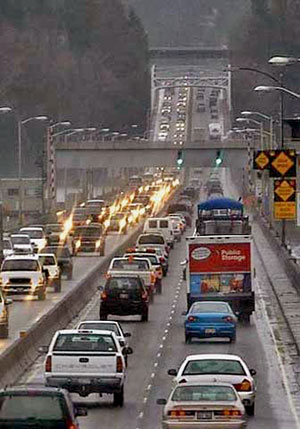
News and Information Congestion pricing is the concept of charging for the use of a transportation facility, such as a roadway, based on the level of traffic congestion. The greater the level of congestion, usually occurring during morning and evening rush hours, the higher the cost to use the facility. Congestion pricing is not a panacea for congestion relief, but it is an important tool that many cities throughout the world have instituted or are exploring as a means to reduce congestion. It has been proven to ease congestion by shifting some rush hour highway traffic to other transportation modes such as vanpools and freeway express buses or to off-peak periods by charging for use of selected roads during a selected time. It has worked successfully in London, Stockholm, Singapore, Minneapolis, San Diego, and Orange County. Because it provides another alternative to managing traffic flow, which is growing increasingly worse. To fulfill our obligation to the people of Los Angeles County, Metro must consider all reasonable options that may contribute to improving our mobility and quality of life. As with any complex issue, many factors contribute to identifying and implementing solutions. At least a few of these challenges include increased population, increased flow of material goods on roadways, more auto ownership and declining funding from gas tax revenue and state and federal governments. Congestion pricing is one approach for efficiently managing capacity on our busy roadways by: In the United States, the conversion of high occupancy vehicle (HOV) lanes to high occupancy toll (HOT) lanes is one way to manage congestion. When driving on a HOT lane, the driver pays a toll that varies according to: Monitoring congestion makes it possible to control the traffic levels at all times and maintain the traffic speed at 50 mph. Congestion pricing, when integrating with other traffic management options, would help improve the travel speed of the managed lanes as well as the general-purpose lane. What kind of demonstration projects is Metro considering for the Los Angeles region? Under the current proposal, carpool lanes would be converted to HOT lanes along the following freeways: Metro has proposed a one-year demonstration pilot project to convert certain carpool lanes into High Occupancy Toll (HOT) Lanes to give drivers (whether solo or carpooler) the option to drive on these facilities (at an minimum speed of 50 m.p.h.) in return for toll payments. When would the tolls be added to the demonstration projects? Implementation of the one year pilot program (I-10, I-110 and I-210) is expected to start summer 2009. Why select these three projects? These demonstration projects meet one or more basic criteria for successful congestion pricing: How would the toll be paid or collected? The latest technology involves an easy to use electronic "fast pass" collection system so that patrons do not have to wait in line at toll booths. Are there any HOT lanes being used in Southern California? Yes. Two examples of HOT lanes in Southern California include SR 91 in Orange County and I-15 in San Diego. In December of 1995, Orange County opened four 10-mile toll lanes in the median of the existing State Route 91; actual toll revenues in fiscal year 2007 amounted to $44 million, about $5.0 million more than projected. Since December 1996 solo drivers on an eight-mile stretch of the I-15 in northern San Diego County have been allowed to use the express lanes on San Diego County's I-15 for a fee, while carpoolers continue to travel free of charge. Will education programs describe how the public can reduce congestion? Yes. Educating and engaging the public regarding commuting choices is part of the outreach program on congestion reduction that Metro will conduct over the next several months. An early step in encouraging the public to adjust their commuting behavior is to remind the public that viable alternative transit options exist such as express bus service, adequate park-and-ride lot capacity, and efficient commuter rail and vanpool options. According to the 2000 Census, 70 percent of Los Angeles County commuters drive alone to work, and only 7 percent use transit. Consequently, outreach to major employers in the region will be particularly important. Employers and employees are primary users of road infrastructure and key stakeholders in the development of financial or other incentives to reduce congestion. Such incentives may include employer-paid transit subsidies, telecommuting options, and staggered work shifts. How much would it cost to use a "toll" lane? Various pricing formulas will be evaluated in the Metro study. In other metropolitan areas tolls range from $4.00 to $10.00 during peak commute hours. Pricing will be determined as we develop our operating plan. What would those funds generated be used for? Revenues generated by the tolls will be used first to pay for the operations of the managed lanes. It is expected that any additional revenues generated from the tolls will be used to improve or enhanced transportation services along or near the managed corridors. These may include additional bus and rail services, roadway improvements, and other complementary services. Doesn't congestion pricing favor wealthy commuters? Congestion pricing benefits all because it provides more options to commuters from all walks of life. Each commuter may select which mode makes the most sense to her or him in terms of cost and travel time. At certain times of day, the least expensive travel options—ride sharing and transit—may also be the fastest. Revenues generated from tolls not needed for the operations of the lanes would be used to fund improvements to mass transit, which many low income families depend on. Additionally, buses and vanpools would be exempt from any HOT-lane charges. This means that anyone commuting by these modes—whatever his or her income—would travel without paying the toll. Why can't carpool lanes help more with congestion? Perhaps the most serious challenge Los Angeles County carpool lanes face is that they are now so popular that they are getting too crowded. Right now, several carpool lanes in Los Angeles County are close to reaching a maximum desirable operating capacity. To ensure these lanes continue to be effective, we must find ways to better manage the flow. One of the options is by implementing managed lane concepts such as congestion pricing. Metro, Caltrans and the Southern California Association of Governments in coordination with Los Angeles County and other major transportation stakeholders are applying for funding for the Congestion-Reduction Demonstration Initiatives under the United States Department of Transportation (USDOT) to do demonstration projects that involve converting High Occupancy Vehicle (HOV) lanes to High Occupancy Toll (HOT) lanes along the: There are actually two separate activities taking place at Metro in pursuit of roadway pricing options. First is the USDOT grant which approval may determined as early as January 2008. If so, the demonstrations could commence about 18 months later. The second activity is a study directed by Metro's Board that requires completion of a countywide study to produce no less than three recommendations for roadway pricing within Los Angeles County. These demonstration projects would commence the following year.
Transportation
Wednesday, March 12, 2008
LA Moves towards More HOT Lanes


Tuesday, March 11, 2008
In Favor of NYC Congestion Pricing
Traffic Congestion Solutions February 9, 2007 by Diana Furchtgott-Roth What if Mayor Bloomberg were to announce that on-street parking in New York City would be free, with no time limits? Initially New Yorkers might be pleased. But they would soon discover that no spaces were available, because cars would stay parked for long periods of time. That's what happens with free goods, in this case, curbside parking places: People consume too much of them, far more than if they would pay for them. Similarly, in much of Manhattan and on some streets in other boroughs, traffic is a nightmare because motorists don't pay the full cost of road use. Although New Yorkers pay gas taxes, these don't cover anywhere near all costs. Drivers pay about 2 cents a mile in gas taxes, whereas travel-costs in congested areas — those costs imposed by each additional driver on other drivers — can be between 10 and 40 times as much. Because roads are underpriced, they are so packed that drivers can move only at a snail's pace. As the secretary of transportation, Mary Peters, recently said, "Today, congestion is choking our cities, clogging our highways and airways, and complicating our lives. … gridlock is taxing our economy and our environment." President Bush, after enjoying six years of speedy motorcades, wants to improve the flow of traffic for everyone. In his 2008 budget, the president asked Congress to allocate $175 million to state and local governments to reduce traffic congestion, on top of $130 million for 2007. The Department of Transportation has asked state and local governments for proposals. Here's Mayor Bloomberg's opportunity to snag some funds and get traffic moving. The only effective way to reduce traffic congestion is to use pricing. This is increasingly accomplished by electronic tolling so drivers don't have to stop. Driving at peak hours, or along certain congested roads, would cost more, so that less-urgent trips would be rescheduled or rerouted. New York City could impose higher tolls for bridges and tunnels during rush hours and charge for cars entering lower Manhattan in the morning rush, or for cars traveling within lower Manhattan during the business day. Alternatively, New York could opt to charge for distance driven. It might copy GPS-based distance measurements being developed in Oregon, or the mandatory meters inside cars in Singapore. Ideally, charges would reflect miles driven in congested areas. Other states have improved traffic flow through road pricing. In Florida, a 25-cent discount on a 50-cent rush hour toll induced 71% of drivers to change the time of their trip at least once a week. Minneapolis allowed drivers to pay a toll to use speedier high-occupancy vehicle lanes, which resulted in a 50% reduction in rush-hour congestion and a 12% decrease in crashes. Southern California's SR 91 has express lanes with electronic tolling at variable prices. These lanes — which are used by all income classes and are particularly popular with women due to their speed and lower accident rate — carry twice as many vehicles as free lanes during hours with the heaviest traffic. And vehicles go three times faster than in free lanes. Some on the political left claim tolls are unfair to lower-income drivers. To resolve this, Alameda County, Calif., and Atlanta, Ga., are experimenting with Fast and Intertwined Regular lanes. Drivers in fast lanes pay tolls, and drivers in slow lanes receive credits. Such credits can be used toward payment of tolls for future trips, or for other transit-related activities. In New York, credits could be given to lower-income drivers through license plate numbers. But it's not tolls that are particularly detrimental to the poor, because they can be rebated — it's congested roads. Congestion lowers mobility, making it harder to travel to much needed jobs. Converting some highway lanes to toll lanes gives low-income drivers a valuable choice of more time. A waiter on his way to pick up a child from day care might find a toll cheaper than a late fee. An objection from the right is that President Bush is breaking his no-tax pledge. However, like parking charges, tolls are not a tax. They are a user fee for road space. Toll revenues can be used not only to ensure that road space is not overly crowded and available when people most need to use it, but also to finance road improvements. One example is new truck-only highways, such as a new tunnel from Brooklyn to New Jersey. Only in the past decade has technology to price road use become widely available and reasonably affordable. The potential benefits to Americans in time and fuel savings are enormous. State and local governments have an obligation to use this new tool to enable traffic to flow freely. Americans rely on prices for a stable supply of food, clothes, water, energy, and telecommunications. Why should roads be an exception? Pricing can improve the usefulness of existing roads and attract funds for improvement. New York should give it a try. This Op-Ed was featured in <em>The New York Sun</em> edition of February 9, 2007.