The phrase,'Unsound Transit', was coined by the Wall Street Journal to describe Seattle where,"Light Rail Madness eats billions that could otherwise be devoted to truly efficient transportation technologies." The Puget Sound's traffic congestion is a growing cancer on the region's prosperity. This website, captures news and expert opinion about ways to address the crisis. This is not a blog, but a knowledge base, which collects the best articles and presents them in a searchable format. My goal is to arm residents with knowledge so they can champion fact-based, rather than emotional, solutions.

Transportation

Showing posts with label Tolls for I-90. Show all posts

Friday, February 29, 2008

Bridge for 520 not ready until 2018


WA House approves 520 tolling study bill

Associated Press Writer

The Legislature moved another step closer Friday to imposing tolls for a new State Route 520 bridge, with the House approving a study group to help determine how the state would collect the tolls.

House Republicans opposed the bill and unsuccessfully tried to make several changes, including a requirement that money raised by tolls be used only on the 520 bridge, which links Seattle and its eastside suburbs across Lake Washington.

The study group will analyze the impact of tolling on the region. It also will consider implementing tolling on the Interstate 90 bridge across the lake, and how tolls will affect traffic flow on Interstate 405. The group will report back to lawmakers in December.

House lawmakers approved the study group on a 63-30 vote. The bill now heads to the Senate for further consideration.

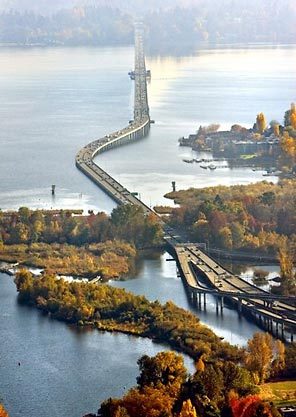
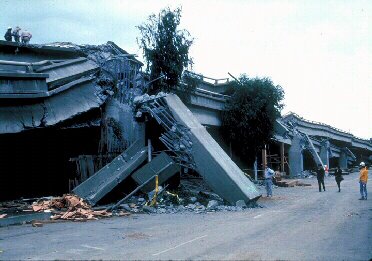
The future of the aging 520 bridge has been a hot topic in Olympia this session, after Gov. Chris Gregoire threw her support behind tolls as a means to pay for half of the $4 billion project. The 44-year-old bridge is in danger of sustaining significant damage, including collapse, during severe weather.

Washington has a long history of fee-free roadways, but voter rejection of a sales tax increase to bankroll the 520 project last year has led to consideration of tolls.

Tolls were collected on the existing 520 bridge after it was built, then phased out after the construction costs were paid. Democrats and Gregoire want to toll the current bridge again, to pay for construction of a new one.

Current designs supported by Democrats call for six total lanes, with four general purpose lanes, along with two HOV lanes. Democrats also want the new bridge to have the capacity for light rail.

"We are locking ourselves into building a bridge that's too small," said Deputy Minority Leader Doug Ericksen, R-Ferndale. "We'll only build six total lanes, it doesn't leave room for expansion."

Ericksen, the GOP's point man on transportation, said Democrats might be supporting an undersized bridge because they want to force drivers out of their cars and into public transportation.

Most of Friday's complaints from Republicans centered on the expected construction timeline. The current goal is 2018, but Republicans want a bridge by 2013.

House Transportation Committee Chairwoman Judy Clibborn, D-Mercer Island, said Republicans missed the mark in their requests. The main cause of the delays, Clibborn said, has been debate over the design plans, which include a tunnel option.

"Some of the amendments we were rejecting were saying, 'Go in and force what you want down the throats of neighborhoods.' And it just doesn't fit well with what we're doing," Clibborn said.

Earlier in the session, the House approved the use of tolls by the state, the first step in the process of installing tolls on Washington roadways. Lawmakers have indicated that 520 might not be the only project that will be paid for with tolls.

Tolls to be abused as a weapon to fight Global Warming?

Seattle Times Olympia bureau Andrew Gerber

OLYMPIA — Two global-warming bills likely to pass the Legislature this session could open the door to tolls on major highways in the central Puget Sound region as a way to reduce traffic and greenhouse-gas emissions.

Environmental groups consider the bills critical to a larger effort to get people out of their cars and into public transportation. Transportation accounts for almost half of the state's greenhouse-gas emissions.

House Bill 2815 requires the state to sharply reduce greenhouse gases between now and 2050. It also calls for slashing the number of miles traveled by vehicles in the state by half in the same time period.

The second bill, House Bill 1773, says tolls should be used to reduce greenhouse gases. It would allow tolls to become permanent and to vary in price based on the time of day.

Both bills passed the House and are in the Senate. They're expected to become law.

Any widespread tolling strategy would likely face strong political opposition and wouldn't happen any time soon.

But environmental groups backing the measures ultimately want the region to use tolls to discourage travel by car, especially during peak travel times. The tolls also could raise billions of dollars to maintain highways and bulk up public transit as an alternative way to travel.

Such a strategy is often referred to as congestion pricing or variable tolling.

A study done last year found the state could raise up to $36 billion over 20 years by charging variable tolls on major highways from Lakewood, Pierce County, north to Everett and as far east as Issaquah.

"Congestion pricing is a key piece of the puzzle," along with increased public transportation and more walkable communities, said Jessyn Farrell, executive director of the Transportation Choices Coalition, which backs the legislation.

Such a tolling system would provide "a guaranteed commute where right now you're stuck in traffic," Farrell said.

State officials shy away from saying Washington is headed toward widespread tolling.

"I don't know what will happen in the future," said House Transportation Committee Chairwoman Judy Clibborn. "I don't think people are ready to get out of their cars yet."

Tolls likely unavoidable

Yet Clibborn acknowledges the legislation could set the stage for a variable tolling system years from now. And most legislative leaders say tolls of some sort are a given.

Already, drivers pay to cross the new Tacoma Narrows Bridge, and Gov. Christine Gregoire has called for adding tolls on the Highway 520 bridge as early as next year to help pay to replace the existing span.

There's also talk of tolls on the Interstate 90 bridge across Lake Washington. And on Highway 167, from Auburn to Renton, the state plans to let solo drivers pay a toll to use the car-pool lanes starting this spring.

Environmentalists see these initial projects as a way to get the public used to the idea of paying to use the roads.

"My hope is that once we try these pilot projects on Highway 167 and the 520 Bridge, people will really see they're getting an added benefit," Farrell said. "I could see this conversation growing exponentially within the next five years."

Clibborn, though, promises the state will move slowly when it comes to additional highway tolls. "If we bite off too big of a bite, we choke," she said.

Given that transportation is the single largest producer of carbon dioxide in Washington, environmentalists say it makes sense to move toward a tolling system that takes cars off the road.

Tolls also would provide the state a new source of money. The growth of state gas-tax revenue is slowing, and, as vehicles become more fuel-efficient, officials predict tax collections won't keep up with the cost of maintaining and improving the transportation system.

"My perspective is that you're going to have to do these tolls because it's the only way you're going to generate [the money] to do the transportation-system improvements you need," said Mark Hallenbeck, director of the Washington State Transportation Center at the University of Washington.

A study done last year by researchers at the University of Washington and the Virginia-based Booz Allen Hamilton consulting firm recommended the state adopt a tolling system that charges people to travel on all the major highways in the central Puget Sound area.

The study, paid for by King County, envisions using electronic sensors to detect cars equipped with transponders as they enter and exit the highways. Traveling longer distances and during heavy commute times would cost more. The fee would be automatically deducted from prepaid accounts.

Options will be studied

Backers of variable tolling argue that, in fairness, much of the money generated from tolling should be used to dramatically improve public transportation. That way, people who can't afford the tolls or don't want to pay them can avoid it by using public transportation.

Buses could be brought online quickly, they contend, followed by high-capacity transit systems such as light rail. Hallenbeck and others say money would also need to go to maintain and expand the existing highway system.

Still, it's not clear that variable tolling could ever overcome political opposition in the state.

State Ecology Secretary Jay Manning stresses that it's one of several options that will be studied by experts.

He notes that cleaner technology, such as plug-in hybrid cars, will help reduce greenhouse-gas emissions in the years ahead.

But he also said, "All the experts I talk to say it's not going to be enough to change the fleet out and have cleaner cars. We're also going to have to reduce vehicle miles traveled, and that's changing behavior. That's not easy to do."

The same bill that would allow using tolls to reduce greenhouse gases also would require state lawmakers to approve any toll proposals.

Recent history suggests that would be a tough sale.

Two bills introduced this year would have tried to link new fees to the amount of carbon dioxide a vehicle spews out. The bills had no chance of passing and didn't even get a hearing.

Yet irate voters swamped lawmakers with so many critical e-mails that Senate Transportation Committee Chairwoman Mary Margaret Haugen sent out a news release saying, "I've never had so many people asking me to kill a bill that's already dead."

Sen. Jerome Delvin, R-Richland, the Senate Republican's point person on global warming, says he's against any attempt to push people out of their cars.

"Their goal goes back to taking our choices away as consumers and forcing what they perceive as the way things ought to run and work in our society," he said.

But even Rep. Clibborn, who's very cautious about any talk of widespread tolling, thinks the state ultimately will move to a system that charges people based on how many miles they travel. Tolling could be the first step, she said.

Such a system will only happen incrementally — or not at all, Clibborn vowed.

"I think people are ahead of us on tolling. I think people are ahead of us on global warming," she said. "But we can easily step on the toes of that good message if we're not careful on how we go forward."

Andrew Garber: 360-236-8268

or agarber@seattletimes.com

Thursday, February 28, 2008

Public will balk at paying tolls on I-90 to pay for 520

Adding tolls to pay for bridge would take a toll on the public

By Jim Horn

Special to The Times

Months after the region's voters rejected a joint roads-transit measure that included part of the funding needed to replace the Highway 520 Bridge, Gov. Christine Gregoire is trying to persuade the Legislature to try a different funding approach to replacing it.

While it's good to see the governor show some belated leadership on this important transportation need, her proposal contains a major flaw and should be rejected by legislators. The flaw in her plan is tolling the Interstate 90 Floating Bridge to help pay for a future 520 Bridge.

I believe the public will reluctantly accept tolls for new infrastructure that adds capacity across water. But the public is not willing to accept tolls over existing roadways built with their taxes, be they over water or land!

To get public acceptance, one must first talk about how tolls are going to be protected — before talking about what the tolls are.

A recent Washington Policy Center poll showed that 81 percent of voters think tolls should only be used for road and highway projects, not for other governmental needs. How will that be ensured?

On what exactly will the money be spent? According to the poll, 70 percent of voters say traffic congestion is the problem. The public expects toll money to be spent on new infrastructure that adds capacity needed to reduce congestion.

One should remember a bit of history: Many years ago, a toll was proposed to pay for added capacity and improved safety on Highway 18. Tolling an existing highway caused such an uproar from communities depending on Highway 18 that it was eliminated from the proposed-projects list.

I would hope that we don't make the same mistake by trying to impose tolling on existing highways, namely I-90. Otherwise, we risk seeing replacement of the aging 520 Bridge take another major step backward, costing us years in the process.

Some people argue that if you put a toll on the existing 520 Bridge to pay for a new one, you also have to put a toll on the I-90 Bridge to deter motorists from crowding the free span.

I don't think it's a persuasive argument. I think few drivers would change their preferred driving route across Lake Washington. People living north of Highway 520 wouldn't come further south on Interstate 405 to go west across the I-90 Bridge and then back north on Interstate 5. They'd still go across the 520 Bridge or go around the north end of the lake.

Only that relatively small percentage of Eastside residents who live between the Highway 520 and I-90 corridors would have a choice. If the I-90 Bridge were to become too crowded, some people living south of I-90 may choose to go around the south end of the lake. With the proposed improvements to I-405, some people may choose that route over I-90 anyway.

The I-90 Bridge is different from the 520 Bridge because the former has Mercer Island dividing it into two spans. I-90 is the only way on and off the island. There is no way Islanders would accept tolling on that existing infrastructure.

Since I-90 runs across the continental U.S., tolling may also pick up opposition from Eastern Washington interests that depend on this highway to move their products to markets or ports.

I know the governor is searching for a solution to the challenge of paying for a new 520 Bridge, but her tolling plan, embodied in Senate Bill 6754, isn't fair.

People who depend on the I-90 Bridge shouldn't be forced to pay a costly toll day after day to help fund a new bridge in another corridor. And we certainly shouldn't toll an existing roadway, which would totally run counter to how we have paid for prior highway projects.

Jim Horn is a former Mercer Island mayor and the former chairman of the Senate Highways and Transportation Committee. He represented the 41st Legislative District

The articles are posted solely for educational purposes to raise awareness of transportation issues. I claim no authorship, nor do I profit from this website. Where known, all original authors and/or source publisher have been noted in the post. As this is a knowledge base, rather than a blog, I have reproduced the articles in full to allow for complete reader understanding and allow for comprehensive text searching...see custom google search engine at the top of the page. If you have concerns about the inclusion of a specific article, please email bbdc1@live.com. for a speedy resolution.