SAN FRANCISCO — Microsoft on Thursday plans to introduce a Web-based service for driving directions that incorporates complex software models to help users avoid traffic jams.
The new service’s software technology, called Clearflow, was developed over the last five years by a group of artificial-intelligence researchers at the company’s Microsoft Research laboratories. It is an ambitious attempt to apply machine-learning techniques to the problem of traffic congestion. The system is intended to reflect the complex traffic interactions that occur as traffic backs up on freeways and spills over onto city streets.
The Clearflow system will be freely available as part of the company’s Live.com site (maps.live.com) for 72 cities in the United States. Microsoft says it will give drivers alternative route information that is more accurate and attuned to current traffic patterns on both freeways and side streets.
A system for driving directions that Microsoft introduced last fall was limited, because without Clearflow there was no information available about traffic conditions on city streets adjacent to the highways. Because the system assumed that those routes would be clear, drivers were on occasion sent into areas that were more congested than the freeways.
The new service will on occasion plan routes that might not be intuitive to a driver. For example, in some cases Clearflow will compute that a trip will be faster if a driver stays on a crowded highway, rather than taking a detour, because side streets are even more backed up by cars that have fled the original traffic jam.
The new service is part of Microsoft’s efforts to catch up with Google, the dominant search engine provider, by offering an attractive array of related services surrounding its Live search service.
Traffic updates have recently become a standard feature offered by the major Web portals as well as a number of specialized services that send the information to cars or to smartphones and other portable devices.
Greg Sterling, an Internet analyst at Sterling Market Intelligence in San Francisco, said there was consumer demand for traffic information, especially among mobile users. The challenge, he said, will be to demonstrate the improvement the company is claiming.
“This is a sophisticated layer of technology that will not be easily understood by the average person,” he said.
The project began in 2003 when Eric Horvitz, an artificial-intelligence researcher at Microsoft, found himself stuck on the freeway while looking for a new restaurant in Seattle. Thinking that he might avoid the traffic jam, he instructed the navigation device in his car to route him via side streets. The result was a nightmare.
“It was awful,” he said. “Everything seemed to be backed up.”
That set Mr. Horvitz, who is the current president of the Association for the Advancement of Artificial Intelligence, to pondering the problem.
“It hit me that we had to do all the side streets,” he said. “We really needed to understand the whole city.”
The Microsoft researchers began trying to do just that by building software algorithms that modeled traffic behavior and collecting trip data from Microsoft employees who volunteered to carry G.P.S. units in their cars.
In the end they were able to build a model for predicting traffic based on four years of data and 16,500 discrete trips covering over 125,000 miles. The system effectively created individual “personalities” for over 819,000 road segments in the Seattle region.
After creating the Clearflow simulation for Seattle, the Microsoft researchers were able to transfer the model by using the algorithms they had developed and then applying them to other cities. The city models are combined with live traffic data generated by networks of highway sensors to create about 60 million road segments, allowing the system to predict congestion based on time of day, weather and other variables like sporting events.
“I consider this to be the moon mission of our machine-learning research,” Mr. Horvitz said. “I’m still buzzing with the glow that this is actually possible.”
Transportation
Friday, April 11, 2008
Microsoft builds software to help avoid traffic congestion


Thursday, March 13, 2008
Using the Eastside as Hi-tech Guinea Pig
Make Eastside a proving ground for innovative transportation ideas
Special to The Times
By some measures, traffic congestion is worse on the east side of Lake Washington than in Seattle itself, with hourlong commutes to Bellevue from Everett and Auburn becoming common. Striking growth, led by some of the world's most innovative companies, has transformed Eastside suburbs into a dynamic new metropolitan core, apart from Seattle and with its own transportation challenges.
Harnessing that entrepreneurial spirit to cut the Gordian knot of regional transportation politics and traffic bottlenecks will require joint public and private funding, new technology and better decision-making. As Sound Transit is seeking new ideas through a major community-survey effort, the region should recognize that the vibrant Eastside crescent is a good place to test some key transportation solutions.
The Puget Sound Regional Council is working to help better coordinate signalized intersections; there are 2,300-plus in our four counties. Greater synchronization, where signals actually talk to each other, could significantly cut congestion. Related strategies use real-time traffic information to alter electronic roadway signs, signals and even lane configurations, maximizing capacity. Applying developer contributions to higher-tech traffic operations is a natural under the state's Growth Management Act. The Eastside is an ideal proving ground.
Then, let's improve the bus experience. On the Eastside, crucial suburb-to-suburb transit remains a challenge even after the 2006 Metro measure added new express bus routes. Microsoft's private Connector buses with their reservation system, Wi-Fi and that magical morning-commute invention, the cupholder, are the gold standard. Other Eastside companies could copy this approach, utilizing grants from the state's Trip Reduction Performance Program and, eventually, carbon-tax credits.
The Eastside is also prime territory to jazz up the dead zones we call park-and-ride lots. They're transformable into high-tech hubs with joint housing, retail services, plug-in electric vehicle stations, technology-office clusters and many transportation choices. One could be a new idea called flexible carpooling, pioneered by a New Zealand entrepreneur named Paul Minett now seeking regional business and political support. Prescreened drivers and commuters pair up in designated park-and-ride areas for trips to different employment clusters, under a market-based credit and debit system. Missed your car pool? Catch the next one!
The abandoned BNSF rail corridor from Snohomish to Redmond and Renton offers a potential 42-mile rail and trail combo that, with track rehabilitation, could feature quiet, high-tech, double-decked, biodiesel-burning, bike-carrying, north-south trains to connect to east-west express bus lines on Highways 522 and 520, and Interstate 90. Private sector cost-sharing is distinctly possible. One example: At the nexus of the rail line, Highway 520 and Interstate 405, where an old Safeway distribution center stands, Wright Runstad is proposing a 36-acre office and housing development (the Spring District). The company could share costs for the trail and a commuter rail station complex.
At stops in Bellevue and South Kirkland, why not add a remote airport clearance station for future transit connections to Sea-Tac Airport that are actually convenient for Eastsiders, as suggested by Port of Seattle Commissioner Bill Bryant? Utilizing commuter rail that could eventually go as far as Renton, and then a speedy connecting bus, you could first check your bags and then go through all the plane preboarding paces with no stinting on security. Upon arrival at the airport, you'd go straight to your gate.
What about state highway projects from Snohomish County to Pierce County that were only partially funded with recent gas-tax hikes? We should use current state transportation-benefit-district legislation as an umbrella to leverage private funding with new public funding in the three-county area.
The centerpiece could be the I-405/Highway 167 corridor from Lynnwood to the Port of Tacoma. Convert the I-405 HOV lanes into time-variable, electronically tolled high-occupancy/toll (HOT) lanes. (High-occupancy cars, van pools and employer-sponsored and public transit would travel free, while solo drivers would pay a toll.) Then add another HOT lane in each direction on I-405 and on Highway 167, where one will open on each side of the King County stretch this spring under a state pilot program.
You'd then have at least two managed lanes and two general lanes, each way, for the entire corridor. This would include the unfunded 11-mile extension to the Port of Tacoma.
Tolls for the HOT lanes would retire the construction debt and pay for the operations of the expanded corridor, including additional express buses.
To add to the regional roads and transit funding pool, implement more HOT lanes and also bring in public employee or building-trade-union pension funds as investors, while maintaining public control of the assets, and tolls or fares.
Eastside suburbs already becoming an economic powerhouse can transform surface transportation by helping the broader region transcend boundaries, harness technology and private initiative, and prioritize completion of the best projects, sooner rather than later. Let's seize the opportunity to innovate. Our region's future depends on it.
Tuesday, March 11, 2008
Microsoft launches its own hi-tech Bus Rapid Transit service

9/7/07
Microsoft giving workers free ride -- with its own bus service
Wi-Fi-enabled system will debut this month
Windows, Office, Xbox, Zune -- and now, a regional bus system.
That's the surprise addition Microsoft Corp. made to its portfolio Thursday, announcing its own bus service -- complete with on-board wireless Internet access -- to shuttle its employees from their neighborhoods around the region to Redmond and back home again.
The 14-bus Microsoft "Connector" system, to debut later this month, was announced as the company unveiled plans to open new offices in Seattle's South Lake Union and Pioneer Square neighborhoods.
At launch, the bus system will handle no more than 1,000 employees a day. That's only a slice of Microsoft's more than 35,000 employees in the region.
But the fact that Microsoft would find it necessary to take such a step added new fuel to the debate over comprehensive regional transportation reform.
 | ||
"This is something that the county bus system should be doing and they're not," said Stephen Gerritson, executive director for Commuter Challenge, a Seattle non-profit. "To some extent, Metro is dropping the ball here."
Even as bus systems struggle to add routes and companies expand their van pools, the regional transportation system is maxed out, said state Sen. Ed Murray, D-Seattle.
The region faces two major obstacles, said Murray, vice chairman of the Senate transportation committee. First: "Our population has grown so much and our employment base has grown so much that our transit system has not kept up with it."
Second: Roads and bridges are failing and aging, he said.
Microsoft drew praise from commuter groups Thursday.
"It is a great corporate decision to take a look at where the transportation system isn't meeting the needs of your commuters and fill in the gaps," said John Resha, general manager of the Urban Mobility Group, a partnership between King County, the city of Seattle and the Downtown Seattle Association. "The system we've got can't evolve quickly enough."
Will it catch on?
Microsoft isn't the first company to offer free bus service to its employees. Google offers about 150 bus runs daily across the San Francisco Bay Area, to and from its Mountain View, Calif., campus, spokeswoman Sunny Gettinger said.
"Part of the reason that we do it is because we really want people to have the opportunity to be able to work at Google in Mountain View and not feel like they're contributing to environmental issues by commuting," she said.
Gettinger, who uses the Google bus service, said it can end up being another place for employees to meet face-to-face. She has been able to resolve work-related issues just by running into the right person on the bus. Google has offices in Seattle and Kirkland but doesn't offer bus service in the Seattle area.
"I hope it will catch on. It's a fantastic idea. (Microsoft is) taking personal responsibility for the traffic that their company is generating," said Elaine Somers, a Seattle environmental protection specialist with the Environmental Protection Agency.
But others said that Microsoft probably will remain among the very few.
"This is not cheap what they're doing," said Kevin Desmond, general manager at King County Metro Transit. "Microsoft employees enjoy good benefits that many employers would give their right arm to be able to provide."
Brad Smith, Microsoft's general counsel, acknowledged it is expensive but declined to say how much the company is spending.
The pilot program will include 14 buses, including seven large coaches with bike storage, and electrical outlets at each seat, in addition to Wi-Fi. Seven midsize coaches will be used for neighborhood pickups. There will be multiple runs in the morning and afternoon, Smith said.
Running one bus for one hour costs the Metro system about $110, which includes the driver, mechanic and fuel, Desmond said. At that rate, it would cost $9,240 per day to run 14 buses for six hours, or $2.4 million per year, not including weekends, the cost of new buses or Wi-Fi service.
Transit reform
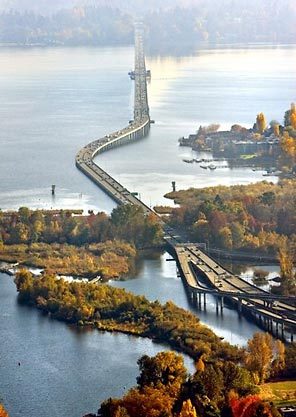
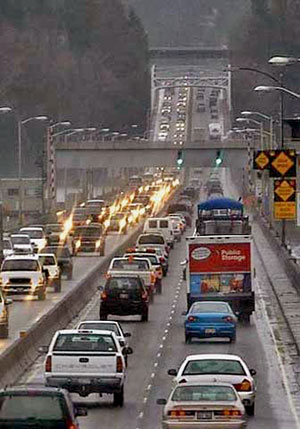
Smith took the opportunity to voice the company's support for Proposition 1, the road and transit package on the November ballot. Microsoft's rapid growth has contributed significantly to clogged roadways, particularly on such arteries as the Evergreen Point Bridge.
He noted that the bus system builds on the company's existing efforts with bus passes for employees, car pooling, hybrid cross-campus shuttles and other initiatives.
"Microsoft has many short-term solutions, like the Connector, for transportation issues that our employees face," Smith said. "But our region needs a long-term solution for the transportation bottleneck that the entire region faces."
Under a 1991 Washington state law, employers with more than 100 workers are required to provide some sort of transportation program and must encourage alternatives to one-person cars.
The state offers tax incentives to businesses that provide ride sharing and public-transportation passes.
King County Metro works with hundreds of companies, said Desmond, who applauded Microsoft's system. For example, in a couple of weeks, Metro will beef up bus service to Children's Hospital and Regional Medical Center -- an option partially funded by the hospital. Also, most of its monthly passes are sold through employers, who then give them to employees as benefits.
Microsoft worked with King County Metro Transit and Sound Transit on its new idea, Desmond said.
"We talked with them directly about how we route buses to meet their bus needs," he said. "There were elements of some of their route ideas which would have had a competitive nature with us."
Metro also works closely with The Boeing Co., which adds 70,000 commuters here each day. "We share data with Metro and Snohomish County," said John Hendricks, who manages commuting issues for Boeing nationally. "We run demographic data on where people live and what time they start to try to build better routes."
Boeing employees are avid users of van pools, though that system is suffering from a shortage of vehicles, Hendricks said. But the company would not consider a private bus system because of liability and the varying needs of employees, he said.
Employee needs
Besides reducing traffic congestion and minimizing air pollution, keeping employees out of bumper-to-bumper traffic also keeps them happy.
Microsoft's bus system coincides with a broader effort, spearheaded by human resources chief Lisa Brummel, to better recruit and retain employees amid stiff competition for talent against Google and others.
Smith said the idea for the bus system grew out of employee suggestions in response to an internal blog maintained by Chris Owens, Microsoft's general manager of real estate and facilities.
The wireless routers to be used for Internet access in the Microsoft buses are manufactured by Seattle-based Junxion Inc. They receive Internet signals through cellular data networks. They're also used by companies including Google and Yahoo and transit agencies such as King County Metro.
Microsoft employees will be able to reserve seats and track buses online.
"If demand grows, we'll listen to our employees -- they're really the ones who came up with this idea -- and we'll invest more," Smith said.