All 3 parts first published at Crosscut.com
The recent former state secretary of transportation has been riding buses a lot lately and crunching numbers, and he's convinced light rail to the Eastside and more Sounder service has no place in a big new transit plan. He thinks an advanced bus rapid transit system is the best way to serve millions of people and smartly manage urban growth. Part 1 of 3
By Douglas MacDonald
June 22, 2008.
First of three parts
Part 1 Ridership today and the suggested Sound Transit sales tax increase.
Part 2: Real riders speak, and Sound Transit's model isn't what they want to buy.
Part 3: The must-do agenda for transit and smart growth.
As memories fade of last November's failed and little-lamented Proposition 1, Sound Transit's board of directors now struggles with when to bring a big new transportation funding package - mostly rail, no roads, all Sound Transit — back to a regional ballot.
Which is the better time to let voters slam-dunk a big new sales tax boost for Sound Transit's vision?
Should it be in 2008, when a young and progressive presidential election turnout would vote green for rail transit?
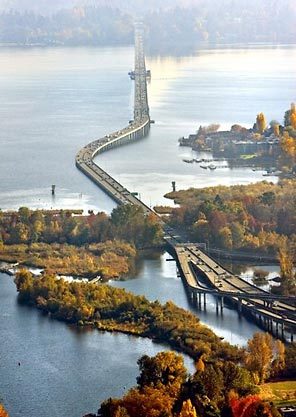
Or in 2010, when taxpayer wallets will be looser with the economy back to full throttle? By then, light rail cars shuttling between downtown Seattle and Seattle-Tacoma International Airport could even warm the doubters to the main attraction of Sound Transit's plan: light rail to Bellevue, taking two existing vehicle lanes off the Interstate 90 floating bridge.
Or is there a third choice - the best - now not even being considered at Sound Transit? A different, stronger, broader transit plan, to be acted on as quickly as possible, costing less and doing more, and much sooner, to meet our region's pressing needs?
Sound Transit's staff and board profess great faith in "public outreach" to gauge sentiment and aid a decision. Never mind skeptical reviews of past survey methods and universally cautionary advice from regional writers (plus #, #, #, and #). Now, according to King County Council member and Sound Transit board member Julia Patterson, the agency should hear from people "who don't come to meetings."
I don't go to meetings now, but I used to. As the state's secretary of transportation and a member of the Sound Transit board of directors for six years, I voted with enthusiasm for the light rail segments soon to provide welcome benefits from the airport in and out of Seattle and to Husky Stadium and, perhaps someday, along Interstate 5 to Northgate.
Now I live in Seattle. I can't drive because of poor eyesight. So almost every day I ride the Metro Transit and Sound Transit buses with the rest of the regulars, learning and thinking at first-hand about our transit systems. I've gained new insights about the connected questions of energy scarcity, population growth, fairness to taxpayers, strengthening of neighborhoods, and protection in the Puget Sound area of water quality, the regional landscape, and natural habitat against sprawl and climate change.
I believe that big choices perhaps soon headed for the ballot about the next steps for transit must be examined with a vigorous, evidence-based progressive critique of where we should be going, and why. How does our regional transit system actually work? How can it work better and offer more in the future? With so much at stake, we had better get it right. There will be no cheap do-overs.
The overwhelming case for transit expansion
The public should certainly care. The case for transit system improvements could hardly be stronger. Family budgets are hemorrhaging from relentless gas-price increases. Deep anxiety feeds on the worldwide drumbeat that oil production has about peaked so that, unlike the last oil crisis, new supply won't ease the pressure on prices. Time now for a Prius? The trade-in value of the gas hog in the driveway has sunk like a rock. Federal statistics show that miles driven by vehicles in Washington have dropped 5 percent or more from a year ago, a huge shift over so short a period.
A sea change is at hand for transit and the public it serves. Over the past year, it's become standing-room-only on key buses for ordinary riders. Every transit system is reporting unprecedented ridership increases.
Regular people in big numbers suddenly are realizing they actually need transit - a very powerful idea when it takes root outside the hothouse environment of transit's familiar supporters.
Catching the news hook of the first annual National Train Day, Sound Transit's own surging ridership was touted in a breathless press release.
The new statistics — Sound Transit's and others' — are trustworthy tallies of who transit's new riders will be, where they will be going, and what they will need in services.
They speak on behalf of regular busy people almost never heard at Sound Transit's meetings.
They make the case for a dramatic change in the pace, direction, and goals of transit's program for our region. They certainly should unsettle Sound Transit.
But before turning to these real-world polling results, let's set the context. That involves the entire picture of transit in the region, not just Sound Transit, the newest kid on the block.
The size and growth of transit ridership in the region
The Seattle metropolitan area is a pretty strong transit market, as these things go late in the golden age of the gasoline-powered private car. People here take transit for a higher proportion of journey-to-work trips than in any but just a handful of other metropolitan areas in the country — New York, Washington, D.C., San Francisco, Chicago, Boston, Philadelphia, and Pittsburgh:
* King County Metro serves more than 150 transit routes in Seattle and the suburbs, including many high-density arterial commuter routes. Metro now logs about 380,000 daily boardings.
* Pierce Transit, with about 45 local, inter-city, commuter, and express routes, now stands at about 50,000 daily boardings.
* Community Transit in Snohomish County has 64 routes, including commuter routes to Seattle's University District, Bellevue, and downtown Seattle, as well as Everett and the Boeing plant there. Community Transit now stands at about 38,000 daily boardings.
* Sound Transit, the multi-municipality entity serving all three counties, has express bus routes on regional freeways and the HOV network and two rail lines operated on BNSF Railway tracks. In the first quarter of 2008, Sound Transit averaged 50,000 daily boardings.
* Then there's Everett Transit, with perhaps 9,000 daily boardings, and Washington State Ferries, with about 13,000 daily boardings of foot commuters across Colman Dock in downtown Seattle.
In round numbers, that puts transit boardings across the region at roughly 540,000 every day. Sound Transit accounts for just nine percent of the total. Altogether, the systems have gained about 37,000 new daily boardings compared to a year ago. Sound Transit has produced a little less than a fifth of the overall growth, combining a nice bump on the express buses with another noteworthy chunk from expanding the number of trains on the Sounder south commuter rail runs.
None of this is to mention 20,000 or so daily vanpool passengers, a potent market for transit growth, up 8 percent over the previous year, and thousands of trips on paratransit for disabled or elderly riders. Sound Transit operates no vanpools and no paratransit.
Paying for regional transit and supporting explosive growth
How is all this growing transit use paid for? Partly from fares, although no part of the overall system covers costs from fares. The rest largely comes from discrete, voter-approved slices of the 8-plus percent sales tax everybody pays every day:
* For King County Metro, 0.9 percent in the sales tax rate, most recently increased by 0.1 percent by voters in 2006. That was to support the "Transit Now" initiative for 15 percent to 20 percent expansion in service spread over 10 years.
* For Community Transit in Snohomish County, 0.9 percent in the sales tax rate, most recently increased in 2001.
* For Pierce Transit, 0.6 percent in the sales tax rate, most recently increased in 2003.
* For Sound Transit, from a taxing district that covers the most populous parts of all three counties, a further slice of sales tax at the rate of 0.4 percent, over and above the slice already going to each county's transit system. This now raises for Sound Transit about $280 million a year. Plus a tax on rental car fees (raising about $2.5 million a year), and a 0.3 percent motor vehicle excise tax (MVET) that hits the average household about $70 a year and raises about $72 million a year for Sound Transit.
The suggested Sound Transit sales tax increase
The debate at Sound Transit is about asking voters to approve another 0.4 percent in the sales tax, doubling the 0.4 percent it already receives. (We will ignore here an even more bullish plan to ask for a 0.5 percent increase!)
If approved, this would amount to a 30 percent increase in funding from the sales tax for the combined purposes of Sound Transit, Metro, and Community Transit in King and Snohomish counties, and a 40 percent increase over the combined level for Sound Transit and Pierce Transit in Pierce County. In areas within King County and Snohomish County that are also in the Sound Transit taxing district, the new sales tax rate for everyone would be 9.3 percent, and for those areas overlapped with the Sound Transit taxing district in Pierce County, it would be 9.2 percent.
Sound Transit's expensive tax increase would be spent almost entirely on the limited routes and services it sponsors, so here's the big question: When could we ever expect more funding for the 90 percent of the system virtually exploding with double-digit ridership increases today that is not part of Sound Transit?
Struggling to digest the big Sound Transit swallow, would public appetite in the era of unaffordable gas prices recover in time to take up the much larger needs of the system as a whole?
The single-vision Sound Transit directors and staff haven't raised this question in their own discussions or in their ongoing "public outreach" publicity blitz.
Riders, potential riders, all elected officials, and taxpayers should care about the big picture, even if Sound Transit apparently doesn't.
Sound Transit's plans for all the new money
What exactly does Sound Transit propose to do with a river of new money from the sales tax — flowing to the board of directors for decades, generating cash and funding years of debt repayment and interest expenses on big new issues of long-term bonds?
The answer is: spend billions of dollars for capital projects for a limited piece of the transit system, save but a few hundred million over the years to support some of future operating costs.
Sound Transit knows exactly what new projects it would build. And when it would hope to complete them.
Don't hold your breath to see new transportation services from these projects anytime soon. Most of the new projects would not go into service until 2020, when today's four-county regional population is expected to have grown by an additional half million people, from today's 3.6 million.
Nevertheless, some of those eventual projects certainly will be big - in dollar cost, anyway!
Sound Transit chooses to guess at the project expenditures as if they were to be made at 2007 construction prices. They won't be, of course. Nobody knows how much inflation will drive up the costs from last year's prices until the projects are built years from now. But if they could be built at 2007 prices, Sound Transit estimates they would cost more than $6 billion.
At the same time, they will - in terms of contributing to regional transit needs — also be very small.
Here's the nutshell summary:
Two-thirds of the $6 billion that will really be much more by the time the serious spending comes would be spent on adding a few new miles of light rail.
Sound Transit has already funded and is now building — or is about to start building — initial light rail sections from the airport to downtown Seattle (in service next year, it hopes) and Husky Stadium (year 2016, it hopes). It wants to extend those sections. South 2.0 miles to South 200th Street (year 2020) and north 4.3 miles to Northgate (also year 2020). Cost of these 6.3 miles of extension at 2007 prices would be about $2 billion, eating up a third of the $6 billion for new capital projects.
What would be the gain in ridership if these extensions were built compared to if they were not? If they were not built, ridership on light rail, according to Sound Transit, would be 42,000 daily boardings by 2020, growing to 120,000 by 2030. Sound Transit does not give a precise breakdown if the extensions were built, but it looks as if the overall gain would be in the area of 50,000 to 60,000, with the first of the extension passengers served not until 2020 and the full gain not achieved until 2030, 22 years from now.
Another huge slug for light rail — about $2.1 billion worth at 2007 prices — would be spent extending light rail about 12 miles from Seattle across the I-90 floating bridge to Mercer Island, downtown Bellevue, and Overlake [PDF]. The cost estimate for this is probably especially shaky, because it rests on the assumption that Bellevue residents and businesses will be content on not insisting that expensive tunnels get the line through town. Anyway, perhaps at some uncertain later date, if even more taxes could be raised, a further extension could be made all the way to downtown Redmond.
If the piece just to Overlake were in place, Sound Transit appears to think that line's ridership might grow from the first new rider in 2020 eventually to daily boardings of 45,000 or so by 2030, 22 years from now.
However, the environmental impact statement for light rail to the Eastside suburbs won't be ready until fall of this year, and details of ridership, costs, and impacts still are being studied. That hasn't slowed down the Sound Transit board's ability to ask the public about the project. And it looks like it might not slow down the Sound Transit board in deciding it's the right way to go. That's an unconventional and questionable course. The principle is that agencies are supposed to put the environmental impact statement in the hands of citizens and decision makers before big decisions are made! That's why we prepare environmental impact statements, not just to justify what government officials have already decided.
Altogether, for spending about $4.1 billion in today's dollars (more because of inflation to the time the projects are actually built), bright ribbons of light rail would serve two corridors in King County only and would eventually accommodate by 2030 a total of perhaps 100,000 daily boardings more than would be the case if none of the proposed light rail extensions in the new plan were made at all.
Reaching that gain in ridership 22 years from now represents the equivalent of growing today's regional transit boardings of almost 540,000 by less than a fifth. That's the equal of growing today's ridership at an annual compound rate of growth of just under 0.8 percent. Of course, if you think about it, even that is a big overstatement, because lots of those so-called new riders are already on the buses to be replaced by the light rail lines, so they really aren't new riders to transit at all!
So much for two-thirds of the $6 billion in project spending.
That leaves about a third for other projects.
Foremost would be for the Sounder commuter rail program. Sound Transit loves its Sounder trains from Tacoma through Puyallup and the Kent Valley to Seattle. Last year it started with eight trains a day and grew the service by 50 percent to 12 trains a day. Buoyed by free parking at the stations and a heavily subsidized fare, ridership responded with a slightly-less-than-commensurate 29 percent year-over-year increase, adding about 1,900 daily boardings.
In the new plan, if it can overcome a pesky caveat ("subject to negotiation with BNSF Railway," which owns the tracks), Sound Transit would add more new trains and make expensive station, parking, and track improvements for a total cost of about $1 billion. (A bit would go for station improvements at Edmonds and Broad Street for the under-performing Sounder north service from Everett.)
The two Sounder lines last quarter registered about 9,300 daily boardings, a 1.7 percent share of overall regional transit ridership.
Without the new investment, Sound Transit says its current Sounder ridership would grow anyway by 2030 to 19,000 daily boardings. If the billion-dollar additional investment were made, the incremental ridership expected by 2030 would be an additional 8,000 daily boardings. That billion-dollar increment would be equal, 22 years from now, to adding about 1.5 percent of today's overall regional transit ridership.
Lastly, the express bus system. The rest of the $6 billion, nearly a billion dollars worth of projects at 2007 prices, would be spent on Sound Transit's regional bus system. Or what would be left of it. Sound Transit bills this as an ST Express System Expansion with the outcome of "boosting service on key corridors by 10-15 percent."
The key word here is "key." Sound Transit doesn't say exactly what should be expected. Don't assume or expect too much!
Some access and park-and-ride improvements would be made in Snohomish County, and $150 million would be earmarked for a new transit center when the Highway 520 replacement bridge across Lake Washington is built. Several other modest projects around the region are suggested, including some improvements for a few miles of arterials on which a couple of routes would operate, and, figuratively speaking, a few dollars are actually designated for buying some new buses.
Without this investment of nearly a billion dollars, Sound Transit tells us that by 2030 its regional express bus routes will board 52,000 passengers a day. That's about what just Pierce Transit alone boards today. With the billion-dollar investment, Sound Transit estimates express bus boardings by 2030 would grow by an additional 6,000.
That's a little more than what just Pierce Transit alone added in new ridership since last year. King County Metro, already reaping new riders from service improvements it began within months of its 0.1 percent sales tax increase through "Transit Now," has added 21,500 daily boardings since last year, more than three times the ridership dividend Sound Transit expects to achieve 22 years from now on its express bus services.
"Time to decide on expanding mass transit," says Sound Transit's "Sound Off on System Expansion" Web page and its ubiquitous advertising campaign.
Maybe there's something else to decide first.
Are Sound Transit's proposals to spend billions of dollars more for a drop in the bucket of new ridership years from now for the region's transit network fairly called a " mass transit" plan at all?
Transit train wreck: Revealing bus-route ridership
We've got buses going everywhere, and guess which routes are logging the biggest increases in ridership? Not the route that would become light rail to the Eastside suburbs. Part 2 of 3
By Douglas MacDonald
June 23, 2008.
Second of three parts
Part 1: Ridership today and the suggested Sound Transit sales tax increase.
Part 2: Real riders speak, and Sound Transit's model isn't what they want to buy.
Part 3: The must-do agenda for transit and smart growth.
Sound Transit wants to hear from people about a plan for a 30 percent to 40 percent (depending on where you live) increase in the sales tax slice devoted to transit. The plan would put billions of dollars into the lap of the board of directors to spend on capital projects for Sound Transit's 10 percent share of the region's transit service. The big investments would be 18 miles of light rail extensions, serving just a few communities, and station improvements and beefed up frequency on the Sounder commuter rail train through Puyallup, Sumner, Auburn, Kent, and Tukwila, from Tacoma to Seattle.
Riders could first use the big projects in 2020. Ten years later, by 2030, 22 years from now, the new projects would have produced a gain in daily ridership, according to Sound Transit, equal to about 20 percent of today's daily regional transit ridership, although many of those riders would just be shifting their transit trip to a rail car from a bus.
Meanwhile, the rest of the regional transit system — 90 percent of today's current ridership — operated by King County Metro, Community Transit in Snohomish County, Pierce Transit, Everett Transit, and Washington State Ferries, already with hundreds of thousands of daily boardings, is bursting at the seams with near double-digit annual ridership gains pressed on existing services by gas-price woes to which no end is in sight and, at least for now, traffic congestion.
What's right with this Sound Transit plan?
Not much. Because it would fail to leverage much of Sound Transit's huge proposed tax-funded spending in the markets where transit growth is happening today and where the most important opportunities and needs for transit improvements and growth are presented tomorrow.
The best proof of the plan's failings lies in little-noticed but critically important details of Sound Transit's reports on its own growth spurt in transit ridership. And looking at the evidence from the other parts of the regional system and other places around the country just underscores the flaws in Sound Transit's approach.
The big route connecting Bellevue and Seattle isn't where the riders are
You can start right at the top by laying Sound Transit's own ridership reports against the plan's main event: $2.1 billion in spending to serve Bellevue-Seattle customers (with Mercer Island riders to boot) with a light rail extension between downtown Seattle and Bellevue and Overlake.
This light rail line would replace the Queen Elizabeth II of Sound Transit's regional express bus system, the Route 550 express bus. Today, the 550 makes more than 60 trips each way every day, every few minutes during rush hour. It has been Sound Transit's biggest express bus route, and with travel times just about the same as light rail, it defines the case for Sound Transit's approach of building out an east-west light rail main line. It would connect up with Central Link light rail, which runs north-south, basically paralleling Interstate 5 through downtown Seattle on which construction is moving ahead to a hoped-for mid-2009 opening.
But there's a stark message drowned out in Sound Transit's crowing over an overall 2007 to 2008 jump of 16 percent in overall ridership.
Which Sound Transit express bus route in that period produced growth less than half the rate [PDF] of the Sound Transit system average? Hint: it's the same route that shows lower daily boardings today than in 2001.
Yes, it's Route 550 between Bellevue and Seattle on the I-90 bridge, drifting for years between 5,000 and 6,000 daily boardings and, even with infusion of a few new riders this year, not yet recovering the peak ridership level of 2001.
The riders are flocking instead to stronger transit routes all over the region
It's not hard to contrast that performance with the routes — Sound Transit's own and others — where ridership is surging. They're different.
Take, for example, Route 535, Lynnwood to Bellevue, Sound Transit's top growth performer of any route, rail or bus, with a 31 percent one-year jump in passenger boardings for the first quarter of 2008.
Or Route 554, Issaquah to Seattle via Eastgate: only 35 or so round trips a day, but a 17 percent one year jump in ridership.
Another big winner was Route 545, Redmond-Seattle, operating over the Highway 520 bridge. Last quarter it added twice as many new riders compared to a year ago than Bellevue-Seattle Route 550, at twice the percentage gain (14), and it has now all but overtaken the Bellevue-Seattle Route 550 in total ridership.
Also in contrast to the lackluster Sound Transit Route 550 on the I-90 corridor, where the big light rail line would be, are King County Metro's routes in the Eastside suburbs and connecting them to Seattle. They, too, showed dramatic increases:
* Route 245, Kirkland to Factoria via Overlake. was up 24 percent (December 2007 over December 2006).
* Route 253, Redmond to Seattle via Crossroads, Bellevue, and the 520 transit stops was up 22 percent.
* Route 255, Juanita to Seattle via Kirkland and the 520 transit stops, was up 10 percent.
* Route 271, Issaquah to the University District, was up 12 percent.
Each of these routes gained more riders over the course of a year than did Sound Transit Route 550 back and forth between Bellevue and Seattle across Mercer Island.
It wasn't just nearby routes serving the transit markets on the Eastside that smoked Sound Transit Route 550. Consider Sound Transit Route 522, Woodinville to Seattle, 33 round trips a day along the Lake City Way/Bothell Way corridor. An 11 percent year-to-year increase in daily boardings since 2007.
Or Sound Transit's own express bus service on the I-5 corridor, between Seattle and Tacoma and Lakewood (reported collectively by Sound Transit as Route 590/592/594/595) . That route showed an 18 percent gain in first-quarter ridership. It actually pushed aside Bellevue-Seattle Route 550 at the top of the Sound Transit ranking table, with almost 5,200 boardings a day.
Blue-ribbon honors, though, go to Pierce Transit's Route 1 into and through downtown Tacoma, joining it to Tacoma Community College on one end and Spanaway on the other. More than 60 trips each way daily and over 8,000 daily boardings. Last year, Pierce Transit increased service on this route by four percent and harvested a 12 percent ridership increase, amounting to almost 1,000 additional daily boardings.
Another blue ribbon winner, Metro Route 358 on Aurora Avenue North, most recently reporting more than 9,600 daily boardings. Even that pales before Metro workhorses like Route 48, connecting areas of the city west and south via the University District, and Metro Route 7 connecting Rainier Beach, Rainier Avenue South, and the International District with each other and with downtown Seattle. Both are recording well more than 10,000 daily boardings. These are just a few highlights from many good examples.
Invest in transit where transit works best
What's going on here?
Sound Transit argues for putting most of its transit investment chips on a bet that just a couple of light rail corridors connecting just a few big destinations will be transit's wave of the future. But riders are turning out in droves to use a much richer network of routes with the capacity to crisscross the region in response to today's real-world travel patterns and markets.
Some of those strong routes join centers with each other. Some connect a string of destinations along suburban corridors. Some are urban cross-town routes, like Seattle's busiest ones. Some perform a mixture of these functions, like Pierce Transit's Route 1. Riders are seizing and exploiting the capacity of that rich network of routes. They're not voting for the worn-out flagship Sound Transit Route 550, which the Sound Transit Eastside light rail program would upgrade.
The patterns of the routes that work best are no fluke. They stem from the way the region has grown in recent decades.
The pattern of commuting from the main suburbs to the big city must have seemed immutable more than two decades ago, when Sound Transit's model first gained favor among a faction of transportation planners.
But our region didn't turn out quite they way they expected, either as to where all the people would live or where all the new job locations and other transportation destinations would expand. Bellevue wasn't just going to funnel into Seattle. And Redmond wasn't just going to funnel into Bellevue to get to Seattle.
King County Metro keeps statistics on the growth of boardings in the various communities. Bellevue's boardings last year were up a not-insignificant 10 percent. But the important fact is the shape of that growth as Bellevue's transit needs develop and mature.
Tomorrow's patterns of travel will show how differently the story is developing from what was envisioned years ago when the kinds of plans now engraved in Sound Transit's vision were first made. Puget Sound Regional Council projections now show that by 2030, only 5 percent of journey-to-work trips to Bellevue will come from the west across the I-90 corridor from Seattle and Mercer Island. Bellevue is now its own regional job and employment center, not a satellite of Seattle. Issaquah, Redmond, Sammamish, Factoria, and Renton will be the transit markets to emphasize in and out of Bellevue — not the trip to Seattle, let alone Mercer Island. Interstate 405 will be much bigger in Bellevue's main game than I-90.
Seattle, for its part, last year added about 12,000 daily boardings. Transit grows more important every day, as citizens are demonstrating by getting on the bus to take themselves to every corner of the city. It's Seattle's own neighborhoods and near-in heavily residential suburbs that will most need and can best exploit transit improvements. A segment of riders going back and forth on what once seemed like an all-important transportation spine between the Bellevue Transit Center and downtown Seattle is now the all-important route for hardly anyone.
Meanwhile, the locales in King County that showed the largest percentage jumps in transit daily boardings last year were Issaquah, Bothell, Woodinville, Auburn, Burien, and Kenmore. Issaquah's gain in boardings was 85 percent. Bothell's was 60 percent. Redmond had an 18 percent gain, adding a thousand daily boardings. Transit service across the Highway 520 Bridge is a huge regional transportation need.
The same patterns of developing needs and markets can be seen, for example, in Snohomish County. Community Transit Routes 201/202 [PDF], between the Lynnwood Transit Center and Smokey Point in Arlington through Everett and Marysville, connect communities that are critical to Everett-area everyday travel markets. And Community Transit Route 101 [PDF] in South Snohomish County, connecting Aurora Village in Shoreline along Highway 99 through Edmonds and Lynnwood to the Mariner Park-and-Ride lot in Everett. In Pierce County, we've already seen the importance of Pierce Transit Route 1. Pierce Transit Route 2 connects downtown Tacoma and Tacoma Community College with the Lakewood Transit Center via Bridgeport Way. Ridership is up 11 percent from a year ago. Pierce Transit Route 53 connects Tacoma Mall with Tacoma Community College through University Place. It's a smaller route, but daily boardings jumped in a year by more than 30 percent.
That's a rich spread and variety of routes. Even if every mile of light rail now proposed by Sound Transit were built, the overwhelming majority of transit use in the region will still be provided by buses and the bus network.
This is absolutely clear from the existing data and from the modest scale of Sound Transit's own predictions of future light rail ridership.
Other regions: it's the same story
Other cities' recent experience underscores that the kinds of services bus networks best provide outperform the limitations of light rail corridors, if the goal is to serve as many people as possible.
Denver has built a lot of light rail. Like metropolitan Seattle, it has witnessed a big recent surge in transit ridership. In March 2008, Denver had daily boardings of about 65,000 on the light rail system. Up by a little over 7 percent from a year earlier. Its bus system, on the other hand, had daily boardings of about 215,000. It grew not by 7 percent, like light rail, but by more than 9 percent from a year earlier on a much larger base. The total number of people joining the daily bus boardings was greater than for light rail, and the percentage growth rate was higher, too.
In Portland, in March 2008, the MAX light rail system had daily boardings of 104,000. In Portland, as in Denver, the bus system nevertheless carries a much larger market share than light rail. Daily boardings on the buses in March were 211,000. Transit has not surged quite as much in the Portland area as in Seattle, an interesting fact in its own right. In any case, light rail boardings in March grew by 2.1 percent from a year ago. Bus boardings, on twice as large a base, grew by nearly twice as large a percentage, at 3.75 percent. However attractive Portland's light rail system, a much bigger gain of actual ridership went to the kind of transit network a good bus system provides.
The mismatch of huge investment on cross-lake light rail with the makings of a transformational leap in transit ridership is evident from every angle. Money is scarce and needs are high. We shouldn't be putting up big tax increases and project spending for the most expensive menu items that provide the least nourishment to the ridership.
Sounder south: transportation's ultimate irony
What about spending a billion dollars on Sounder? That, it turns out, is downright bizarre.
It's time to call Sounder south by its right name: Sprawl Rail.
The biggest challenge to the region's Vision 2040 growth management goals is to favor more growth in more compact communities at the more central areas of the region's population and job locations. The idea is not to favor the continued fever pitch of development at the fringes of the designated Urban Growth Area with the long and inefficient transportation requirements that always accompany that pattern of development.
Why, considering our land use and growth strategies, would we spend our money on a transit investment to make trips halfway across the region and to support its market appeal, expand sales tax-funded free parking at Puyallup (already 546 spaces; more in the plan), Sumner (already 327 spaces, more in the plan), Auburn (already 676 spaces; more in the plan), and Kent (already 1,100 spaces, more in the plan)? Today, those spaces are being filled by commuters driving to the stations from east of the Kent Valley all the way to Covington, Maple Valley, and Black Diamond, as well as unincorporated areas on South King County that are not even within the designated Urban Growth Area. And south and east of Puyallup to South Hill and beyond in Pierce County. At the station, they can hop the long train ride for the rest of their marathon commutes!
This is a transit vision promoting long-distance separation of housing and jobs, fueling the wrong kind of development in the wrong places. It works at cross-purposes with the growth strategies to which the leaders of the region are committed.
Would well-informed voters vote for this? Only if they live where they can drive to one of the new parking lots and use a transportation route to their far away destinations.
But even many of Sounder's riders won't vote for it. They won't have to. That's because they actually live outside the boundaries of the Sound Transit taxing district in places like Covington, Maple Valley, and Black Diamond! Get it? The city mice raise their own sales taxes to get transportation funding for the future sprawl of the country mice. Now there's a smart growth plan if ever there was!
When we are presented with the moment to make transit investments on the scale of hundreds of millions of dollars, we should focus the money where it will support, not undercut, good regional growth strategies. And help many tens of thousands of citizens, not just a few.
Climate change action for greenhouse gas reduction?
Greenhouse gas reduction from the transportation system matters. It's time for real action to make daily travel less of a threat to the planet.
Sound Transit offers this climate-action advertisement for its plan: "One of the most important things people can do to reduce their carbon footprint is use public transit. By expanding regional transit, this [Sound Transit] proposal would bring about 110,000 new daily riders to Sound Transit's services — an increase of 55 percent or more — by 2030." (Repeating an earlier side note, many of these riders are already transit riders Sound Transit wants to switch from express buses to light rail! But we'll leave that detail aside.)
To buttress the fragile enthusiasm of the Sierra Club for the plan, Sound Transit has promised sometime soon to produce an "industry-leading GHG emission analysis."
Here's the creative challenge the authors of that analysis will face if they want Sound Transit to be pleased with their report:
The plan makes no real impact on ridership until 2020, and the growth number of 110,000 new transit riders is not to be achieved until 2030.
That is not the urgency the case requires!
The plan in truth grows today's regional transit ridership by 2030 by only 20 percent — and probably not even that — compared to today's total regional ridership. Not 55 percent, as Sound Transit suggests by using only its own small fraction of regional transit ridership as the denominator. Indeed, in the overall picture of needed greenhouse gas emission reductions from the transportation sector, the mark of this plan will be so miniscule and so long in coming as probably to be below detection.
This is not enough! Not for billions of dollars in projects and a big new sales tax slice for transit — but only for Sound Transit.
The epigraph for the greenhouse gas analysis on the Sound Transit plan should probably be the sound bite from the bad news scouting report on the basketball recruiting prospect: "He's slow, but he's short."
Indeed, a greenhouse gas proposition offered in Sound Transit's promotional material is so weak that it must yield one or the other of only two conclusions:
* One merited but unfortunate conclusion would be: Why bother?
* The alternative and much more appropriate conclusion is: For that much money, we must not rest until we find a way to do much better!
Benefits, costs, and chutzpah — you've got to be kidding
Recently, Sound Transit issued a press release promoting the supposedly happy conclusion by its consultant that 15 years after the projects in this plan were completed — that would be in about 2035, a date the release manages not to mention — the value of the benefits resulting from the plan would finally catch up with the costs of building the projects. Without the tweaking of every assumption in its favor, the magic year — if ever — would have been even farther away.
The devil was really in the details of the consultant's report, however. The most startling was this: According to the consultant, the plan would cut the otherwise projected daily total of vehicle miles driven in the region in the year 2030 by a whopping 180 million miles a year. Sound like a big number? Well, the forecast for 2030, to which the reduction would be applied, is about 95 million miles a day. So the good news for $6 billion of spending and a big tax increase is that, according to its own consultant and Sound Transit, not its critics, the region would see about two days' worth of reduction in miles driven, or about one half of one percent.
The real stunner here, however, is actually a bit of inside baseball. Even this tiny shred of good news ginned up by the Sound Transit consultant depends on the assumption that when the cars come off the highway because riders shift to transit, nobody else decides to drive in the now freer flowing lanes. There is, in other words, no recongestion effect from latent demand.
Every environmentalist in America, and a lot of other people, too, believe that the best case against building more highways is that latent demand will recongest the new capacity. That's the basis for the expression everyone's heard a thousand times: "You can't build your way out of congestion." Are you prepared to believe that the largest single slice of benefits the consultant identified in its report for Sound Transit is the benefit to car drivers who will be able to get places faster, because there will be a little more space on the road, and that no recongestion effect will apply? That's got to be a head scratcher of mind-melt proportion for any environmentalist. But it's actually in the report — as Casey Stengal would have said (and if you have a good eye for the fine print): "You can look it up." [PDF]
Equity and common sense
Why are there so many disconnects and perplexities in this assembly of projects that prompts Sound Transit to raise and spend billions of tax dollars?
Ask insiders that question, and apologists mutter, "sub area equity." That's not the whole answer, but it's part of it.
No one seems comfortable trying to explain the baroque complexities of sub area equity. Generally, it has to do with the notion that the benefits of taxes should turn up in Sound Transit project spending in the areas within the parts of the Sound Transit taxing district from which the taxes were generated.
As a rule of the project selection game, sub area equity seemingly trumps ordinary considerations of political equity, as in who gets to pay for this and are the benefits being sensibly distributed to people and communities who need them? It trumps common sense, as in why can't we achieve a better fit of projects that would actually promote serious and prompt greenhouse gas reductions?
Nobody seems very happy about it.
The fundamental reason it leads to such bad results is that Sound Transit's rules so limit the kinds of transit projects it can consider. Therefore, to raise taxes enough to generate the money for good but expensive projects in one area, it has to find a whole lot of equally expensive things to do from its limited project menu in other areas. How different it would be, for example, if in areas like Pierce County or Snohomish County new sales tax revenues in a Sound Transit package could be spent on extending regular bus routes to places that need them, in true collaboration with Community Transit or Pierce Transit, rather than pouring money down the Sounder drain.
Flawed rules always lead to bad outcomes. Sub area equity ought to be changed so that a plan sent to voters can truly achieve regional benefits from region-wide taxation.
Get a better plan
A better plan would build a transit system that would be used by many more people, make transportation more efficient, and help everyone adjust to an end-of-cheap-oil world. And cut greenhouse gas emissions by dramatically increasing shared vehicle ridership. And support the growth strategies that will build more compact communities, reducing unwelcome auto dependency and contributing to the protection of our region's environment, especially the ecosystems of Puget Sound.
By the way, a part of that plan — just a part — might well include extending light rail to Northgate, if more federal money can be found to help do it.
The public should be beating down the doors at Sound Transit. Not for Sound Transit's plan, but for a better plan.
Transit train wreck: Here's how to do buses right
They aren't the only solution, but they are the most flexible and potentially most attractive solution if they are used well. Bus lines are flexible, scalable, and can touch more people than rail, and they don't have to be a pain to use. Part 3 of 3
By Douglas MacDonald
June 25, 2008.
Last of three parts
Part 1: Ridership today and the suggested Sound Transit sales tax increase.
Part 2: Real riders speak, and Sound Transit's model isn't what they want to buy.
Part 3: The must-do agenda for transit and smart growth.
Public transportation in metropolitan Puget Sound today achieves something like 540,000 boardings a day. That's with a narrow definition that doesn't include vanpools or special handicapped or elderly transportation, or getting kids to and from school on school buses, or ride-sharing, or private shuttle vans to the airport, all of which it should. It also leaves aside walking and the bicycle, the healthy, low-fat transportation alternatives.
All these things can contribute more to the transportation task. But to keep it very simple, we'll concentrate here just on so-called "fixed route" transit systems.
Even though the daily boardings seem like a big number, transit's role in the overall daily job of personal transportation is pretty modest. It has a long way to go to play the role it should in an end-of-cheap-oil world. Yet our regional transit network is strong compared to most other places. We have dedicated funding from the slice of the sales tax that goes to transit. Voters will approve more if they see a sensible plan.
Transportation is on the threshold of dramatic changes as we lament the lost luxury of cheap oil and worry about the future. Things need to be different. That includes cars that run on renewable energy and more efficient roads to continue to carry freight as well as a lot of daily personal trips for many people. Changes at the margins of accustomed ways of doing things, however, won't be enough. There needs to be a big shift of trips to shared-vehicle transit.
Transit also must play a key role in shaping and serving communities' growth in housing and jobs. We need compact, transportation-efficient communities that are both desirable — people's first choice — and affordable to people who today are all too literally driven to live in distant and sprawling residential areas. Social engineering is a bad idea for pushing change. Good transit is a good idea. We need to put our energies into the good idea.
Set a goal, take names, and kick butt
Progress must be made with urgency, and it can be if we set a goal and fix accountability for performance. Today, the overall system of transit in the region has no such goal and no effective accountability for an overall program of change.
It's not even clear that King County Metro, Pierce Transit, Community Transit, and Sound Transit are seen by one another, let alone by anybody else, as custodians, together, of a single system working toward a single goal and vision for transportation in the region.
Let's first take the entrepreneurial step of setting a goal. The winds of change will be pushing in the right direction, so let's make the most of our opportunity.
Here a goal: A million total daily transit boardings in the region within five years — 2013.
That's a far more ambitious and useful call to action than embracing the hope of seeing 120,000 new daily riders on Sound Transit's sub-system midway through our children's lifetimes in 2030! It's more in line with Community Transit's announced intention of growing ridership by 50 percent by 2012. That's the spirit we need.
We should judge our plans and results against our ambitious goal and speak plain English to the public about how it will be done and what progress we achieve month by month and year by year.
Look to the future, not the past
It's an open secret that in transit circles and among transportation progressives there's not much enthusiasm outside Sound Transit itself for its current plan. Ask, "Why should we go with the Sound Transit plan?" The most common answer is this: "We've been trying to get this done for a long time and if we don't get it done, we'll never get anything done."
Against that answer comes that verity of transportation planning for as long as people could walk: If you're on the wrong path, it's never too late to turn back.
That does not mean back to the old roads-versus-transit wars. Roads have their own issues — one of the most important is to make sure they can handle transit. But our topic is all about transit. What kind of transit, and where, and how, to deliver transit's promise? There is no weaker retort from Sound Transit to transit-oriented critics than the lame: "If you criticize our plan, you're just for roads." Forget that one. That's not what we're talking about.
Does Sound Transit have a role to play? Yes, but it has to change if it wants to be helpful. A Sound Transit internal budget document contains an interesting mission objective for Sound Transit's combined Public Relations and Planning Department (an unusual and probably un-wise organizational co-habitation):
Establish Sound Transit as the regional think tank for research, analysis and development of strategic policy initiatives that advance the way the industry approaches the provision of public transportation services.
We could use that. But it isn't happening.
Now, Sound Transit recognizes only one brand in the region: Sound Transit. Its corporate strategy and its big advertising budget — who has ever seen its tax-funded equal? — focus overwhelmingly on a single product: rail transit. That won't do for a truly regional-minded transit agency.
Successful organizations build their strategies around meeting customer-driven needs. The customer-driven mission here is to help move ordinary people where they need to go. It's not to lay a few ribbons of expensive rail lines where it seems suitable and convenient to engineering firms, public relations consultants, contractors, and rail buffs.
Sound Transit has to back off the merchandising of this expensive and one-dimensional plan that most people don't need and won't use and enter a collaboration to see how all transit can best work for all the people of the region. The ridership numbers for all the systems are the best place to start the planning.
Regional leaders have to step up
Last year, King County Executive Ron Sims got it right when he broke ranks with the wisdom of the establishment and called out the bankruptcy of Proposition 1, the big tri-county roads-and-transit ballot measure that failed in November. He was met with tongue clucking and even a short-lived shunning. But his focus was clear and correct, and he put the first cracks in the Kool-Aid pitcher.
Other voices around the region are now starting to ask the right questions about the son-of-Proposition 1 transit plan from Sound Transit. This plan will not deliver what needs to be done to help our voters and our communities.
As those rumblings build, the county councils and the other county executives and municipal leaders have to come together with a voice that insists: "Let's do this right!"
Better transit service — especially on the buses
Buses are the workhorses of transit. Even if the most ambitious Sound Transit light rail vision were ever achieved, buses would carry the vast majority of transit riders every day for the entire foreseeable future. The regional statistics put this point beyond debate.
Unfortunately, that fact is discomforting for an elitist ideology deeply entwined in today's transportation gestalt. A car at best is a necessary evil. A bus is always better than a car but not actually good. A rail car is good and better in every way than a bus.
That bias isn't helping. And it isn't even valid. The real question is what works best where. Carpools, vans, and ride share can be very important and should get more attention. Walking is a major transportation mode. There are places where rail will be cost-effective. And buses are crucial.
Buses can be energy-efficient and cost-effective ways of getting people conveniently from place to place. Bus systems offer great capacity, easily scaled up by increments, and great flexibility in deploying and routing equipment to meet needs that change not just from day to day but even as communities' growth changes their transportation needs across years and decades.
But we need a modern bus ride — the best. We should be prepared to pay taxes to help get it. The transit agencies and local governments need better cooperation to overcome challenges and speed up changes.
Here is what modern bus systems offer. Check what we already have and what we need to improve:
* Most important of all, frequent, frequent, reliable schedules. Where we've offered good schedules, ridership has soared. It's the single attribute of a transit system that always returns the biggest ridership dividend. We need to do still more.
* Safe, clean, comfortable buses. All around the world the industry standard is improving. We need to show people the best in passenger comfort and convenience from this country and abroad. Our region is already one of the very best in using electric trolleys and hybrid buses for energy efficiency, and more can be done there, too.
* Covered bus stops with benches and suitable security systems. And information displays that announce when the next bus will arrive. And modern electronic systems so everyone settles up their fare before boarding so that trip times are shorter than today — with, please, the inexplicably delayed regional fare card.
* Roadways designed and managed to work for transit. Priority at traffic lights to give bus riders the fastest possible trip. Unclogged travel lanes for buses; some curb lane parking will have to make way! HOT lanes on freeways with variable tolls to clear congestion out of lanes that buses share with cars. These are all tried and true practices around the country and the world. Some we are already doing them here, but, especially in Seattle's neighborhoods, clogged streets are slowing buses and trying riders' patience, and we need to do more.
* Information on the Internet for bus riders as good as what car drivers now get on traffic cam sites, flow maps, and message displays. Look at Busview to see rudiments of the promise, but that is a long way from what it could be! Check out Next Bus on a cell phone the next time you are in Vancouver.
* Helpful drivers. Courteous fellow passengers. These things exist now, and they can become the norm if we set and enforce the expectation.
Bus rapid transit
Put together the best of buses and bus technology for fast, reliable travel times with faster boarding and less waiting on free-flowing corridors that support frequent service. That's called bus rapid transit [PDF].
With bus rapid transit, you can match and sometimes surpass all the service attractions of light rail. And at a fraction of light rail's cost, because buses can use a lot of right of way we already have, including the existing HOV lanes. They cover a much broader geography than light rail. And at a fraction of light rail's start-up time, because you can implement these kinds of bus solutions with much less capital spending, and you can do it in quick, affordable steps.
To see the action today, you go to cities already seizing bus rapid transit to solve problems like metropolitan Seattle's. Bogota, Colombia, moving more than a million people a day. Nine cities in China. London. Vancouver, B.C., Brisbane [PDF] in Australia. Las Vegas, Cleveland, Eugene [PDF], and Boston [PDF]. This is just a brief selection. This month's news: Bus rapid transit is the preferred choice for a big Metro extension in Los Angeles. International engineering firms [PDF] tout bus rapid transit's ability to attract new riders by combining the high performance characteristics of rail with the flexibility and economy of buses.
To envision how basic bus rapid transit will work here, there's not long to wait until Community Transit in 2009 christens its SWIFT service over a 16-mile, 15-station route from Aurora Village through Shoreline, Edmonds, and Lynnwood to Everett Station. Every 10 minutes, another bus! New, easy-to-board buses. Large and comfortable bus shelters, and more. For a start-up cost not of billions, or even hundreds of millions, but $25 million to $30 million.
King County Metro's first bus rapid transit RapidRide services are planned for five routes: Aurora Avenue North between Shoreline and downtown; downtown and West Seattle across the West Seattle Bridge; Redmond to Bellevue through Crossroads and Overlake; Federal Way to South 154th along Pacific Highway South; and Ballard/Uptown to downtown. But RapidRide on Metro won't be seen on even the first route (Pacific Avenue South) until 2010, with years of implementation for the other routes. That's too slow for a RapidRide.
Even Sound Transit knows about bus rapid transit. It's never been willing to put on the table a first-class bus rapid transit option with HOT lanes for future Interstate 90 service between Seattle and Eastside communities (including Bellevue), for fear the comparison would blow away the expensive light rail plan to Bellevue.
But on Highway 520, Sound Transit agrees bus rapid transit is clearly the wave of at least the foreseeable future, and it offers at least someday (after the new bridge is built) to spend for a new transit center somewhere in the corridor.
As already noted by community members, that's too little, too late in improving transit in the corridor. Advocates for plug-in hybrids have shown how a transit center could be built in South Kirkland that would gather riders from a host of adjacent areas and send them on their way to all the key destinations — while their cars would spent the day at the park-and-ride connected up to the regional power grid. Wouldn't that help shorten one-driver-per-car commutes and seize just one of the opportunities environmentalists have spotted for big greenhouse gas reduction from bus rapid transit?
Eavesdrop on the buses and at the bus stops and you might be surprised that regular people have heard about bus rapid transit and want to see how it can improve their trips. We need to hear the riders themselves and deliver bus rapid transit service that will vastly help those riders and attract many more.
Data and vision should direct transit service expansion
Good examples for service expansions are easy to find. They are too numerous to list in their entirety. If the transit and transportation agencies were working together, both on planning and implementation, and money came available to support a coordinated vision, all kinds of things could be done in short order.
Examples abound.
* Issaquah is an oddly neglected stepsister in Sound Transit's plan. It's a prime market for expanded service right now (together with Sammamish), but all it gets in the current plan is a promised "light rail feasibility study." It needs new service to Bellevue and Redmond on the Eastside and to downtown Seattle, the University District, and North Seattle across the lake.
* Pierce Transit Route 53 from University Place to Tacoma Community College isn't as big a route, but it just delivered a 20 percent one-year ridership jump. Look there.
* Bellevue needs new service — focused on where demand is growing in its own daily travel profile, not on the throw-back vision that the highest need is for suburban suits to commute to their Seattle bank high-rise offices. Bellevue needs service to and from the locations where people live who are working in the new jobs in Bellevue. Last year, Sound Transit's Everett-Bellevue route showed a ridership jump of 24 percent. Lynnwood-Bellevue jumped 31 percent. Auburn-Bellevue jumped 18 percent. There are more riders where those riders came from.
* In Snohomish County, Everett needs better service to areas east of Interstate 5, south on the Highway 99 corridor, and north to Marysville, Arlington, and Smokey Point, in addition to more service to Seattle locations downtown and to the University District, as well as to the area served by the north portions of the Interstate 405 corridor.
* In Seattle itself, bus overcrowding on many routes is already holding back ridership growth. Metro rules may have to be stretched (there will be some political heat) and buses shifted from a few underutilized routes elsewhere in the system to meet demand where it's highest.
The list goes on and on. It's important to say that the transit agencies themselves know these opportunities and needs. They may require more money for faster implementation and to keep pace with their own rising fuel costs. They need to be cheered on by the public and supported and encouraged by elected officials so they can meet the market's demonstrated need for service improvements — to say nothing of supporting greenhouse gas reductions much larger and much sooner than hoped for in the Sound Transit go-it-alone plan.
Line up transit with the growth strategies that will really make a difference
Our region faces huge population and job growth right now and in coming decades. Probably even larger than we had thought if a previously unforeseen wave of climate refugees sifts population into the northwest and away from water shortages and the energy-wasting futility of air-conditioning the hot southern deserts.
The challenge: to grow and to prosper and all the while to preserve the values of our environment and, specifically, the irreplaceable ecosystems of the Puget Sound basin. That's what makes ours a unique place where people want to bring their businesses and families to live and work, or stay here if they are already so lucky — if we can preserve what's different and special about this place! There's no other place anywhere in the country like here.
The strategy: change the way we grow so that our rural and natural areas will always be there to enjoy and share, because more people want to and can live more closely together in and near the cities with homes, shopping, schools, and daily recreation at hand. Trips necessarily made today by car, serving people in sprawled exurbia, are placing excessive demands on time, space, the ecosystem and, now with the gas crisis, on money. We should not tolerate growing into a future where we will live in barren bunkers witlessly carved from our beautiful setting, as eternal hostages to the mistakes of our own bad planning.
Regional officials have mostly embraced the right direction in the Puget Sound Regional Council's new Vision 2040. But we are not yet successful in making the strategy happen, especially in bringing the appeal of compact communities into reality in and close to Seattle, Tacoma, Everett, and Bellevue.
Transit has a huge role to play. Transit oriented development is planner jargon, but everybody gets the idea. Build a transit station and people will want to come to live nearby for the convenience of their commute, and soon enough there will be a QFC, a Walgreens, a locally owned video store, and even that most recently listed endangered species, a neighborhood hardware store! Housing for a mix of incomes. Where you could even conveniently walk to shop or even enjoy a meal out with friends — assuming someone had given forethought to good sidewalks and a pleasant environment to travel around on foot, and even local streets with room for bicycles, not just cars.
Imagine further. This place we need is not just a light rail station, or even a half dozen of them, strung like widely separated big beads on the necklace of a couple of light rail lines. A light rail station isn't either the necessary or sufficient transit condition for forward-looking transit oriented development. A lot of money spent on a new light rail station won't turn downtown high-rise Bellevue or already condo-ized Mercer Island into a new mixed-housing urban village.
You also can bet that a new light rail station in south Bellevue won't be surrounded with a lot of transit-oriented development. The light rail station for Tukwila, now almost fully shaped abreast Highway 518 near Seattle-Tacoma International Airport, will be no catalyst for an urban village. More promising results, happily, seem to be emerging near the new light rail stations in the Rainier Valley.
But light rail stations with a small pocket of surrounding development will always be too meager in number and too long in coming to bring about a transformation in regional land use. It's also clear that vibrant and compact growth can as easily spring up where there is no light rail now or in the foreseeable future, as in booming Ballard or in Renton.
The key to vastly more positive results is to envision the desired kind of development laid out along an entire transit corridor. Instead of small clusters of development around isolated stations, imagine an extended boulevard of housing and shops and sidewalks with high-quality bus transit carrying people to it, within it, and through it. And to bring the concept to a regional scale, imagine not just one or two such corridors, but a multitude of them.
You can see what such a corridor might look like today in a few neighborhoods on Capitol Hill in Seattle. You can see it coming into being right before your eyes on the revitalized Pacific Avenue in Tacoma. On Phinney Ridge and Greenwood Avenue in Seattle, the vision is half-realized. On Aurora Avenue North — now there's an opportunity, just waiting to be spurred by vision served by, yes, bus rapid transit, and seized upon by developers.
To see a real diamond in the rough, look at Bothell Way, Highway 522, north of Lake Washington. It hardly gleams like a jewel today. Mile after mile of roadway clogged with cranky, impatient drivers and bordered by used car lots, muffler shops, auto parts stores, and little strip malls, all surrounded by acres of asphalt as far as the eye can see. It's the broken and forlorn landscape of late-20th century Car World. Who would want to live there? But Lake Washington sparkles just blocks away! And the existing bus route — Sound Transit Route 522, in this case — already demonstrates a logical route linking all the way from downtown Seattle to Woodinville, with a host of intermediate destinations.
What if Sound Transit or King County Metro or both together were talking with citizens and local officials about the potential of bus rapid transit on that route? If we look ahead five, 10, or 20 years — who knows then what the price of gas will be or whether regular people will be able to afford it at all — could that mess of asphalt be encouraged to take new form with a forward-looking upgrade of Sound Transit Route 522 to bus rapid transit? Could new families want to live between Woodinville and Seattle on a magnificent avenue where every change you make from today would only improve our use of the impervious acres of asphalt already there?
Or is it easier to punt? Leave the current transportation/land use picture in its current dispirited Car World condition. Then watch with indifference as unsustainable low-density development continues to sprawl into the distance between Woodinville and Sultan, where every new house, driveway, parking lot, and strip mall scours forest, pasture, and field, inexorably destroying piecemeal the sustaining ecosystems of Puget Sound?
Of course, if Vision 2040 is to be achieved, we need the totally transformed Highway 522 corridor of which today we can only dream. And a lot of other paces like it.
How many times do we utter or hear the platitude that we must link transportation and land use? Really good bus service is a transportation investment that unlocks the opportunities of transit-oriented development in dozens of locations in and near all the cities of Puget Sound where growth should be happening.
Even if we started today, we wouldn't be the first to get it. For example, Ontario's York Region suburb, Canada's fastest-growingmunicipality, is proceeding with Viva, an elegant four-corridor, 60-station, 54-mile bus rapid transit system. It serves the region's own suburban canters and, as could be done here to Sound Transit's now a-building Central Link light rail, connects to the rail system to downtown Toronto. Early phase operations began in 2005, expeditiously and cost-effectively delivered by a fast-moving, design-build, public-private partnership. The next phase is proceeding to 2012 with the expectation of serving 155,000 riders by that date.
Viva is the talk of the industry [PDF] for showcasing the ability of phased-in bus rapid transit to stimulate smart growth development. The region brought its transportation investments together with good zoning solutions and tax-increment financing around a "centers-and-corridors" smart growth strategy. Private real estate investment in the brand new York Region Markham Center is expected to produce 4,000 residences and more than 4 million square feet of office space. In Cleveland and in the San Gabriel Valley east of Los Angeles, you can see other versions of the same exciting opportunity tied to bus rapid transit.
Recently, a new coalition has come together in the Puget Sound region calling itself the Quality Growth Alliance. The idea is for the region's most creative and forward-looking architects, developers, and planners to spur local officials and citizens into action that will lead to attractive new compact communities for good lifestyles for the 21st century.
Here's how those quality growth experts should bring high theory down to real world action: They should get on the good bus routes and use their eyes and imaginations to look out the bus windows, prospecting for the locations where transit is already working and surely can be the catalyst for the urban boulevards of the compact communities in our future.
What they discover will lead them in directions that will make our cities better places to live, our transportation investments more people-friendly and more planet-friendly, and our land uses truly supportive of the protection, not the destruction, of the ecosystems of a healthy Puget Sound basin.
One immediate question they might answer is this: If you were Sound Transit, and all the rest of the regional transit system together, what would you do with a sales tax increase and $6 billion to spend on projects? Sound Transit and local officials need to hear their answers. Regular citizens should chime in, too.
Doug MacDonald served as secretary of transportation for Washington from 2001-2007 and during that time was an ex-officio member of the Sound Transit board of directors. From 1992-2001, he was executive director of the Massachusetts Water Resources Authority in Boston. Since moving to the Greenwood neighborhood of Seattle in 2007, MacDonald's interest in the relationship between transportation, land use, and the environment has been informed by almost daily use of the Metro Transit bus system, since visual disability precludes him from driving. You can reach him in care of editor@crosscut.com.
View this story online at: http://crosscut.com/2008/06/25/sound-transit/15327/